253: whose voice is it anyway?

On Monday afternoon I had one of those newfangled online chats with Claire Adler, a heritage, culture and community consultant who – a long time ago when she was still at Hackney Museum and I was still a teacher – was the person who got me involved in museum learning through a teacher focus group. A few months ago she posted on LinkedIn about the idea of ‘capable environments’, which are those where everyone can thrive. You can read more about them here. As I may have mentioned once or twice, my current job is at a small arts charity which is in the process of building a new home in the heart of Islington, and we are committed to being radically inclusive, and a place of belonging and welcome for everyone.

This is a big ambition for a small organisation, but one we’re passionate about and we dedicate significant time to looking at what we’re doing through the lens of access and inclusion. I spend a lot of time talking to other organisations, and to people who may not have ‘a visit to a gallery’ on their to-do list, and for whom cultural activity comes quite a long way down the list of priorities for a whole range of reasons. This is particularly so while we’re still mired in the depths of the cost-of-living crisis. Even a ‘free’ venue has things that need to be negotiated, especially when you have children who can spot a museum shop or cafe a mile off.

Cultural confidence is another blocker: is this a place for me? Will people know I’ve never been to a gallery before? What do I do while I’m there? Will there be ‘people like me’ there too? Can I take my own lunch? Is there a prayer room/quiet space/changing places toilet? What happens if my son/daughter/family member has a meltdown? For so many people, a spur-of-the-moment visit isn’t an option, and this is doubly so if it’s out of the comfort zone or a new place.

Physical access is another concern. We’re in an extremely fortunate position in that we’re not redeveloping an existing museum or gallery but rather bringing a derelict building back into use and so have a pretty blank slate when it comes to designing out any barriers that prevent access. Bolting on mitigations after the fact is always harder, especially in historic buildings. There’s lots of handy regulations and information out there to help you, too, and consultants who’ll assess your site, your offer and so on.

But…. if there’s one thing I’ve learned in the past seven years of co-design, co-creation, co-production, co-curation and conversation (isn’t that a nicer word than ‘consultation’?) it’s that you can read up all you like, you can bring your own experience to bear and that of those you care for and spend time with (‘lived’ experience and ‘loved’ experience, as it was described in a webinar I attended not long ago) but there’s no substitute for going out there and asking the people who you hope will become your core audience and the best future advocates for your site.

Obviously you can’t recruit a representative of every single group of people to sit on an ‘access panel’ and (since we believe in paying people for their time) we definitely can’t afford to. So how do we ensure that people and their needs are not only represented but included in what we’re doing? Particularly as including specific groups of people automatically excludes others, which is the opposite of what we’re going to do with the Centre.

First, we’re taking the Social Model of Disability as our starting point, and working from the principle that removing barriers and considering people’s needs before we build makes things better for everyone – for example, if you’re hanging an exhibition consider who needs to see the images before you put them up rather than having to provide ramps or steps after you’ve opened. Trust people to know what they need, and be open to hearing them. When we committed to co-creation at Young V&A we spent a lot of time considering what this meant in practice, and what it meant in the end was that everything we thought we knew – as people who had been children at some point – was wrong, so we needed to throw preconceptions out of the window and be open to being guided by the participants. I called it ’embracing the chaos’ and some of those projects were absolutely chaotic but truly joyous and mind-opening experiences. I still have the odd conversation where people want an idea of what the outcome of a co-project will be, but I remain committed to genuine co-ness. It would be easier if I could say ‘yeah, it’ll be x or y’ but that’s imposing our wants on people and not being guided by theirs.

Admitting you don’t know everything when you’re supposed to be the experts is quite hard – but people of all ages are the experts in their own lives, and doubly so when you consider intersectionality as well.

And this is where conversation comes in, of course – chatty, informal moments as part of other events such as our play activities over the summer where one of the questions we asked was what would help them to visit as families. We’d made it explicit when we recruited families that everyone was welcome, and considered their needs when we planned events. As guided by the social model rather than the medical model, we asked what they needed to make their visits easier rather than asking for unnecessary medical information. Someone telling me they have a diagnosis of this or that is meaningless, but telling me that their visit can be made easier with ear defenders, a well-signposted accessible toilet, a quiet room, step-free access etc – that’s helpful, non-intrusive and ensuring these and other facilities and equipment are freely available and that this information is easily found on a website benefits everyone.

Working with organisations like Euan’s Guide and looking to people like the accessible museum award-winning Barnsley Museums is also good practice – and one of the best things about museum and galleries and the people who work in them is that as a general rule we love talking about what we do to other people so there’s lots of advice available about how to do things well. Yes, it would be quicker if we didn’t talk to people about everything from physical access through to exhibitions via signage, play, learning programmes and what people want to do when they’re through the doors, but how can we be radically inclusive and representative of all our visitors, staff and volunteers if we’re selective about the voices we hear and the people at the metaphorical table?

My vision as Head of Learning and Participation is that when we open the doors we’ll be somewhere that’s part of people’s daily routine: on the way home from school families stop in to spend time in the gardens or trying their hand at whatever’s on offer in the creative space; that we’re the go-to for somewhere to go on a rainy day; that teens come and hang out with us because they know they’re welcome; that we get to know our locals by name. Last week’s inspiring talk by Amy Akino-Wittering at Young V&A about their successful and radically inclusive front-of-house recruitment process will hopefully guide our own process later in the year. Watch this space….

Things making me happy this week

  • Interesting inclusive faith training on Thursday
  • 12k walk on Saturday morning
  • A great meeting with someone about a project related to one of my favourite writers
  • Bumping into Jill at St Paul’s though I was unable to convince her to sack off her meeting and head home with me instead!
  • A visit to talk to the team at Langley Academy, where museum learning is built into the curriculum…
  • …which meant I got to stay overnight with London sister and have coffee with my Eton buddy
  • A visit to Lift Youth Hub to meet the team and envy their views over London
  • Coffee with Miriam on Saturday afternoon

Today I am off to Waltham Abbey Wool Show with Heather for a day of squishing and possibly sniffing yarn.

Same time next week then!

Kirsty x

What I’ve been reading:

Fearless Fourteen/Finger-Licking Fifteen/Sizzling Sixteen/Smoking Seventeen – Janet Evanovich

My Animals and Other Animals – Bill Bailey

Million Dollar Demon – Kim Harrison

Guards! Guards!/Men At Arms – Terry Pratchett (Audible)

203: a wander through the realms of imagination

This week my team and I headed to the British Library to see the Fantasy: Realms of Imagination exhibition before it closes later this month. As I may have mentioned once or twice over the course of this blog, I love a bit of SF/F, so I was very excited about seeing this show.

Entering the space through a sparkling, fairy-lit forest portal (I knew it was going to be good) and avoiding the first hazard in the shape of a couple of school groups, we were immediately immersed in the very beginnings of fantasy through ‘Fairy and Folk Tales’. Highlights for me were glorious Arthur Rackham illustrations, a 1918 ‘Ancient Mappe of Fairyland’ by Bernard Sleigh and an earpiece playing Steeleye Span’s Thomas the Rhymer. It’s easy to dismiss fairy tales – especially if you grew up with the later, heavily sanitised Ladybird ‘Read it Yourself’ versions - but the original stories as written down by people like the Brothers Grimm were, well…. grim. One of my favourite childhood books, Alan Garner’s The Owl Service, was featured here along with a plate from the service which inspired it.

‘Epics and Quests’ was the second section, and of the things I liked about this exhibition was that it delved far deeper than the the European traditional forms of fantasy and ‘sword’n’sorcery’ tropes. Studio Ghibli’s Princess Mononoke appeared here, along with more of my all-time favourites in the shape of The Dark is Rising by Susan Cooper, T.H.White’s The Sword in the Stone, Tolkien in book and film (Gandalf’s staff!), and Warhammer. Tove Jansson’s illustrations for the Swedish translation of The Hobbit were included, with a rather trollish Gollum facing off with a behatted Bilbo Baggins. Apparently her depiction of Gollum caused Tolkien to amend his description to include the word ‘small’ in future editions! Dungeons and Dragons also popped up here, Livingstone and Jackson’s Fighting Fantasy series, and a marked up script for Monty Python and the Holy Grail. I refrained from quoting large swathes of the film, as I’d like my team not to think I’m a complete geek. Ha.

Section three covered ‘Weird and Uncanny’Valentina and I had great fun in the interactive wibbly wobbly space where you appeared as if by magic and went all swirly. Here there was also a game called Fallen London, a text-based RPG set in a London stolen by bats. Of course! Philippa Pearce’s Tom’s Midnight Garden was included, along with Neil Gaiman discussing The Sandman and the power of being a writer. H.P Lovecraft’s Cthulhu (that’s hard to spell) featured, and the board game A Study in Emerald based on a Neil Gaiman story.

Section four, ‘Portals and Worlds’, explored the alternative realities built by fantasy writers and artists. Here was Terry Pratchett’s Discworld Map, and a whole lot of schoolchildren building their own worlds with the help of a gallery educator. We had to step over them to see Elphaba’s costume from Wicked, as they were worldbuilding all over the floor. I felt there were some gaps - not enough urban fantasy which, given the quality of work in this genre over the last 30 years or so by people like Charles de Lint and Ben Aaronovitch, felt like a real missed opportunity. Finally there were some Live Action Role Play costumes including a spectacular dryad.

It was inevitable that I was going to leave the exhibition with a reading list! Uprooted by Naomi Novik and Gods of Jade and Shadow by Silvia Moreno-Garcia are the ones that caught my imagination.

I was quite disappointed to reach the end of the exhibition, which came far too quickly. The exhibition design was atmospheric, and managed to stay away from the whimsical in the main. It finishes later this month so get in quick!

Other things making me happy this week:

  • Mooch round the market with Miriam
  • A D&D game where I got to call down a lightning storm and be all Dr Strange
  • A birthday trip for Thing 3 on Saturday night to see My Neighbour Totoro at the Barbican, which I’ll write about next week
  • Starting a new scarf as my portable project, using this pattern. I had to adapt it as working into slip stitches all the time would be a nightmare. This is using a Stylecraft DK yarn that I bought in a sale a while ago.
  • Good progress on the temperature stitch for the year – I’m still not ready to start the books but the shelves are nearly done!

Now I must get up and make a banana cake….

Kirsty x

What I’ve been reading:

Friends of the Dusk/All of a Winter’s Night/The Fever of the World – Phil Rickman

The Chalice – Phil Rickman (Audible)

Over Sea, Under Stone– Susan Cooper (Audible)

Map Addict – Mike Parker

Draw Your Day – Samantha Dion Baker

174: a day trip to Cambridge

A week post-Race to the Stones and my feet are almost back to normal size, although luckily I haven’t had to test this by putting anything like shoes on! The only day I’ve left the village was Thursday, when we went on a work team outing to Cambridge where the University Library is showing our exhibition Raymond Briggs: A Retrospective until late August.

Cambridge isn’t somewhere I have spent a great deal of time – I went to a humanist naming ceremony there once, and while Timeshare Teenager 1 was at Anglia Ruskin we popped up to see her, but other than a two-hour delay on a train back from somewhere where we got to sit in the station that’s been it. My very efficient Public Programmes Producer Jo organised the day, finding out about trains and buses, which was much appreciated by myself and the other member of the team Valentina.

Jo knows about things like group save tickets, and so we met at Kings Cross to catch the train and grab breakfast from Leon. Miraculously the trains were well-behaved all day (unlike the tube on the way home). Cambridge University Library is an impressive 1930s building which reminded us all of a power station – which makes sense now that I have discovered the architect, Giles Gilbert Scott, also worked on Battersea Power Station (and the red telephone box, which is cool).

The gallery is tucked away to the side of the main library entrance; quite a small space but the exhibition is full of sketches, roughs and proofs from some of Briggs’s best known-works like The Snowman and Father Christmas as well as from his longer graphic novels like When The Wind Blows and Ethel and Ernest. My sister’s favourite, Fungus the Bogeyman, also featured – I’d forgotten all the wonderful words in this one, and how endearing Fungus was.

We liked the simple sketch/make trails, especially playing with scale and getting messy with the giant’s footprint. We were amazed at the different illustration styles Briggs used over the years, and at the neatness of his typography for Fungus’s pages. The scrawled notes like ‘no full frontal nudity for Father Christmas’ made us laugh. When The Wind Blows brought back memories of the 80s and the very real fear of nuclear war, and The Tin-pot Foreign General and the Old Iron Woman was a stark look at the Falklands War.

If you’re in the area do go and see it – free entry and you also get to marvel at the University Library.

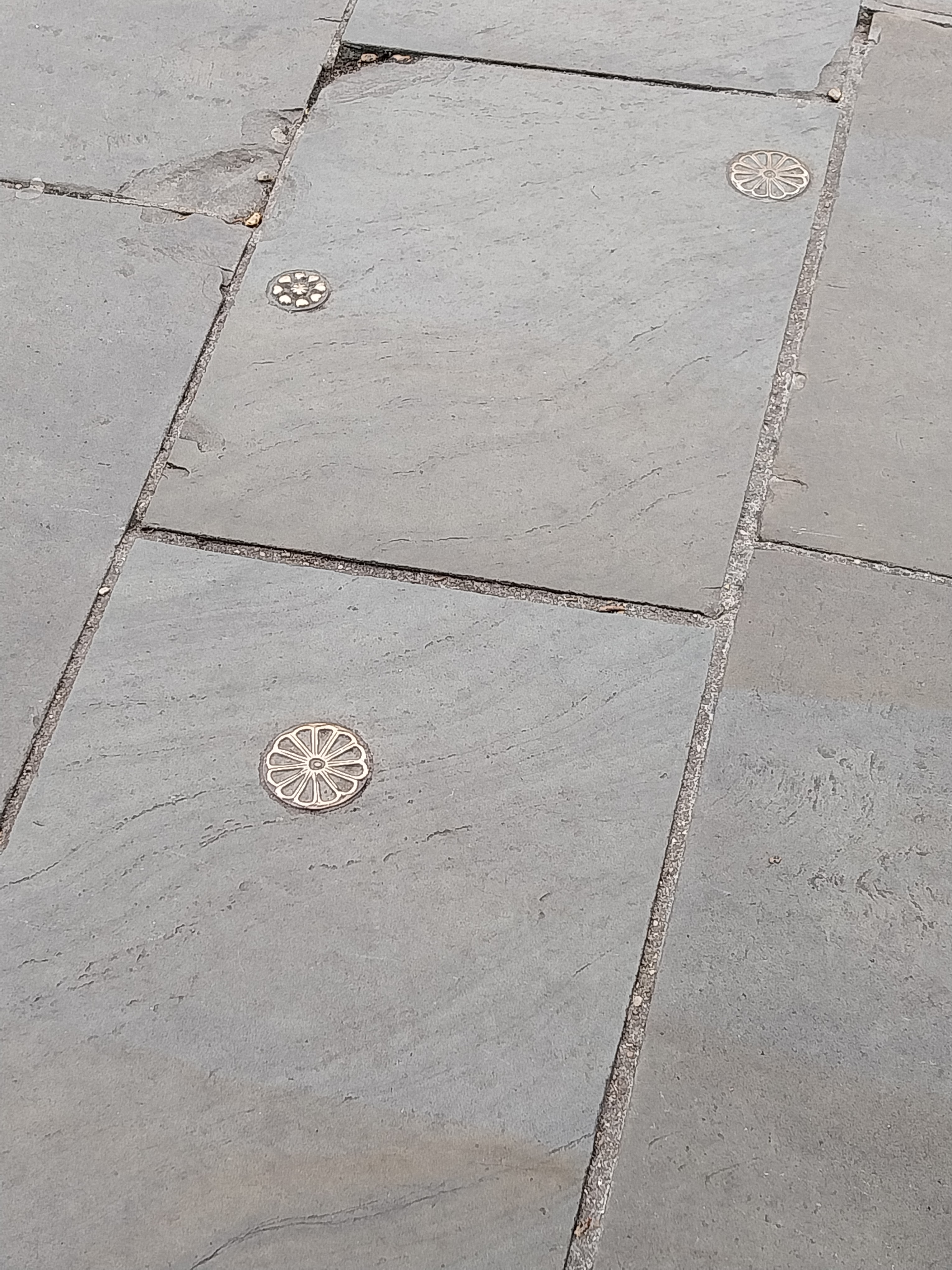
After leaving the library we walked through the grounds of one of the colleges, watching people punting and a fashion shoot with preppy clothes on the banks of the Cam, and made our way to Kettle’s Yard where we were planning to have lunch and a look at the Palestinian embroidery exhibition. The pavement on the way was scattered with bronze flowers, which Google informed us was the Cambridge Core and Flower Trail, inspired by a medieval coin hoard found by Anglian Water workers.

Lunch was a salad with hummus and falafel, with a lemon and ginger lemonade, while Jo and Valentina had huge vegetarian wraps. Jo tried the sticky toffee cake too, while I resisted the delicious-looking date flapjack.

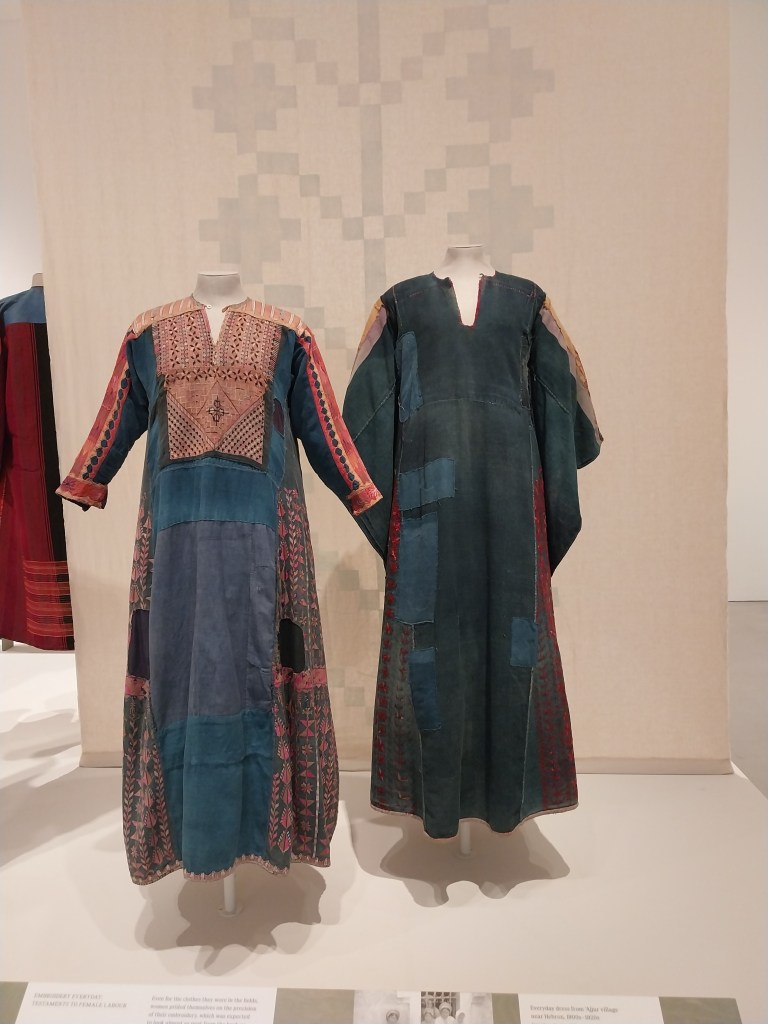
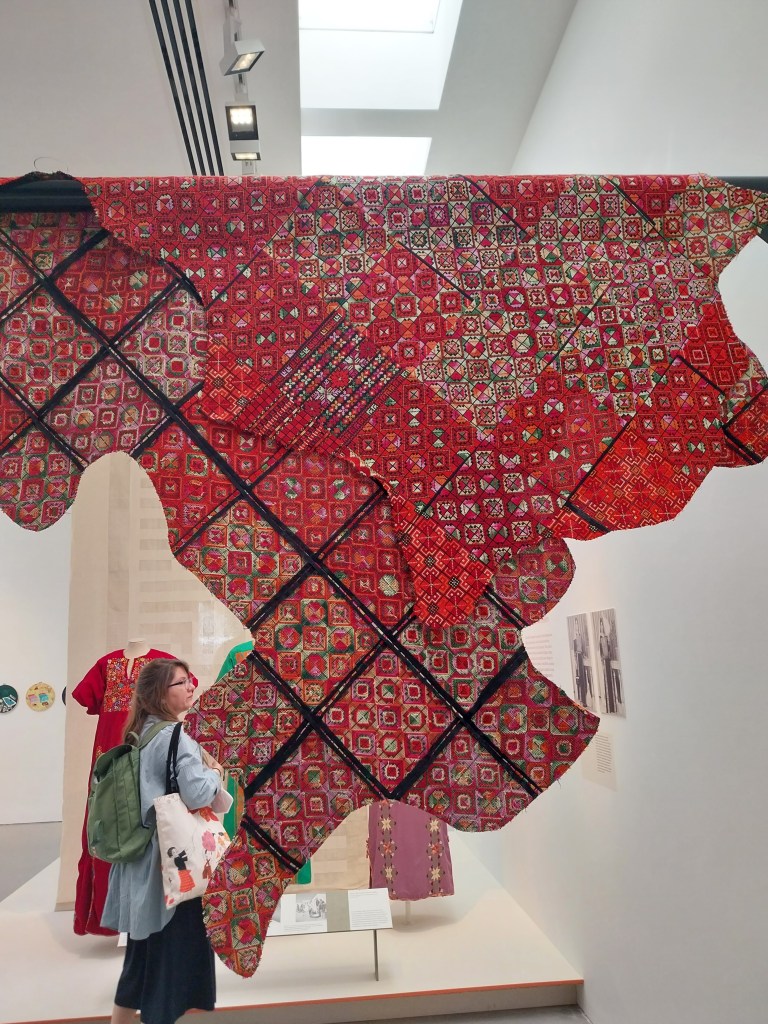
Material Power

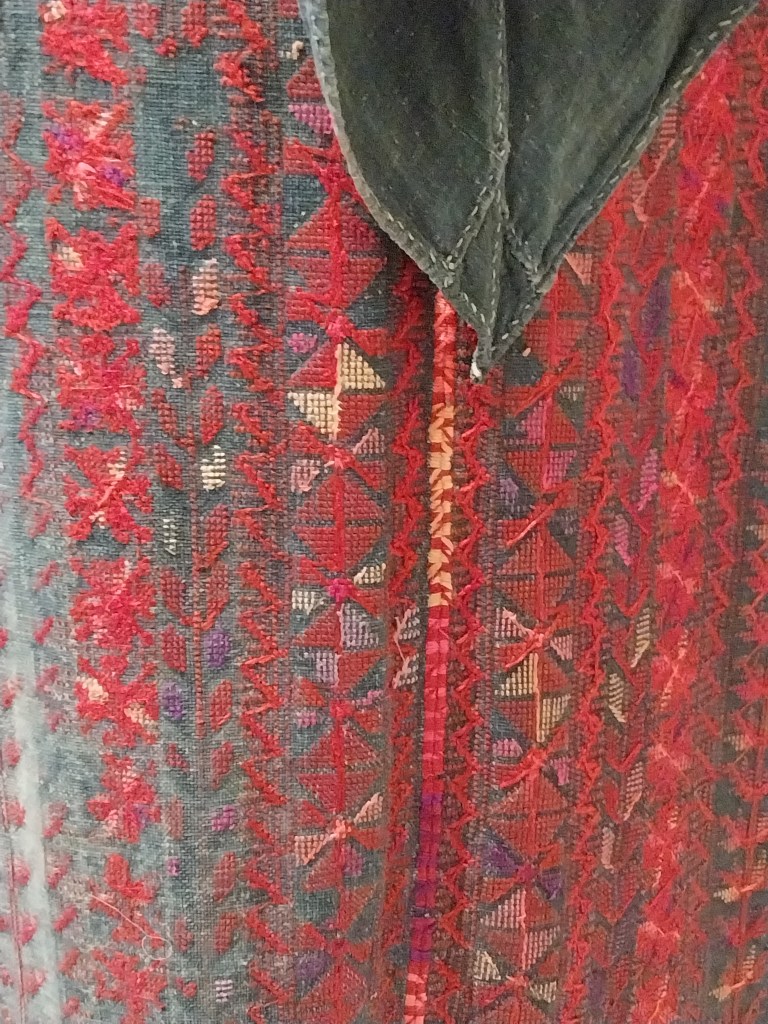
Our slot to visit the house was at 2pm, so we visited the Material Power exhibition first. The show covers both historic and modern dress, and the role of embroidery as a social signifier and a form of protest and resistance. As a cross-stitcher and very basic embroiderer, the amount of work and detail in the gorgeous garments left me speechless (I know!), especially the inside out garment where the back of the work was spectacularly neat. The image of the ’embroidered woman’ in the PLO material was striking. Upstairs was more modern clothing, and we were struck by the foregrounding of Palestinian women’s voices by simply having their video playing out loud, while the curator had to be listened to on headphones. Valentina has Palestinian ancestry, so the exhibition held personal meaning for her.

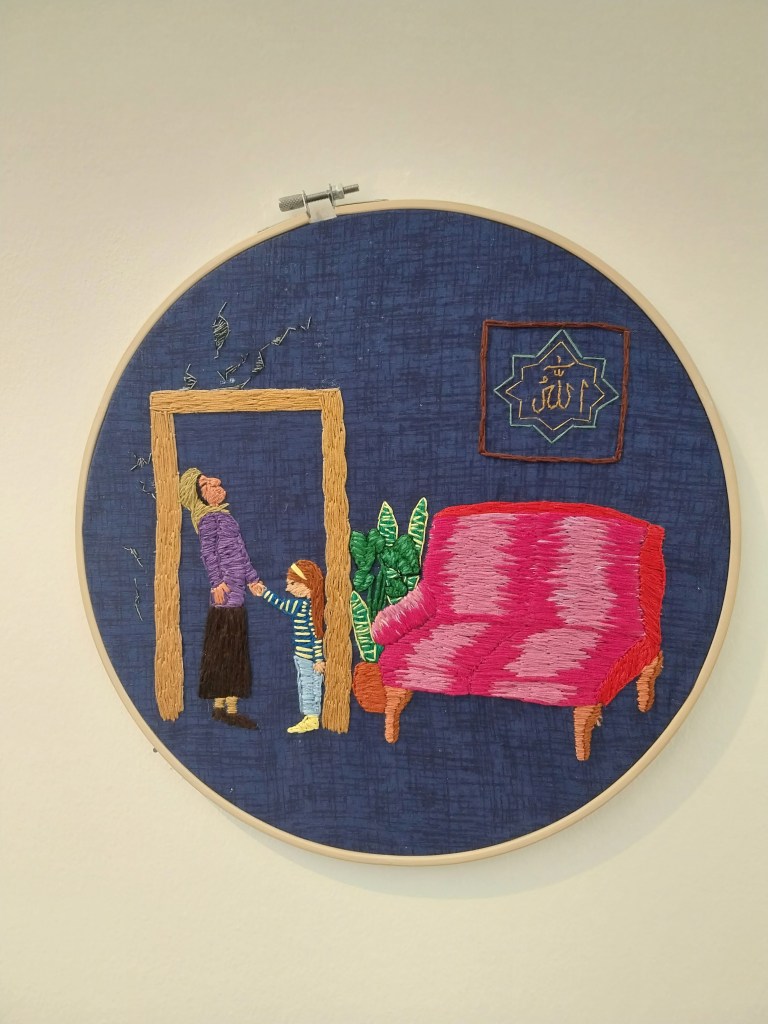
The piece that moved me most was the one above, Aya Haidar’s Safe Space series: a set of six hoop embroideries documenting her mother’s memories of growing up on Lebanon in the Civil War (1975-1990), and the steps people took to stay safe from everyday violence. Saucepan helmets and bullet proof vests, sleeping under beds, piling furniture to protect from flying glass, captured in a ‘domestic’ craft.

Finally we popped up to look at the ‘reflection and response’ space which turned out to be a corner in a corridor. The rest of the exhibition was so well done that I was a bit disappointed by this, though space is obviously an issue. There was a lot to reflect on and this felt like an afterthought.

To the house!

I’d heard of Kettle’s Yard as someone on my MA course was a volunteer there, but didn’t know much about it so had no idea what to expect. I was completely enchanted from the moment we walked in.

The website says, ‘Kettle’s Yard is the University of Cambridge’s modern and contemporary art gallery. Kettle’s Yard is a beautiful House with a remarkable collection of modern art.’ This does not do it justice. You can take a virtual tour here, but if you’re in Cambridge – perhaps to see the Raymond Briggs Retrospective! – go and visit. It’s magical in the same way that Dennis Severs’s House is: out of time, and with the sense that someone has just left the rooms. Apparently Helen and Jim Ede welcomed visitors and fed them tea and toast, and this spirit of home remains.

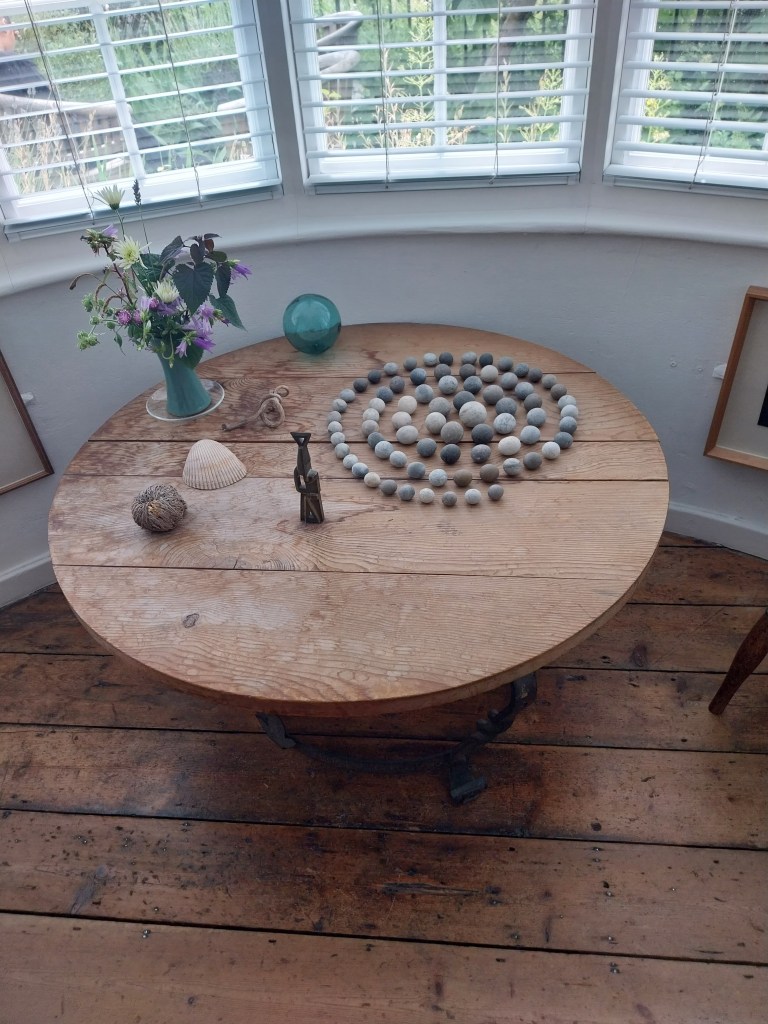
When your timeslot arrives you are escorted to the house where you ring a bellpull and are greeted by an incredibly knowledgeable person who clearly loves their role. You can sit in any of the chairs but you can’t touch any of the exhibits, which was frustrating for someone likes me who loves a pebble and a found object.

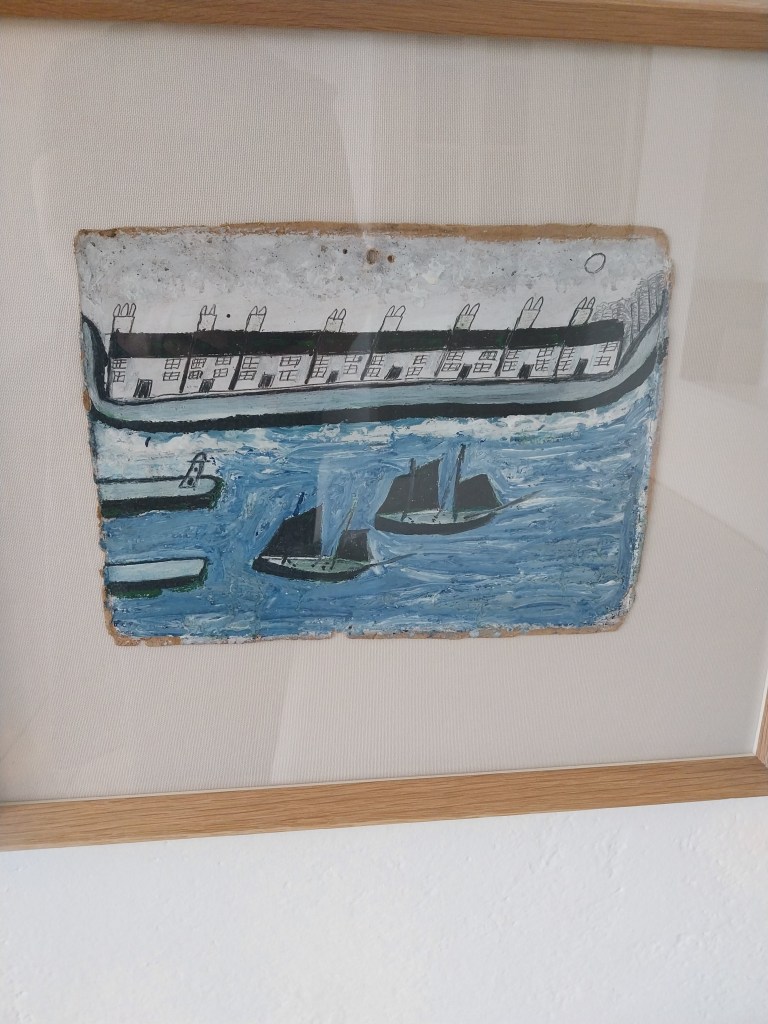
This being me, I gravitated to the packed bookshelves in Helen Ede’s room where I found such old friends as Lucy M. Boston’s Green Knowe stories (set in Huntingdon) and Sellars & Yeatman’s 1066 and All That. I wanted to find a chair and read for a while. The whole house exerts a sense of calm that I usually get from being at the seaside. Many of the paintings that called to me were seascapes, particularly Seascape with Two Boats by Winifred Nicholson where my eye was caught by the small child exploring the rocks and the Alfred Wallis Five Ships, Mount Bay which reminded me of Aberaeron.

I also liked Cornelia Parker’s Verso series – photographs of the reverse of button cards from a museum collection, which highlight the work of the seamstresses who had to mount these buttons.

You can read more about Jim Ede and Kettle’s Yard here and here. If I go missing, you’ll find me tucked in a corner of his house with one of Helen’s books.

Next week will be a crafty update as I have been busy with crochet creatures, cross stitch and a make and share for the new issue of Tauko magazine. Here’s a teaser…

Kirsty x

What I’ve been reading:

Overboard– Sara Paretsky

The Ward Witch – Sarah Painter

Moon Over Soho/Whispers Underground – Ben Aaronovitch (Audible)

Emily Wilde’s Encyclopaedia of Fairies – Heather Fawcett

Desert Star – Michael Connelly

Ye Gods! – Tom Holt

The Good, The Bad and The History – Jodi Taylor