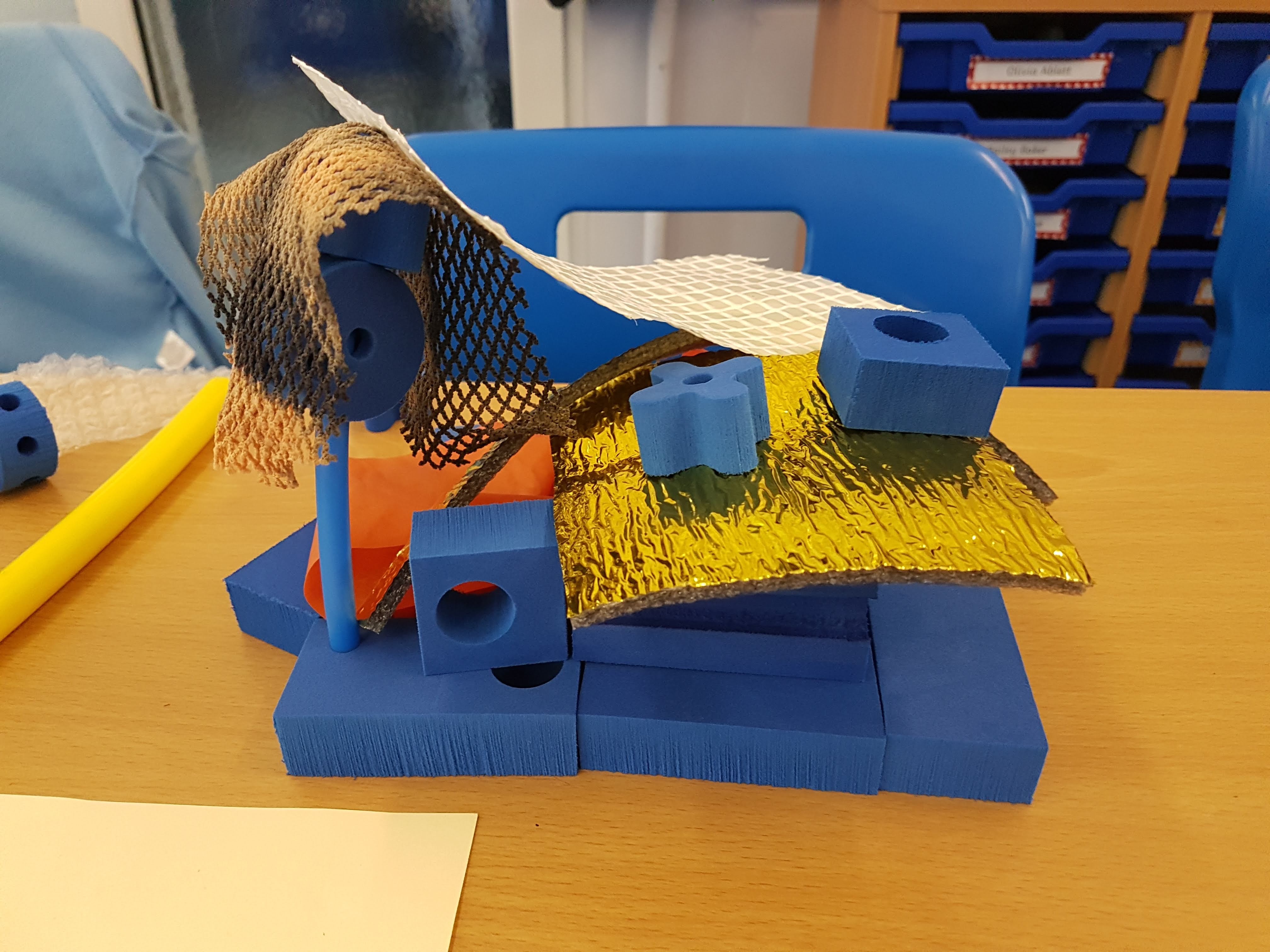
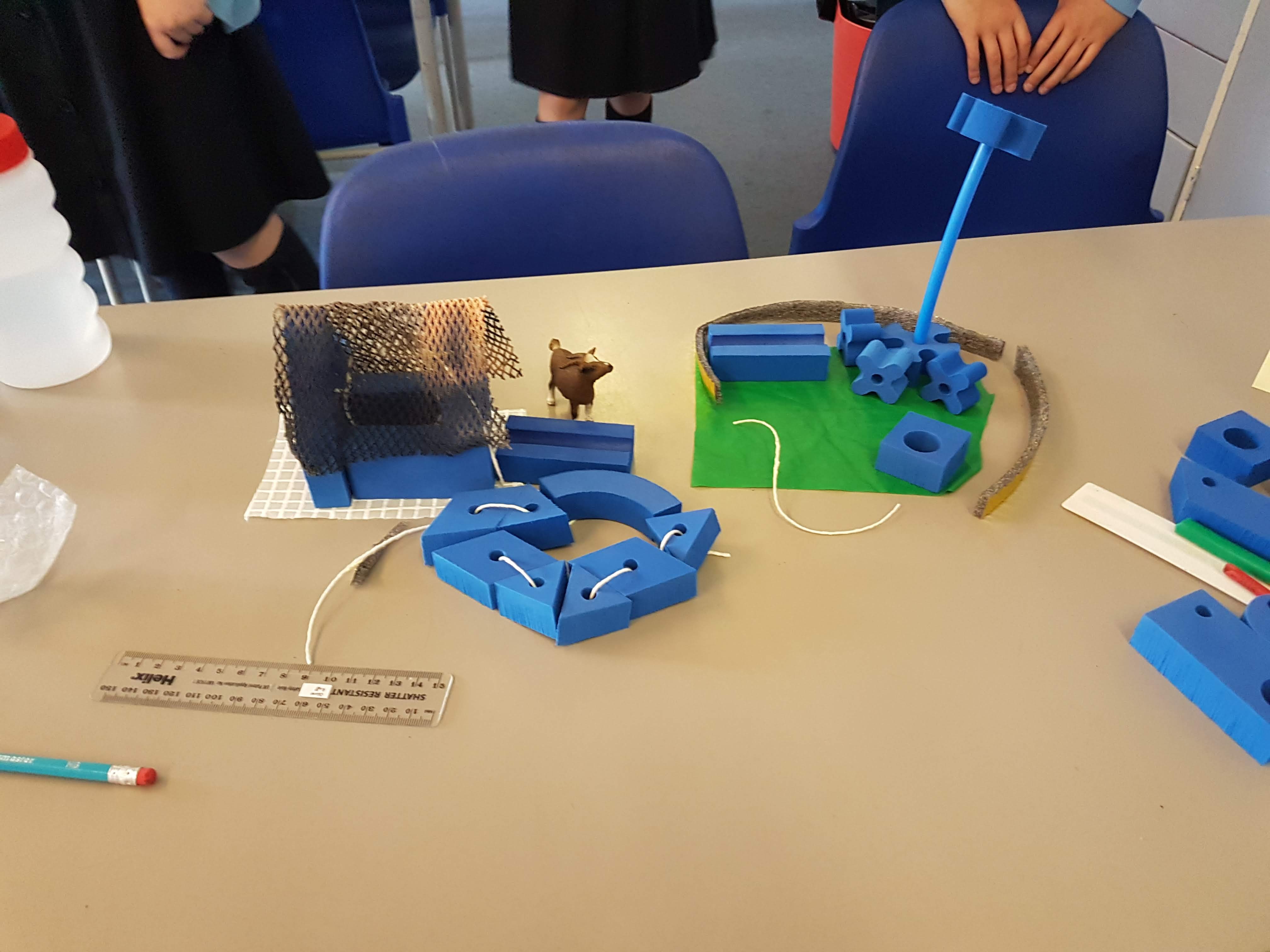
This week I took my new school session out to Thing 3’s primary school to test it on Years 5 and 6 – still playing with blue Imagination Playground blocks, but this time the tabletop version which are definitely easier to carry around. Added to these were scraps of fabrics, pipes, string and other loose parts, building on the work we’ve been doing over the summer.
The session, called ‘Think Small’, is an introduction to user-centred design, helping children to understand the iterative design process, work collaboratively and communicate ideas, and finally to work creatively with materials. These are some of the 5Cs of 21st century skills and are the some of the building blocks for learning in the new museum.
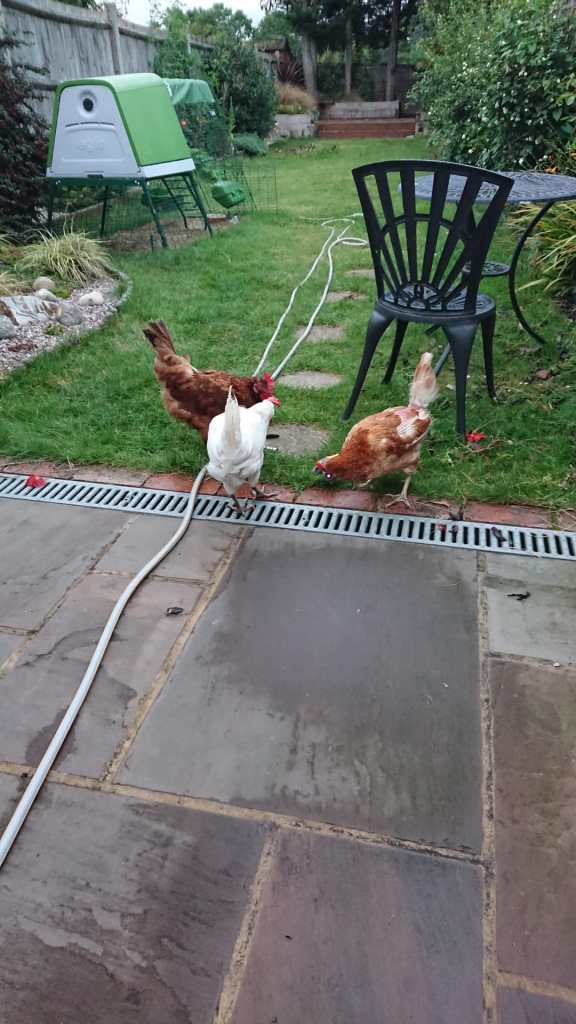
Photo and chickens courtesy of Chinami Sakai
We started by thinking about chickens, and what they need to be safe and happy: brainstorming ideas as a class, and then looking at the Eglu. The chickens in question can be seen above – Mabel, Doris and Tome, who belong to one of my colleagues and who were previously commercial egg-laying chickens. We’re in a relatively rural area, so some of the children already had experience of chickens, and were keen to share their ideas. ‘Space to play’ was the most important thing according to one child whose granny is a chicken keeper. We looked then at the Eglu, a chicken house which was designed to make it simpler to keep chickens in garden and which you can see on the left of the picture.
We moved on to talking about what pets we have at home – cats, dogs, guinea pigs, chameleons, geckos, the odd bird and tortoise, hedgehogs – and how they need different environments. I split the classes into four groups, and each team picked a mystery bag with an animal model. As a team they generated a list of things their animal needed which became their ‘client brief’. They were surprised to discover that they wouldn’t be the designing the home for their animal, but had to swap their briefs with another team. Each group then became ‘animal architects’, looking at the brief together and each child designed a home that they thought met that brief. The hardest bit, we discovered, was when the children had to decide which design from their group met the brief best and would be the one put forward to the ‘clients’. Some groups decided quickly, while others needed some support.
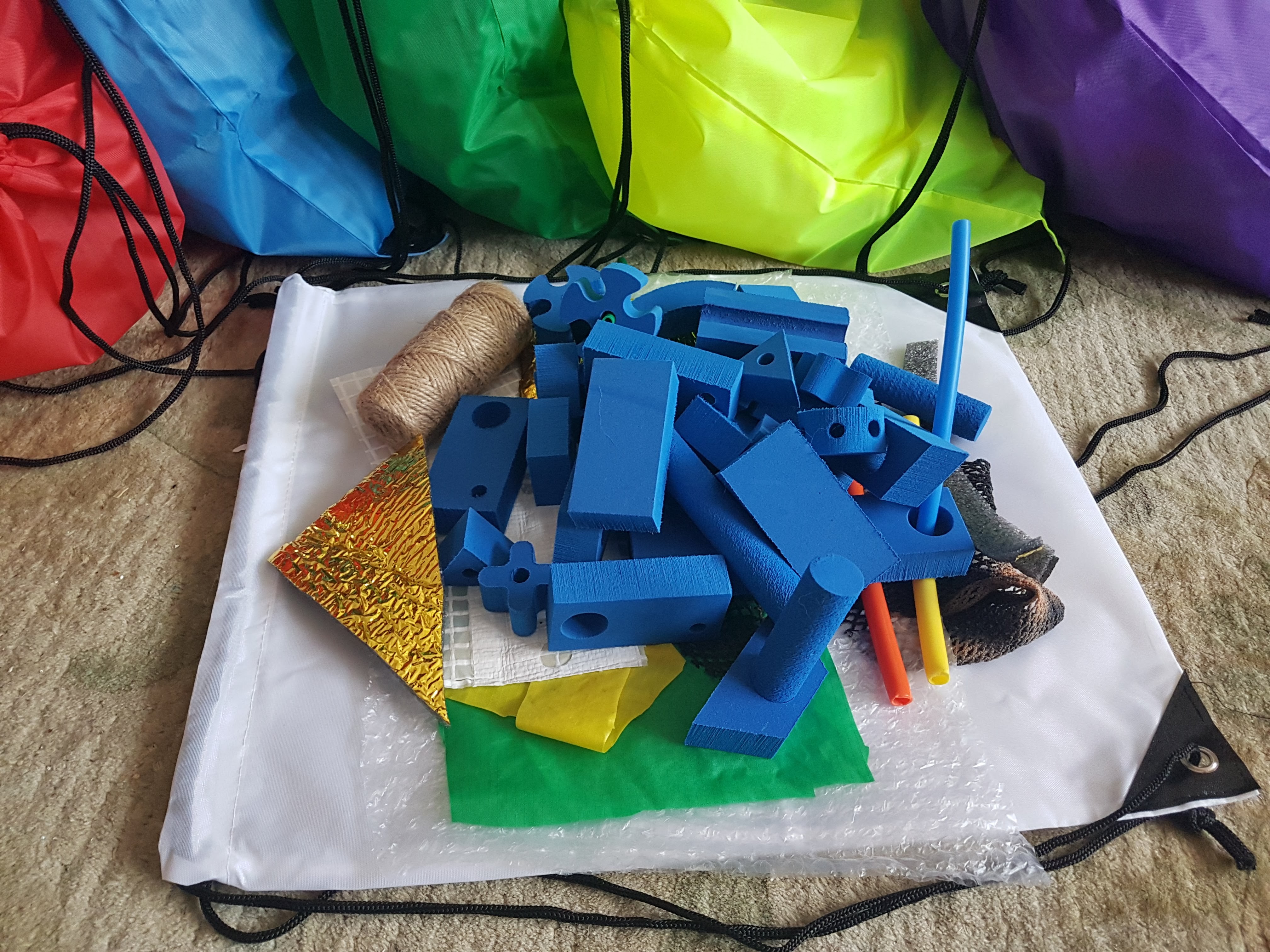
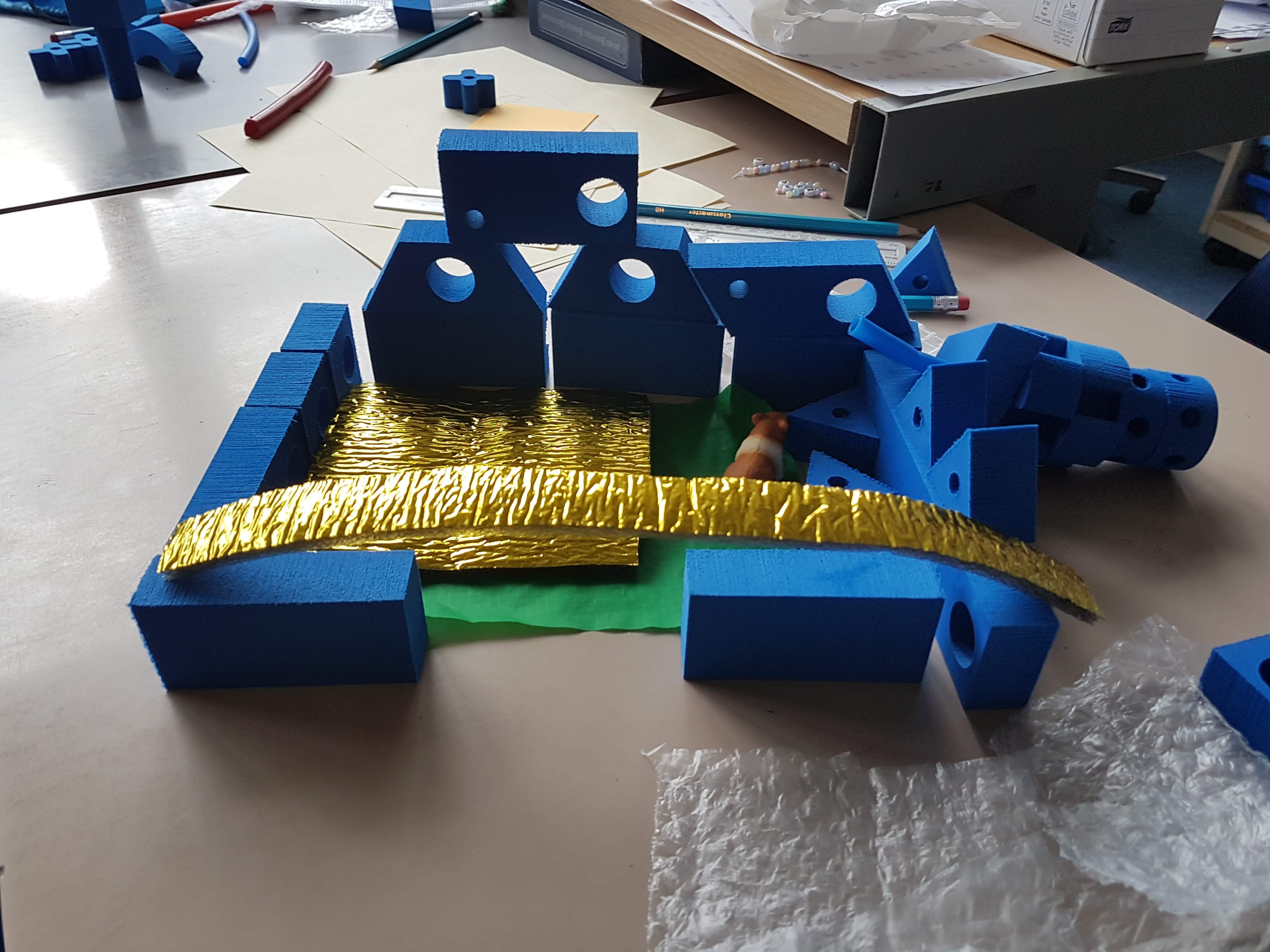
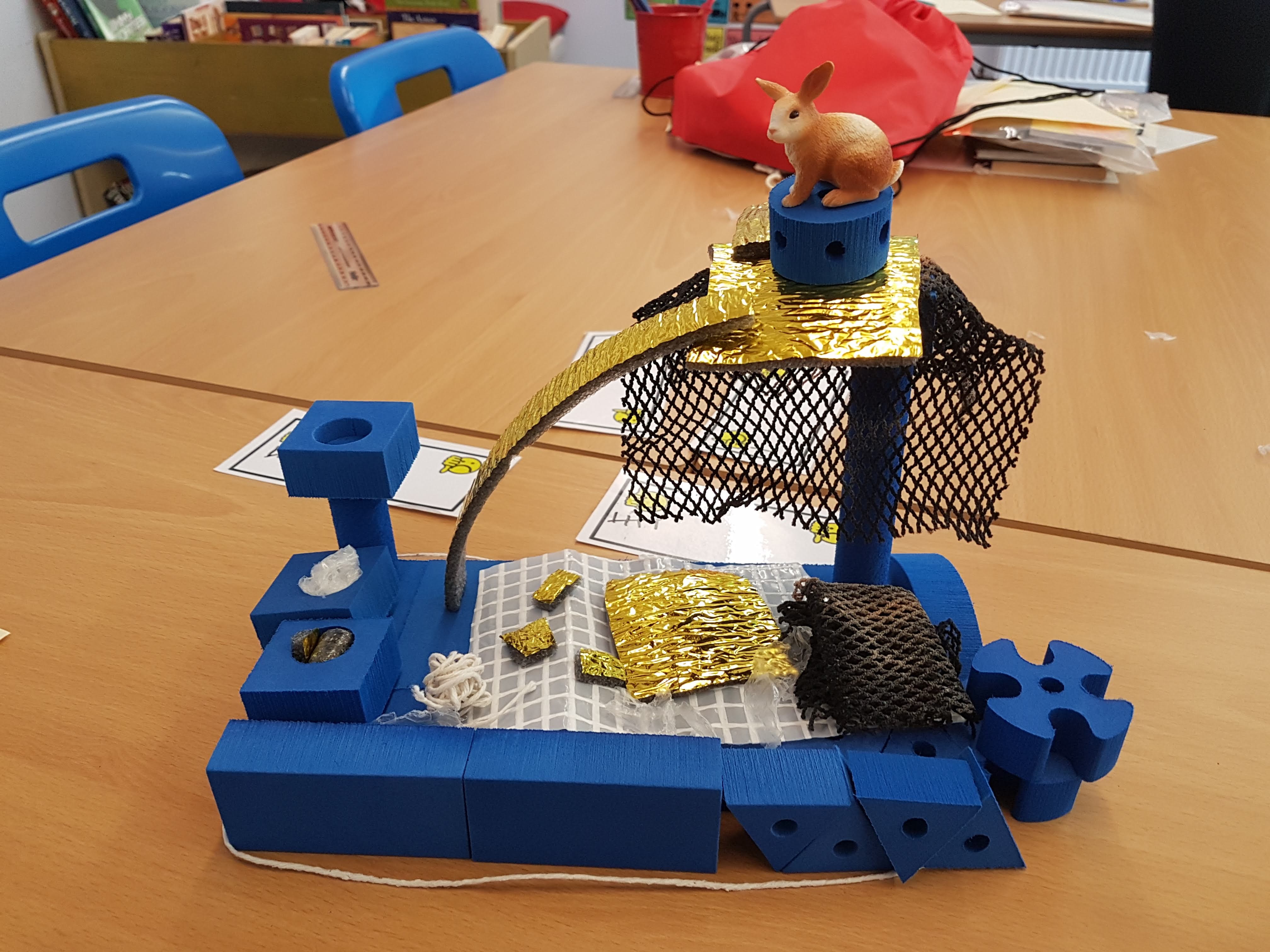
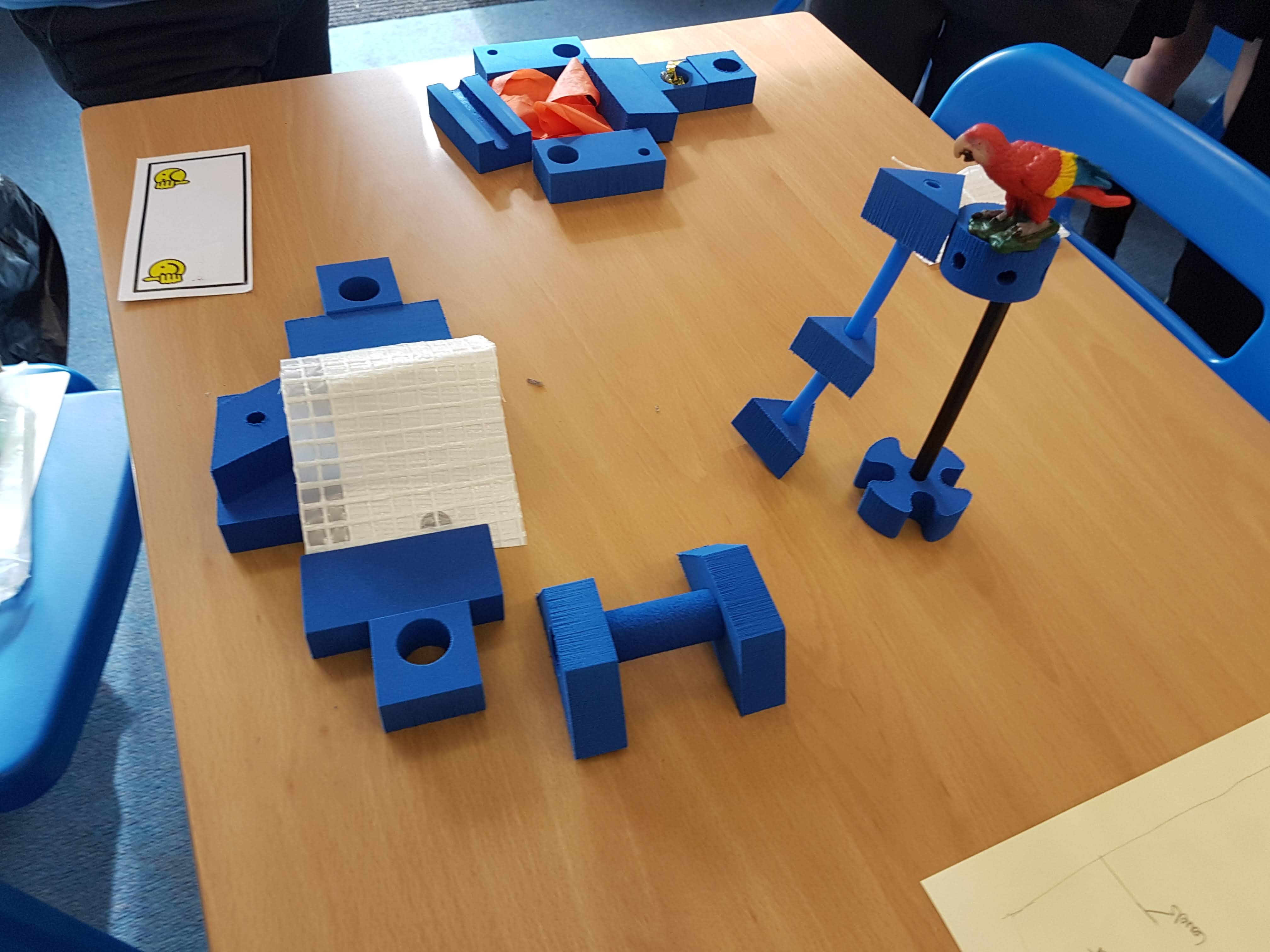
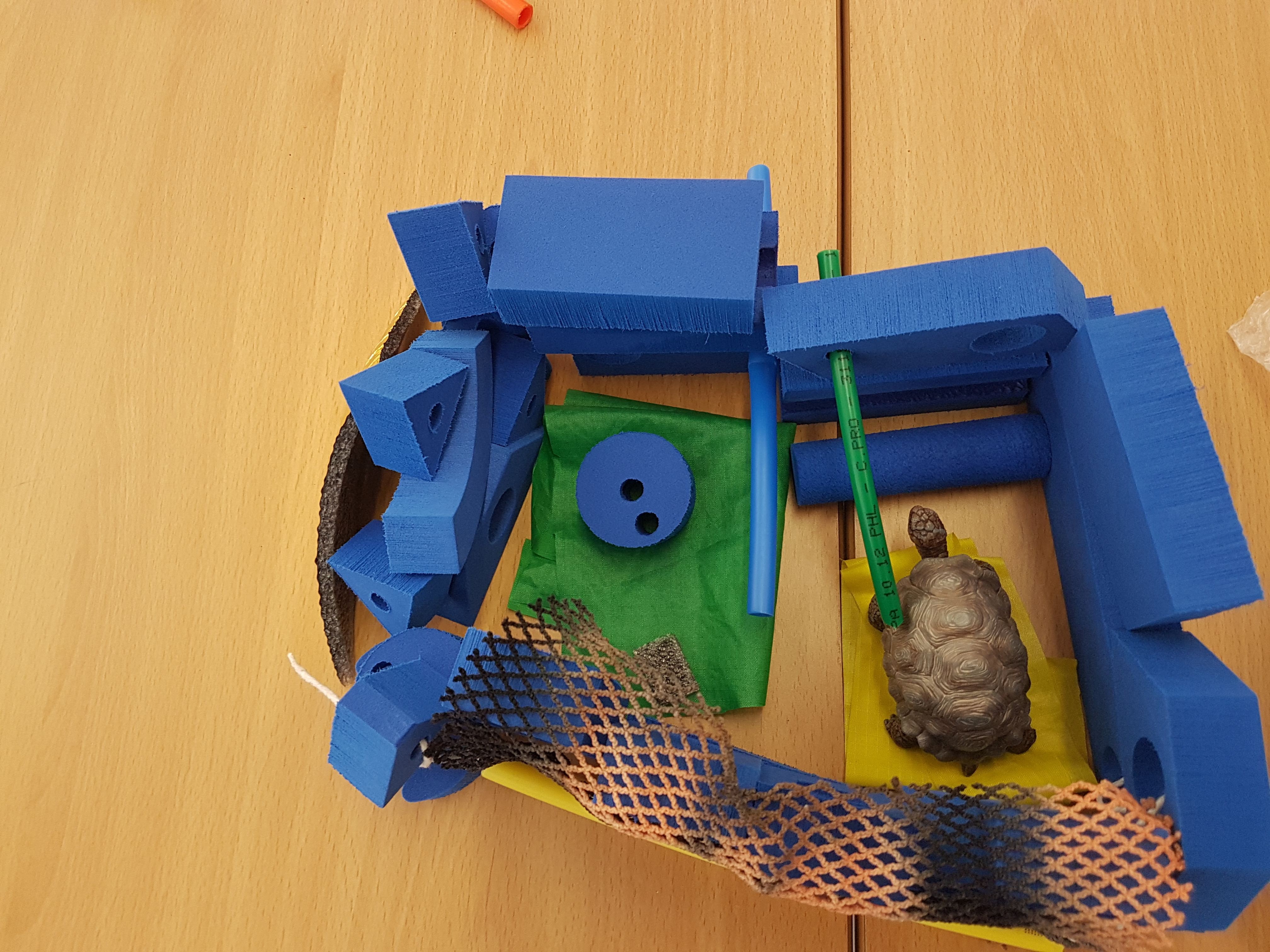
The materials the children were given
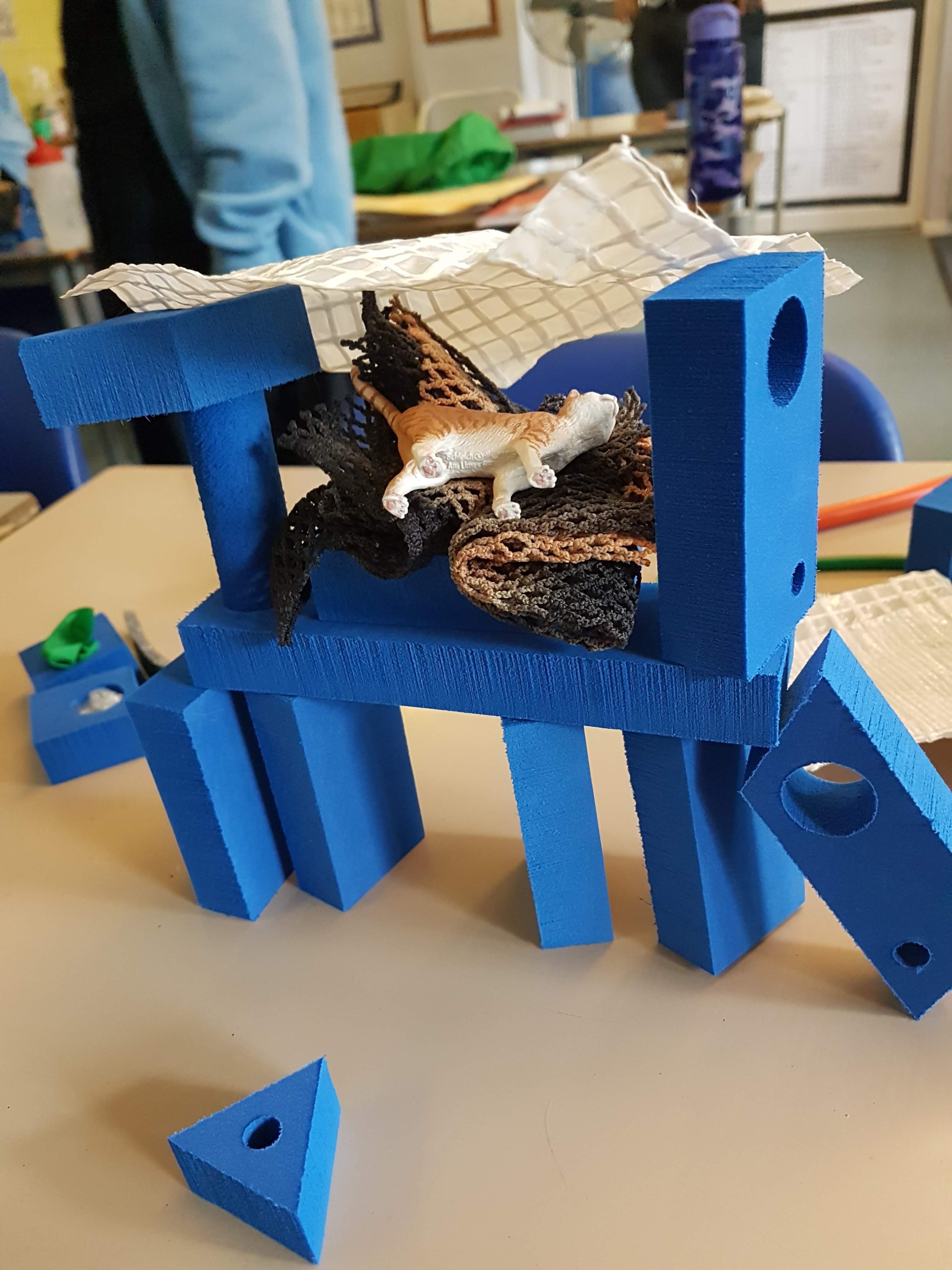
The clients gave feedback on the designs and then the architects used the creative kit to build the chosen design, incorporating the feedback, and finally the groups looked at all the designs while the architects talked us through them.
Cat
Hamster
Multi-level rabbit house
Parrot
Giant tortoise
Hamster again
The happiest goat ever
Over the four sessions I refined the format and changed some of the timings, and delivering it to the different year groups allowed me to see how it works with different abilities. The classes are quite small, with less than 25 in each which meant four groups in each session was viable. One thing about working with ‘animals’ was that it gave all the children a chance to shine and share prior knowledge from their out-of-school experience rather than reinforcing classroom learning.
I didn’t let them use sellotape or glue, so they had to come up with other solutions to hold objects together or in a particular shape. One boy shone as a project manager, helping his team realise the design he’d created.
Feedback from the children themselves was entertaining: one of them informed me that he didn’t know DT actually involved ‘making things’, another was keen to find out more about making structures stable. Apparently it’s harder to build than to draw, and it needs more brain power than they expected. Building with blocks takes a ‘lot of thinking’. They were surprised when they had to swap their animals to let other people build their ideas; DT is not just on a computer; and it was interesting to think about what other people need. One asked how long it takes to become an architect, so I’m counting that as a win! One wanted to know if I was really Thing 3’s ‘actual mum’.
Thing 3, of course, was mostly just concerned that I didn’t embarrass him too much…
Meanwhile…
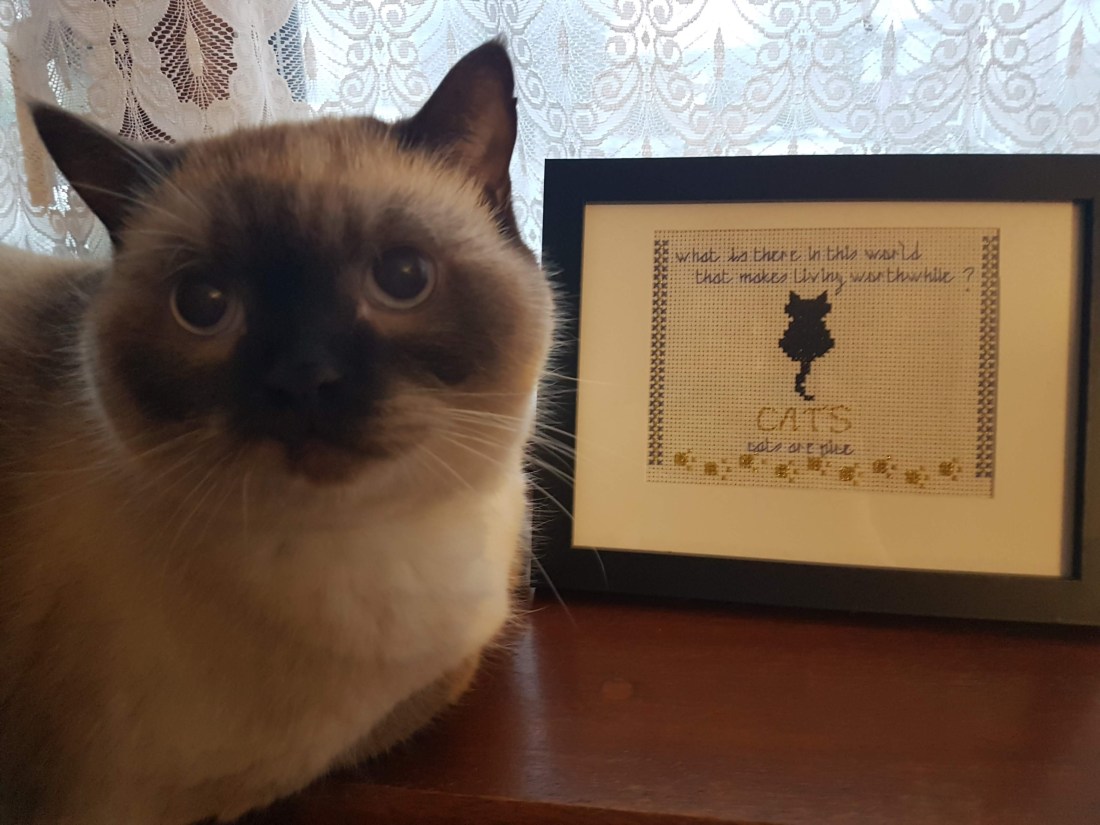
Bailey approves of the dragon egg bag
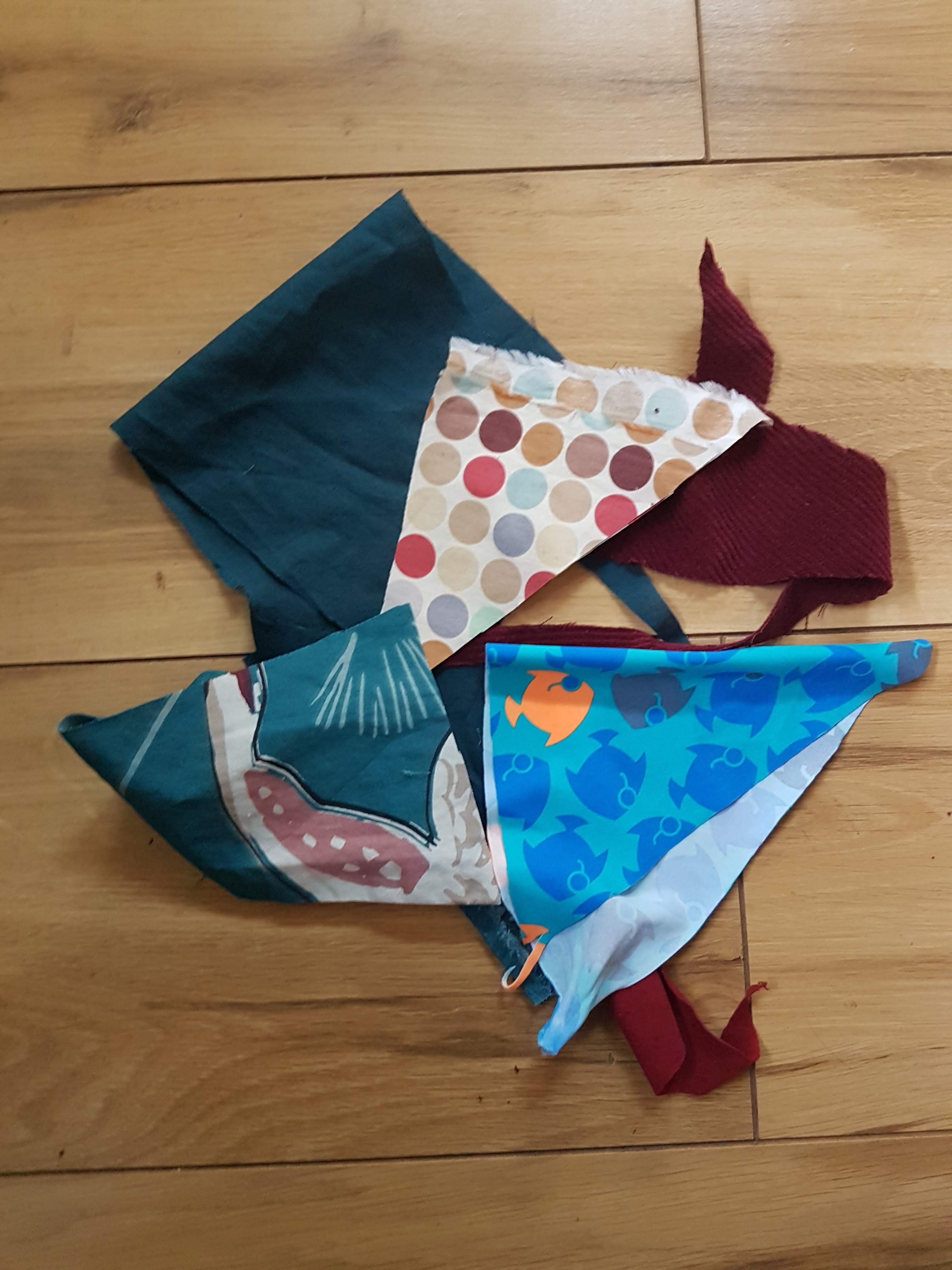
Scraps from the sewing projects I cut out yesterday
As you can see I have some sewing to be getting on with! My first foray into swimwear, for example: a two piece that will be easier to get out of in the winter swimming. The water was 12.6 degrees this morning, so we’re on our way to single figures. There’s also been cross stitch in the evenings, which I’ll share when it’s finished. See you next week…
Kirsty x
What I’ve been reading:
Forests of the Heart/The Onion Girl – Charles de Lint
It’s been mentioned before that I’m a bit of a butterfly when it comes to making and crafting: I usually have several projects on the go that can be picked up and put down, taken on tubes, worked on as a way to help me focus in meetings or at D&D games, focused on while the TV happens in the background, that sort of things. These are alongside the ones that need more attention – things with sewing machines or full coverage cross stitches, for example.
So, imagine my delight yesterday when my crafty buddy H and I visited the Autumn Knitting and Stitching Show at Alexandra Palace – the first live craft event we’ve been to since the Waltham Abbey Wool Show in January 2020, before all those lockdowns. I’ve always liked the autumn one better than the spring one (at Olympia) for the exhibitions of quilts and students’ work. The venue is also pretty amazing, with glorious views over London. ‘Ally Pally’, as it’s known, is one of those Victorian ‘people’s palaces’ which have so much history attached to them: the BBC broadcast from there, it was used as an internment camp during the First World War, there’s an ice rink and a beautiful park.
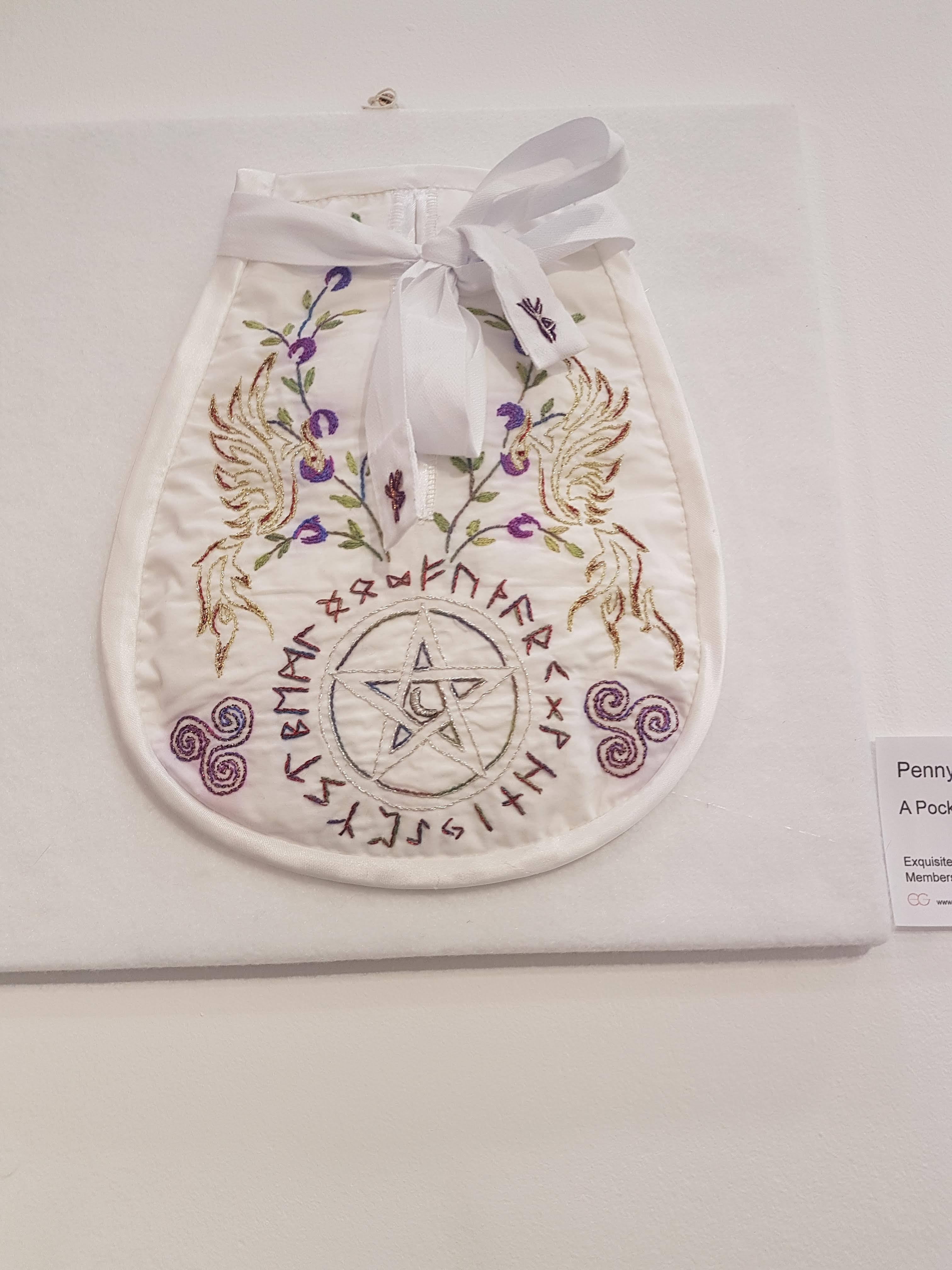
‘A Pocket Full of Magic’ – Penny Hill
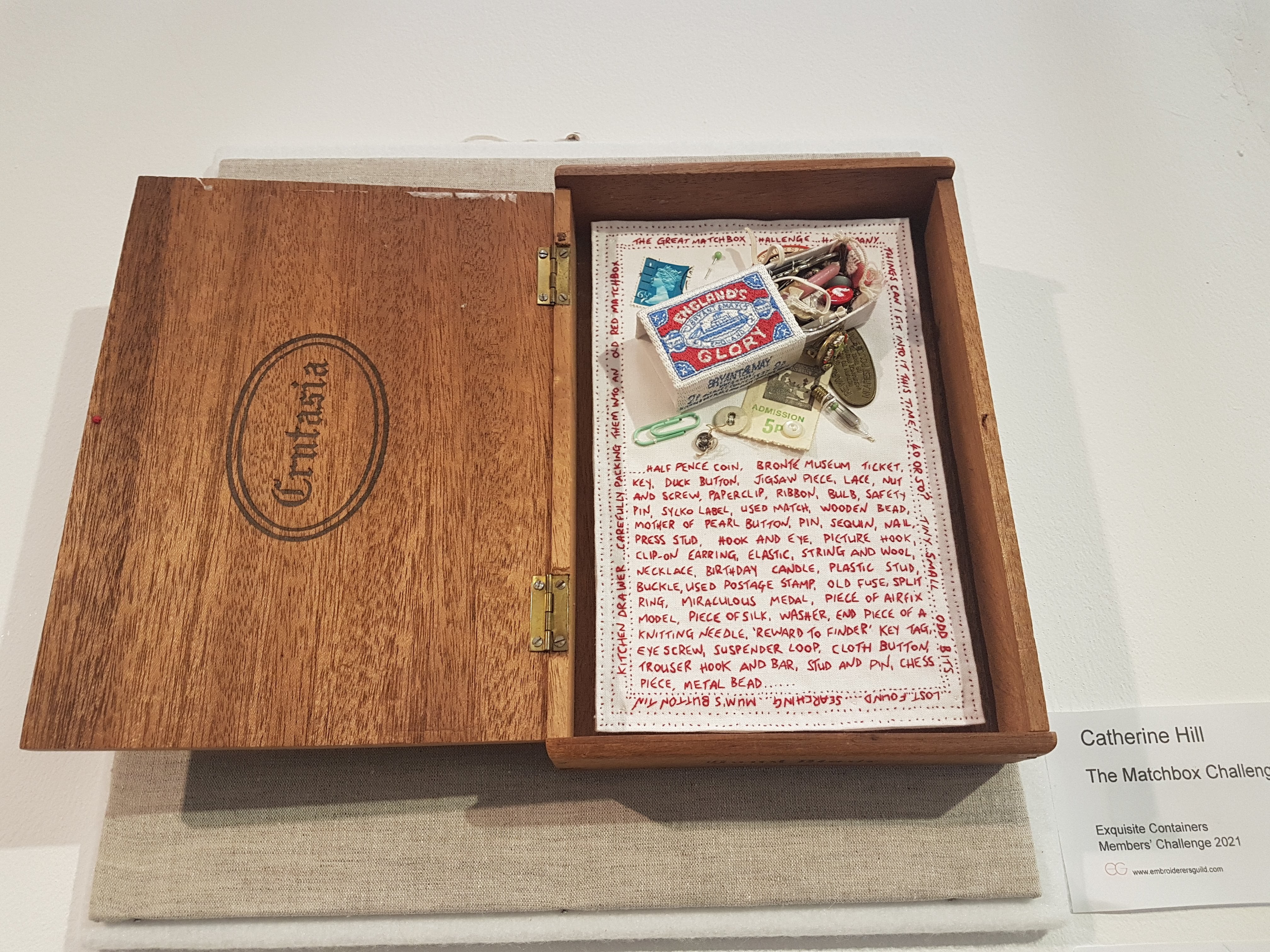
‘The Matchbox Challenge’ – Catherine Hill
Exquisite Containers – Embroiderers’ Guild
We started with a plan to work our way around the outside stalls, which took us through (among other things) the Embroiderers’ Guild Members’ Challenge exhibition ‘Exquisite Containers‘. We spent a long time talking to the Guild member watching over the exhibition, admiring her mother’s stunning or nue book covers: after working for many years and bringing up her family, she vowed after retirement that she’d dedicate her time to her craft and did just that for the next 25 years or so. We talked about the loss of creativity in the school curriculum – she had written a stern letter to Gavin Williamson lambasting him about the destruction of the creative subjects.
‘I do believe we are muted’ – Philippa Moggridge
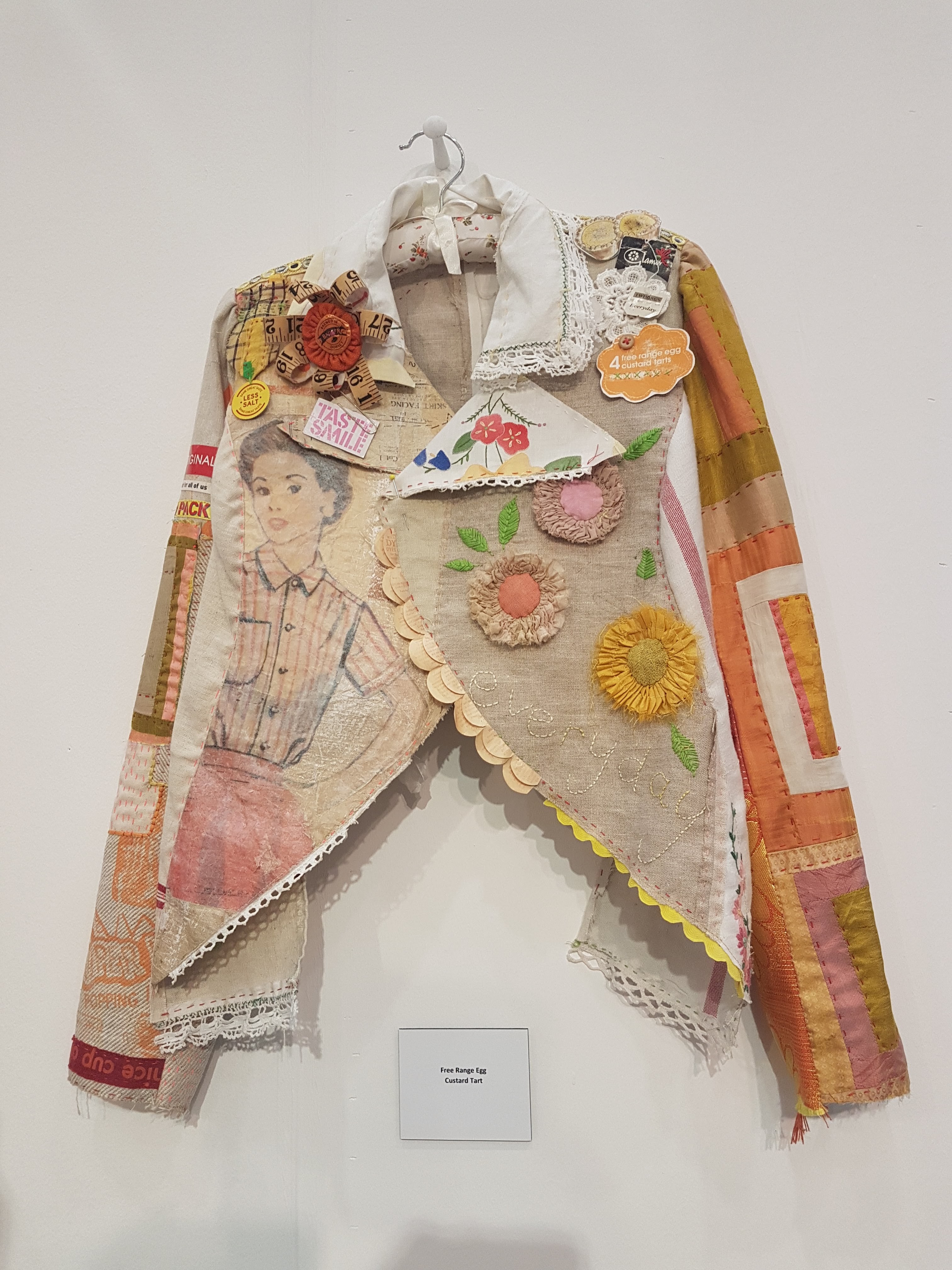
Free Range Egg Custard Tart – Maria Thomas
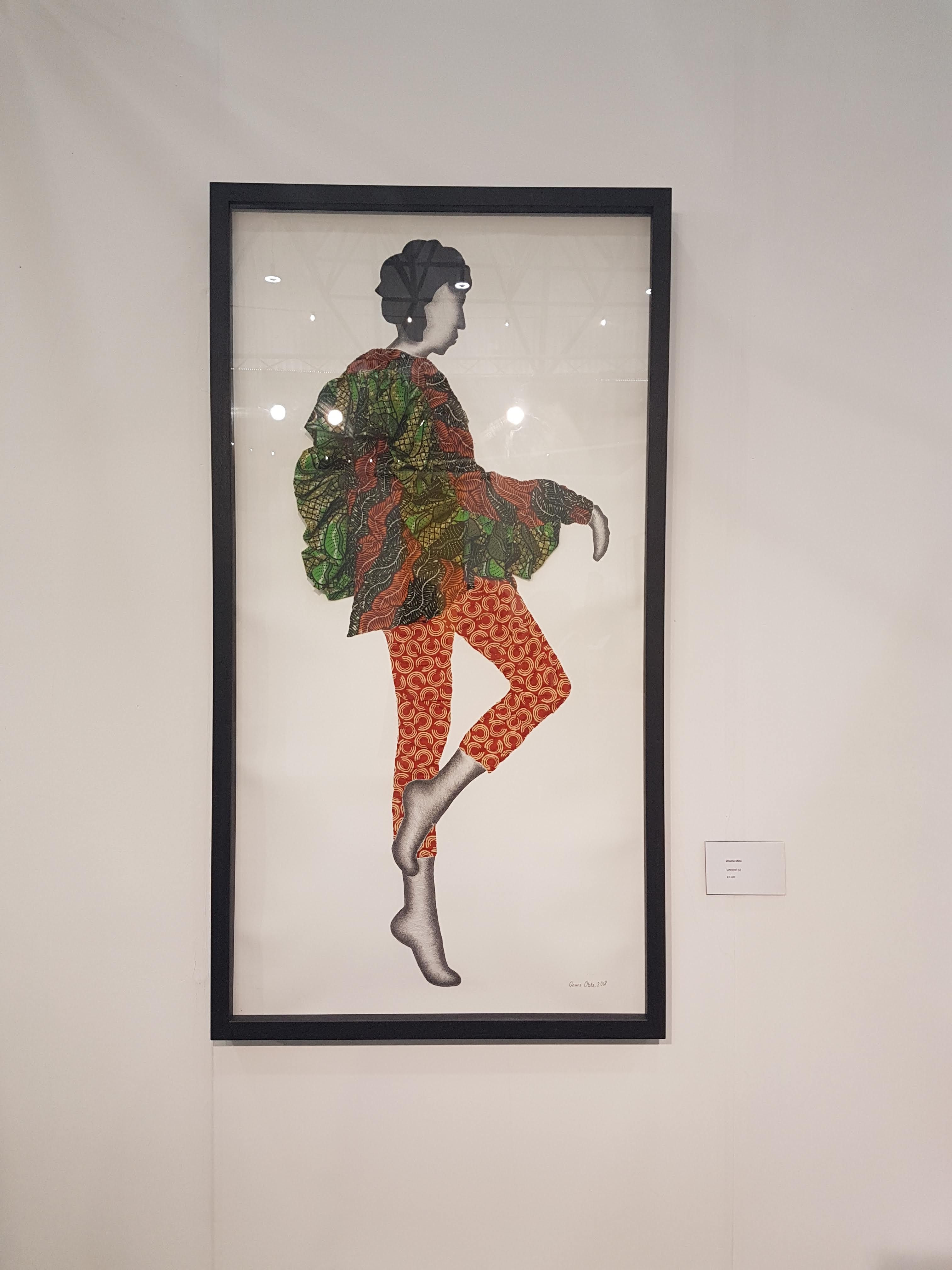
Untitled (v) – Onome Otite
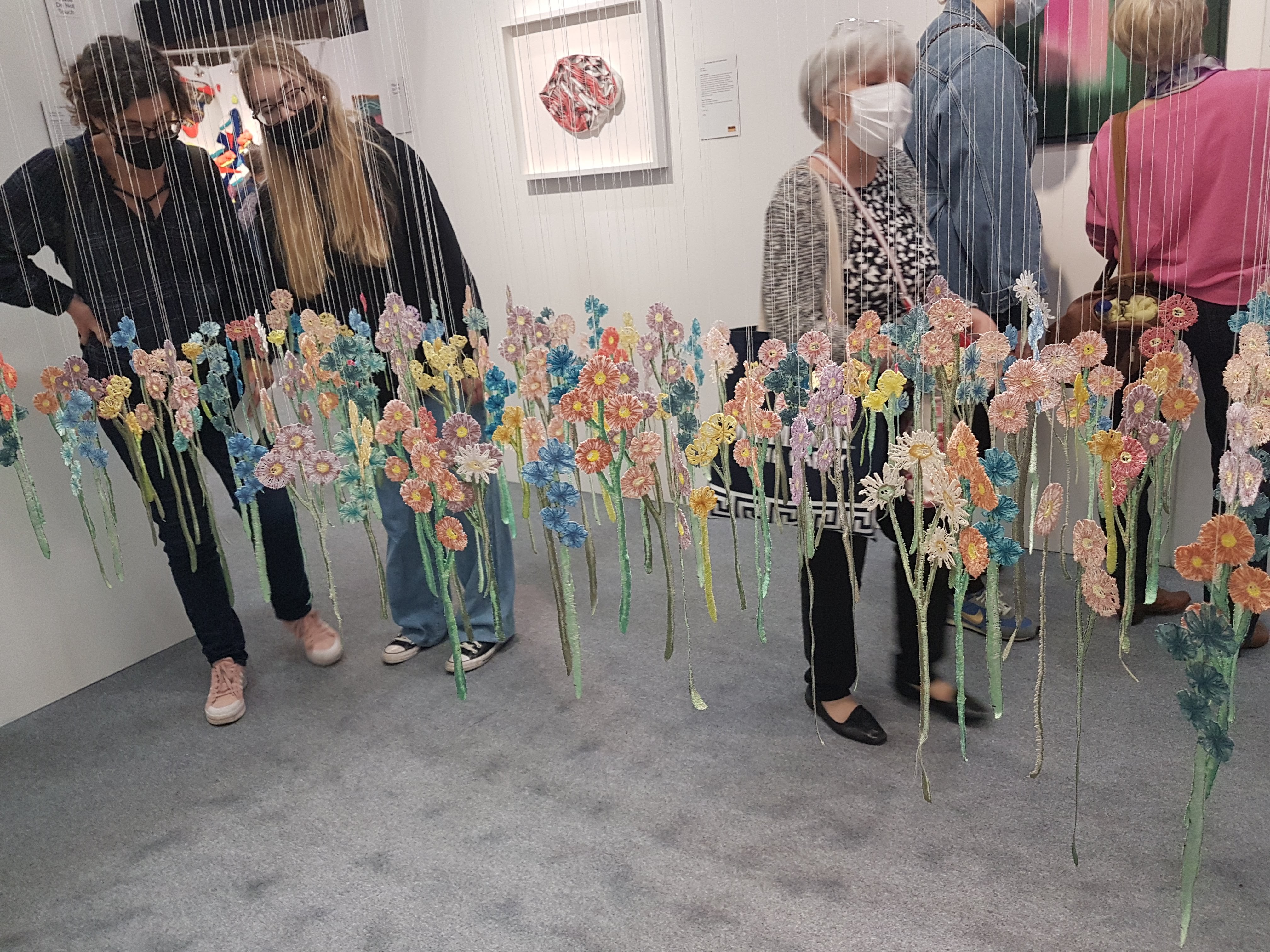
Embroidered flowers
Maria Thomas’s aprons
An A-level project from Kings’ Ely…
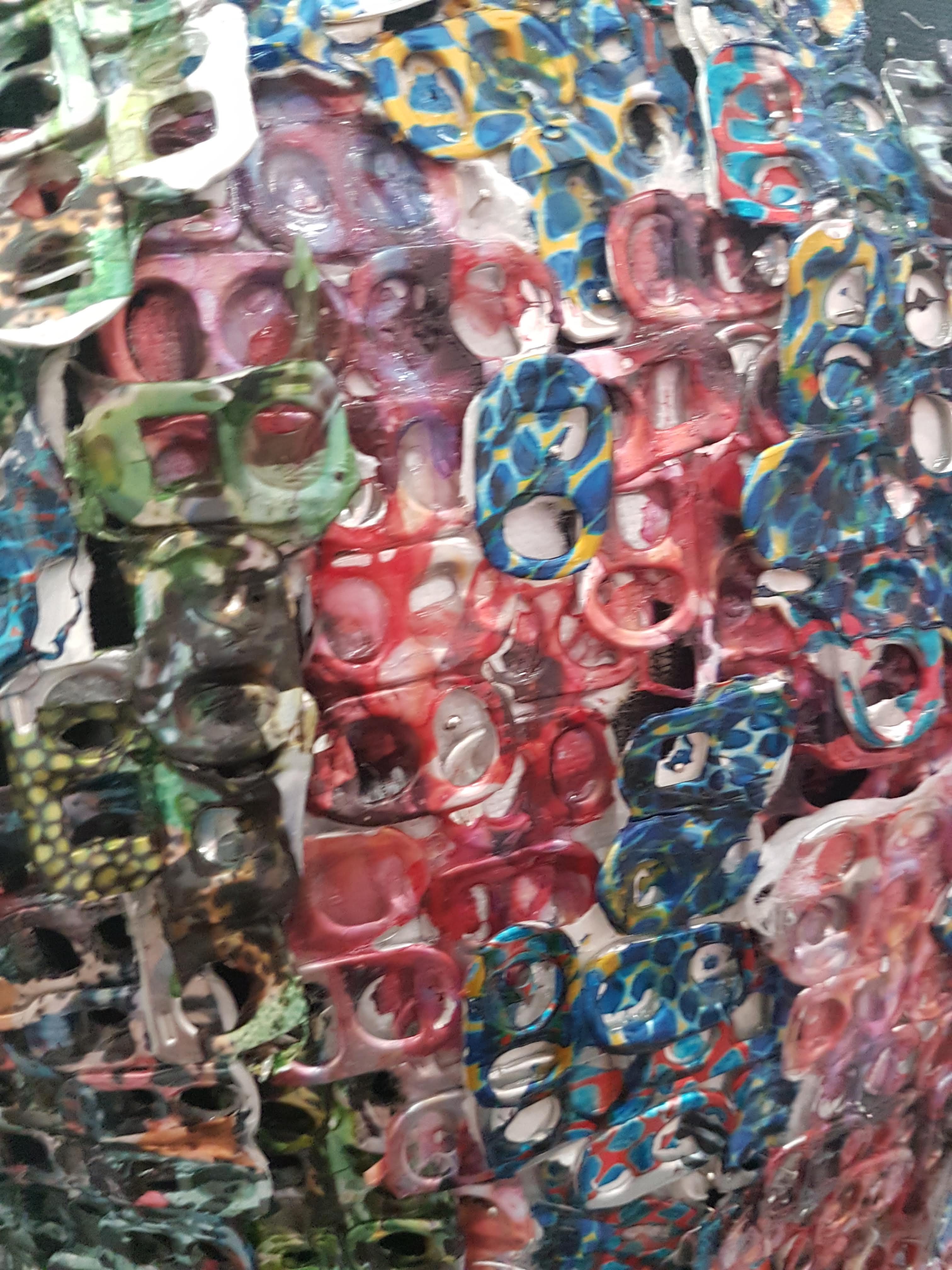
…made of ring pulls!
H is a DT teacher which gives us an excellent excuse to talk to people about techniques, and I was keeping my eyes open for makers who were working with up/recycled materials. Maria Thomas’s work ‘Relative’ explored her place in the world as a mother, daughter, aunt, niece etc through mixed media pieces like the Free Range Egg Custard Tart jacket pictured here. These pieces were inspired by the housecoats her mother put on after work to do housework and cooking, to protect her ‘good’ clothes. I loved the way books, vintage packaging and text were blended into the patchwork and quilting. I’d really like to work with her.
Onome Otite‘s textile collages filled us with joy – so much colour and movement in her pieces inspired by Cirque du Soleil, using bright ankara and batik fabrics. There were several stalls selling African wax print fabrics, and when I find the right pattern I have all their cards. Lovely bright reds and yellows called to me, but I resisted.
After the exhibitions we hit the stalls – usually H is a good influence on me, taking lots of pictures of projects we’d like to do rather than buying the kits. Yesterday we were terrible influences on each other, though at least her ‘this will be a Christmas present!’ buying was a good excuse. There are so many lovely kits and fabrics to buy, and you can squish and squash them all you like, and have chats with the stallholders. We got hopelessly overexcited when we saw Matt, Peter, Mark and Raf from the Sewing Bee, especially when Matt and Peter stopped for a photo op with us. I came home with an English Paper Piecing jewellery set, some Foundation Piecing patterns, space invaders jersey fabric (new pants coming up!), some sewing patterns from an indie maker, a lot of business cards, haberdashery bits and bobs and gadgets, a sari silk skirt in my favourite reds, and a Christmas decoration kit which I can only put down to end of day panic buying. We had a go at marbling fabric, admired woodblock printing and mini screen print kits, got carried away by puffins, hares and highland cows, lusted after high-tech sewing machines and storage furniture. I left with a lot of ideas for things I really want to make. Now to find the time….preferably before the next show!
It won’t be this week, for sure: this week I am trialling my new school session in Thing 3’s primary school, and updating a talk about play for a local FE college. My hallway is full of boxes of strange resources like model chickens and miniature blue blocks (as seen in this week’s cover photo), scraps of fabric and laminate insulation. I’m also working on the next birthday present, and playing around with a small crochet bag design.
I’d better go off and do something useful….
Kirsty x
What I’ve been reading:
Tales from Moominvalley/Finn Family Moomintroll/Comet in Moominland – Tove Jansson (Audible)
Trader/Someplace to Be Flying/Dreams Underfoot – Charles de Lint
Normal service resumes after the last couple of weeks! It’s September after all, with the new school year kicking off: new shoes, new bits of uniform ordered if not actually delivered thanks to the shipping delays, driver strikes and shortages that definitely aren’t anything to do with Brexit, good heavens no, timetables downloaded, last minute coursework that Thing 1 assured me all summer she’d done, and so on.
Last weekend I braved Westfield (is it only me that feels the need to shout ‘Westfield! in a bad Radio 1 DJ sort of way?) with Thing 2 in order to buy school shoes. She has very very wide feet (an I fitting) so I knew Harlow at the end of August really wasn’t going to provide what we needed. Instead we had a mum and daughter day out shopping. We also needed school trousers, as we haven’t been able to find the particular style she wants online – the Next ones came up like thick leggings, the George ones were too high waisted, the suggestion of the Banner or Trutex ones either earned me a withering look or weren’t in stock (ditto New Look, Very, Tu, Morrisons, Matalan – everywhere!).
Tim Westfield! Westwood. WestWOOD. Not field.
Thing 2 has been, from a very early age, a child who knows her own mind. In many ways this makes me proud. In other ways it makes me want to slug gin in my coffee and leave her to it. Despite Westfield’s (Westfield!) many shops, we failed to find either shoes or trousers so I ended up buying shoes we could both live with online and she can either alter her thinking about the kind of trousers she wants or wear skirts for the year. I too can be stubborn. We did have a lovely lunch at Wagamama followed by bubble tea for her, and she chose some new clothes at Primark and New Look as well as some bits and bobs from Flying Tiger. I bought some more notebooks – I do love some stationery!* I took her over to the less shiny side of Stratford too, as she wanted some baskets for her bedroom: after Westfield (etc) I think the old Stratford Centre came as a bit of a shock to the system. I used to shop there when I first lived in London as it was the closest place to Forest Gate. It hasn’t changed much, really, in the last 25 years. The planners tried to make it look pretty by installing shiny leaf sculptures (or possibly fish) in front of it in 2012 in case tourists happened to glance in that direction on their way to the Olympics, but it didn’t really help. I suspect some actual investment might have been a better idea, except that just didn’t happen, and what they were left with was an island of Poundlands and Shoe Zones.**
The ‘Stratford Shoal’ by Studio Egret West in 2012. It’s not so shiny now.
*as it turned out I did not need to buy notebooks as I came home with many many new notebooks from the Digital Accountancy Show I worked at later in the week. Ah well. Still, you never know when you’ll need a notebook. Or ten.
**I could go on about the regeneration of Stratford for 2012 at length, but I won’t because it makes me quite annoyed.
Making and doing
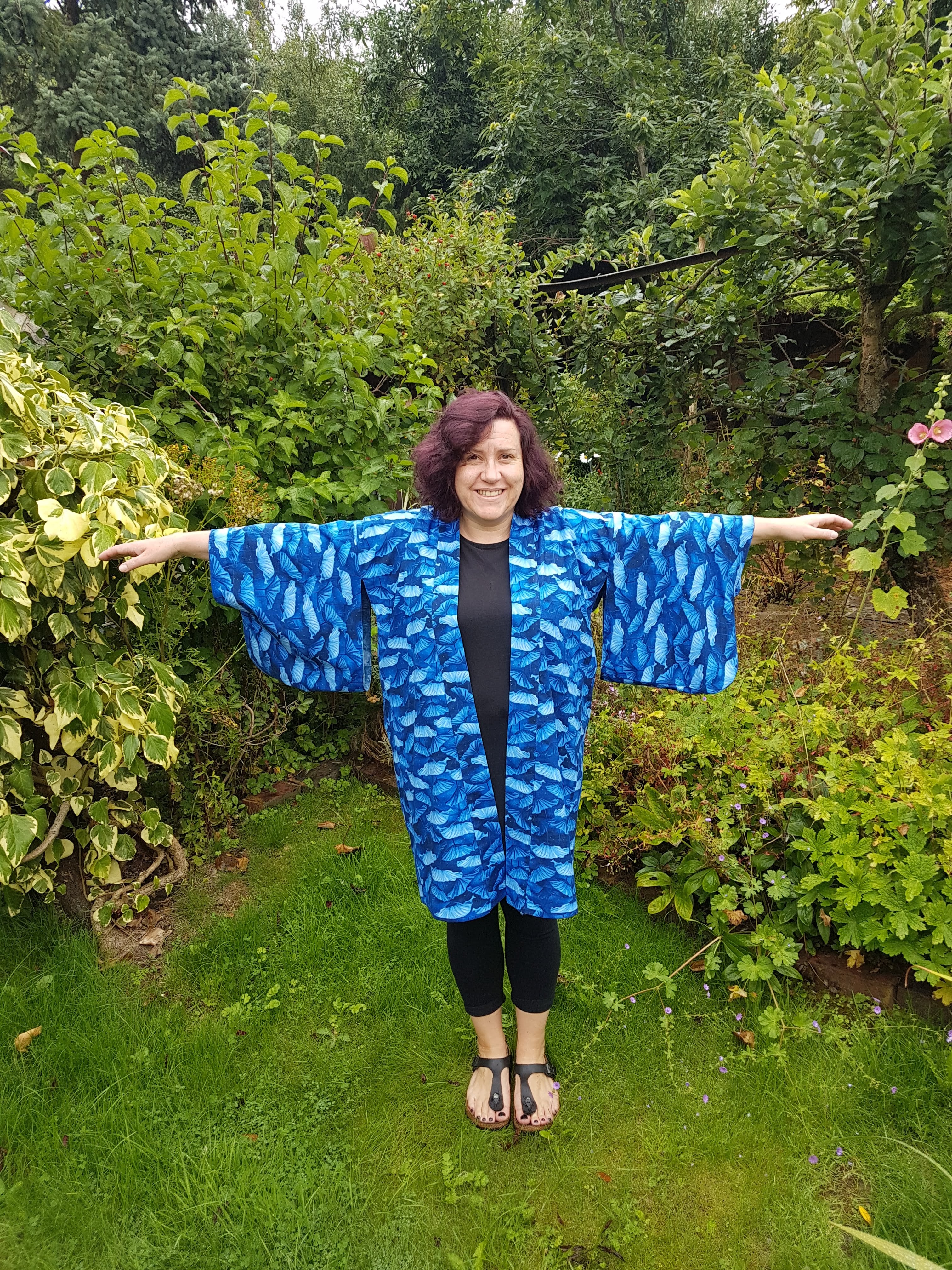
I had a few days to recover from the ordeal of shopping with Thing 2, so obviously this involved fabric and leaving pins all over the floor, crochet and cross stitch. After the challenge of making Irish sister’s 1920s skirt I gave in and bought the Japanese Haori and Hapi pattern from Folkwear that I have been ogling for several years. They are not cheap patterns, but come with wonderful histories of the garments and traditional detailing information. They are also adding more and more of their paper patterns to their PDF catalogue, which makes me happy indeed.
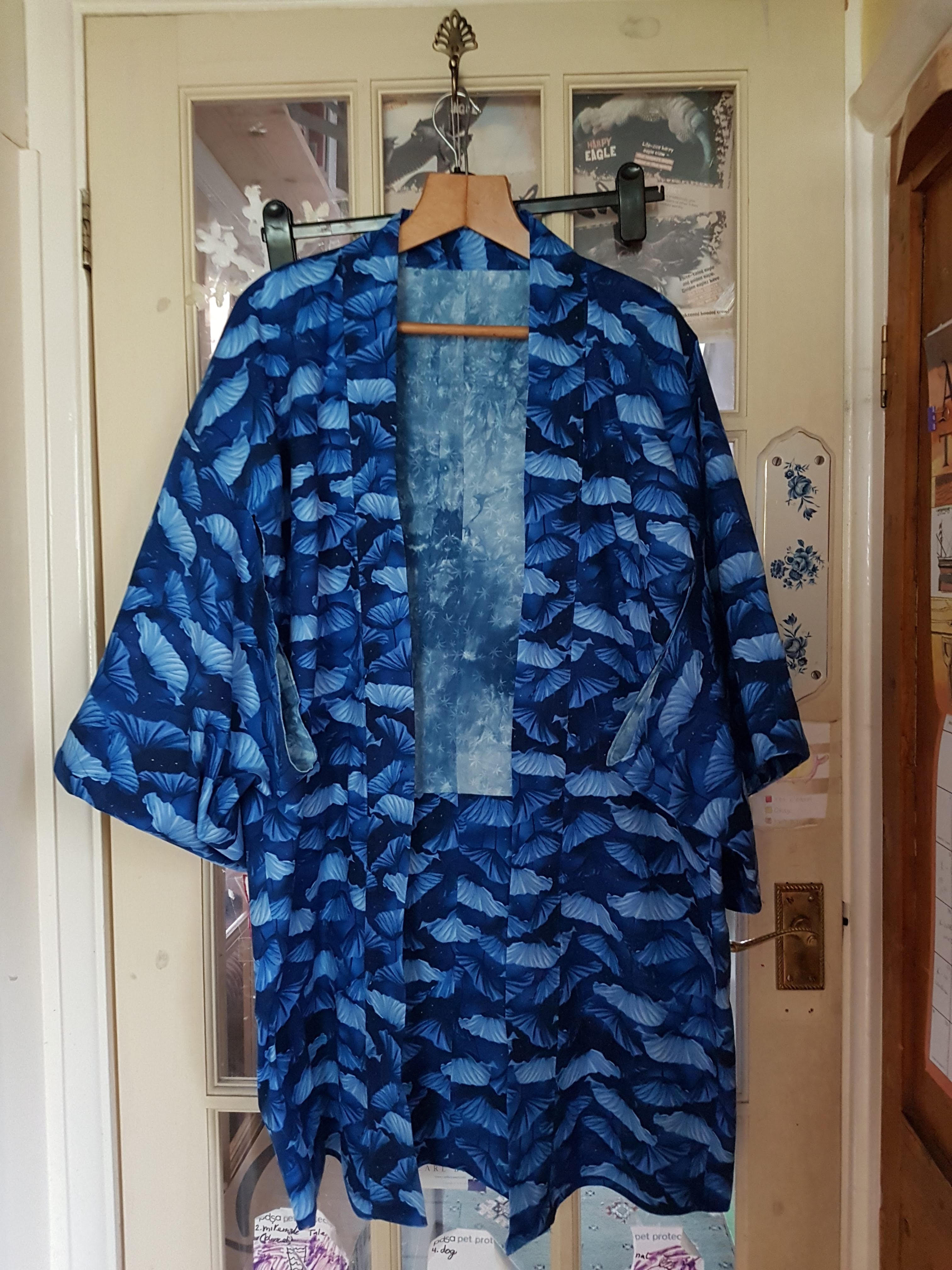
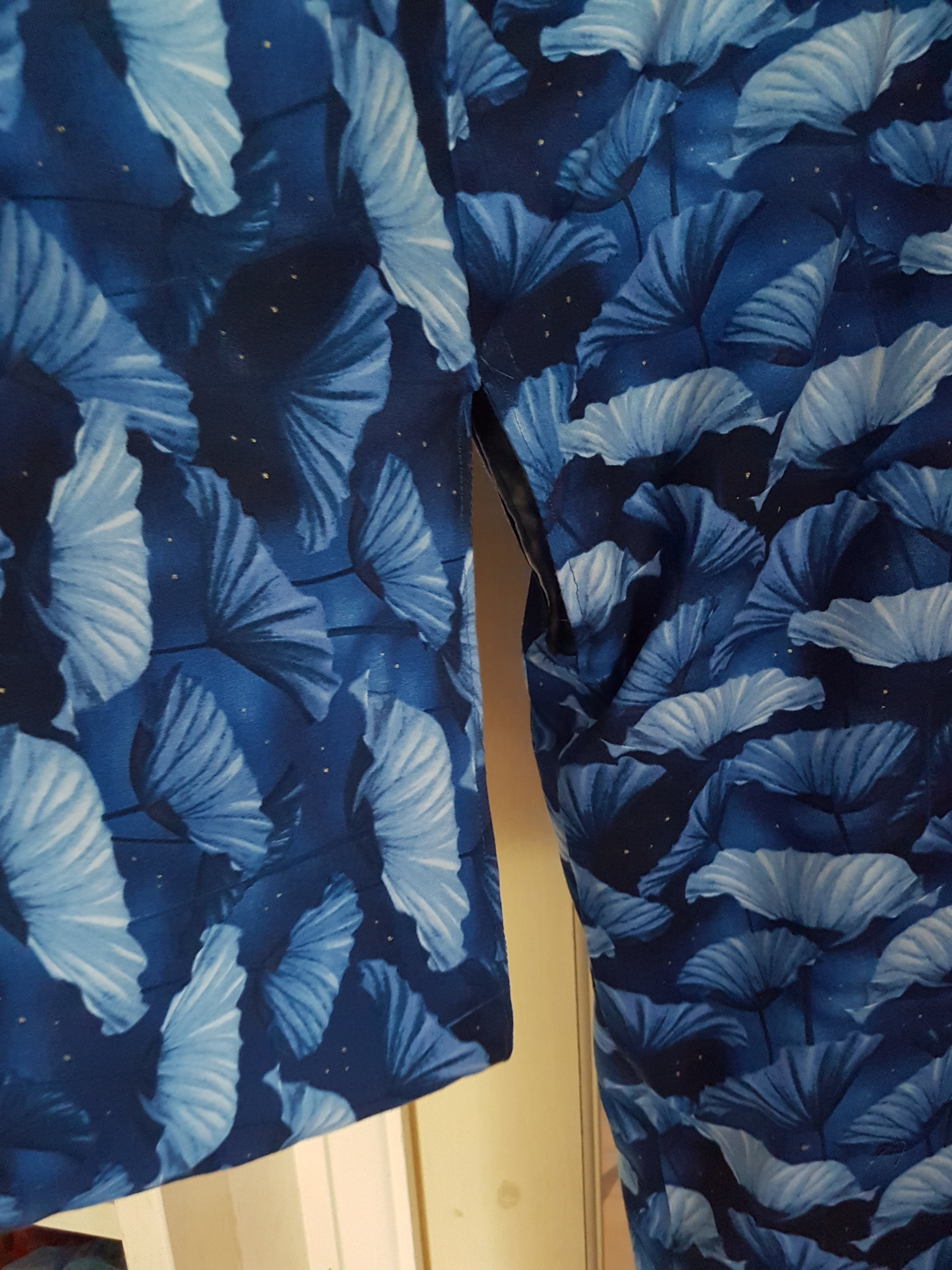
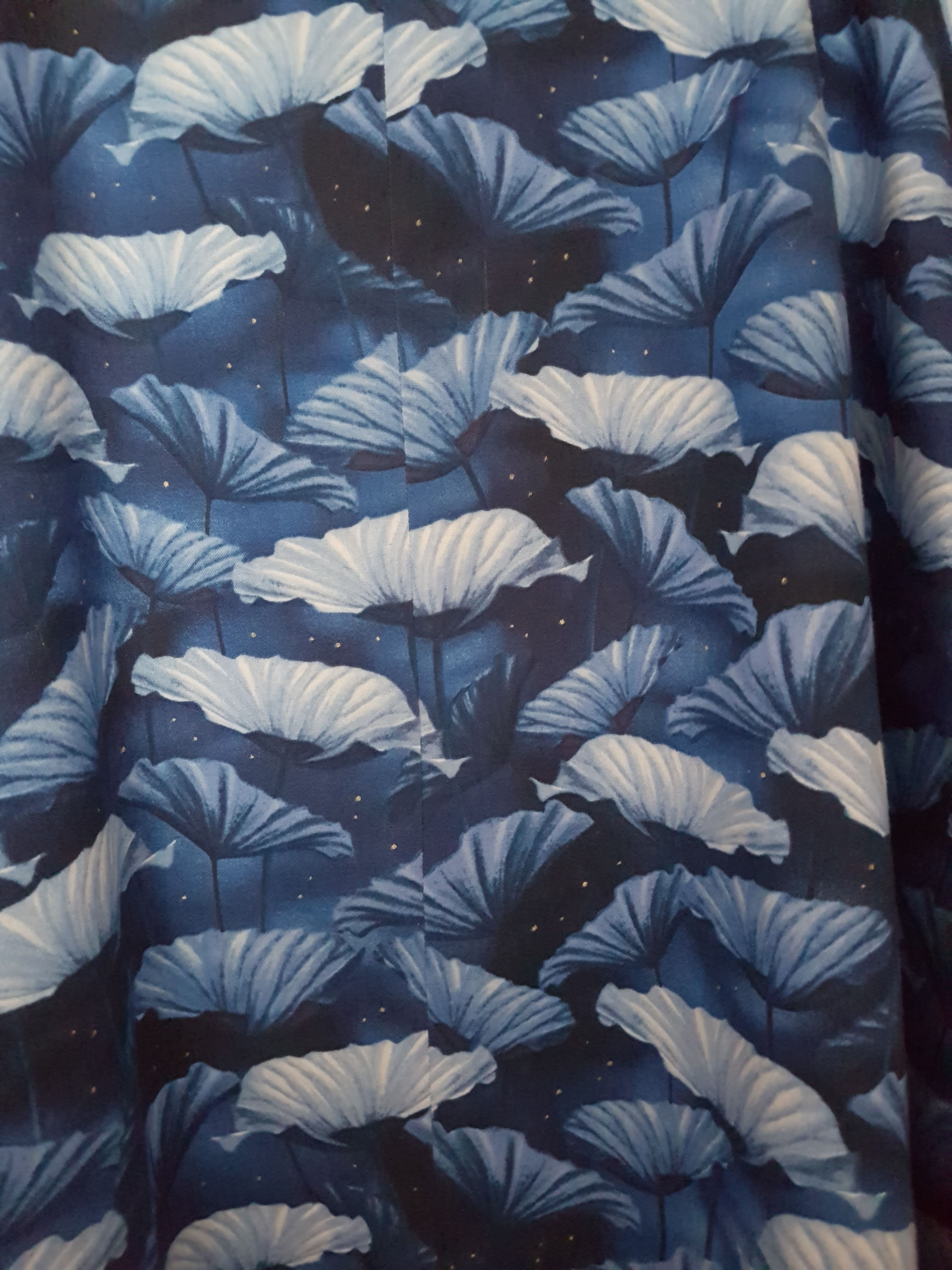
I used a gorgeous fabric from Kanvas Studio – Moonlit Lilypads from their Moonlight Serenade collection, and for the lining some tie-dyed cotton that was sold as a star print but when it arrived the print was distinctly…. herbal. The fabric is a one way print which the pattern isn’t suitable for but I rather like how its turned out despite that.
I made the Haori option – a lined, mid-thigh length jacket which comes up quite long on me. The pattern was occasionally a bit confusing to follow, with hand drawn illustrations, but as long as I took it slowly and did a lot of pinning and tacking it wasn’t too bad to construct. My hand sewing is shocking, so if I ever decide to enter the Sewing Bee I’ll have to work on that, and I cheated by machine stitching some of the bits I should have slip stitched but hey, I’m the one wearing it. I love the sleeves, and this is quite cosy to wear so I think it should get a lot of use.
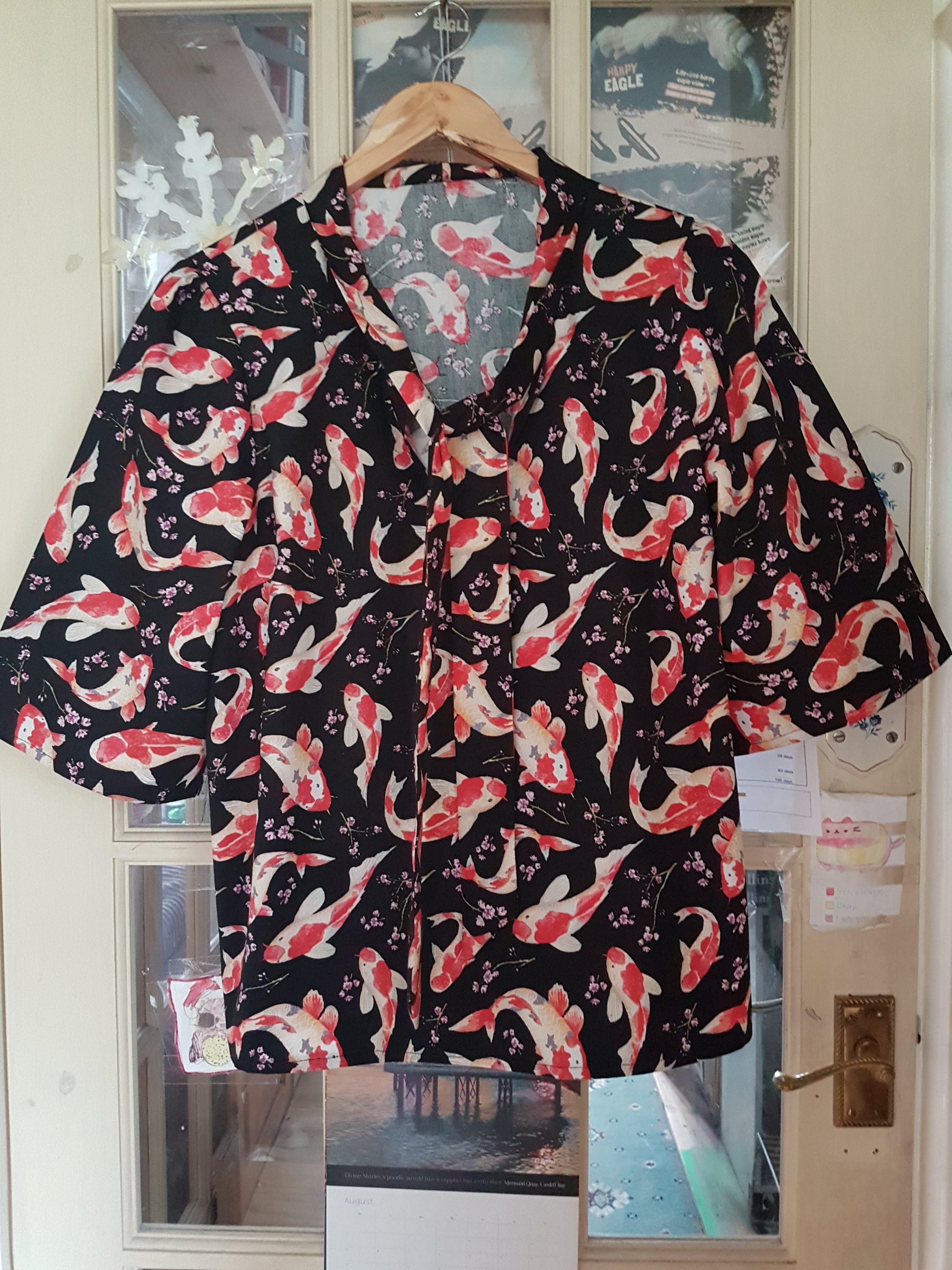
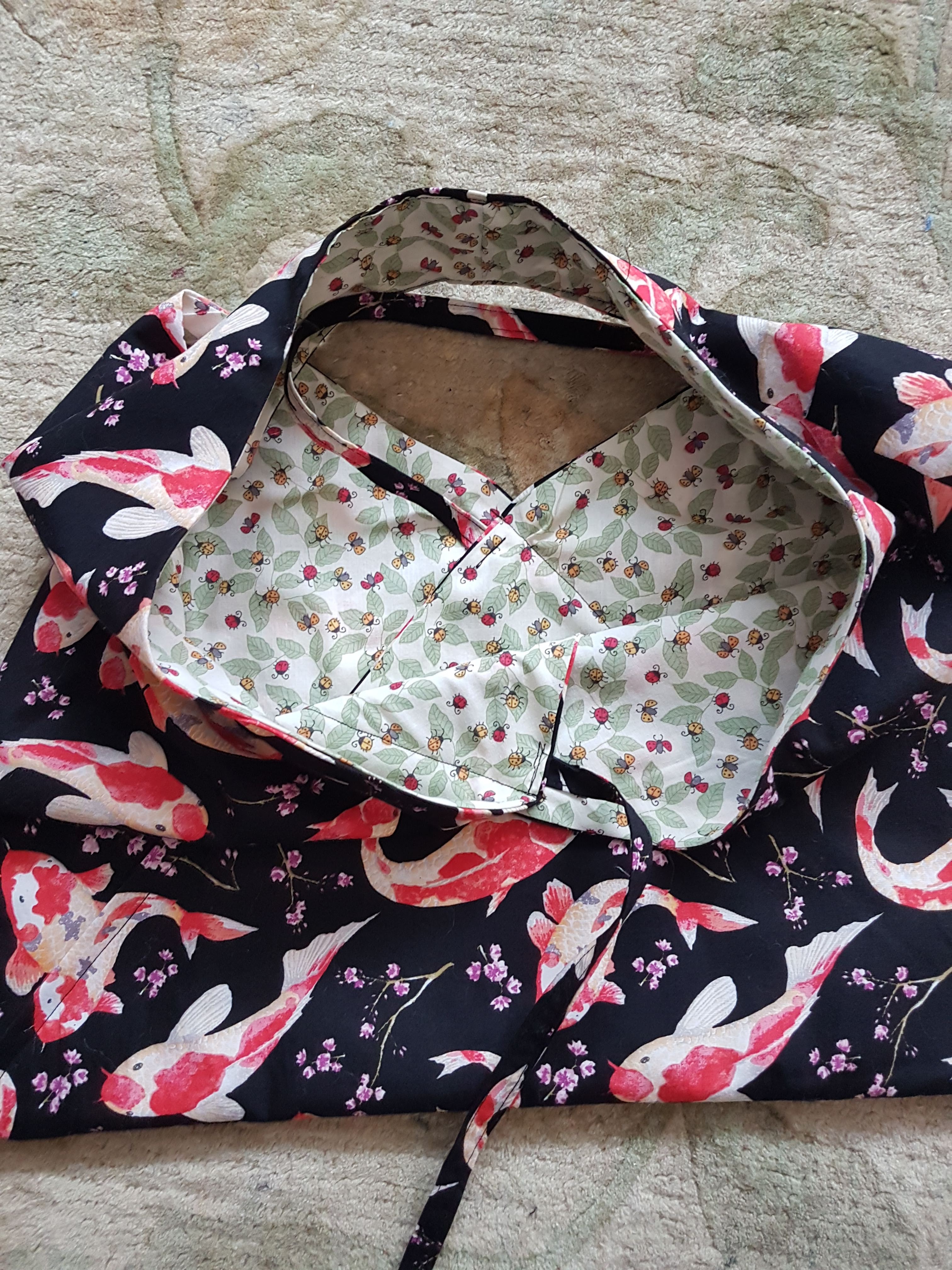
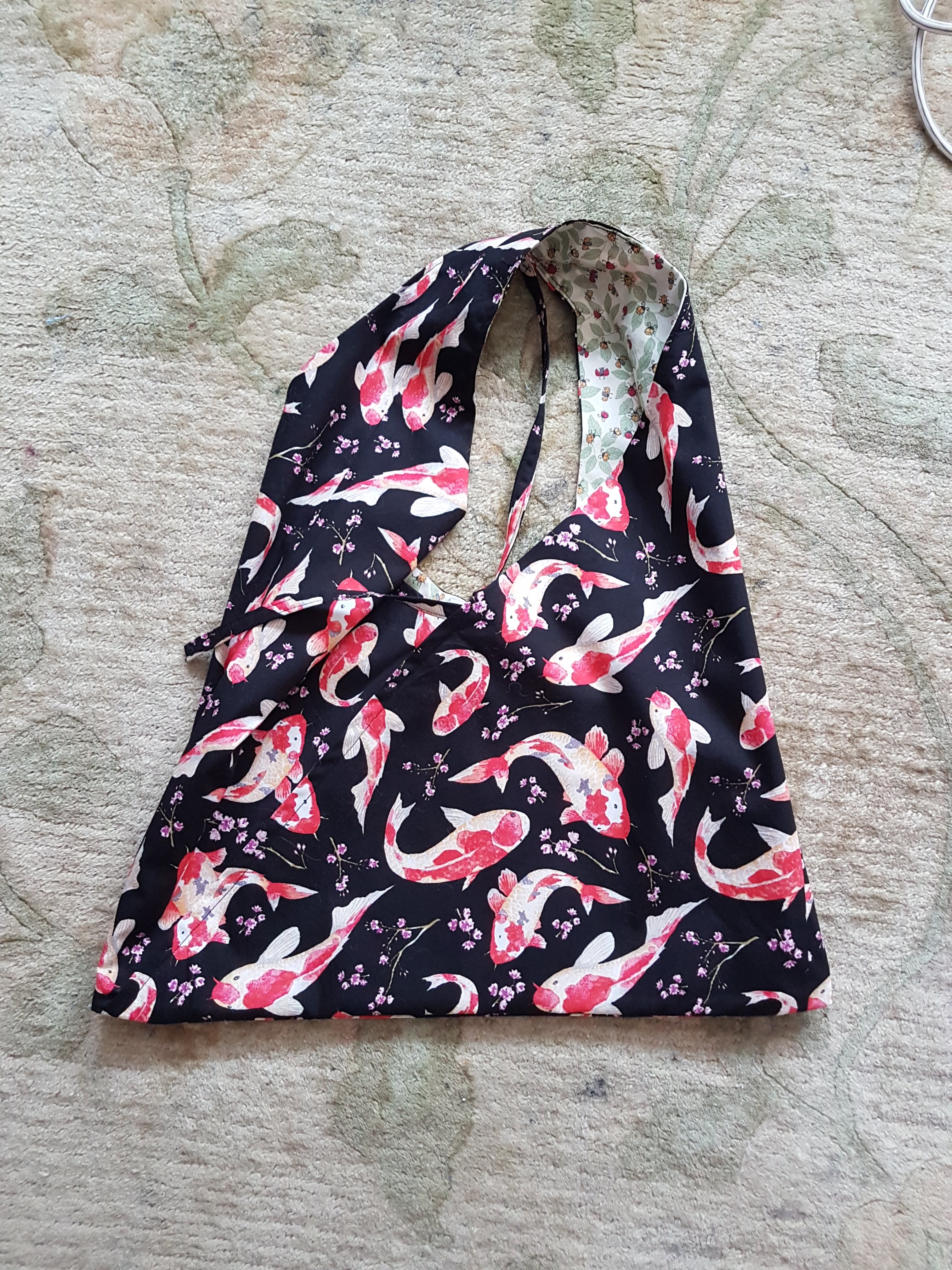
Continuing the Japanese theme, I used some of the leftover koi fabric from making a Simple Sew Lottie blouse to make this Nori Kimono bag. I lined it with some ladybird print polycotton fabric that was an ebay purchase, and it’s had a compliment or two already. I haven’t worn the blouse yet! I love this fabric, it’s so colourful.
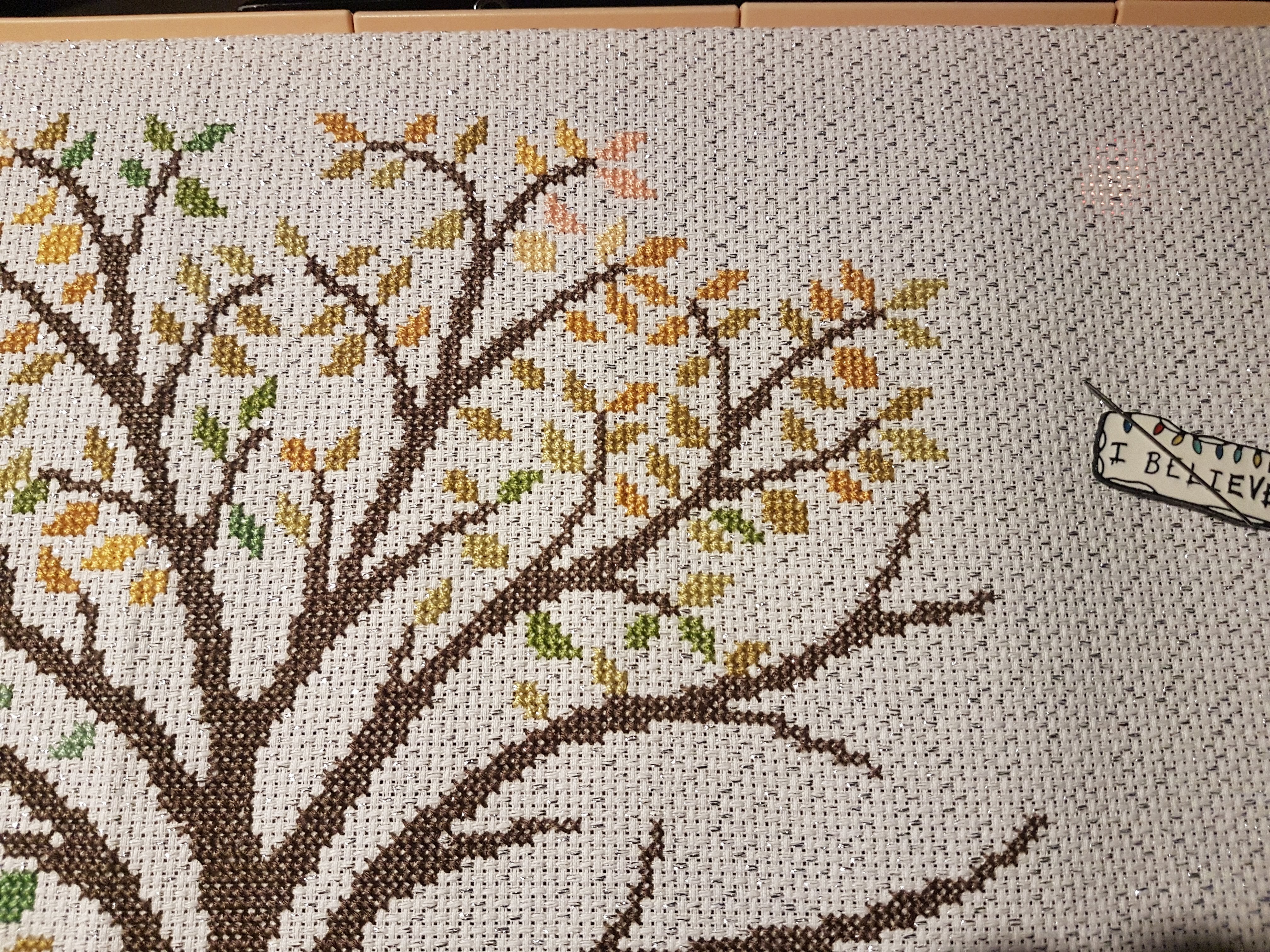
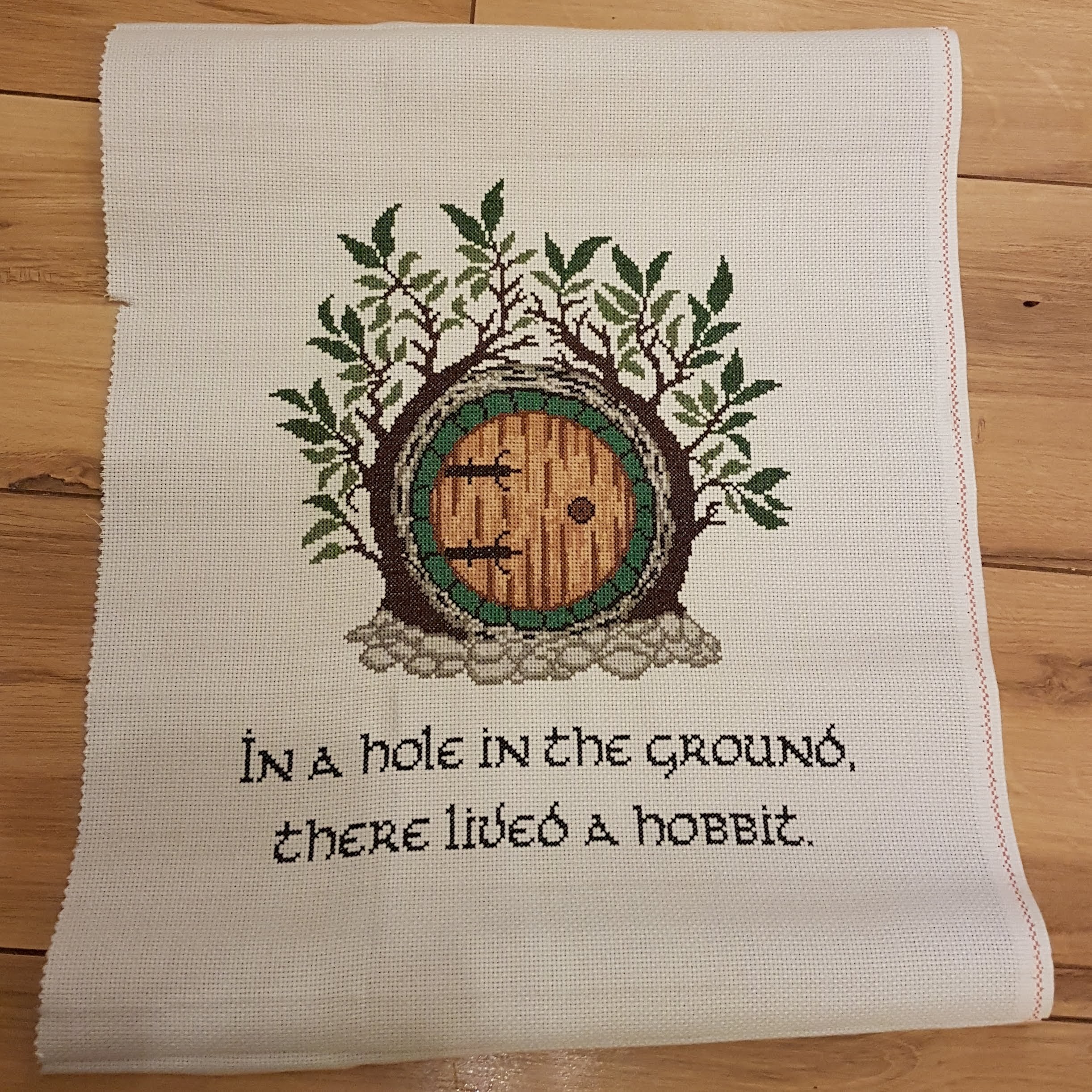
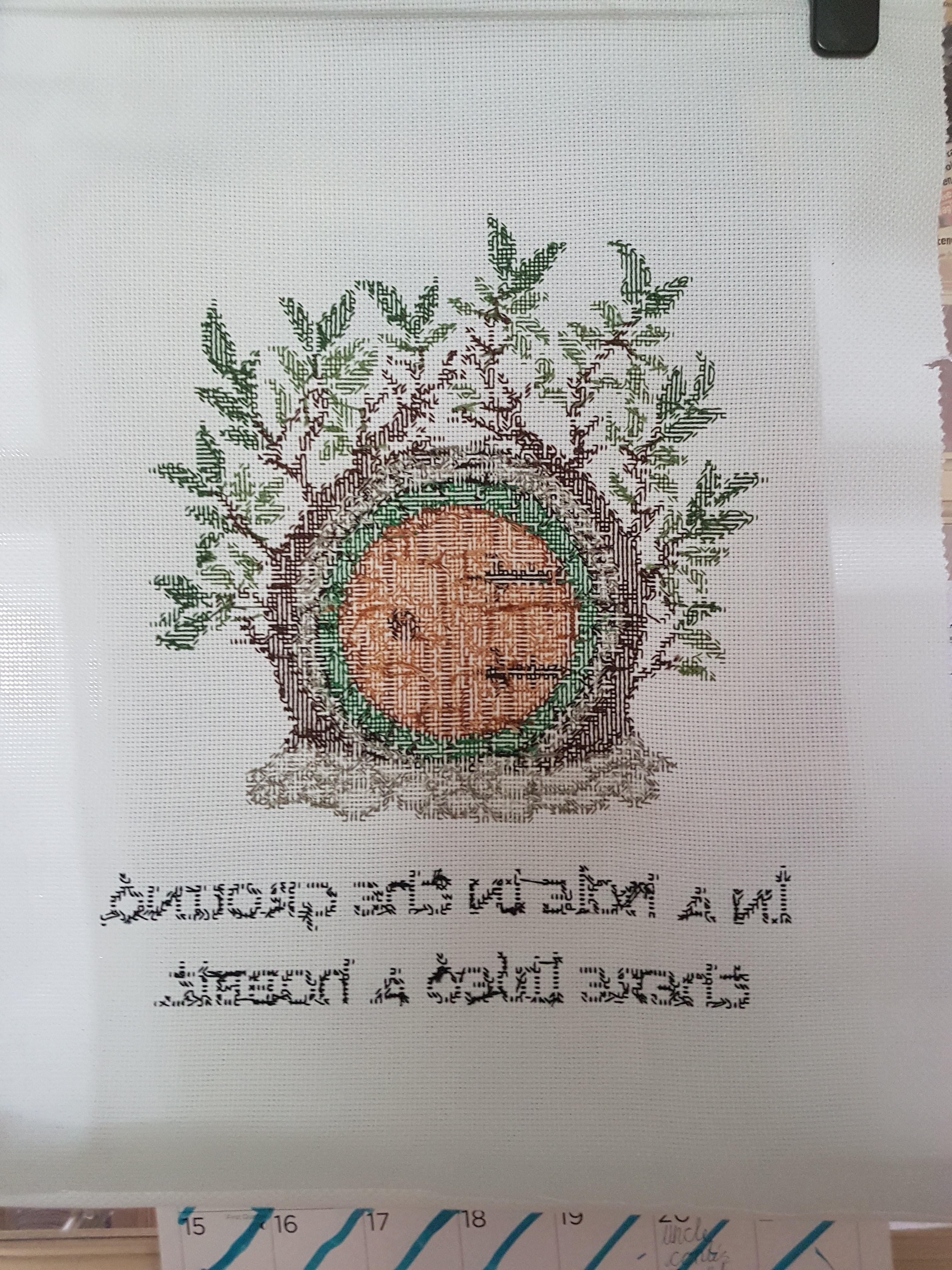
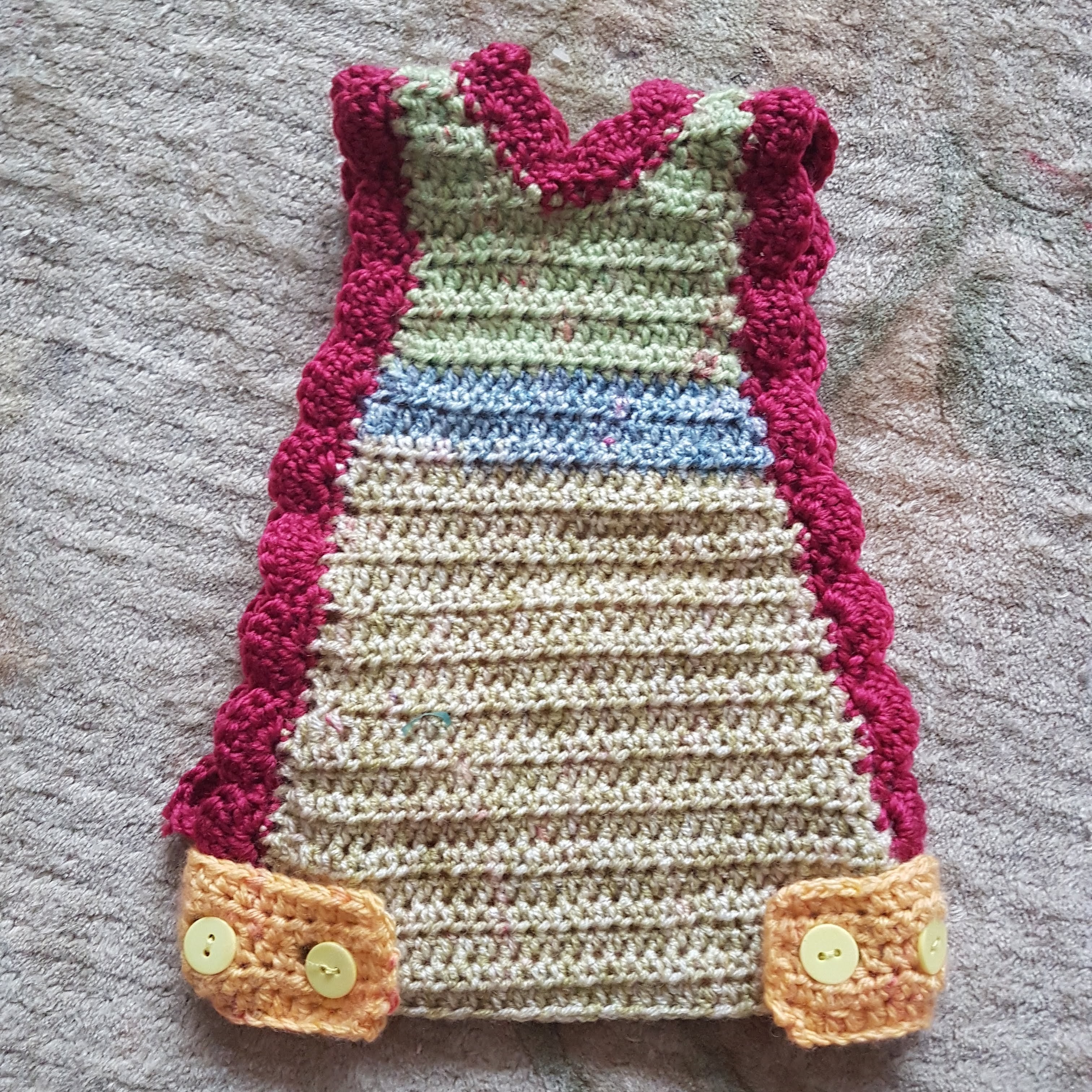
As ever I have been cross stitching and crocheting: the temperature tree is up to date, the Hobbit Hole is finished, the Build Your Own Beehive Shawl and the socks are ongoing, and I took a break to make a chicken sweater as one of my lovely colleagues adopted some commercial laying hens (not battery ones!). These are all the bits I haven’t shared with you in my last couple of sensible weeks.
Temperature Tree…
…high of 23, low of 16 in August. Call that a summer?
Front…
…and back
Chicken sweater!
Morgan jeans – pockets
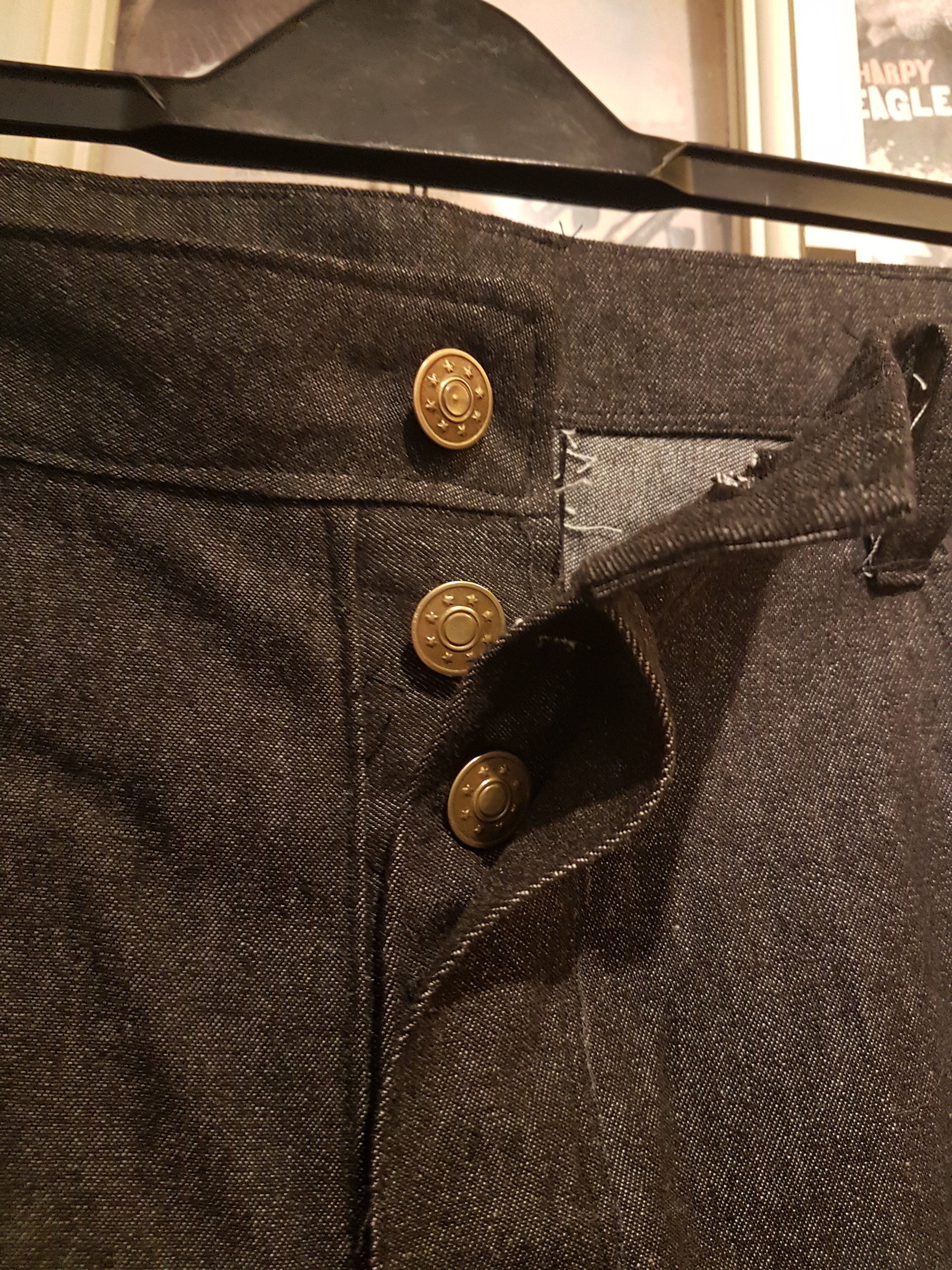
Button fly
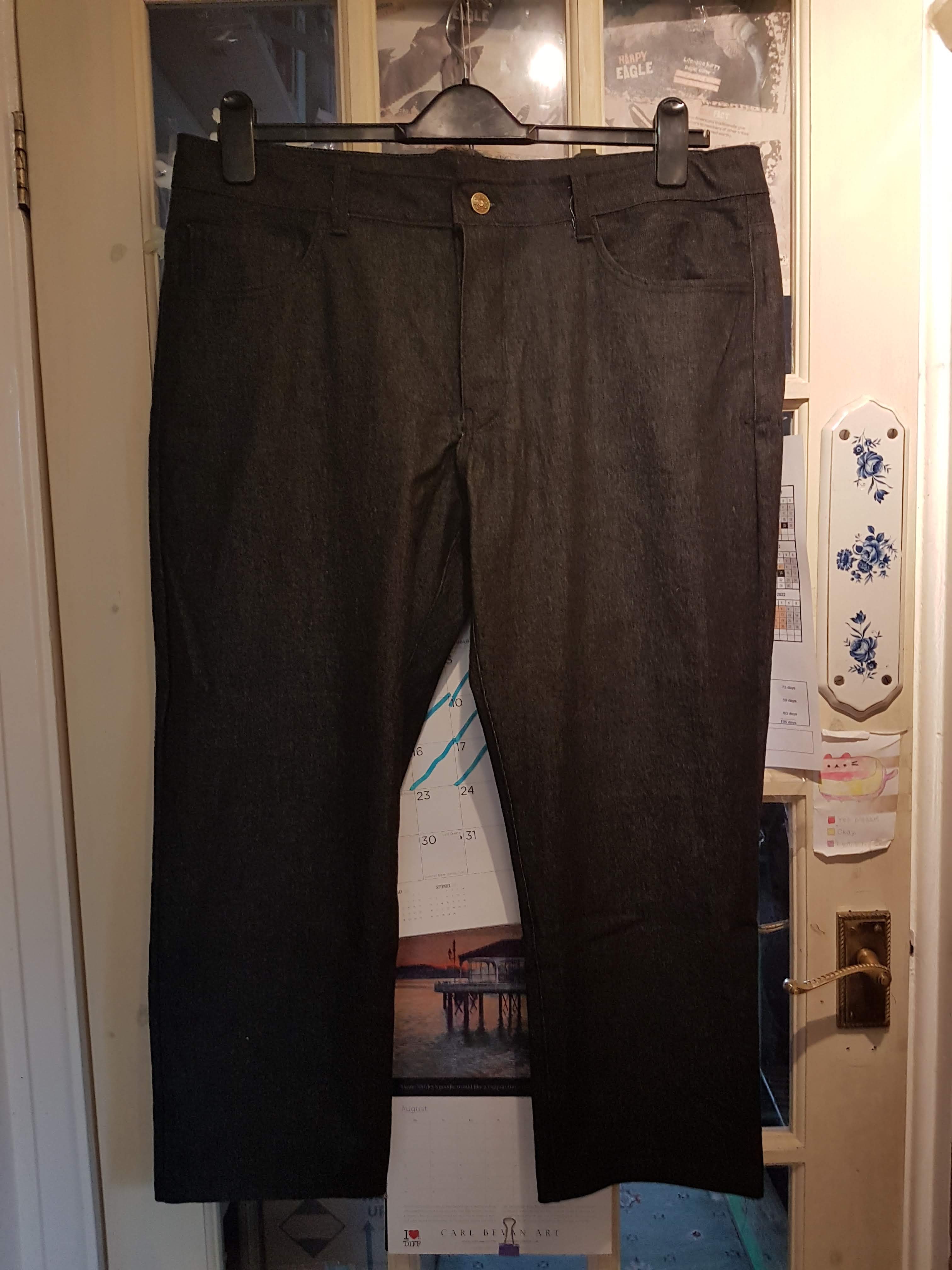
Morgan jeans in black denim
Bigger on the inside
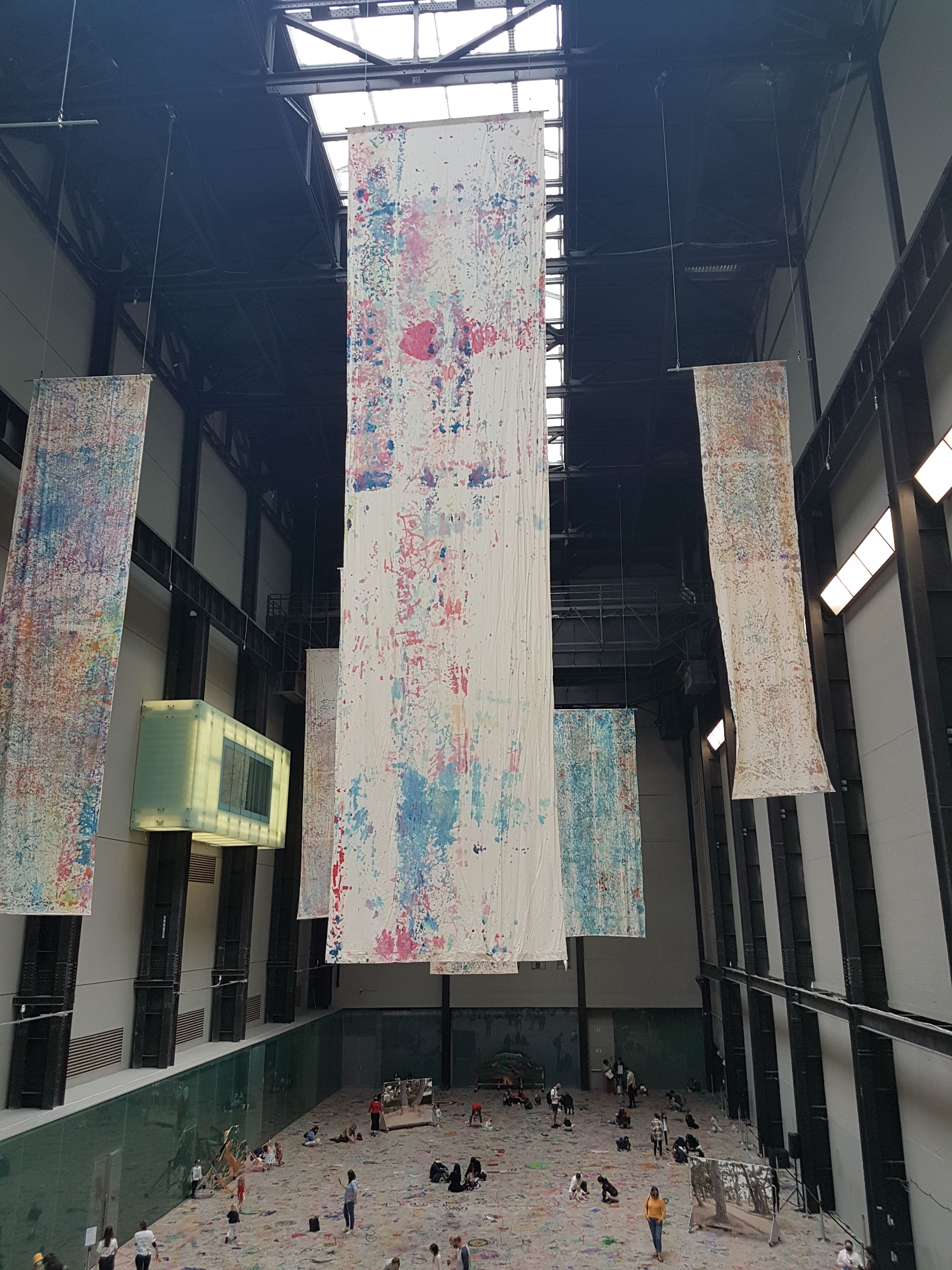
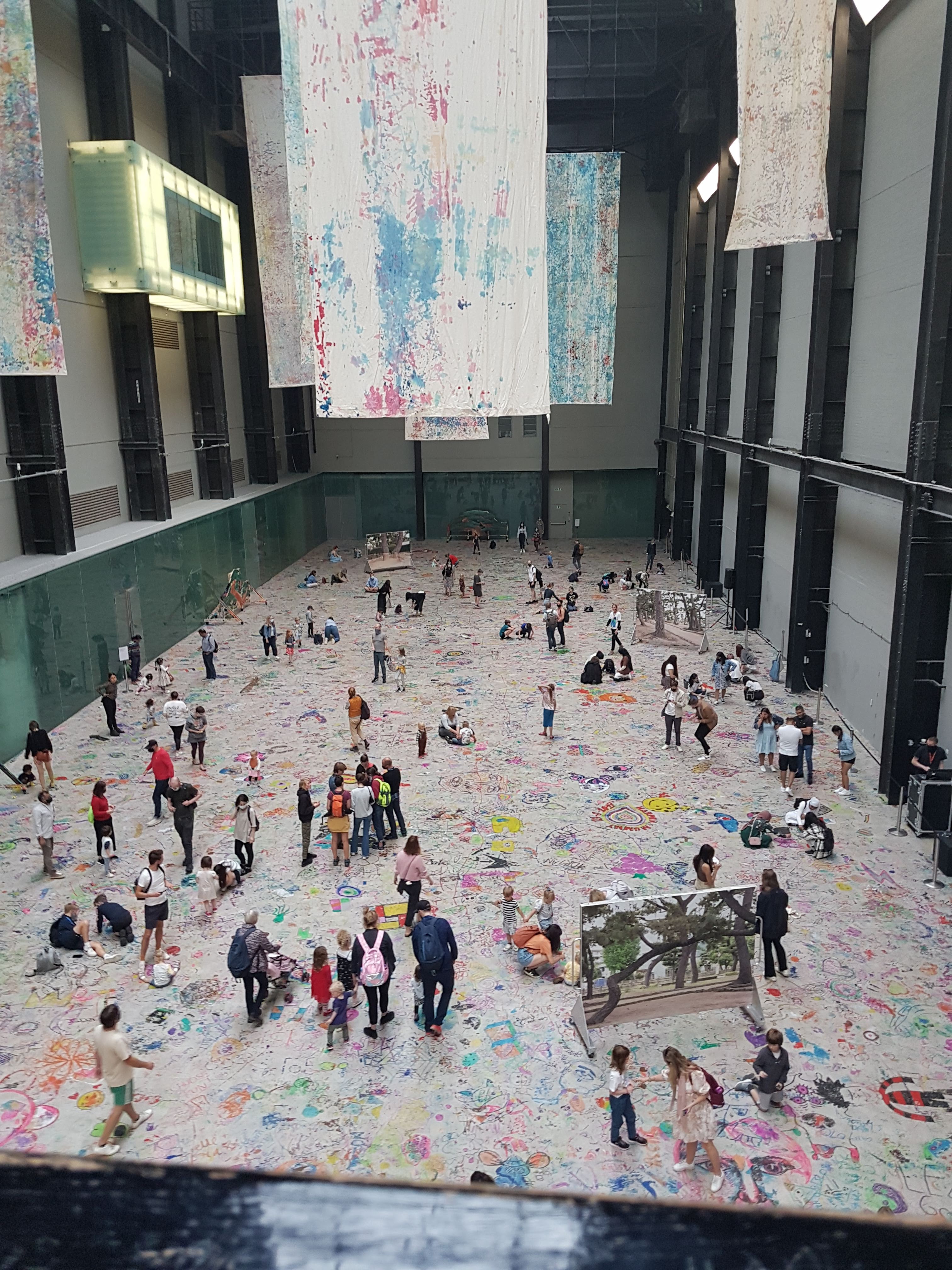
Uniqlo Tate Play in the Turbine Hall – please draw freely
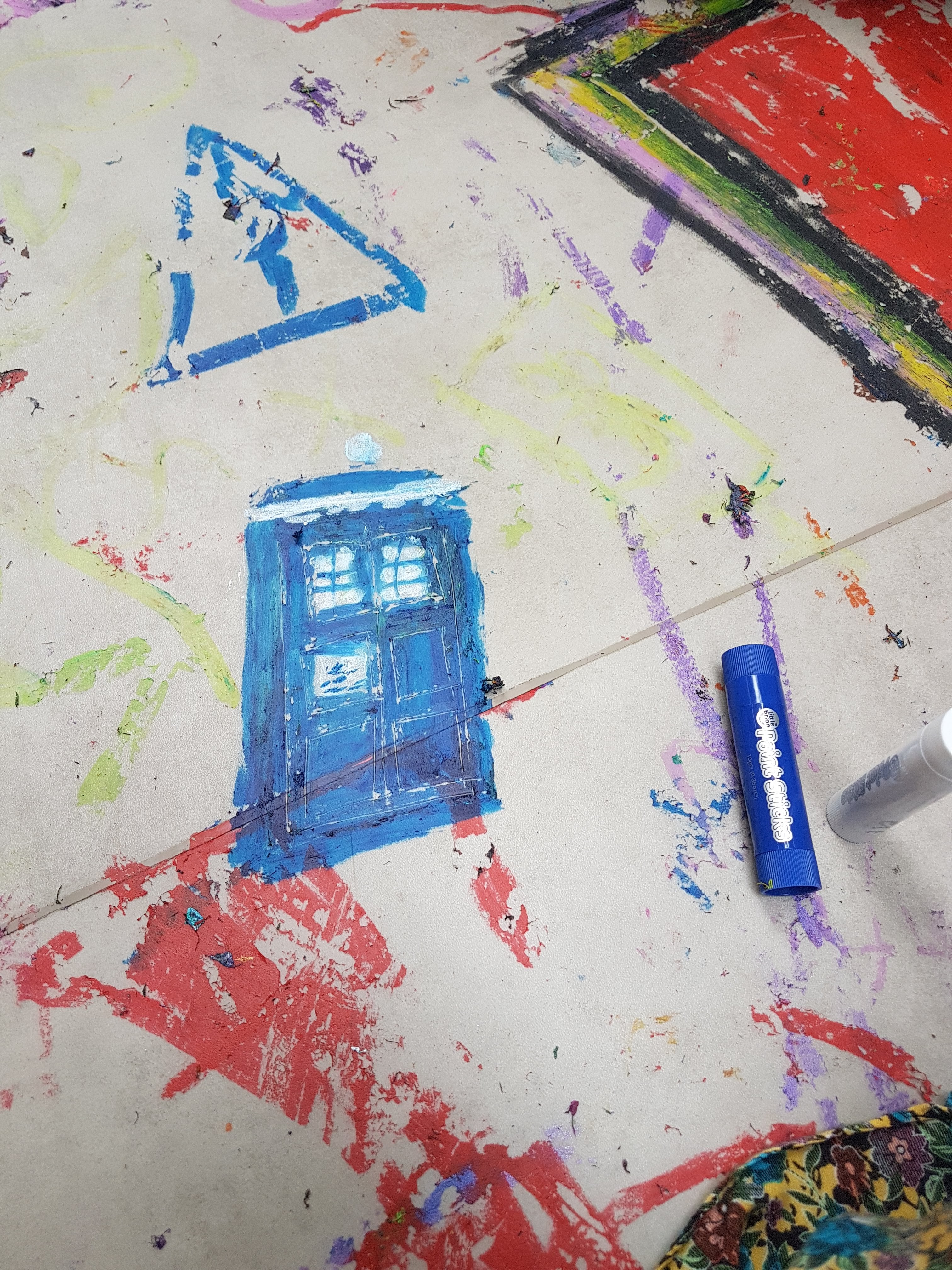
The chicken-adopting colleague, myself and two others also visited Tate Modern to see their summer activity – drawing freely in the Turbine Hall as part of the Uniqlo Tate Play programme. The artwork is amazing and it was great fun adding our little bits to it! I really want to make something out of one of those banners!
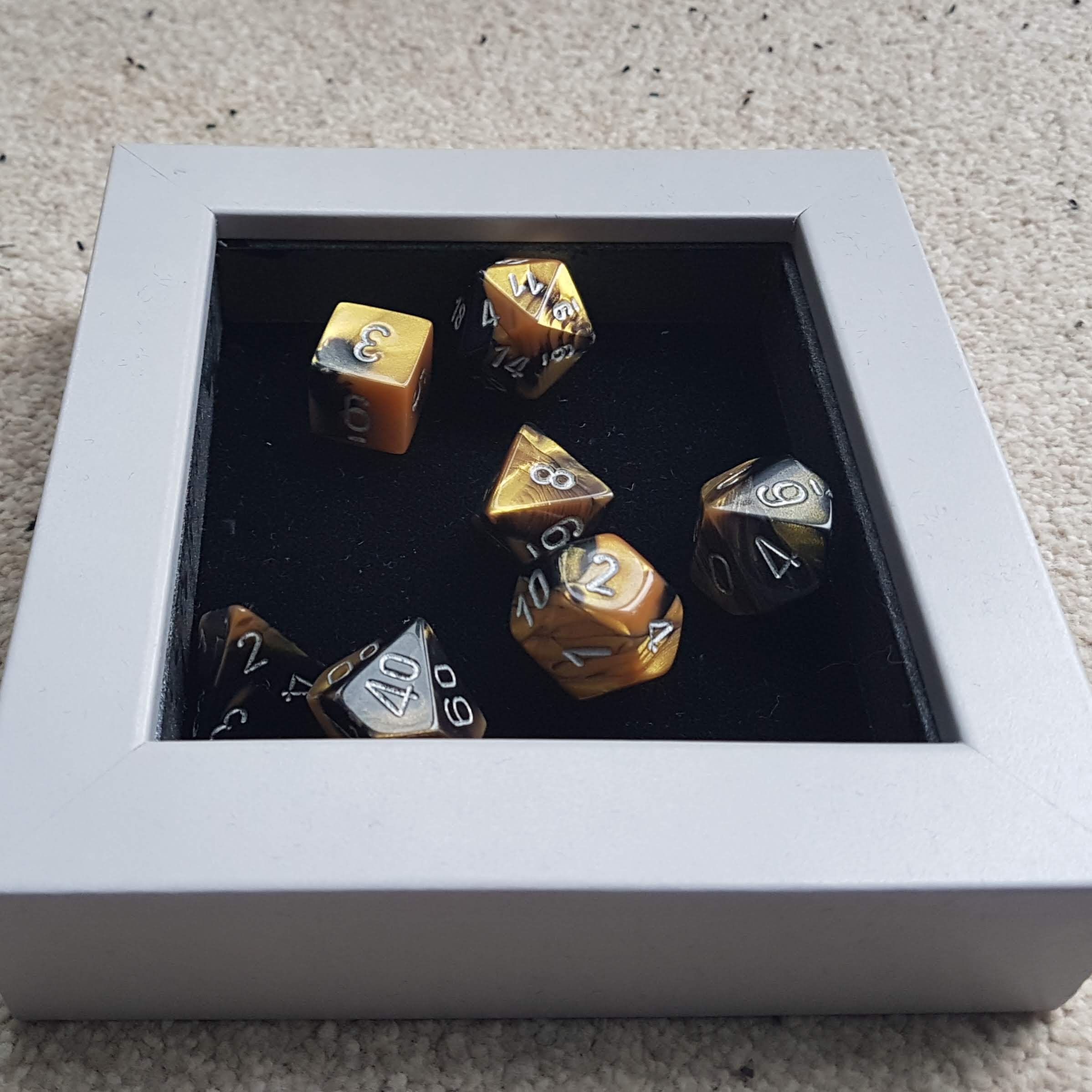
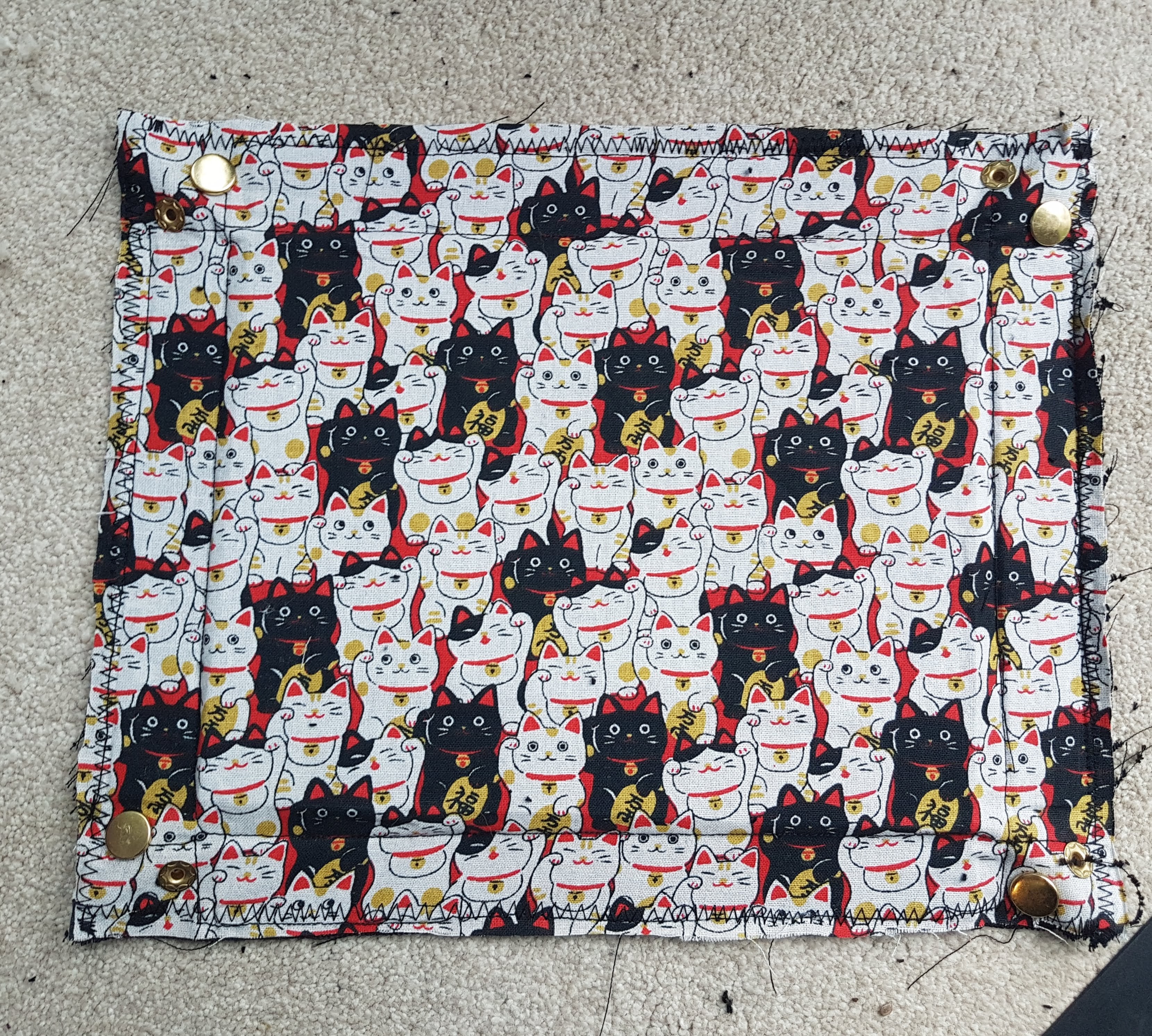
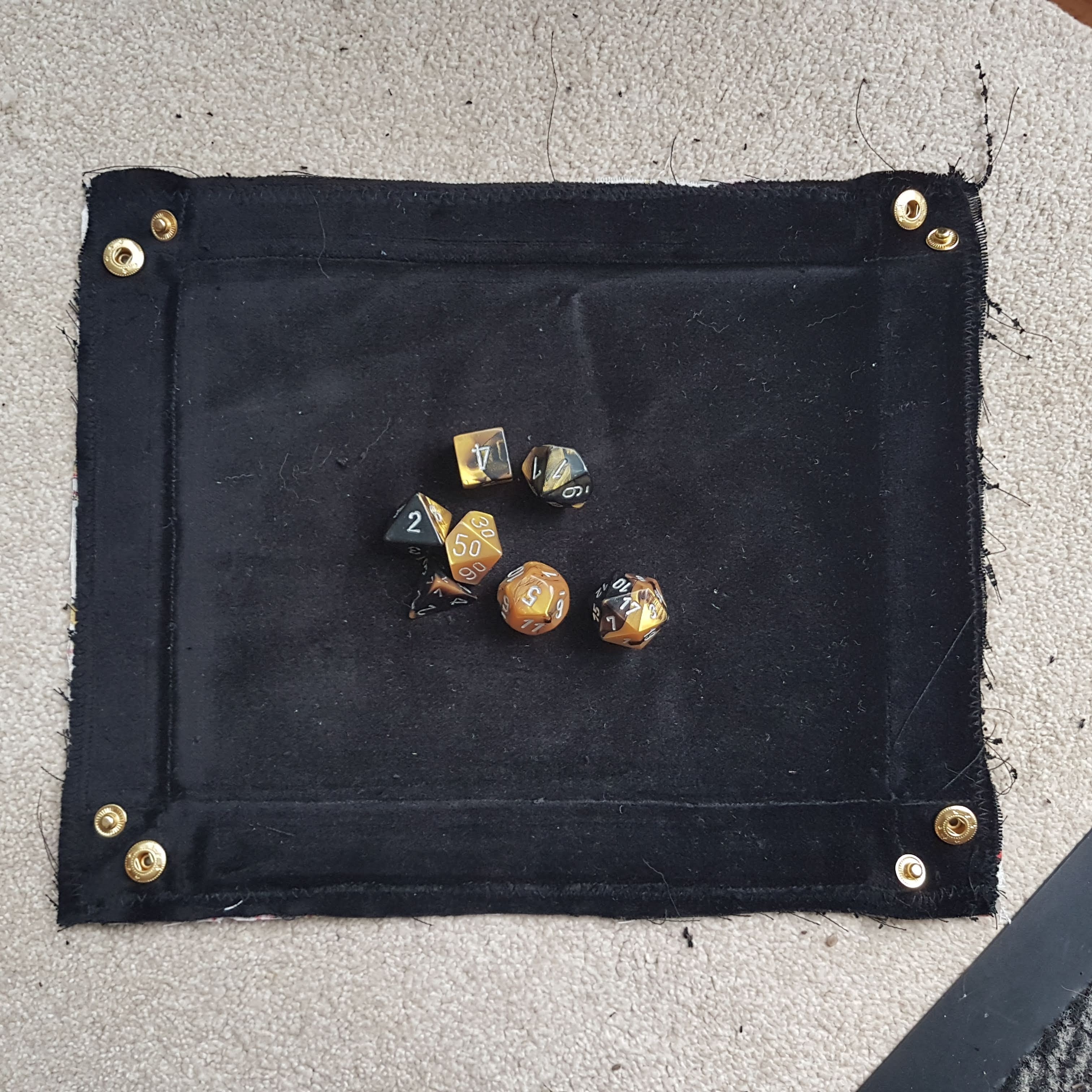
The latest thing I have been up to is dabbling in Dungeons and Dragons for the first time in about three decades – I filled in for someone who couldn’t attend a regular game on Friday and managed not to kill his character off so hopefully I’ll be allowed back! The host (Dungeon Master) and his wife have a beautiful gaming table so dice trays are very much the order of the day – I played around with an online tutorial yesterday, and using things from in the craft shed I made a collapsible fabric one and another using a shadow box frame. I’d forgotten how horribly velvet frays so I shall have to do something about the edges but it was quite quick and fun to make.
It’s been a very productive few weeks, as you can see! I’ll see you all again for week 77…now I must go and do the ironing I have been putting off for months.
The pattern Irish Sister (let’s call her Steph, as it’s her name) and I chose over a Zoom call was the Cordelia skirt from Wearing History. These Resto-Vival™ Patterns are original historic patterns that have been restored and revived, and have had pattern markings and sizings added that the modern sewer is used to seeing rather than the basic perforations that were common in early sewing patterns. While making this I was watching the Great British Sewing Bee’s early series, and I had a lot of sympathy for the sewers encountering their first 1930s pattern! We chose to make the skirt in street-length (with no train) and in a plain grey cotton sateen from Ray Stitch which I thought would have the drape and weight needed for the shape we were after. Ray Stitch offers a thread matching service, which we took advantage of, as I wasn’t sure if I’d have the right grey in my stash. We also needed ‘belting’ which turned out to be grosgrain ribbon.
Steph sent me the measurements we needed, and as she fell between sizes we chose to go slightly larger for breathing purposes, and so she could wear the correct historical layers underneath if needed. She – like me – is not blessed with great height and this is a skirt that runs long, so I had to redraft the length and then the back: the shortening had to be done at about thigh length, rather than from the bottom. As so much length was lost I was able to cut out the skirt on the cross-grain, which meant I didn’t have to piece the fabric. The original skirt was made from one piece of fabric, seamed up the back and given shape through waist darts where the side seams would sit and further darts in the belting.
How straightforward, I thought! What was I worried about?
And then I realised it called for dress weights, which I had never used before although Google tells me they are still popular with various royals who need to maintain their dignity while getting off aeroplanes in windy places. Hurray for Google, eh? Neither were there any instructions for fastening the skirt, or indeed many for making the skirt up, despite it being only one seam and some darts. Basically: sew darts, sew skirt together, add the belt.
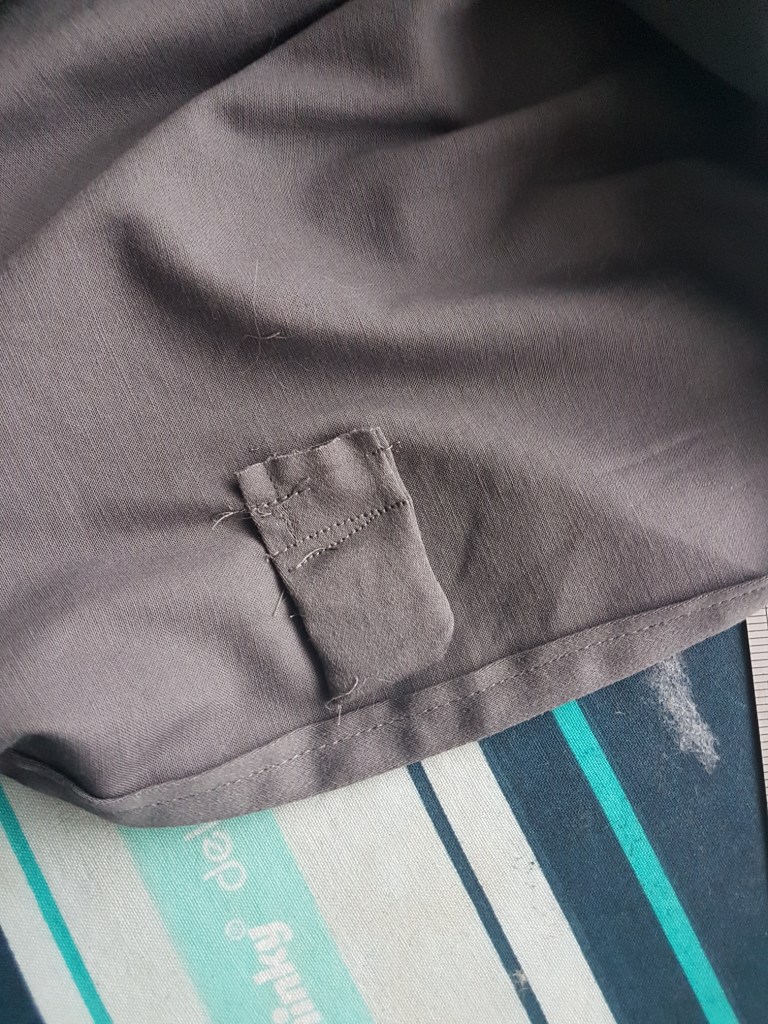
A quick message via Etsy to the very helpful Lauren, owner of Wearing History, solved the fastening question: she added a placket with snaps and a hook and eye. After consultation with Steph we decided we could get away with adding a zip as they were invented in 1913 and the character she will be playing on film is from 1921 (the centenary of the creation of Northern Ireland). I went for an invisible zip, as it should also be hidden by her middy blouse. Originally I put it in properly, but then I had to take it out as the skirt needed to be taken in after finishing it, so then went back to my much quicker method. The pattern weights were more of an issue as I tacked them in but they didn’t want to stay tacked. Every time I shook out the skirt they fell off. I didn’t want to fix them in permanently in case Steph didn’t feel they were necessary!
For once I was good and tacked the waistband in before stitching it down – I am not a tacker usually, as I am a lazy sewer and prefer pins. I’m glad I did, as I had to adjust some width out of the waist after I’d tacked it in. My dressmaking mannequin, known as Lucy, came in very handy this week for measuring as well as for keeping in progress pieces on!
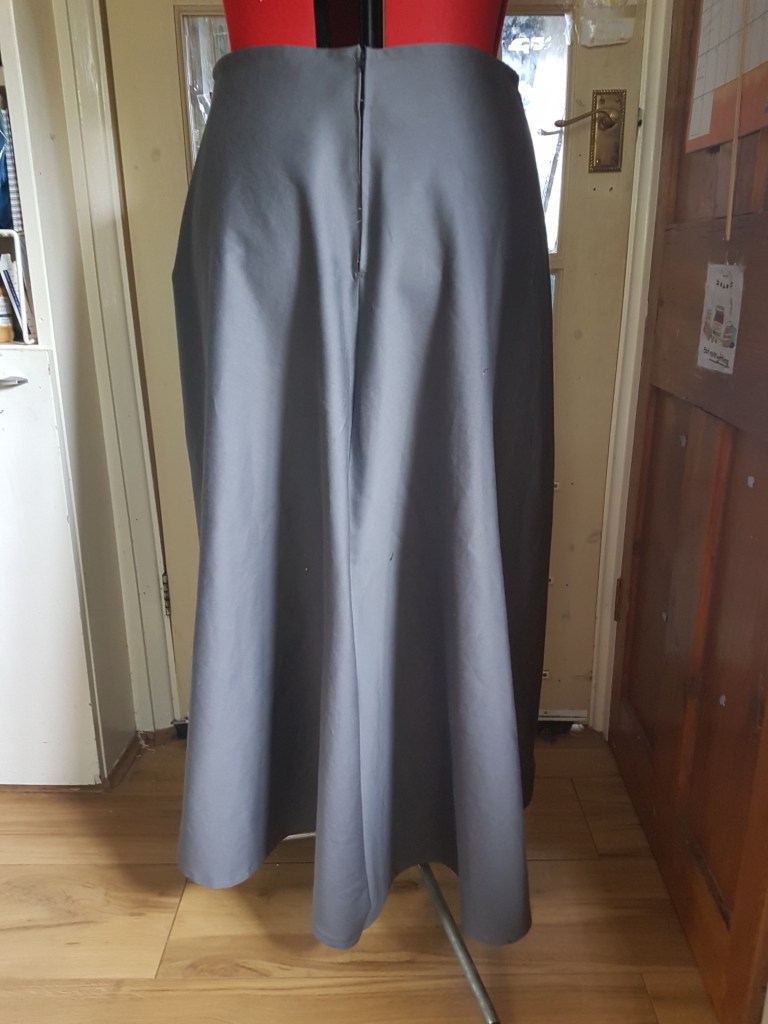
Here is the finished skirt – I think it turned out OK, and it’s in the post to NI already. I just hope it fits…
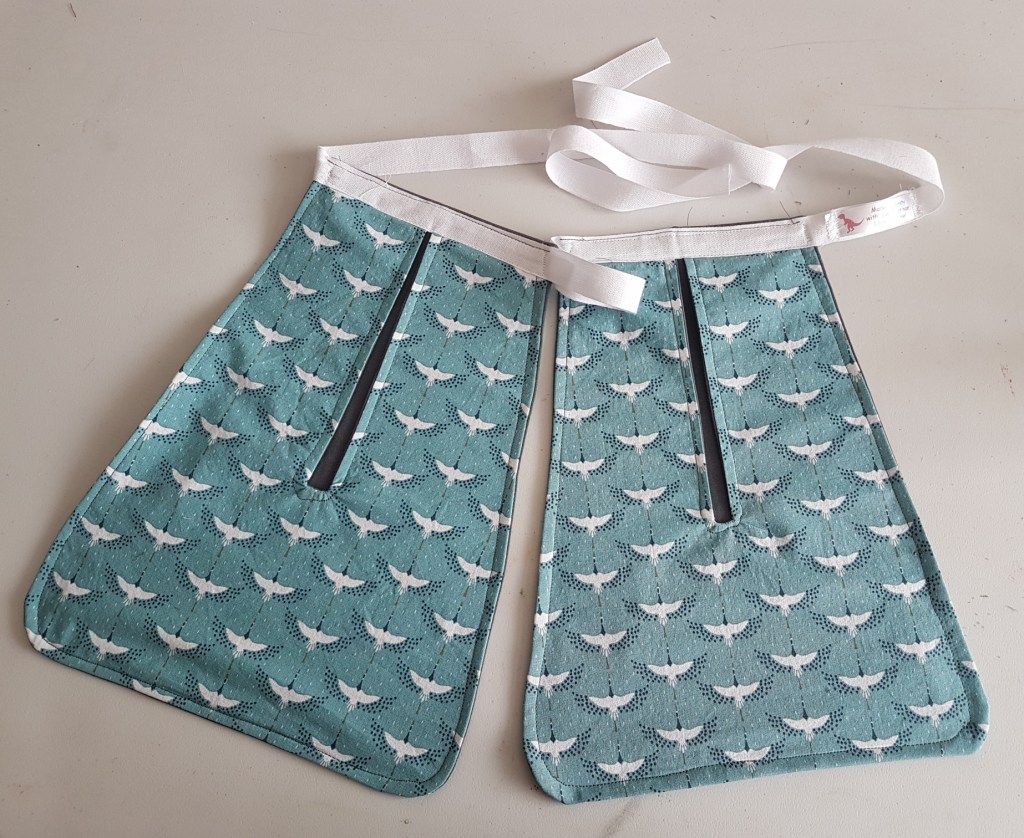
I also packed off a pair of historic pockets – I have been obsessed with making these this week. The pattern is by Hamblemouse, who is starting a pocket revolution inspired by the parlous state of pockets in women’s clothing. I love adding pockets to things, so the idea of pockets that you can just add to whatever you’re wearing is genius. Women used to wear these under their clothing, and then handbags came along – but what if you need your hands free? There’s an excellent history of pockets on the site if you’re interested – I love the idea of keeping gin and kittens in them, frankly.
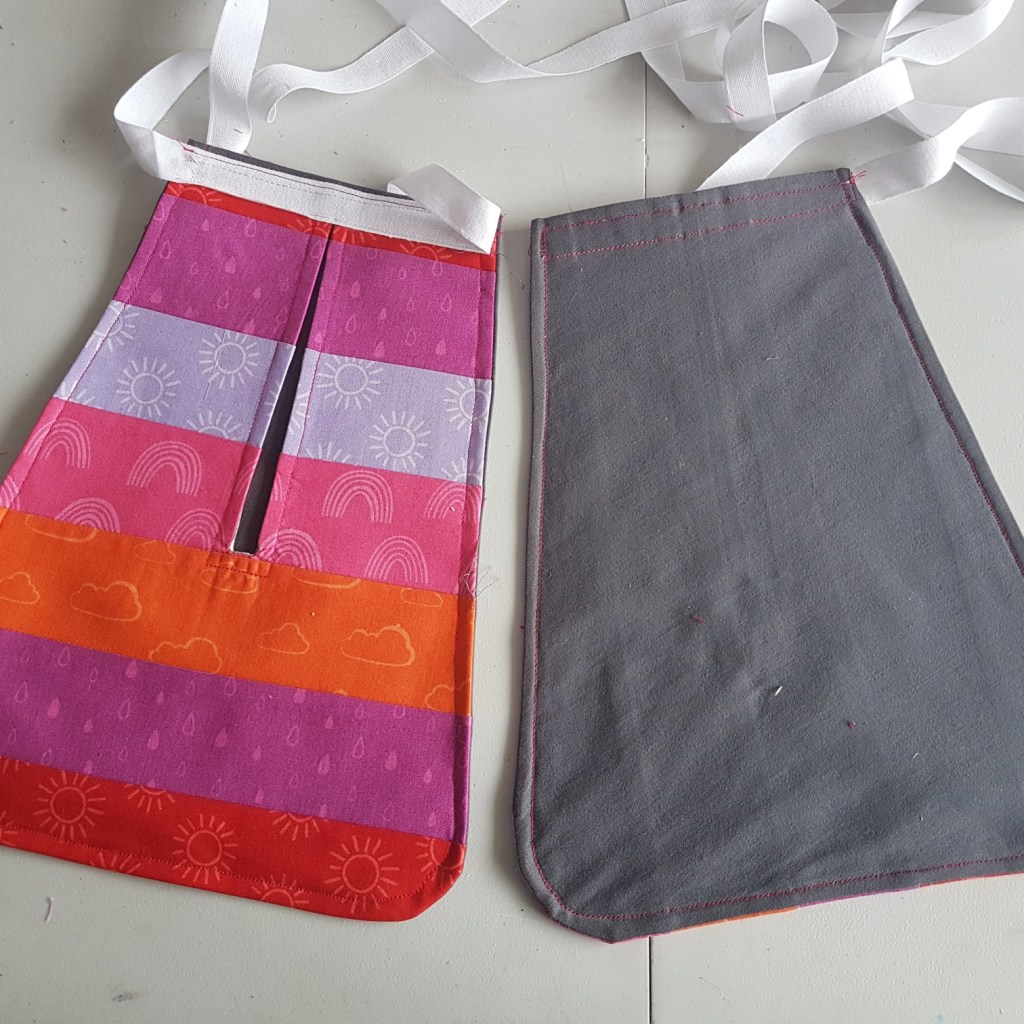
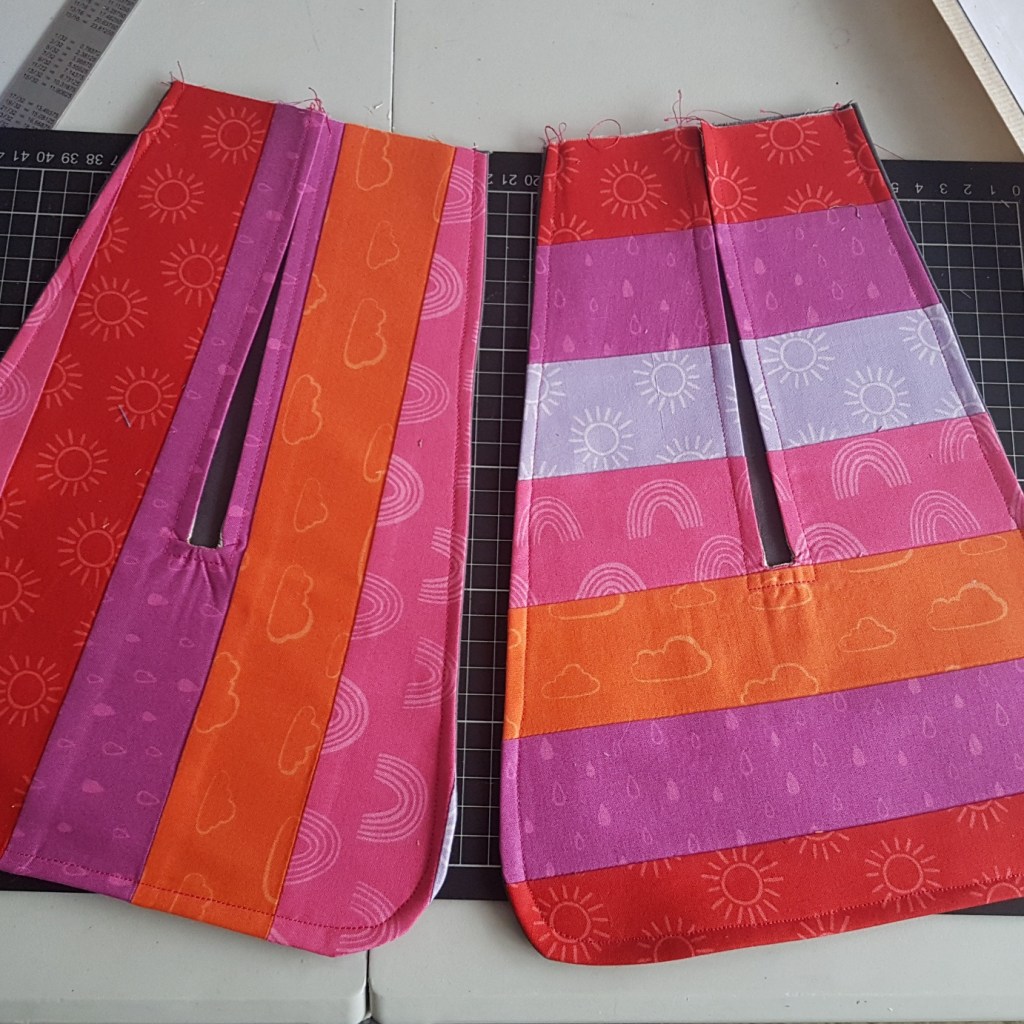
I started with a couple of sets made from leftovers from other projects, and then I got overexcited and used some leftover jelly roll strips to make some single ones, which might be the most gorgeous things I have ever made. They look like sunsets and they are perfectly pressed (for a change). These are too lovely to hide, and I may make them for every conservator I know for keeping useful things (and gin and kittens) in.
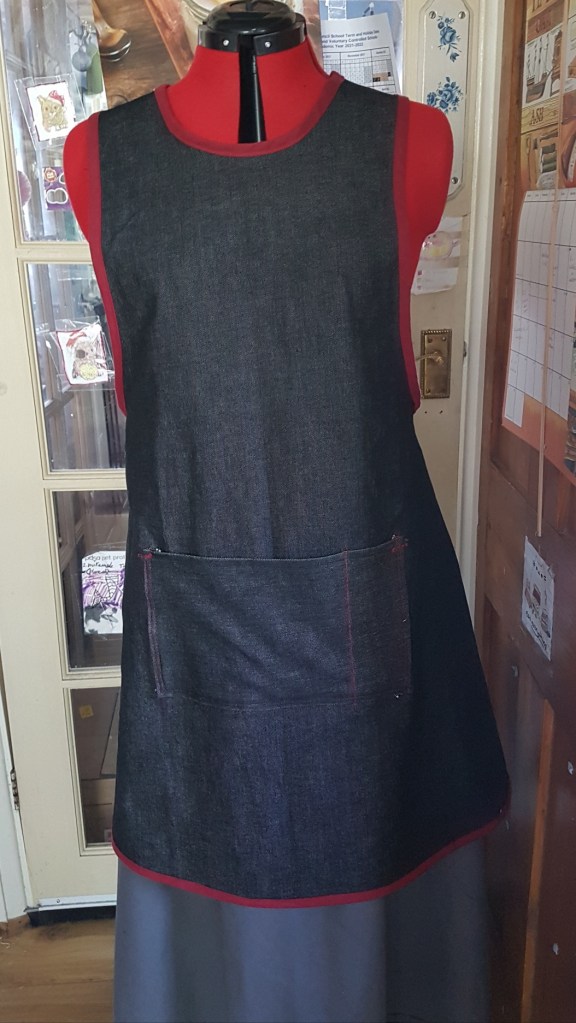
I’ve also made a cross-back apron, using this fabulous free pattern and tutorial from Hey June Handmade – a colleague was wearing a calico one for a workshop last weekend and it reminded me that I had wanted to make one. Toast have one for sale for £69 – mine was made from denim leftovers and bound with home-made bias binding left over from a quilt last year. The leftovers are from the Morgan jeans I cut out weeks ago and started making this week – all done apart from buttons and rivets, as I discovered I had run out of jeans buttons.
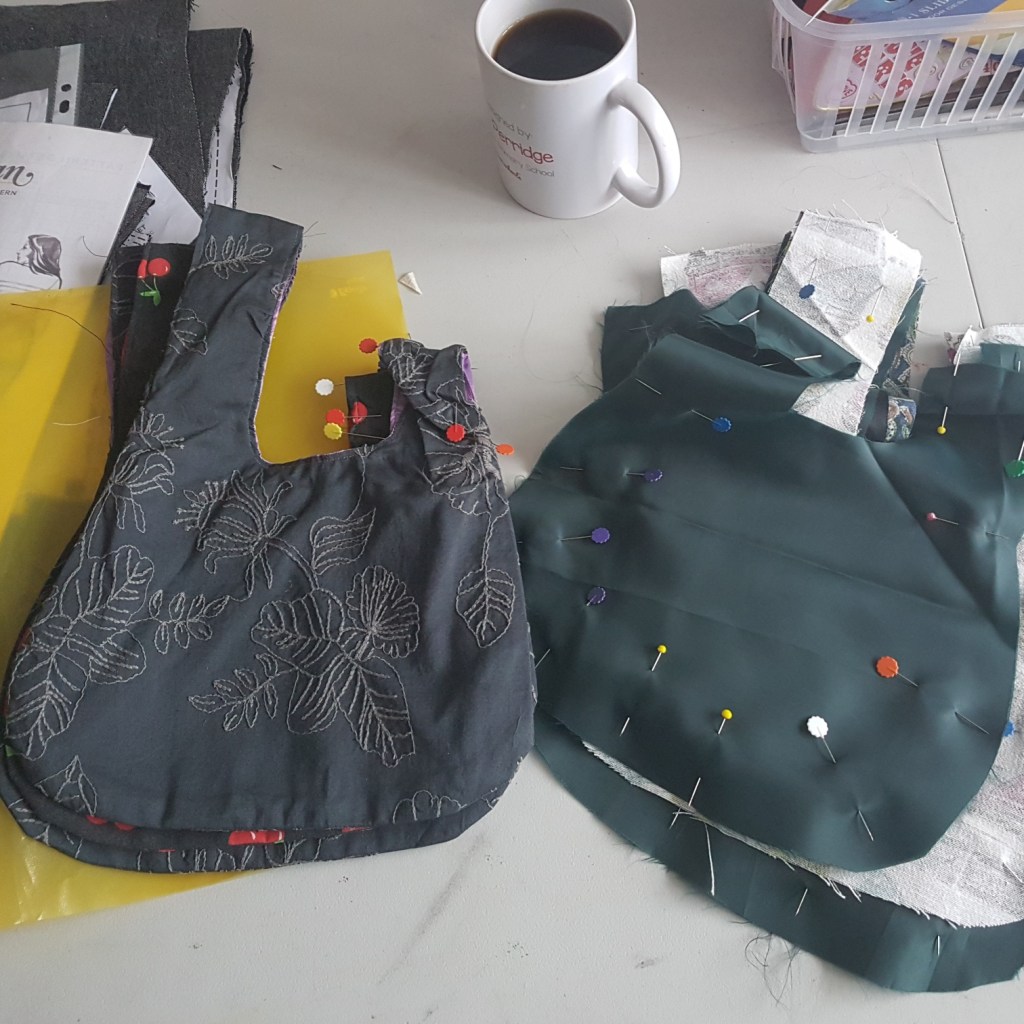
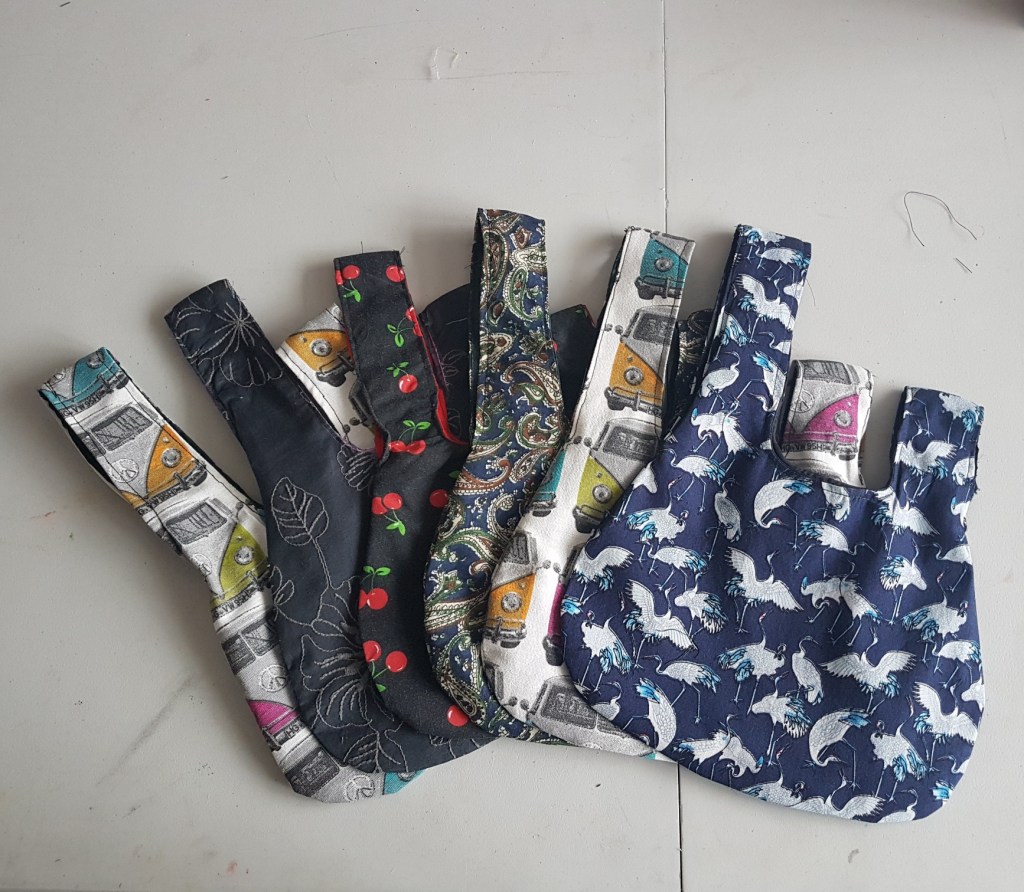
Seven years ago I cut out a pile of Japanese knot bags, made one for a teacher gift for Thing 2’s Year 1 teacher, half finished a couple of others and then left the rest. These are also handy small bags that slip on your wrist, so I have FINALLY finished them this week (every year I have got them out and added them to the to-do pile, and every year I have put them away again…).
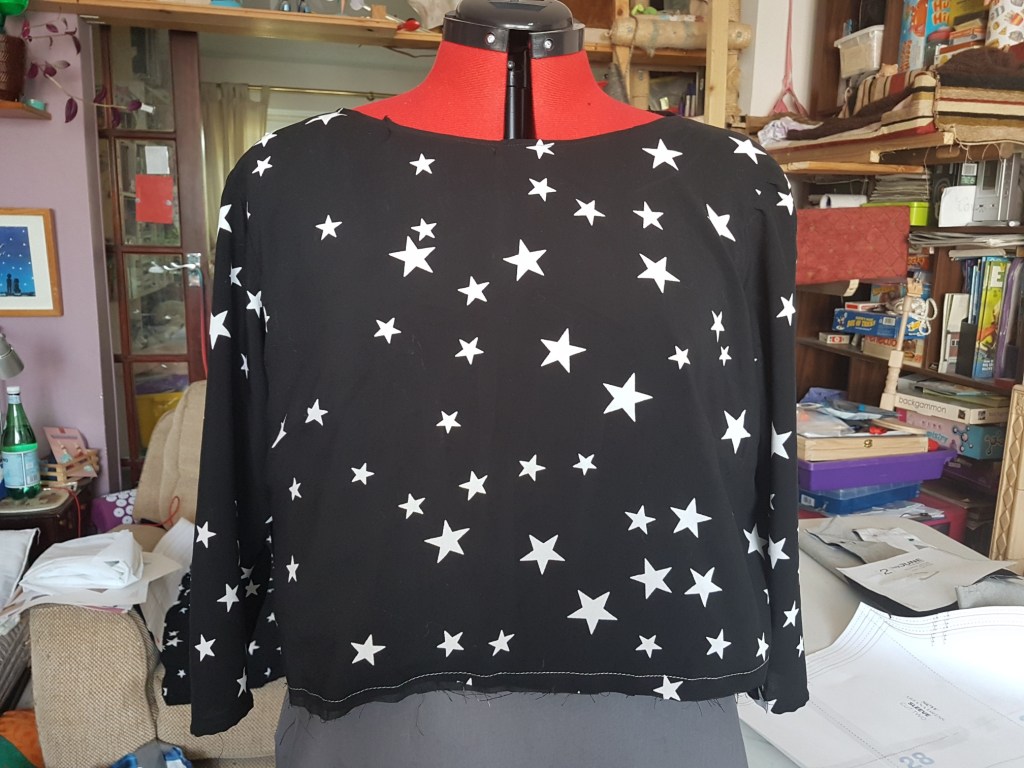
My final make of my week off was a dress, using the Ariana midi dress pattern from Sew Magazine – a free template download of a buffet-style dress. I used some lovely star print fabric (at least, it was lovely till I started trying to cut it) that I bought last year – I’d been going to make an Anna dress with it but it’s too fine. The bodice is lined with plain black polycotton sheeting, and for some reason the pattern calls for a lined bodice and a facing. I left out the lining fabric facing as it was totally unnecessary. Much cursing was done over the gathering of the tiered skirt – I think I should just be grateful it was only two tiers – as well as over the bodice instructions. It’s turned out OK but is definitely a maxi rather than a midi – I should have taken a few inches out of the first tier, I think. If I make it again…. oh, who am I kidding? I’m never doing that bodice again.
The front
The back
The useful pocket
The cursed bodice
Finished dress
Cut out seven years ago…
…finally finished
My last sewing job this week has been to go to a friend’s house and help get their daughter started with patchwork – she had a sewing machine for Christmas and what with Covid etc it’s taken a while to get round to the promised lesson! I started with straight line sewing on paper and then we made a simple nine-patch block, which hopefully will get her going!
Tomorrow I am back to work so the sewing machine will be getting a rest! I have two blouses cut out, from a favourite Simple Sew pattern, but they can wait….
See you next week! I have to start thinking about school uniform soon, and the annual trauma of the school shoes….
Kirsty x
What I’ve been reading:
Bill Bailey’s Remarkable Guide to Happiness – Bill Bailey
This week I have not done a lot, really – work, read, enough stitching and crocheting to make my arm and shoulder ache, watched a lot of films (with Jason Statham in, for some reason – not my choice) and fed a lot of children.
I did go out on Wednesday: to give blood (donation 24! The things I do for a mint Club) and then into Bethnal Green where we said goodbye to the old Museum of Childhood before the base builders etc move in for the next couple of years. It was a quiet goodbye, with a lot of faces missing from the team I joined four years ago: a few through natural career progression but more thanks to the many restructures that we have been through in that time. I also ate at Chiringuito in Bethnal Green for the first time (fish tacos) and learned more about flying ants than I ever thought I needed to know. This is what comes of working in museums, where we acquire random bits of information through being incurably curious about pretty much everything. Top tip for you people out there – curators and other museum people are good to have on pub quiz teams*.
Photo by Helena Rice
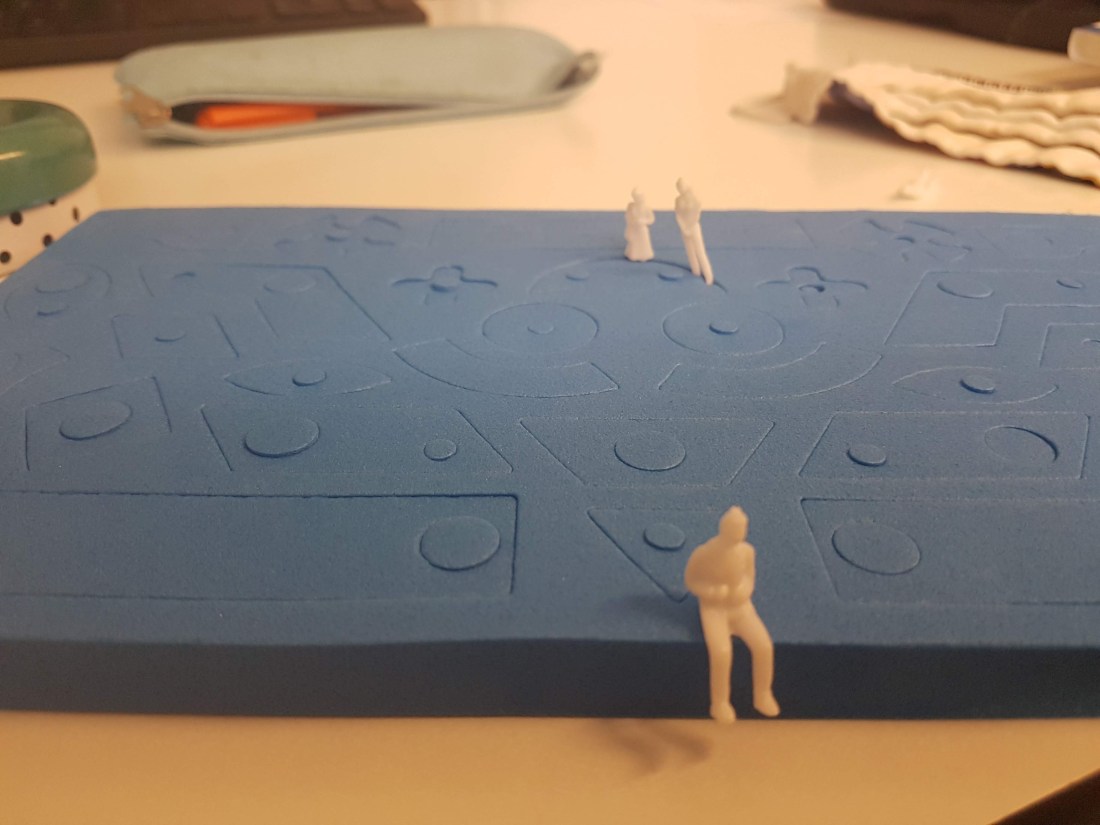
For the next two years we are wandering souls, washing up in small groups in corners of the V&A at South Kensington, clutching our laptops and wondering where we left our pen last week. 40% of our time is ‘on-site’ at the moment, though for the learning team that time is currently out and about with our blue blocks, which is great fun even in the rain. (I am writing this on Saturday morning, by the way, as tomorrow I will be out with the team all day at The Get Together in the Queen Elizabeth Olympic Park).
This seems to be a fairly normal work pattern right now, as far as I can tell. Hybrid working, blended working, whatever you want to call it, seems to be here to stay, certainly in the non-people-facing jobs. It’s good not to have to commute all the time, and platforms like Teams and Zoom are making it easier to stay in touch with colleagues, but I do miss the spontaneous Friday lunches and the kitchen chats, or feeding the ducks on a lunchtime walk. It’s too easy when working at home to not have those social moments. In ‘normal’ times you spend 36 hours a week with your colleagues, and if you have good ones (I do) they become your work family. I miss the kettle moments (water cooler moments, presumably, in those nations less reliant on tea for functioning), team problem solving in the office (gang, have you got a minute?), people popping in and out to raid the biscuit tin. Our office was the home of the biscuit tin, which meant we knew what was going on on the floor as people came in for Oreos and hugs. Mostly I just miss people!
*However, a whole quiz night made up only of museum people is a terrifying experience. If you are the quizmaster/mistress, be very very sure that your answers are correct, or the likelihood of a dawn duel with historically accurate weaponry is high. You have been warned.
Why my arm aches…
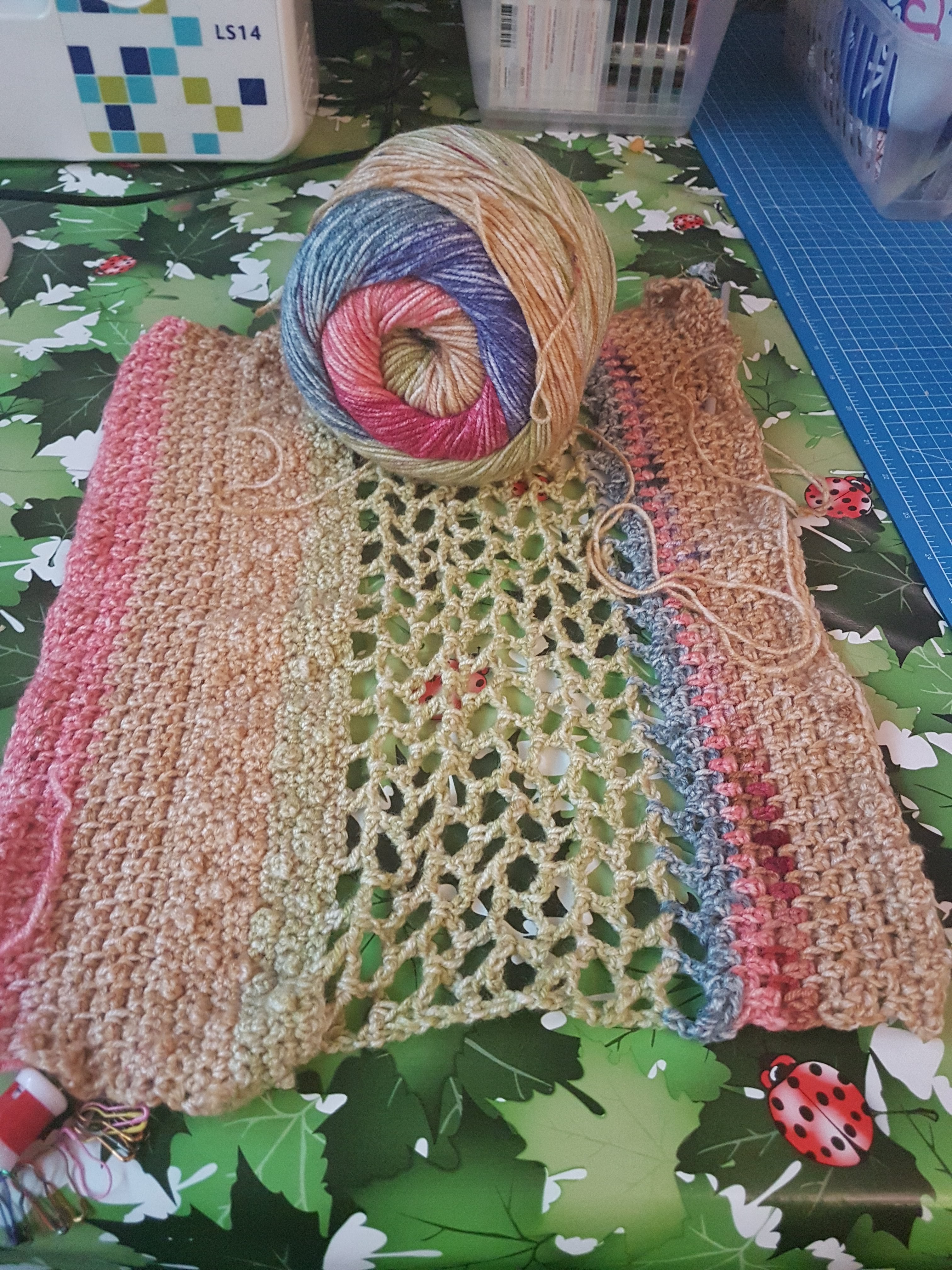
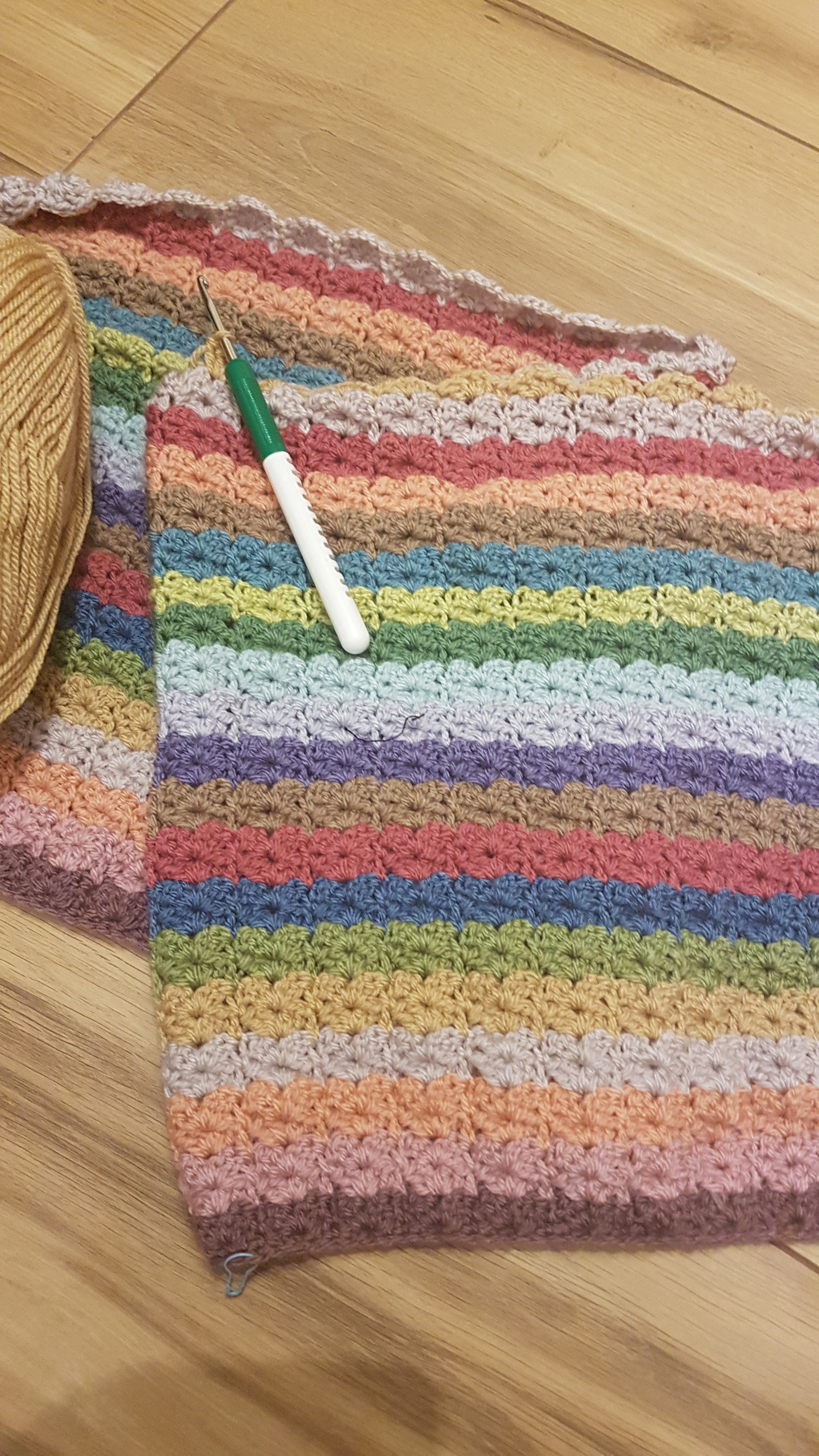
This week I started the shawl pictured here – the Build Your Own Beehive Shawl CAL by Fleabubs and Lala. I did not need another project, but this was such a pretty pattern and I already had the yarn sooooo…. the yarn is Stylecraft Batik Swirl in the Rainbow colourway. The shawl is made up of ten-row repeats of three different stitches – trellis, pollen and honeycomb. It feels a bit more scarfy than shawly to me at the moment, despite increasing the starting chain from 60 to 80, but my friend Ruth who pattern tested it says it pays for blocking. I hope so – when it comes to scarves and shawls I definitely lean towards the dramatic swish and swirl rather than the single wrap! Perhaps this is what comes of working in historic buildings, where ‘work blankets’ are definitely a thing in the winter.
I’ve also made progress on the Hobbit Hole – only the lettering to go now, which is exciting, and then I need to frame it and find it a home.
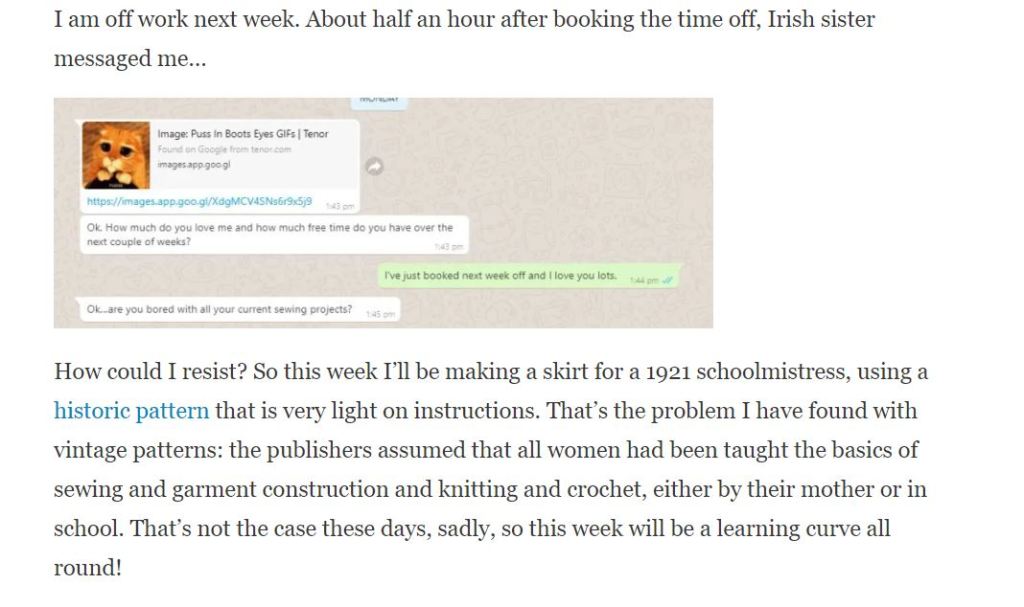
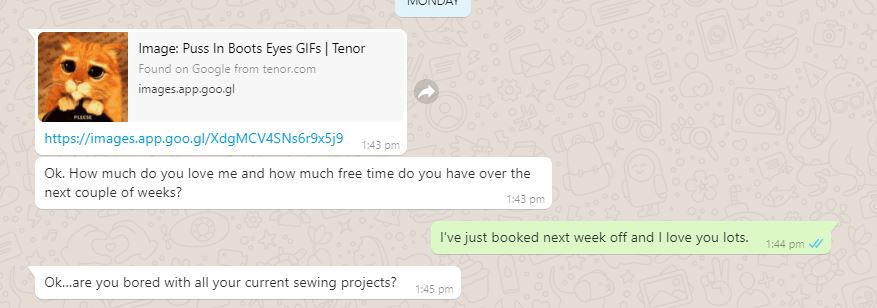
I am off work next week. About half an hour after booking the time off, Irish sister messaged me…
How could I resist? So this week I’ll be making a skirt for a 1921 schoolmistress, using a historic pattern that is very light on instructions. That’s the problem I have found with vintage patterns: the publishers assumed that all women had been taught the basics of sewing and garment construction and knitting and crochet, either by their mother or in school. That’s not the case these days, sadly, so this week will be a learning curve all round!
I am off now, as we are going to see Timeshare 1 and the grandson shortly. See you next week!
Sometimes you get handed a book, or a recommendation for a book, that a friend or family member has loved and you read it….and it’s okay. It’s not life changing, and you probably wouldn’t say it’s great, but it’s readable. There have been many books like that- and that’s fine, because there’s a lot of different authors and tastes in the world and as Terry Pratchett says many times it would be a funny old world if we were all alike.
Sometimes the book is so terrible you question why you’re so fond of that person.
Sometimes you recommend a book that you have absolutely loved to people you like and they think it’s….okay. Not life changing, not great but…okay. I find it’s best not to take these things personally as clearly those people are wrong, or just need to read it again properly, or aren’t in their right minds.
Sometimes a book has rave reviews, and/or a massive marketing budget, and shoots up the bestseller lists, and films are made of them starring people who you may or may not have heard of, and that’s fine too. Sometimes these are good books and terrible films, sometimes these are terrible books and okay films. Sometimes they are terrible books and you can’t bring yourself to watch the film.
Sometimes – just sometimes – you get given a book and it’s wonderful: it keeps you awake long after your bedtime and stays with you so you can’t wait to pick it back up in the morning. This can be for many reasons: the adventure, the need to know what happens next, the lyricalness of the writing, My recent read ‘Once upon a River’ by Diane Setterfield was one of these books. Others include:
Boy’s Life – Robert McCammon
Hearts in Atlantis and The Body – Stephen King
The Once and Future King – T.H. White
The Outsiders – S.E. Hinton
The Great Gatsby – F. Scott Fitzgerald
Stardust – Neil Gaiman
The Travelling Cat Chronicles – Hiro Arikawa
Ring the Hill – Tom Cox
The Time Traveller’s Wife – Audrey Nieffenegger
This week I have added another one to the list – a birthday gift from my colleagues but I detect the hand of my wild swimming colleague in this one. Wild Woman Swimming by Lynne Roper, which is a journal kept over five years of wild swimming in West Country waters. It’s a poignant read: Roper took up wild swimming after a double mastectomy and built a community of swimmers around her, as well as becoming a key member of the Outdoor Swimming Society. Sadly she died five years later of a brain tumour, but she filled those five years with adventure and wrote about them in exquisite, immersive prose. I’ll be recommending this one to friends, but I might not lend them my copy….
There may be many more of these magical books on my shelves of shame, or lurking on my Kindle, and I really ought to get round to reading them. I always swear I won’t buy any more books until I have finished the ones I have (I know, I laugh too) and then the BookBub daily email comes in, or I find something wonderful in a charity shop, or someone recommends a book they have loved and suddenly there’s a new addition. Perhaps I need to make a reading resolution that every other book I read is one from the shelf…. that sounds more realistic, at least!
In the meantime, if I promise not to buy them, will you tell me which are your favourite books to recommend to people?
Trial and error, error, error
You would think that if you have sewed a neckband onto something the wrong way up that it would be a straightforward job to unpick it and put it on the correct way. This was not the case with the blouse hack of the McCalls 8104 dress, which I had to unpick three times before I worked out which way was the right way, and which bits I’d sewed together wrong in the first place. I also managed to sew the bodice and lower bodice pieces together upside down when I started it on Monday, so I am amazed I got it finished at all.
The lovely turquoise cotton fabric is from Higgs and Higgs, and I bought it with my birthday Amazon vouchers – I love the statement sleeves and the slightly fitted waist on it, and the fact that there isn’t a standing collar. I’m not sure what it is with sewing patterns, but every collar I have made is just too seventies – indie or big four, it’s a bit of an issue. I shall just have to learn how to redraft them.
In the name of sorting out my shed I have gone through the hundreds of sewing patterns (mainly free magazine gifts) with a view to handing them over to a friend who has just qualified as a DT teacher – if she doesn’t want them herself she can donate them to school! My August resolution is to have a good tidy up in the shed and donate anything I really won’t use to people who will make good use of them. Things 1 and 2 have just had their ears pierced, so Thing 2 has been making earrings and jewellery with one of her friends which is making a dent in the stash already!
I haven’t done a lot else, really – my sourdough starter has been in heavy use this week as Thing 3 has decided he really likes the bread, and with the discard I have made pizza (always a hit) and cinnamon rolls which were soft and delicious. I’ll definitely be making those again!
So that’s my week! I’ll be off now to do a bit of reading over lunch and then start constructing the jeans I cut out last week….
Kirsty x
What I’ve been reading:
Wild Woman Swimming – Lynne Roper
Raising Steam/The Truth – Terry Pratchett
How to Sew Sustainably – Wendy Ward
The Ultimate Sashiko Sourcebook – Susan Briscoe
Visible Mending – Arounna Khounnoraj
Cider with Rosie – Laurie Lee (Audible)
Good Omens – Terry Pratchett and Neil Gaiman (Audible)
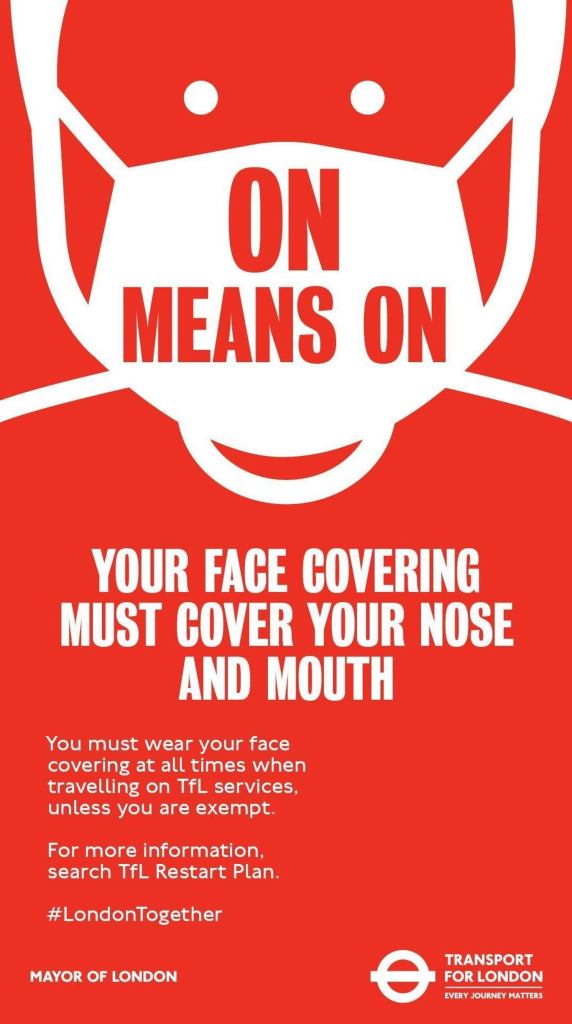
This week I have mostly been in my house, having been ‘pinged’ by a (double vaccinated) friend I saw last weekend: I did leave the house on Friday as Thing 3 had to go back to school but by that point I’d done four lateral flow tests and a PCR and all of them came back negative. I find it quite unbelievable that so-called ‘Freedom Day’ is going ahead tomorrow, when cases are shooting up again and school bubbles are bursting on a daily basis. Herd immunity by vaccination isn’t working as you can clearly still catch the virus. Herd immunity like some kind of national chicken pox party seems to me a rather irresponsible idea. Passing responsibility from the government to the people to keep themselves safe seems pretty idiotic also, especially when some of these people being given that responsibility require bloody great posters on public transport explaining how to wear a mask properly.
One of the pluses of being at home has been the opportunity to attend – if only virtually – courses, conferences and seminars that would otherwise be out of reach: those in Australia and America, for example, but also those closer to home but at a tricky time e.g ones that happen while the Things are claiming they are about to actually die of starvation, Mum, die! Like this weeks Crafts magazine event on “Space for play: how can makers bring joy back to our cities?” (Disclaimer: I was given a free ticket for this, as a bonus of attending the CPD I wrote about last week). Thank you to Thing Two, who with assistance from Thing One made delicious gnocchi for the family dinner that night.
Featuring architects, artists and playworkers, this was a really interesting discussion around public art as play space and why it’s a good idea to commission these rather than anchoring a lot of off-the-shelf play equipment in a fenced-off square. Penny Smith of Assemble Play pointed out that playgrounds like these were invaluable when we needed to build a workforce of people with physical strength and co-ordination – but are less useful now, in the 21st century, when employers value creativity, collaboration and problem-solving skills over more traditional needs. Risa Puno, an American interactive installation/sculpture artist, spoke about the need to build spaces that connect people to each other. Hadrian Garrard of Create London, an organisation that commissions public art and architecture, explained why they brought in artists to build these spaces. Artists research a space, work with the local community to find out what they think a space needs, and explore materiality. Higham Hill Theatre, by vPPR, is great for this: a community amphitheatre which joins up the cafe and the play area. This was commissioned as part of Waltham Forest’s ‘Making Places’ scheme.
vPPR selected the site because it was a forgotten parcel of the park, used for anti-social behaviour. By re-activating the site, and creating links to the park amenities, the place is transformed into a site of creativity and play.
vPPR
As Risa Puno says, you never know how people will interact with a space or an installation, so you need to make something that people can explore on their own terms. The Diana Memorial Fountain, never envisaged as a play space, is a prime example of this: once it became clear that people were going to use it as a paddling play area, it had to be made safe to do so. Why not build in play from the start?
In the panel discussion at the end, the speakers were asked where they most enjoyed playing as children: outdoors was usually the answer. Several of the speakers had grown up in rural areas, and talked about fields and woods, which reminded me of my own play spaces.
When we moved to Raglan, I was just seven and only a few houses in our road had been finished: there was a building site opposite the house with no fencing (imagine!) and a meadow next door but one, and for a child whose outdoor boundaries had previously been a couple of lamp posts, this was magical. Piles of brick dust and sand (brick dust does not come out of socks), bulldozers, foundations and scaffolding: this was an adventure playground when the builders had left for the weekend. In the meadow, there was a cave of trees and a stream with very shallow banks and we played for hours in this space. There were tiny fish in the stream and water snails to be caught, archaeological discoveries to be made, wildlife like slow worms and grass snakes in the long grass, and all within metres of the front door. That’s not to mention the castle at the top of the hill and the fields around it, all of which were within ten minutes of home. There was a play park at the other end of the village, which was fun, but once you’ve been on the swings and that mad Wicksteed rocking horse, what else was there to do? So we exercised our imaginations and explored the world, and made discoveries and generally entertained ourselves.
I’m glad we are bringing up the Horde in a space where there are trees to climb and woods to explore, though they don’t have the freedom that I did as a child which is sad but a sign of the times. Walks – when we can convince them to leave the house! – can take hours, and that’s fine by me.
The sun has got his hat on
Summer is putting in one of its brief appearances at the moment, so I have had a couple of happy post-work hours in the garden during isolation. As well as the gnocchi, Thing Two is turning out an excellent G&T with fresh raspberries and strawberries, which was a perfect Friday afternoon treat.
A perfect post-work moment
I had a day off on Friday and spent it cutting out a pair of Morgan jeans, an Anna dress and a blouse hack from this month’s Love Sewing magazine free pattern. Yesterday morning I put the Anna dress together: it was supposed to be the maxi length but where I’d extended the arms on the bodice I didn’t have quite enough fabric so ended up with the midi. The fabric is from last summer – Pound a Metre, I think – and is a light polycotton. I made my first Anna dress last year and it’s become my go-to throw on this summer, so a new version was definitely in order. I managed to jam my overlocker in the process, so I think it’s going to need a trip to to the sewing machine doctor if I can’t work out what the problem is myself!
The Morgan jeans are also a remake of one from last summer, as they have become a wardrobe staple – boyfriend cut and cropped, they are so comfortable. I bought some black lightweight denim from Amazon with my birthday vouchers, so will hopefully get to those tomorrow at some point.
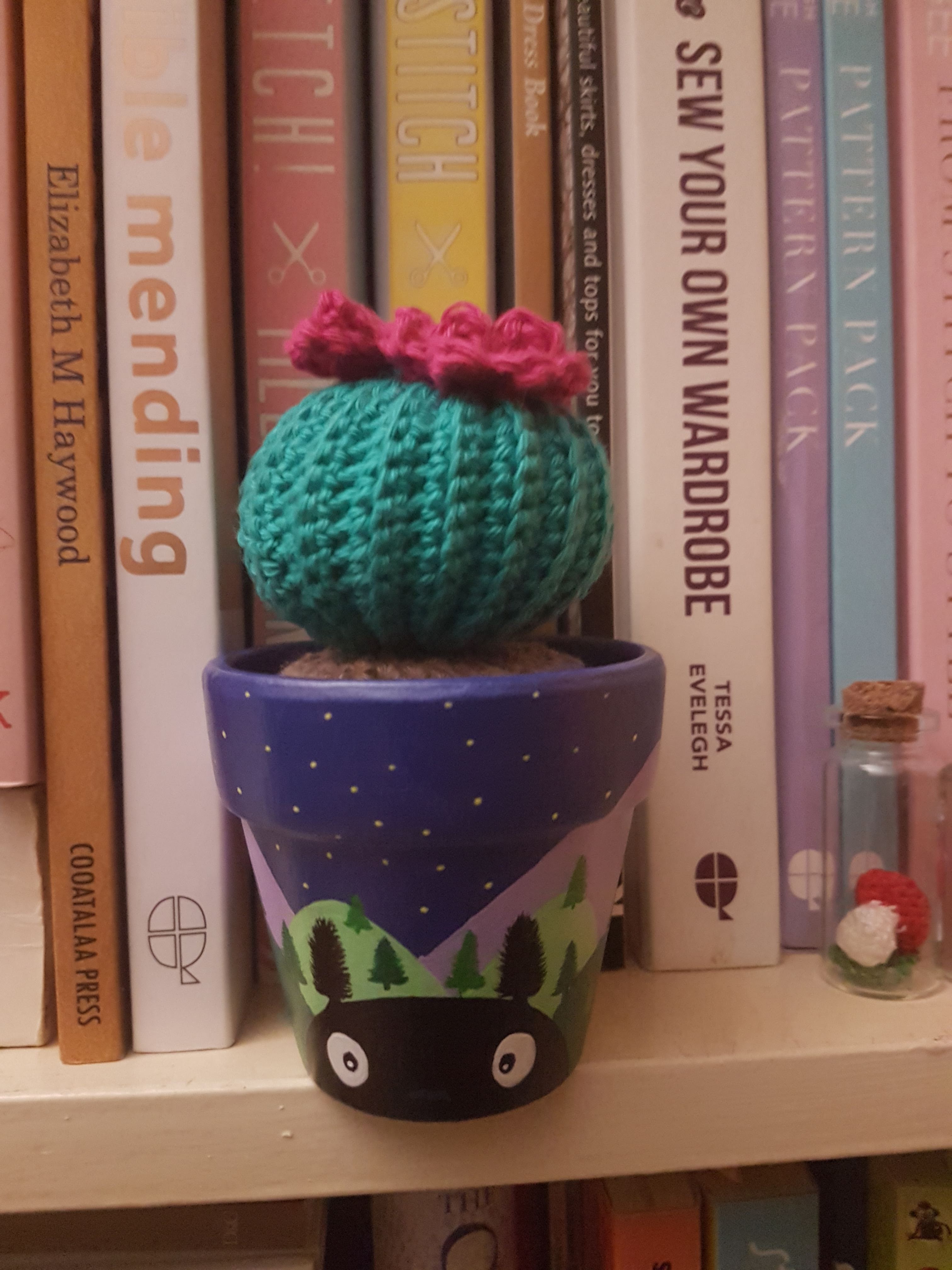
I’ve been crocheting with cotton this week – it’s too hot for anything else! One of my lovely birthday gifts from my colleagues was a gorgeous hand painted flower pot from DOMIcafe on Etsy – not having the greenest of fingers, as my hydrangeas would testify if I hadn’t killed them all, I decided I’d make a crochet cactus to go in it instead. I used Scheepjes Catona from the stash, and this pattern for a round barrel cactus by Zoe Bartley on Ravelry. It only took a couple of hours, and I love it.
I also whipped up a crochet jammie dodger, because why not? The top one is with a 3mm hook, the bottom is with 2.5mm and I think I prefer that one.
So that’s been my week: I’ll be released back into the wild on Wednesday, just in time for the summer holidays!
See you next week for week 70!
Kirsty x
What I’ve been reading
Night Watch, Thud!, Snuff, Raising Steam – Terry Pratchett
Listening: The Socially Distant Sports Bar. (Not to be listened to on public transport as you will become that person sniggering in a corner, in front of children, or in earshot of the easily shocked)
Stir Up Sunday is when families get together to prepare the Christmas pudding, and it’s the last Sunday before Advent*. I first heard about it from my original boss at the Museum of London Docklands – I don’t remember this being something we did when I was a child. I have a vague recollection that my grandma used to make the Christmas puddings and when she got too old we either had shop-bought ones (that were usually still in the cupboard in May – who has room for Christmas pud if dinner is done properly?) or no pudding at all. I confess to not liking Christmas pudding anyway.
There was always a Christmas cake though, mum-made and usually with a disaster story attached – my dad is partial to a fruit cake so she made them throughout the year, but the Christmas one always went a bit wrong. This year London sister has made one for the parents and sent it in the post to France, and all they have to do is feed and decorate it.
I didn’t like Christmas cake, either – I still don’t like shop-bought ones. I’m not a lover of candied peel, glace cherries in anything, or unexpected bits of nut. When I became a proper grown up, however, I decided that along with being able to stuff a turkey without wincing (I usually remember to take the neck and giblets out…) I ought to make Christmas cake too. I’d won a Mary Berry recipe book in a Christmas party raffle a few years earlier and found the Classic Victorian Christmas Cake, so thought I’d give that a go – OK, it was the only Christmas cake recipe in any of my books, so it was an easy choice! I think it’s also the only thing I have ever made from the book.
Mary Berry’s cake. Not mine.
I left out the glace cherries and almonds, replaced the cherries with more dried fruit, and rather than soaking the fruit in sherry I used rum. Then I fed the cake with more rum. Mary wasn’t clear on how often you should feed the cake, or on how much you should be feeding it, so I erred on the side of caution and that first cake was a) very moist and b) capable of putting you over the driving limit. So that’s been my go-to recipe since then – I didn’t make one last year, as I usually end up eating far too much of it myself, but this year my budding Heston Blumenthal (aka Thing 2) has been putting pressure on me to make one.
So yesterday Thing 2 and I set the fruit to soak (in the last of the cherry gin, due to a lack of rum in the house) and on Tuesday afternoon we will stir up and bake our 2020 cake. Just before Christmas we’ll decorate it – madam has very strong opinions on cake decorating so I may leave her in charge of that.
*Yes, I know Stir-Up Sunday is technically next weekend, but never mind. I’m sure there will come a time when Thing 2 doesn’t want to cook with me, so until then I’ll make the most of it.
Work is the curse of the crafting classes
This week I have been working from home – an online symposium on Monday about Creativity in Education Now, run by Creative Schools and Creative Colleges. Interesting stuff: the keynote speaker was Bill Lucas, author of Teaching Creative Thinking and my new hero. There was a poor OFSTED rep there, who was trying really hard to say that there were lots of opportunities for teaching creativity in schools as part of the new(ish) inspection framework, but she kept hammering home that everything had to start with knowledge acquisition. She wasn’t open to ‘split screen’ teaching, where creative skills are developed at the same time: as she was an ex-art teacher that surprised me.
The rest of the week was spent on meetings, and on developing a set of learning outcomes for one of the new galleries in the museum. It’s going to be an amazing space – as with the rest of the museum, focused on building creativity in children, young people and their families – and the deep dive back into our thinking over the past year or so has made me excited about the transformation project all over again. It’s been hard at times this year to remember what a brilliant thing we’re doing – losing six months to furlough meant it’s taken a while to get back to this point – but this task has reminded me.
On the subject of creativity – I love what the Natural History Museum have been doing to support audiences. This lovely free Dodo cross stitch pattern is available to download, and you can also make a giant squid or a whole set of nudibranches. The patterns come with really simple instructions, too, and are part of a suite of equally brilliant craft activities. Nice job, NHM.
You can find the V&A’s own offer here – less for kids but some gorgeous Mary Quant patterns remade by Alice and Co Patterns, as well as other projects inspired by exhibitions. You could also check out the #LetsMakeWednesdays posts on the V&A Blog.
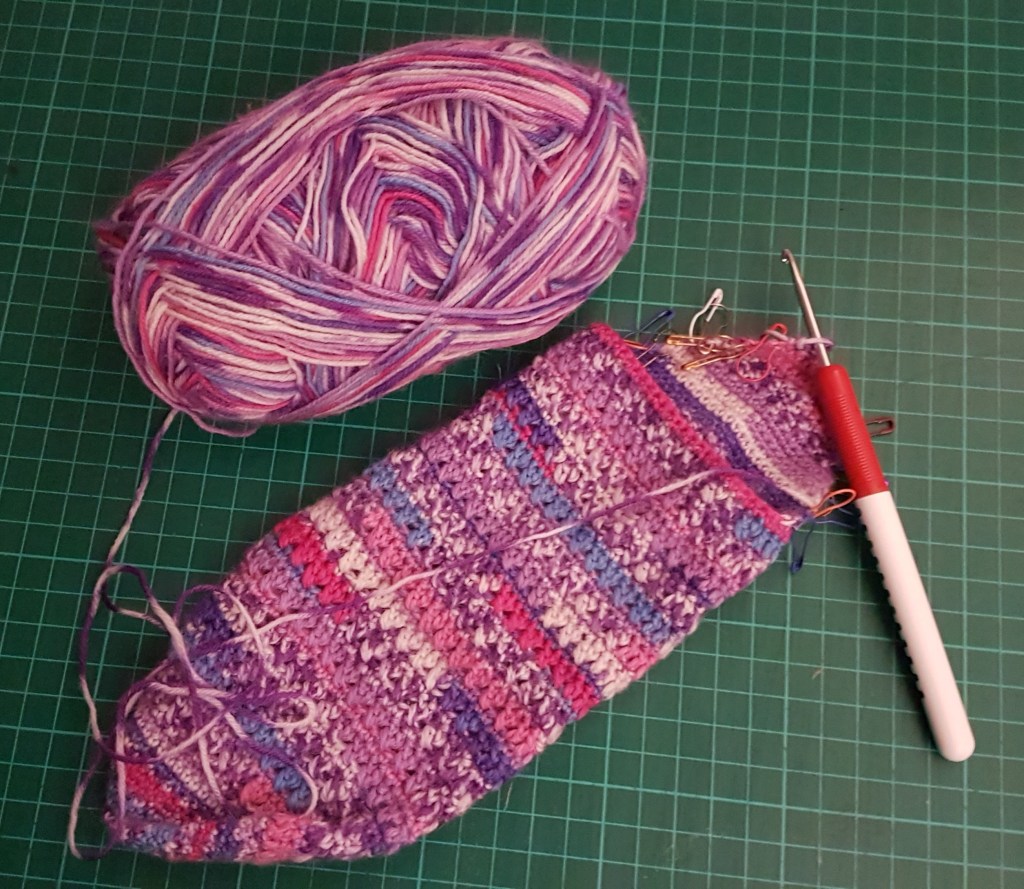
Where was I? Oh yes, working at home – that means no progress at all has been made on the portable sock project, which has the heel flap done on sock 1 and is ready to turn when I get back on the tube tomorrow.
Sock bristling with stitch markers
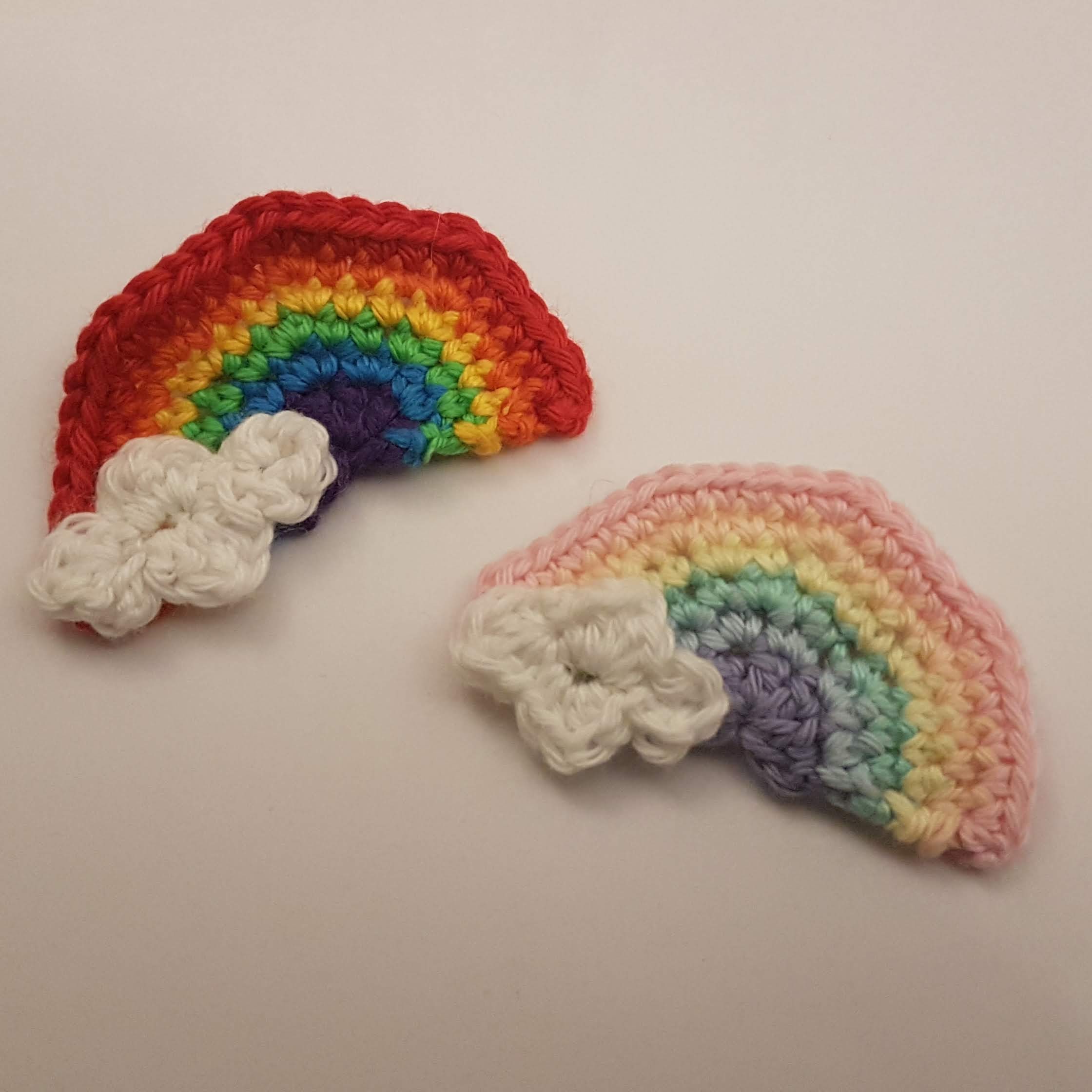
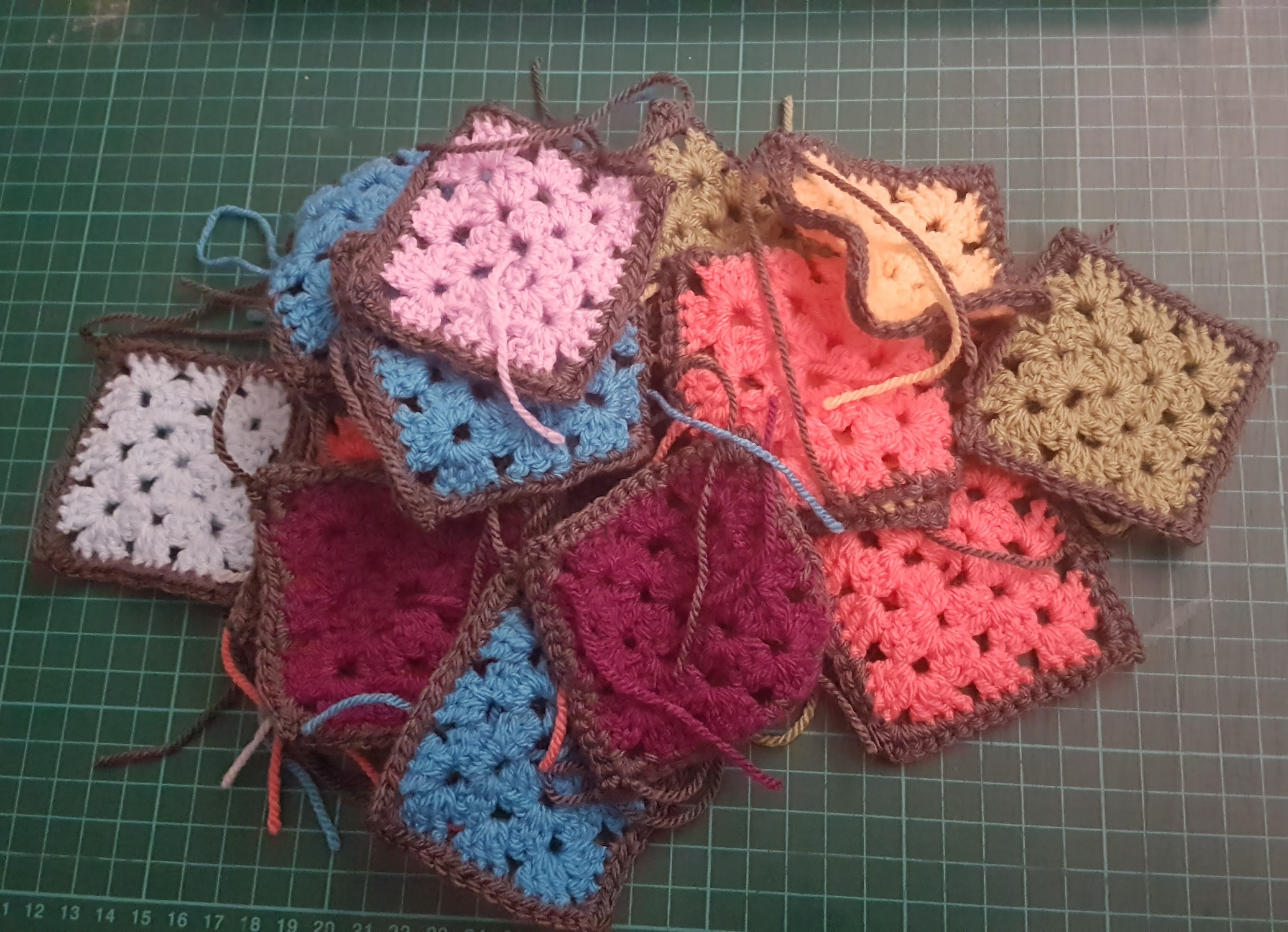
The Hydrangea blanket has a few more stripes, and I have also been working on rainbow jewellery which will hopefully find their way into an experience hamper at some point. The rainbow pattern is by Ever Laughter and you can find it here. She used aran yarn to make her applique, I have used Perle no 8 for the necklace and Scheepjes Cotton 8 for the brooches. I like the pastel one just for a change up! The pile of squares is the Zoom blanket underway in Stylecraft Special DK.
Hydrangea blanket
Brooches
Fiddly.
Zoom
Crochet!
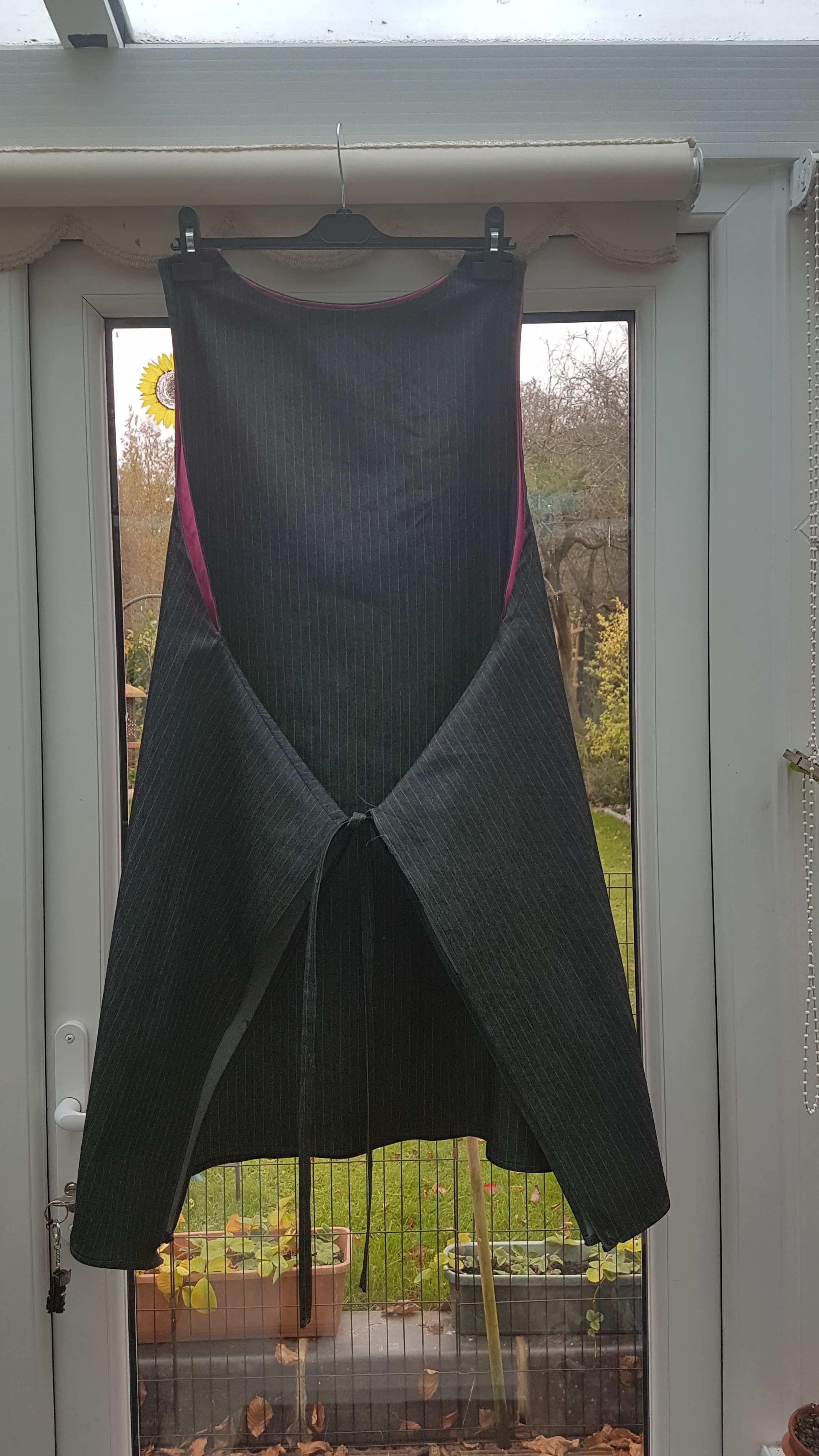
I’ve managed to sew up both the dresses I cut out last weekend, too. Both were pretty quick makes and came together in just a couple of hours each, and both have proper pockets to put things in. You can’t underestimate the value of pockets!
Dottie Angel apron dress in pinstripe denim
Simplicity K9101 in a duvet cover
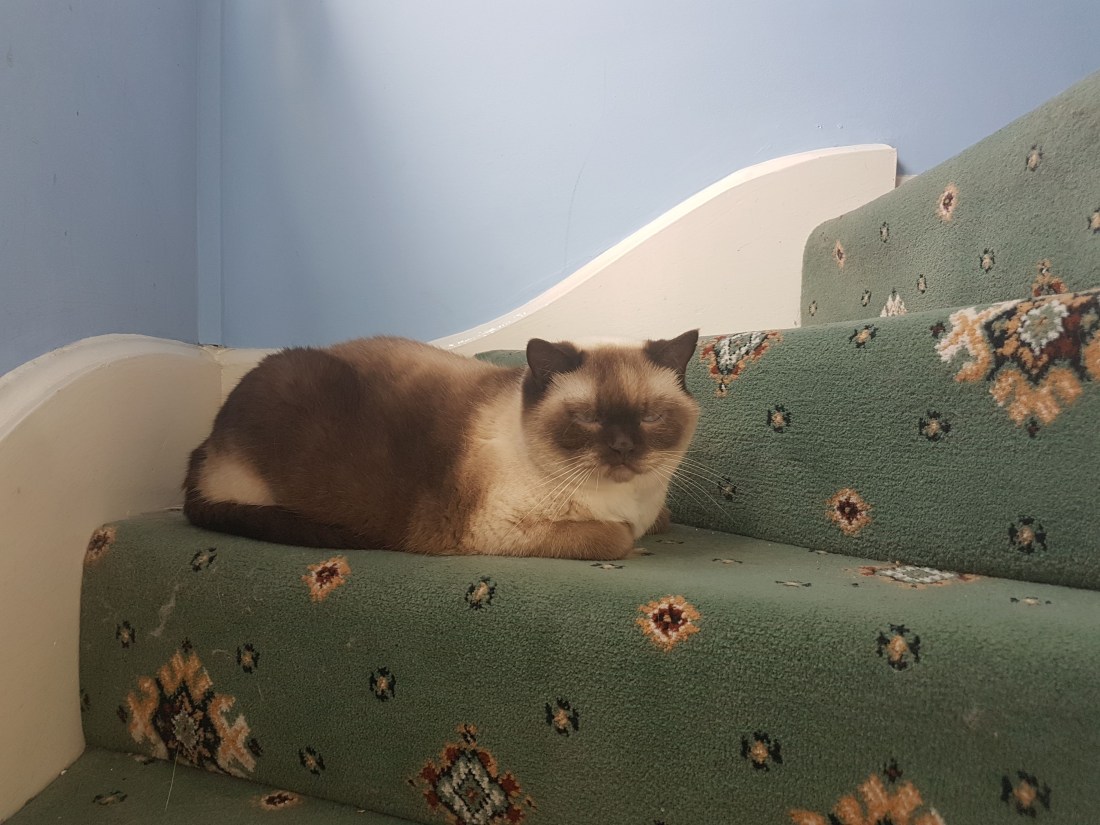
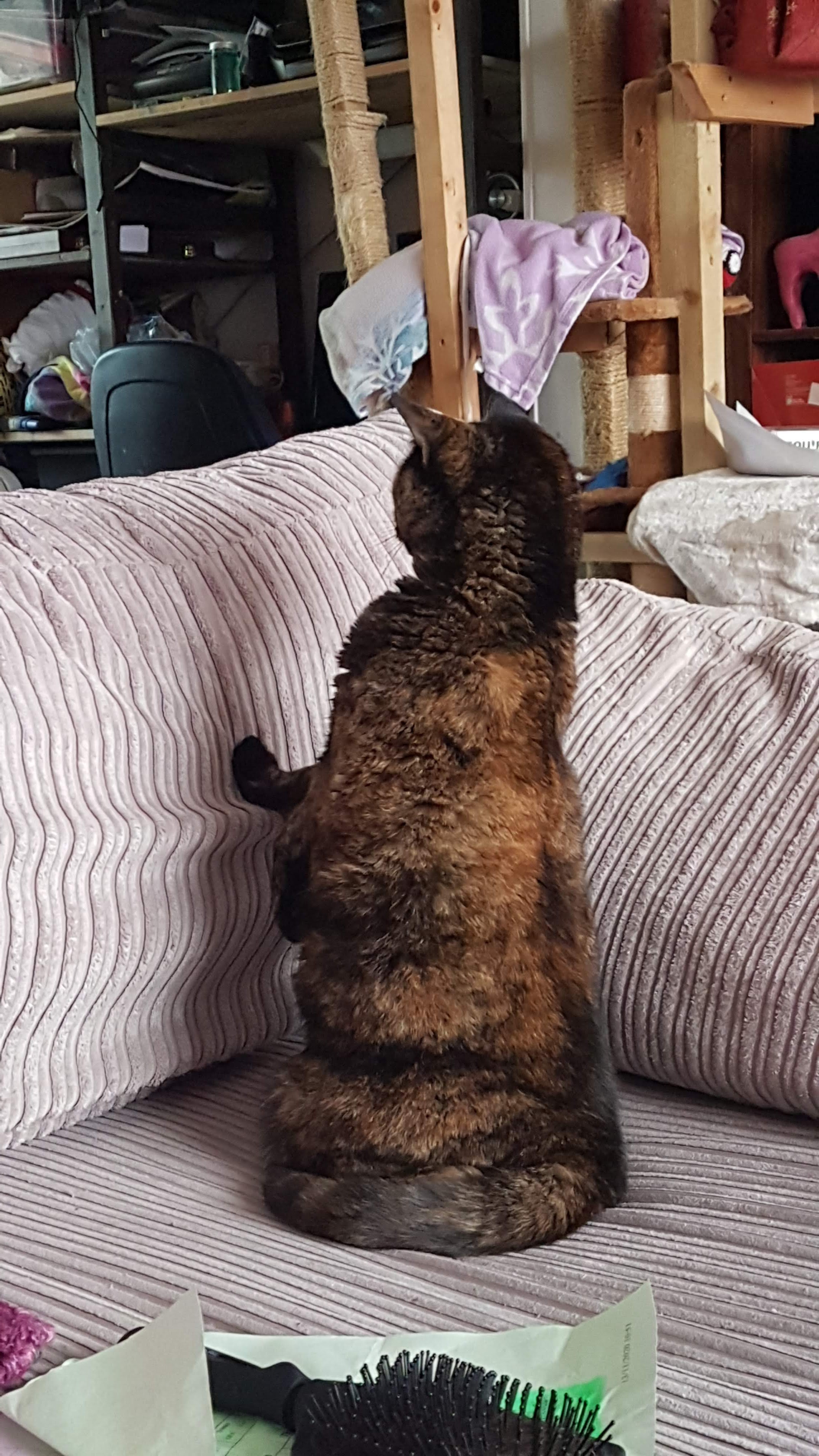
Being at home all week – with Lulu on downstairs cat duty – has reminded me how much that cat loves my beloved. The first picture is when she heard him come through the back door – Thing 3 is currently complaining that she jumped off him as soon as her human came downstairs. She’s not a lap cat like the other two, but will lean on you or cuddle up if you’re sitting down and if my beloved is not in the room. If he is, you haven’t got a look-in….
Lulu in meerkat mode
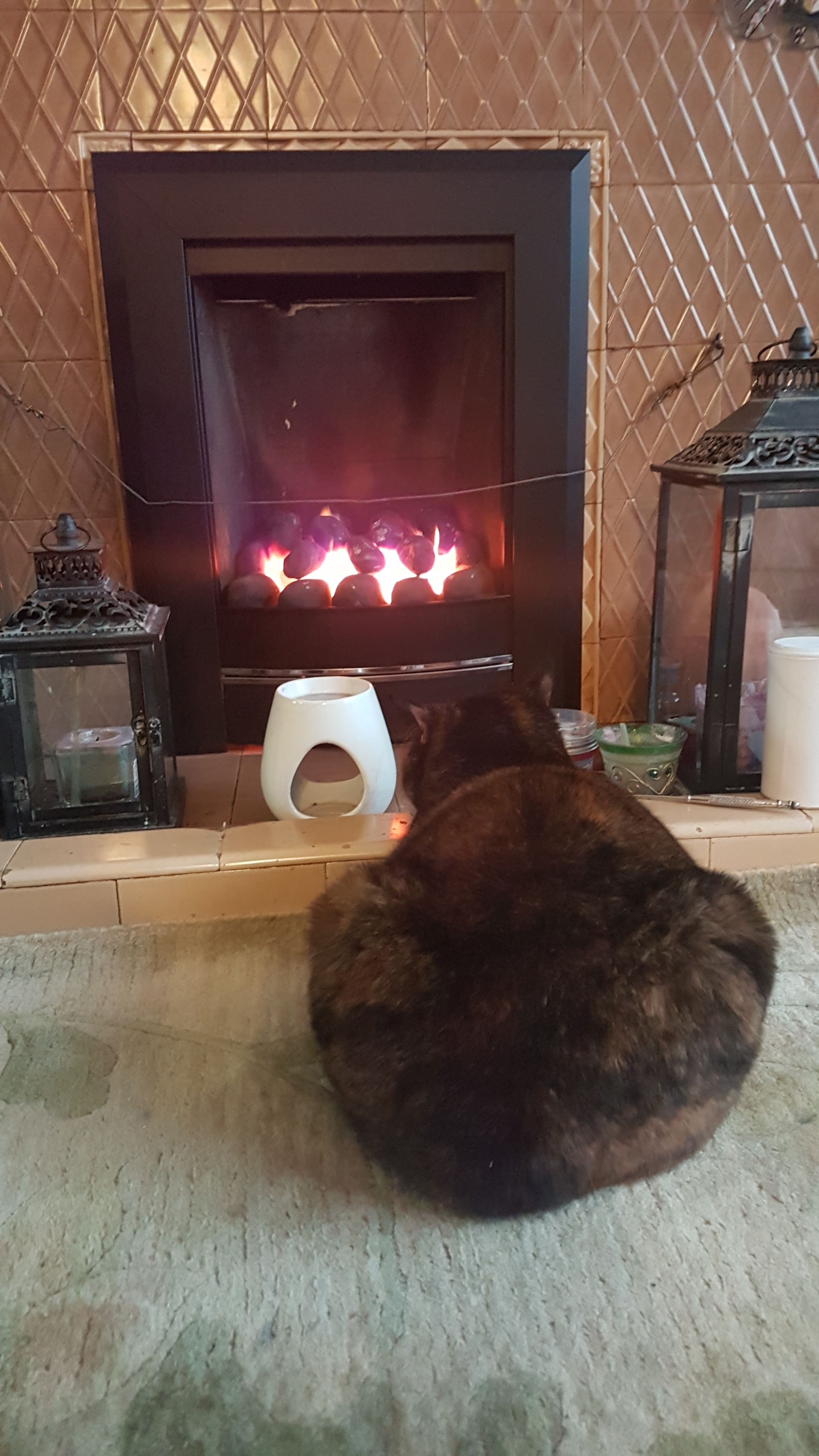
Seeing pictures in the flames
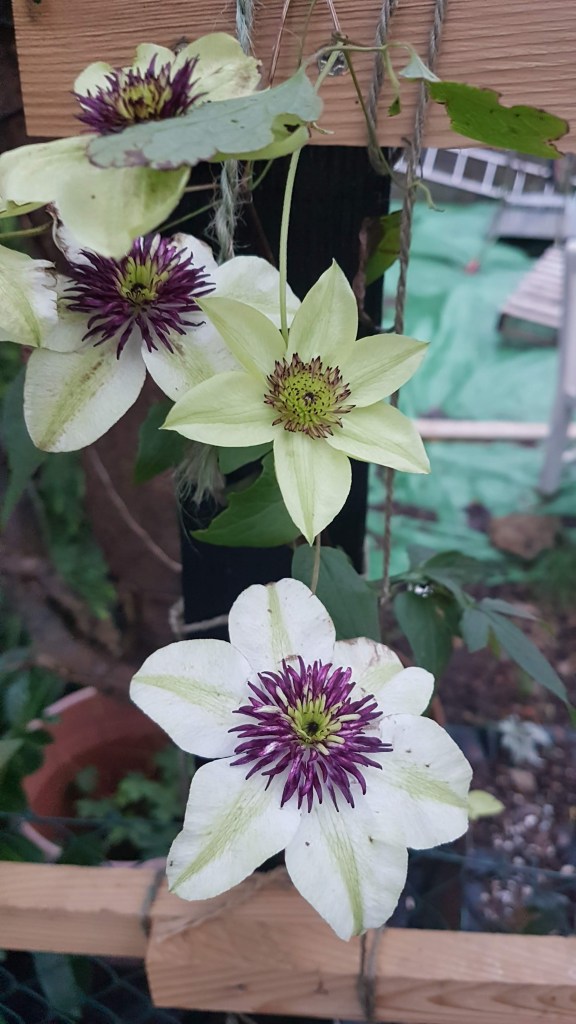
I’ll leave you this week with a picture of a clematis in the garden still bravely struggling on. I love the colours of this one.
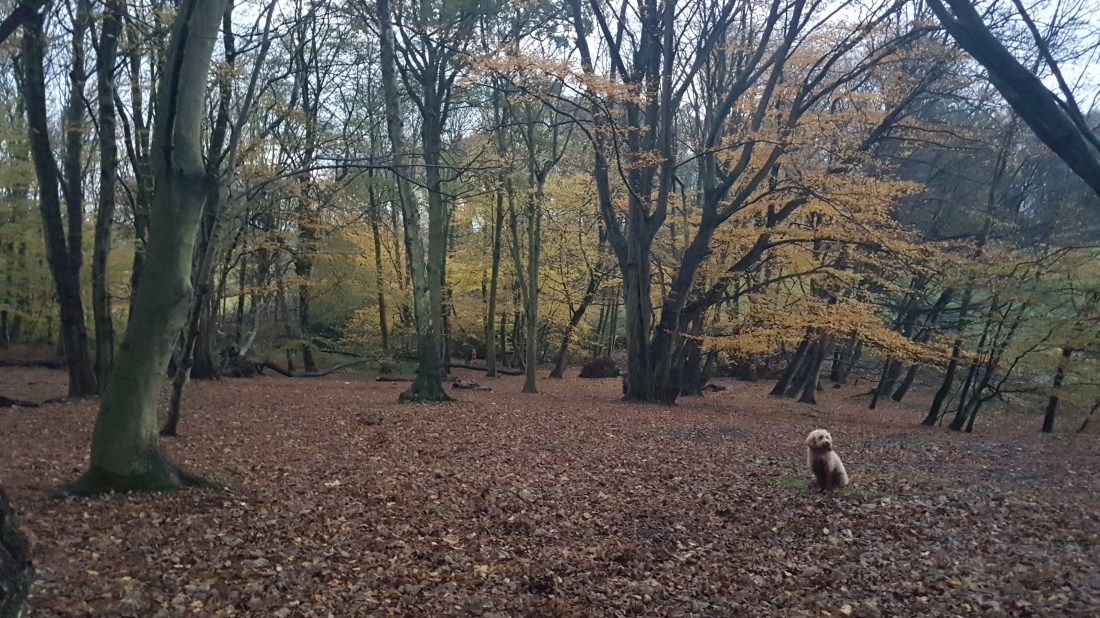
See you at the end of week 36, when we can see how the cake turns out! This week’s cover photo is the woods on Stonards Hill in Epping looking very autumnal.
Kirsty x
What I’ve been reading
The Penguin Killer – Ste Sharp
Enemies at Home/Deadly Election (Flavia Albia) – Lindsey Davis (Audible)
The Law of Innocence (Mickey Haller) – Michael Connelly
Gobbelino London and a Scourge of Pleasantries – Kim M. Watt
Once upon a time, way back in the educational dark ages (well, pre-National Curriculum, anyway) Welsh was not compulsory in South Wales schools. I was at infant school in Cardiff, and Welsh wasn’t taught till juniors. When I was just seven, we moved to Monmouthshire where it wasn’t taught at all. My (English) secondary school headteacher, when the NC was introduced in 1988, campaigned to have the school classified as being in England as many of the pupils were bussed in over the border from Gloucestershire: he claimed that more people spoke Chinese in Monmouth than Welsh. He may well have been right at the time, but that wasn’t the point.
He was unsuccessful, fortunately, but as I was too late to feel the impact of the NC while I was still in school I didn’t get the chance to learn Welsh until I was doing teacher training in Aberystwyth. Conversational Welsh was offered as a weekly elective in the lunch breaks, so I was able to count to ten, talk about the weather and say hello. I could also understand drinks orders in the pub I worked in. This was helpful when the gang from Yr Hen LLew Du made their occasional forays into the English-speaking pubs to try and annoy the barmaids, who were invariably students. Not speaking Welsh at the time was a severe handicap when applying for jobs in Wales, as it was necessary to be able to teach the language as well, which I assume is why for many years Wales’ greatest export was teachers who had fallen into the National Curriculum gap.
My parents weren’t Welsh speakers either: they had been at school in Cardiff in the 1940s and 50s. At that time, Wales was still suffering the hangover of the Industrial Revolution. English landowners – who owned the mines and the steelworks – saw Welsh as the language of revolution, especially with the rise of the unions, and it was banned from being spoken in schools. Children who spoke Welsh in school were made to wear the ‘Welsh Not’ – a sign hung around their necks to humiliate them, much as a dunce cap might be worn. The influx of Irish and Northern English into the Valleys to work in the mines, the steelworks and the associated infrastructure industries further diluted the language.
In 1847 a set of Parliamentary Blue Books were published on the state of education in Wales:
“It concluded that schools in Wales were extremely inadequate, often with teachers speaking only English and using only English textbooks in areas where the children spoke only Welsh, and that Welsh-speakers had to rely on the Nonconformist Sunday Schools to acquire literacy. But it also concluded that the Welsh were ignorant, lazy and immoral, and that among the causes of this were the use of the Welsh language and nonconformity.” (Wikipedia)
Evidence for this came mainly from Anglican clergy (who didn’t speak Welsh) at a time of burgeoning non-conformism in Wales, from landowners (er, ditto) and none of the commissioners were Welsh speakers. The argument that the Blue Books put forward was that embracing the English language would allow the Welsh to achieve their potential and take full part in British civic society – the authors were apparently concerned with the wellbeing of the Welsh (how delightfully colonial!). Non-conformists were often Welsh speakers, and a lot of them headed over the sea to the Americas where they set up Welsh communities and the language survived* – and handily provided me with a dissertation subject for my degree in American Studies. (Welsh migration to the USA from Prince Madoc onwards, in case you’re interested!).
The suppression of Welsh actually started a lot earlier than the Industrial Revolution, with the Act of Union in 1536 when it was decreed that English should be the only language of the courts in Wales, and that Welsh speakers could not hold public office in the territories of the king of England. This didn’t work terribly well at first, as the majority of the population were Welsh speakers, so a lot of interpreters were used in the courts. The upshot of this was the growth of a Welsh ruling class who were fluent in English, and Welsh became confined to the lower and middle classes. From 1549 all acts of public worship had to be conducted in English, though Elizabeth I wanted churches to have Welsh versions of the Book of Common Prayer and the Bible from 1567. The first complete Welsh translation of the Bible came in 1588.
A radio broadcast called ‘Tynged yr Iaith’ (The Fate of the Language) by Saunders Lewis in 1962 marked a national change in attitudes to the language, and you can read much more about this here. Welsh was on the up again…
Back to me (it’s my blog, after all) and my adventures in Welsh. Road signs were in Welsh, and our family holidays were in west Wales where much more Welsh was spoken. My Aunty and cousins spoke Welsh, so I’d always heard and seen snatches of the language. I’d wanted to learn but ended up working in east London as a teacher, and Welsh language courses were thin on the ground.
My London sister started learning Welsh with Duolingo and Say Something in Welsh a couple of years ago, and she encouraged me to learn too. I say encouraged – she signed me up to SSIW’s six minutes a day programme as a birthday present. The end of Duolingo is in sight for me now, though I can’t say the same for SSIW which I find really hard and have had on pause for ages.
I am a lifelong learner, as I’ve mentioned in an earlier post about my adventures in crafting, and it’s been suggested that language learning ‘boosts’ brain power by exercising the parts of the brain that process information. Learning a new language also contributes to a growth mindset, and understanding something you didn’t expect to is a great motivator. My fellow museum bod, gig buddy and Welsh learner Jen and I went to see Elis James and Esyllt Sears doing stand-up comedy in Welsh at the London Welsh Centre last year: I was really excited to be able to understand – or at least get the gist of – about two thirds of the show. (As an aside, we chatted to Elis James afterwards and he was really lovely).
Duolingo is excellent for vocabulary building and for sentence construction, but I have real problems with SSIW. I’m a visual/kinaesthetic learner – when I did the VAK assessment for a management course a couple of years ago I scored equally highly on the Visual and Kinaesthetic scales and extremely low on the Auditory. It wasn’t anything I didn’t know already but at least it explained why I was having terrible trouble with SSIW!
I learn by doing, or by seeing – if my hands aren’t doing something then I tune out very quickly. This means I take a LOT of notes in meetings. It’s not diligence, it’s self-preservation – if I’m not taking notes I tune out. My previous line manager used to be able to tell when I switched off if a meeting went on too long!. I crochet my way through conferences or use a fidget toy, as if my hands are occupied I’m able to focus on what’s being said. SSIW, as it’s entirely auditory, really doesn’t suit my learning style at all – writing down the week’s sentences in advance was useful, but ideally I would be writing them down as I went along. But not knowing how to spell most of the words made that quite tricky, as did the fact that I generally did the SSIW sessions while I was ironing and refereeing the Things. Perhaps I need to sit down, on my own, with a pen and paper and try my usual learning method of copious note taking. I have a Welsh dictionary, and a grammar book, so there’s really no excuse.
*As an aside to this, there have been a lot of jokes on social media in the last couple of days that a Welsh-speaking nation have finally beaten the All-Blacks at rugby….sadly, it was Argentina, so Max Boyce probably won’t be memorialising this in song.
Creative industry
Despite being back at work full time it’s been a productive week! Normally at this time of year I’d be making jewellery to sell at the Christmas markets but this year I don’t have any booked for obvious reasons.
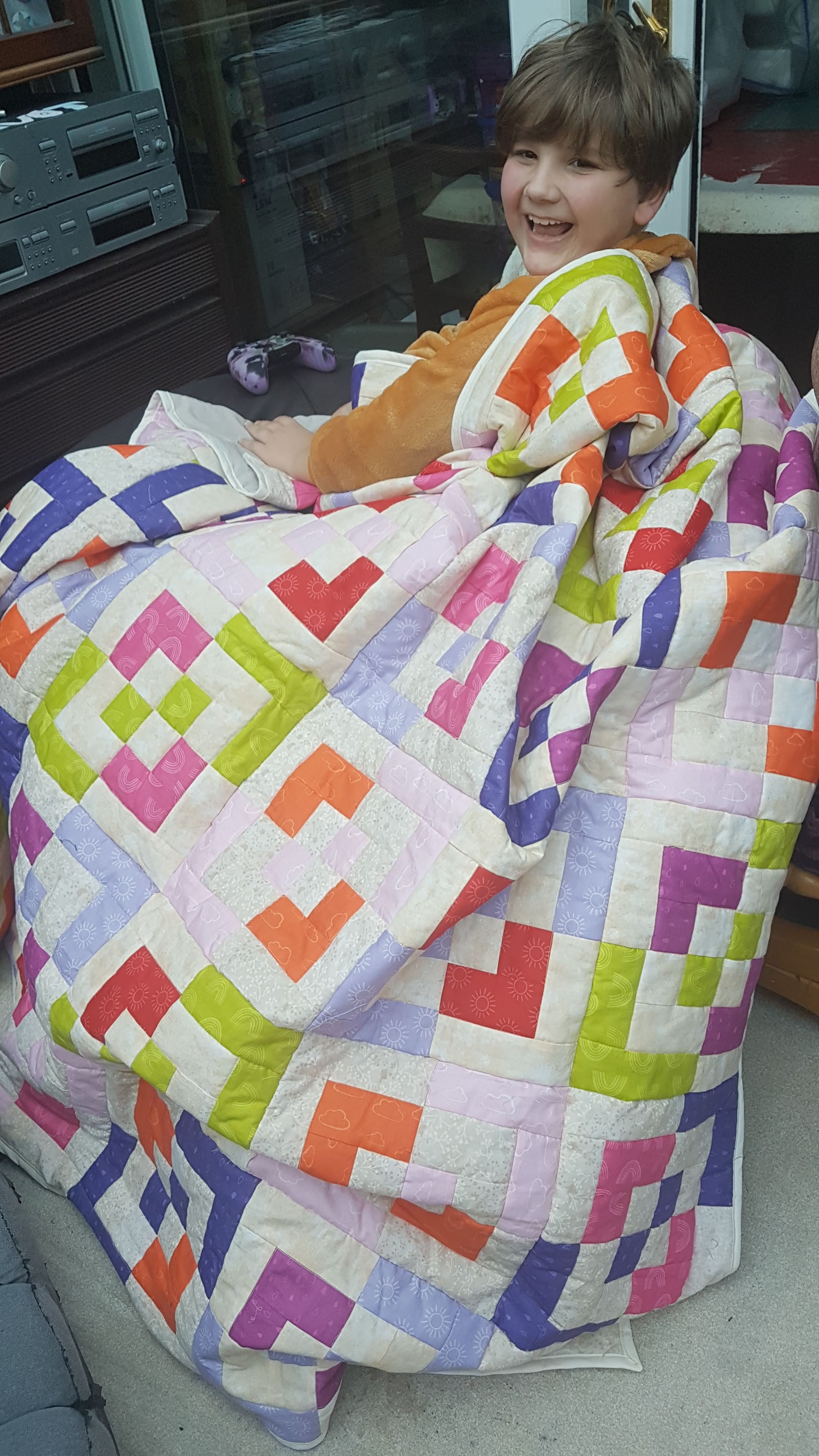
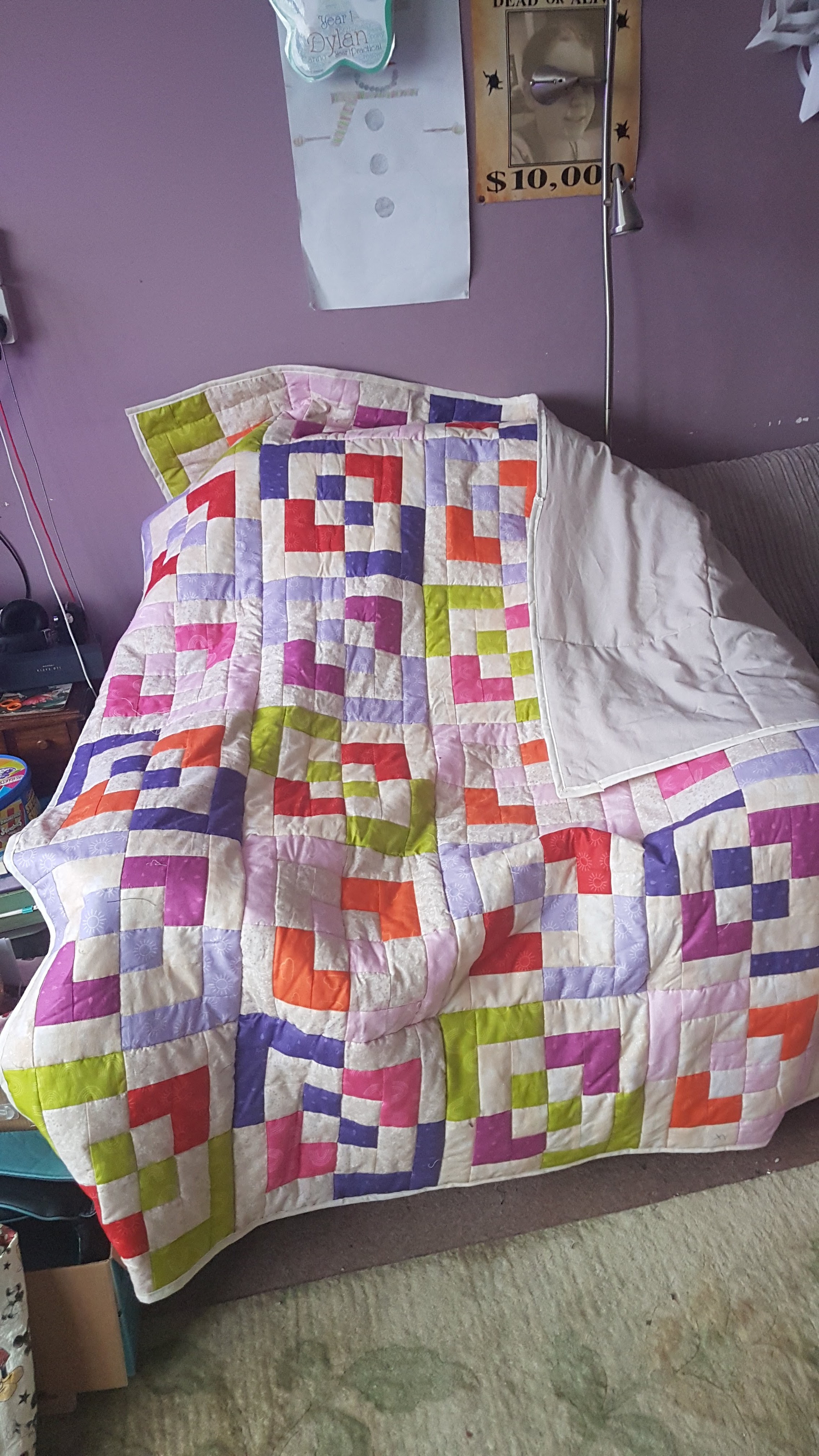
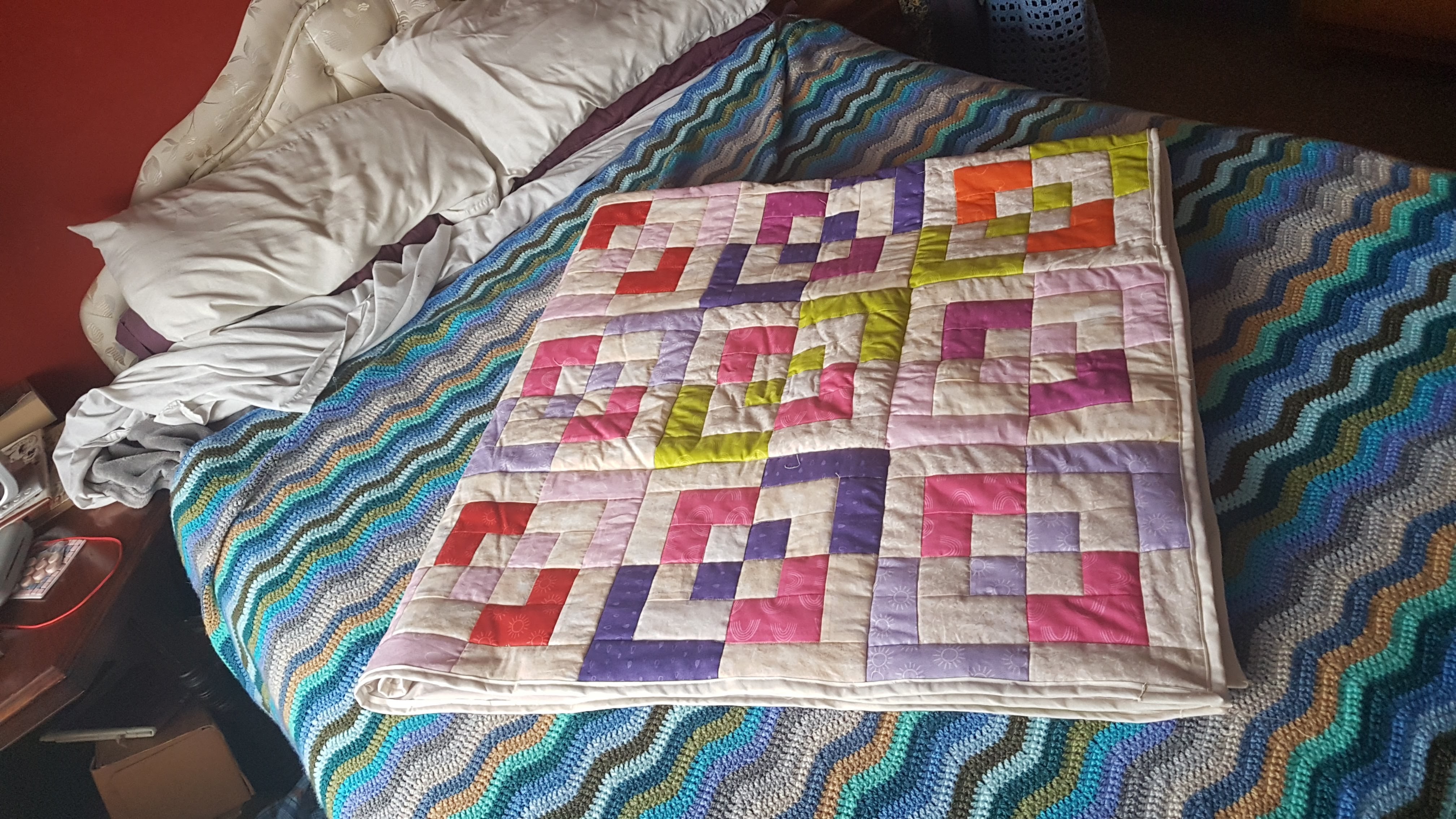
I mentioned in last week’s post that my plan for the rest of the day was to finish the Bento Box quilt. That’s the one I quilted as I went along, so after I’d backed it I was able to add another few lines of quilting in the ditch just to hold it together, and then bound it. I backed it with a 100% cotton sheet I’d bought in a sale, and bound it with a ready-made cream bias binding from Bertie’s Bows. Just to recap, the coloured fabrics are Stuart Hillard’s Rainbow Etchings designs for Craft Cotton Co, and I used nearly two jelly rolls to make it. The blenders, wadding and multicoloured quilting thread are from Empress Mills, and I used this tutorial.
Thing 3 tucked up nicely
There’s nowhere big enough in my house to lay this out fully!
On the bed
‘scuse the rumpled sheet! This is folded in four. The largest quilt I have made!
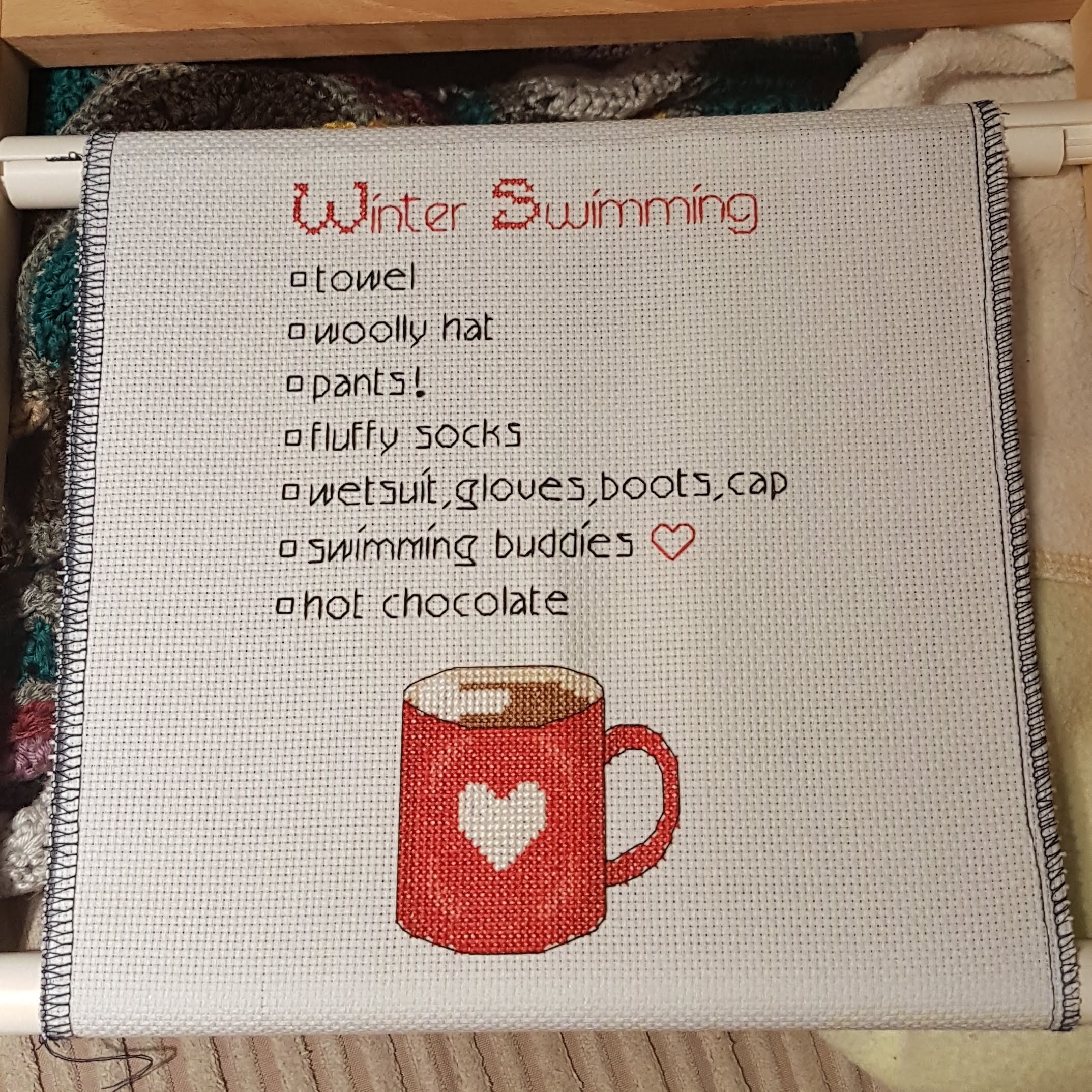
I also promised I’d show you the Winter Swimming cross stitch when I’d finished it…the wording is my own work, using DMC stranded cotton, alphabets from this book, and the mug design can be found here. Despite the fact that I can hear the rain hammering on the conservatory roof right now and it’s still pitch dark at 7am, I’m really looking forward to getting back in the socially distanced lake this morning!
Onesie and wellies optional.
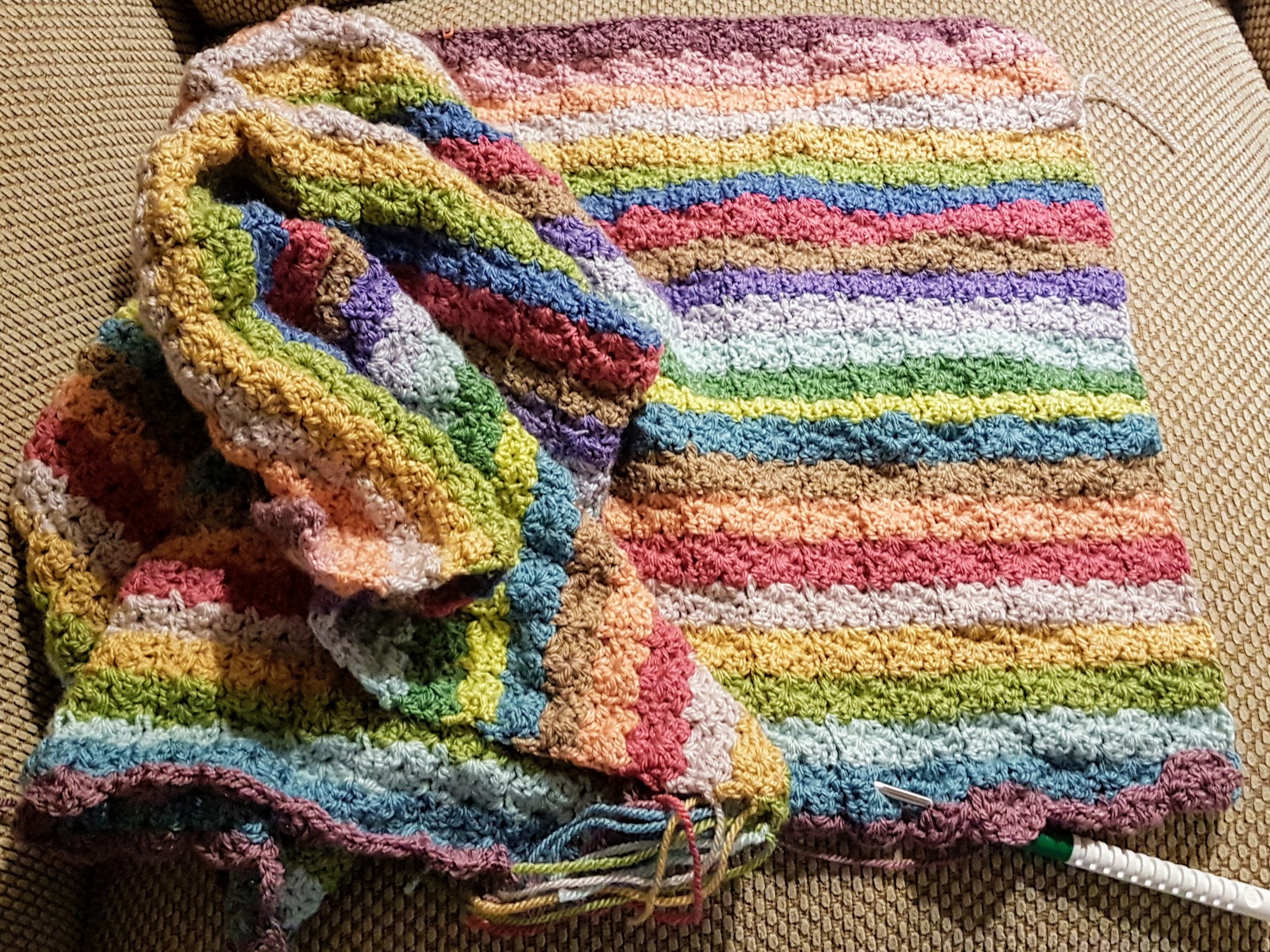
The Hydrangea blanket is coming on nicely – I am just about a quarter of the way through it now. It’s such a relaxing pattern to do, and I am following Attic24’s colour order as well. The yarn is Stylecraft Special DK from Wool Warehouse, where the official Attic24 shop can be found. I really love the faded colours.
25% of a Hydrangea Blanket
Yesterday’s job was to cut out a couple of dresses as I haven’t done any dressmaking for a while and at some point I’m sure I’ll get out of jeans and leggings for work again – at the moment I am mainly surrounded by dusty boxes and ladders, so looking tidy is not a priority. Both patterns are by Simplicity – K9101 was free with Sew magazine and the Dottie Angel (8230) is one I have made before. It’s great for throwing on as a top layer. I’m making version A with the double pocket from B, in a pinstriped denim. You can see the back of the fabric I’m using for K9101 behind – it’s a cotton duvet cover I picked up at The Range. I’m using the navy side for this, and there’s a purple side as well which may well end up as an Avid Stitcher drop-sleeve top. I do love a layer.
The weather this weekend has been truly atrocious, so yesterday Thing 3 and I spent some time doing jigsaws together. He has loved puzzles from a very early age (I do too), and when I declared a screen-free afternoon yesterday we had a few games of Dobble and then made a 3D puzzle of a baseball boot and a couple of Star Wars puzzles.
Thing 2 played a couple of games of chess with her Dad and Dobble with me – Dobble is like extreme snap and trickier than it sounds! I foresee a massive boom in the sale of chess sets, by the way, as a result of the Netflix series The Queen’s Gambit. We’ve just binged it and the finale had us on the edge of our seats.
Now excuse me, Duolingo has just told me it’s time for Welsh….see you at the end of week 35! I’ll leave you with a photo of a Little Egret who was hanging round the brook on the High Road all day on Friday.
Kirsty x
What I’ve been reading:
The Forest is Crying – Charles de Lint
The Spook who Spoke Again – Lindsey Davis
The Ides of April/Enemies at Home (Flavia Albia) – Lindsey Davis (audible)
The Law of Innocence (Lincoln Lawyer) – Michael Connelly



































 What Kirsty did next