222: a nettle-strewn hellscape, you say?

Last Sunday afternoon London sister Tan and I went for our first long walk for aaaaages – well, since the ludicrously long one we did last July. She’s been running a lot (marathons and half marathons) while I have been doing weekend wanders and hoping that at some point the rain will stop long enough for the footpaths to dry out.

Despite her belief that Essex is a fly-blown wasteland, Tan trekked over to my ‘ends’ and we did the Moreton and the Matchings circular walk that I’d tried a couple of times last year. It takes in a few pretty churches and villages, and – as it turned out – a LOT of nettles that haven’t been cut back. These were head height in places, with added brambles, and some farmers haven’t cut the crossfield paths so many detours were taken. I spent some time on Monday morning reporting all this to the council, who may or may not get round to looking at it in an estimated nine weeks or so. Add the detours to my legendary (lack of) sense of direction, and the 17k walk came in at just under 20k.

You can just see the top of my head – this was a waymarked footpath!

We stopped for a snack break (Mini Cheddars, Snickers and coffee) on the green at Matching, next to the very pretty medieval marriage feast house and the church, facing an oak tree that was planted for Queen Victoria’s jubilee in 1887. The friendly vicar came along and very helpfully told us that they had a toilet, which made us happy. We saw kestrels, heard a lot of pheasants, snuck up on a few bunnies and a muntjac, and apart from the extremely hardcore nettles it was a good ramble. We finished with a look inside the 13th century St Mary the Virgin church in Moreton, where we’d parked the car, and then she refused to take my directions on the way home and insisted on using the satnav. Honestly!

Still, Tan’s opinion of Essex has changed – it’s now a nettle-strewn hellscape. Which is nice.

So how’s that skirt coming along?

Very well, thank you for asking! Having definitely said last week that I wasn’t going to do any boro patching as it would be too cottagecore for words, I remembered that not only did I have some Japanese prints in the stash, I had a boro inspiration pack from Japan Crafts that some lovely Secret Santa gave me a couple of years ago when the Young V&A theme was ‘blue’ so clearly DESTINY was saying DO A PATCH.

Derived from the Japanese boroboro, meaning something tattered or repaired, boro refers to the practice of reworking and repairing textiles (often clothes or bedding) through piecing, patching and stitching, in order to extend their use.

Also, the skirt doesn’t have pockets, and I NEED pockets, so I made a boro patch as a pocket. I used some of the indigo fabrics, some scraps from the V&A sample sale, and a square of cotton as a base, and lined it to make a patch pocket. That was my portable project on the tube this week, and it was clearly performance crafting as people kept watching me. As well as the running sashiko stitch, I also used some of the fabric features to embellish with lazy daisy stitch and outlining hexagons. I enjoyed it so much that I looked for other things to boro – starting with some of the zillion cotton tote bags I have collected over the years, probably! This will also encourage me to use some of the embroidery threads people keep giving me…

I gave up on all my marking tools and just used washable poster paint to mark out the final bits of stitching I wanted to do on the skirt, which was lovely and messy and a good way to spend a Saturday afternoon after a morning of ironing. While waiting for the front of the skirt to dry, I marked up a fabric pouch that I bought in a Hobbycraft sale with the Seigaiha (wave) stencil, and then used Bondaweb and more fabric scraps to create a boro panel on a tote bag. The yellow marking pencil worked on this, so I used the Sakura (cherry blossom) and Fondou (weight) stencils for a panel as well. That should keep me busy! Also, guess what everyone is getting for Christmas?

Things making me happy this week

  • Cat insurance. Lulu isn’t well and the vet quoted me £600. Once I’d stopped freaking out they helped me put the claim in so that they would be paid directly. Now we just need to get the meds down her.
  • Inter-library loans, and new colleagues who recommend books to me. The two may be connected.
  • Lots of strawberries and raspberries from the garden
  • Coffee with Brian on Thursday morning and a colleague who is leaving asking if they can join my early morning coffee roster. This is clearly now A Thing.
  • Cinnamon Bun flavoured Pretzel Flipz.

Today I am off to hang out with illustrator Skye Baker at the Little Angel Theatre community street party in Islington, where we’ll be illustrating houses.

Next week I may even have finished the skirt – the problem is always knowing when to stop with these things….

Kirsty x

What I’ve been reading:

Demolition Angel/The Forgotten Man/The Watchman/The Promise – Robert Crais

Shadowstitch – Cari Thomas

Neither Here Nor There – Bill Bryson (Audible)
154: oh, darn

This week has been all about learning new skills, in the spirit of my New Year’s revolutions: an online course in pattern cutting on Sunday, with Monisola Omotoso of Pattern Cutting Deconstructed, and two in-person courses on Visible Mending with Hannah Porter of Restoration London. All of them were part of the V&A Academy offer.

Pattern cutting was a completely new skill for me, as usually I use ready made patterns from either the ‘Big Four’ pattern companies or smaller indie designers. I didn’t know what pattern cutting was or how it translated to the bits of paper I apply to fabric and cut out, so the theoretical aspects were interesting, and it also introduced me to a new fabric called aso oke, a hand woven West African material used to make gorgeous traditional wraps and robes.

Starting with a look at Moni’s own career working within the fashion industry and as a freelance cutter at companies like Alexander McQueen, the course took us through how draping in 3D translates to 2D paper patterns, how aso oke is being used on the catwalk today, before taking us through the process of creating a pattern for a top using our own measurements. Aso oke is woven in fairly narrow strips, so you work within the width of these, although the pattern could then be used with any fabric. It also comes ready hemmed, so you don’t have to finish your garment in the same way as you would a ‘by-the-metre’ fabric. I bought my fabric at Metro Textiles.

As the garment is symmetrical, you only create half a pattern which you then cut on the fold of the fabric. Moni took us through the process of pattern marking (darts, notches etc), and even managed to do a bit of on-screen sewing using the paper pattern which was apparently a first for the V&A Academy! I’d highly recommend one of these courses – short tasters, which at £15 for 90 minutes is very good value.

The second two courses – Visible Mending – were in person at the V&A yesterday, which meant I got out of the house and spent a lovely day being peacefully crafty. There were only 16 people on each course, so Hannah was able to give one-to-one help where necessary, and all materials were provided along with tea, coffee and biscuits. At £35 per course this is very reasonable.

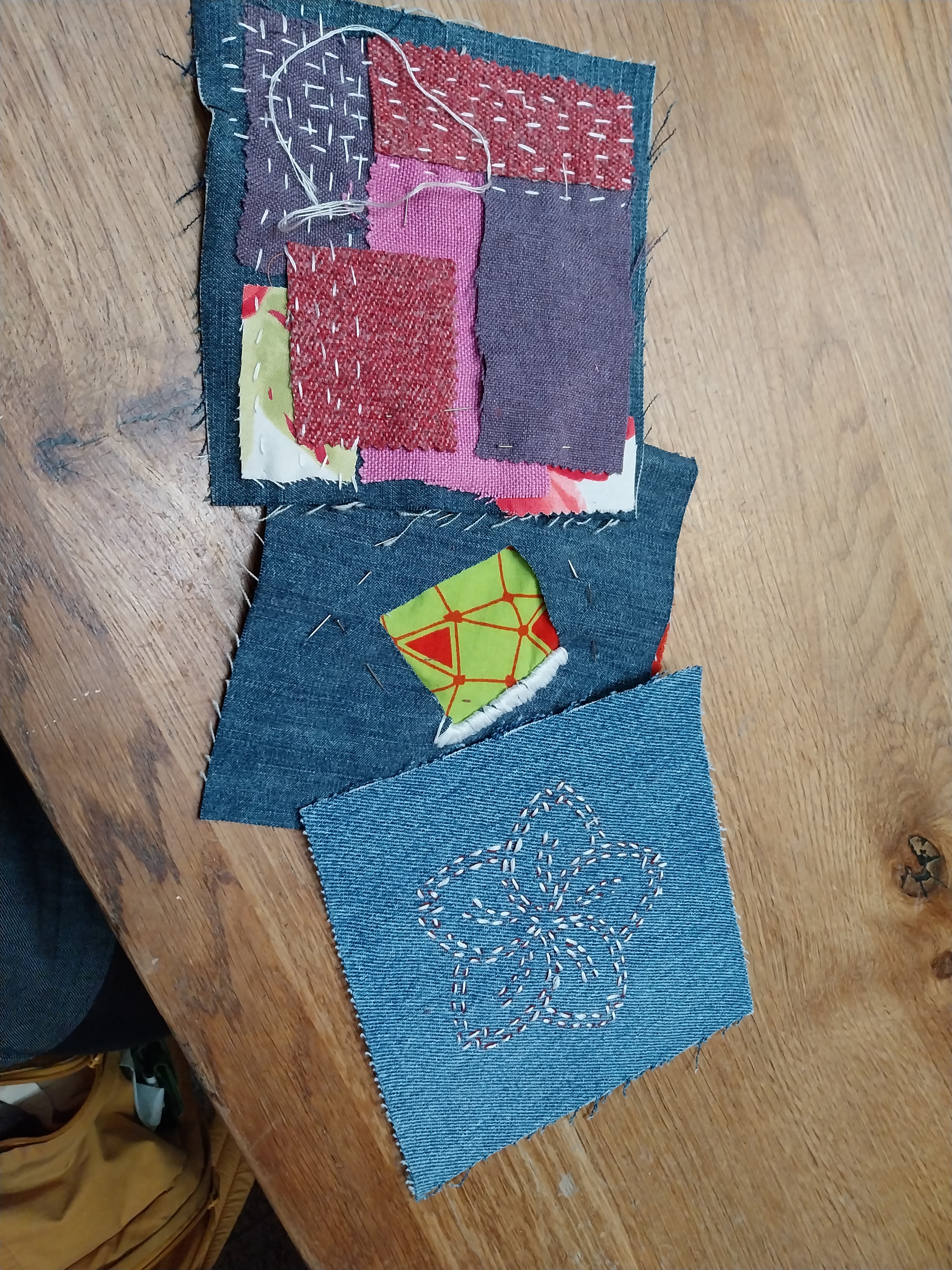
The first 90-minute course was on Sashiko stitching. I had done this course online previously, and enjoyed the opportunity to learn how to do it in person with proper materials as opposed to those I scrounged out of the shed (it says something about me that I had all the things I needed in the shed, but let’s not go there). The course covered sashiko – beautiful Japanese traditional stitching patterns – alongside satin stitch patching and boro. Sashiko means ‘little stabs’, we were told, and refers to the running stitches used to create the designs. Satin stitch is a dense coverage stitch which is used to fix patches behind holes as well as for decorative embroidery, while boro means ‘ragged’ or ‘tattered’ and refers to layering fabric patches to add warmth and strength to garments as well as for repair. Old garments would traditionally be used to create the rags when they were beyond repair, giving them further useful life. You can see my attempts below!

The second Visible Mending course was on darning, which I haven’t tried before but which is a handy skill to have if you’re going to make your own socks. Again, we were taught three techniques over the session with varying degrees of success! Materials provided included various coloured yarn, knitted samples to practice on and a square of stockinette stitch fabric.

Swiss darning was first up – also known as ‘duplicate stitch’, it can be used to add surface details to knitted pieces as well as to mend and reinforce knitted fabrics. Once I’d got the hang of it it wasn’t too tricky, but my first attempts kept going off the straight line of base knit and off on tangents.

We also tried woven darns, creating a warp and weft from yarn to cover and reinforce the holes we’d cut in the perfectly good squares. Mine were messy but did the trick which I suppose is the point! The houndstooth darn with tassels was a proper dog’s dinner, and I don’t think I’m quite ready to wear my darns with pride, but at least I can fix my socks….

Other things making me happy this week:

  • Two days with the wonderful DT classes at Ursuline Academy, retesting our ‘Design Can’ sessions and the ‘If the Shoe Fits’ session
  • A day at St Andrew’s primary in North Weald, working with the asylum seeking families currently staying in the village – so much fun and creativity
  • Walking therapy with Miriam putting my head back together
  • The Ninja Foodi thing. It’s my new best friend.
  • Finishing my dragon scale socks (then realising a) they were two different sizes and b) neither of them fitted me so I have frogged both of them back to before the heel to redo them)

Now I have to go for a training walk! Same time next week…

Kirsty x

What I’ve been reading:

Small Favour/White Knight – Jim Butcher

The Fifth Elephant/Snuff – Terry Pratchett (Audible)