222: a nettle-strewn hellscape, you say?

Last Sunday afternoon London sister Tan and I went for our first long walk for aaaaages – well, since the ludicrously long one we did last July. She’s been running a lot (marathons and half marathons) while I have been doing weekend wanders and hoping that at some point the rain will stop long enough for the footpaths to dry out.

Despite her belief that Essex is a fly-blown wasteland, Tan trekked over to my ‘ends’ and we did the Moreton and the Matchings circular walk that I’d tried a couple of times last year. It takes in a few pretty churches and villages, and – as it turned out – a LOT of nettles that haven’t been cut back. These were head height in places, with added brambles, and some farmers haven’t cut the crossfield paths so many detours were taken. I spent some time on Monday morning reporting all this to the council, who may or may not get round to looking at it in an estimated nine weeks or so. Add the detours to my legendary (lack of) sense of direction, and the 17k walk came in at just under 20k.

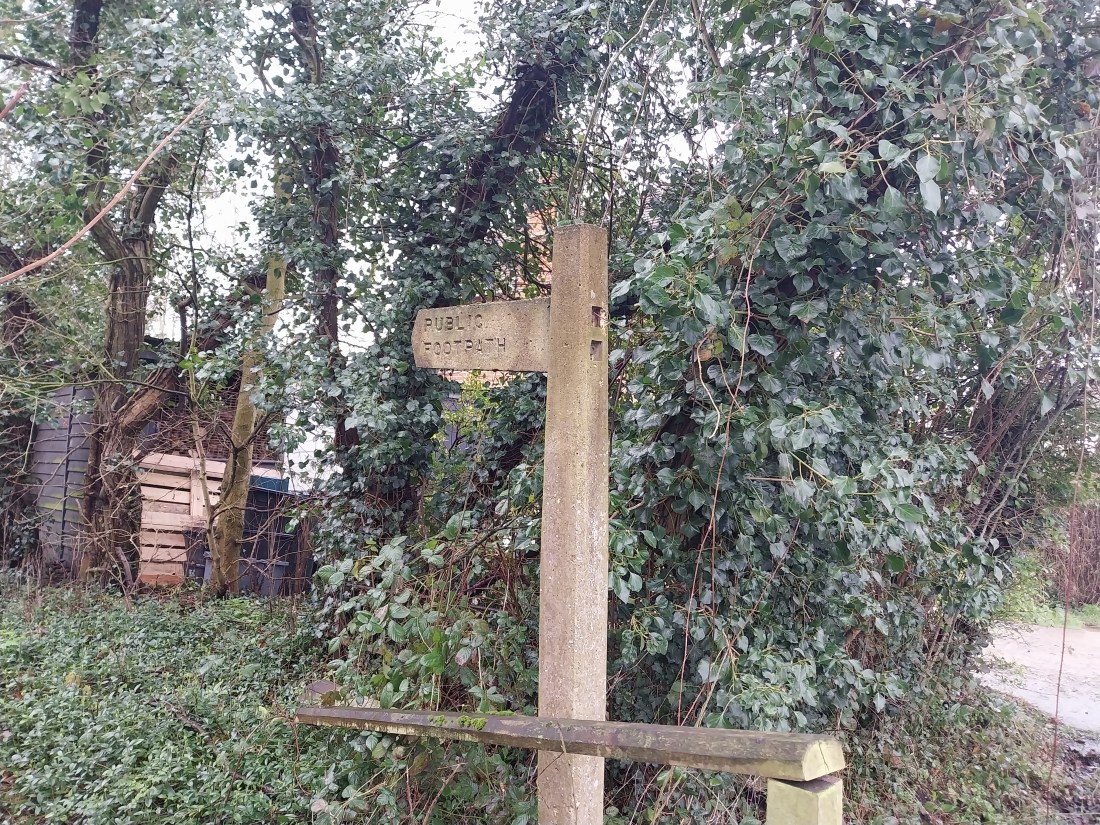
You can just see the top of my head – this was a waymarked footpath!

We stopped for a snack break (Mini Cheddars, Snickers and coffee) on the green at Matching, next to the very pretty medieval marriage feast house and the church, facing an oak tree that was planted for Queen Victoria’s jubilee in 1887. The friendly vicar came along and very helpfully told us that they had a toilet, which made us happy. We saw kestrels, heard a lot of pheasants, snuck up on a few bunnies and a muntjac, and apart from the extremely hardcore nettles it was a good ramble. We finished with a look inside the 13th century St Mary the Virgin church in Moreton, where we’d parked the car, and then she refused to take my directions on the way home and insisted on using the satnav. Honestly!

Still, Tan’s opinion of Essex has changed – it’s now a nettle-strewn hellscape. Which is nice.

So how’s that skirt coming along?

Very well, thank you for asking! Having definitely said last week that I wasn’t going to do any boro patching as it would be too cottagecore for words, I remembered that not only did I have some Japanese prints in the stash, I had a boro inspiration pack from Japan Crafts that some lovely Secret Santa gave me a couple of years ago when the Young V&A theme was ‘blue’ so clearly DESTINY was saying DO A PATCH.

Derived from the Japanese boroboro, meaning something tattered or repaired, boro refers to the practice of reworking and repairing textiles (often clothes or bedding) through piecing, patching and stitching, in order to extend their use.

Also, the skirt doesn’t have pockets, and I NEED pockets, so I made a boro patch as a pocket. I used some of the indigo fabrics, some scraps from the V&A sample sale, and a square of cotton as a base, and lined it to make a patch pocket. That was my portable project on the tube this week, and it was clearly performance crafting as people kept watching me. As well as the running sashiko stitch, I also used some of the fabric features to embellish with lazy daisy stitch and outlining hexagons. I enjoyed it so much that I looked for other things to boro – starting with some of the zillion cotton tote bags I have collected over the years, probably! This will also encourage me to use some of the embroidery threads people keep giving me…

I gave up on all my marking tools and just used washable poster paint to mark out the final bits of stitching I wanted to do on the skirt, which was lovely and messy and a good way to spend a Saturday afternoon after a morning of ironing. While waiting for the front of the skirt to dry, I marked up a fabric pouch that I bought in a Hobbycraft sale with the Seigaiha (wave) stencil, and then used Bondaweb and more fabric scraps to create a boro panel on a tote bag. The yellow marking pencil worked on this, so I used the Sakura (cherry blossom) and Fondou (weight) stencils for a panel as well. That should keep me busy! Also, guess what everyone is getting for Christmas?

Things making me happy this week

  • Cat insurance. Lulu isn’t well and the vet quoted me £600. Once I’d stopped freaking out they helped me put the claim in so that they would be paid directly. Now we just need to get the meds down her.
  • Inter-library loans, and new colleagues who recommend books to me. The two may be connected.
  • Lots of strawberries and raspberries from the garden
  • Coffee with Brian on Thursday morning and a colleague who is leaving asking if they can join my early morning coffee roster. This is clearly now A Thing.
  • Cinnamon Bun flavoured Pretzel Flipz.

Today I am off to hang out with illustrator Skye Baker at the Little Angel Theatre community street party in Islington, where we’ll be illustrating houses.

Next week I may even have finished the skirt – the problem is always knowing when to stop with these things….

Kirsty x

What I’ve been reading:

Demolition Angel/The Forgotten Man/The Watchman/The Promise – Robert Crais

Shadowstitch – Cari Thomas

Neither Here Nor There – Bill Bryson (Audible)

221: you know they sell those, don’t you?

A few weeks ago, as you may remember (it’s fine if you don’t. Really.) A & I visited a cemetery in South London and took in a charity shop while we were there. I bought a couple of linen skirts, one in navy and one in black. This week I have been bombarded by adverts from a clothing company who sell Japanese-inspired printed dresses and skirts and sashiko-style prints featured heavily. I did a sashiko mending course last year at the V&A, so – as all crafty types have a bad habit of doing – I decided to make my own version using the navy skirt.

Sashiko (刺し子?, literally “little stabs”) is a form of decorative reinforcement stitching (or functional embroidery) from Japan. Traditional sashiko was used to reinforce points of wear, or to repair worn places or tears with patches. Today this running stitch technique is often used for purely decorative purposes in quilting and embroidery. The white cotton thread on the traditional indigo blue cloth gives sashiko its distinctive appearance, though decorative items sometimes use red thread.

https://craftatlas.co/crafts/sashiko

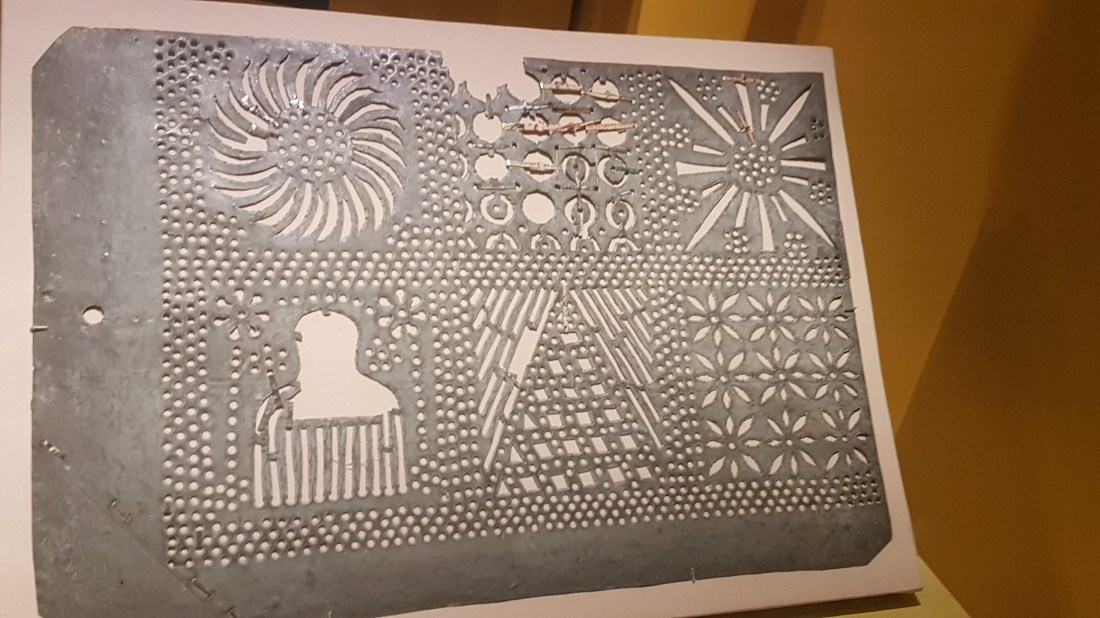
I have the templates, I have the threads and needles, and in theory I have a whole variety of marking tools for use on fabric. Chalk pencils, marking pencils, air-erasable chako pens, heat-erasable markers, dressmakers’ carbon paper, fabric pens…I have them all and none of them did the job, The chalk pencil snapped. The marking pencil only made tiny marks with the stencil but was good with a ruler. The chako pen disappeared within seconds. The heat-erasable marker didn’t work on the fabric. The fabric pens don’t show up. The carbon paper tears. Something that should be straightforward has turned out to be rather frustrating. The only thing I’ve found that does work with the stencils is a Derwent white blender, which washes off me and the stencil so I really hope it washes out of the fabric too….I probably should have checked…

Anyway, I have done a row of sakura blossoms and the next row will be waves, I think, though I might use some of the patterns from this book if I can find a way of marking them! I may also try some boro patches, but don’t want to lean too far over into folksy/cottage core. At least I don’t think so – my mind just recalled some Japanese cotton prints I have in the stash. Oh dear.

You’re supposed to use a running stitch but in some of the curves I found it easier to take individual stitches. You can definitely see where I started, and in which direction I travelled. Once you’re actually sewing its quite a fast craft, but the marking may defeat me!

Other things making me happy this week:

  • Visiting RIBA to talk about potential for working together, and getting a tour of the building – I have serious architecture and learning room envy.
  • And as I was in the area, I messaged my lovely ex-director and for once she was working at home. We had a walk in the sunshine round Regent’s Park and I found one of Quentin Blake’s Enormous Crocodiles in the wild.
  • Early morning coffee this week with Amanda at EL&N in St Pancras. St Pancras always makes me want to hop on the Eurostar and head off into the wilds. Sadly neither of us had our passports and we both had morning meetings. Ah well.
  • Finishing the crocheted Christmas cactus. This one was a lot of trial and error and the flowers need a bit of work.
  • Running into another friend at the station – you know that friend who gives the best hugs? That one!
  • A great kick-off meeting for a community project with The Parent House in Islington.

And now I am off to investigate the shed to see if I can lay hands on that quilting fabric…

Kirsty

What I’ve been reading:

L.A. Requiem/Chasing Darkness/The Last Detective/The First Rule/Demolition Angel – Robert Crais

Shadowstitch – Cari Thomas

The Lost Continent– Bill Bryson (Audible)

205: it’s very nice…what is it?

One of the things we believe at work is that – given the right tools – everyone is an illustrator, and we don’t limit illustration to picture books which is the answer virtually all school children give me when I ask ‘what is illustration?’ at the start of a session. That includes the Year 10s I worked with last week, and even post-graduate illustration students seem puzzled when I ask them how they’d define illustration.

We say it’s art with a job to do, the art we see all around us, the art which helps us make sense of the world. It’s art that communicates without words – though typography is part of illustration – and it’s art that’s been around since before words. There’s a lovely animation here that illustrates (see what I did there?) all this much more eloquently that I have.

I love all these definitions and the learning strategy I’m currently writing has this as its mission, and I’m quite prepared to think of myself as an illustrator but…not a very good one, and I’d never apply the word ‘artist’ to myself. For that I blame school. Art, after second year comprehensive, was for people who were ‘good at’ art. I was not ‘good at’ art – the best mark I ever got was a B- for a drawing of mum’s avocado plant which I was very proud of, but that mark was all the feedback I got – nothing constructive, no next steps, no ‘try doing this’. I don’t remember ever being taught to draw, or indeed to use watercolours, to try typography, or collage, or any other art form – these were things you either could or couldn’t do, and no real effort was made to change this state of being. Presumably this changed when you got to do art GCSE, but I don’t know – maybe the teachers gave that sort of feedback then as exam results depended on a certain level, but also there was an expectation that if you were doing the subject you were already good at it. This still makes me sad, and I can see the impact that this sort of school experience has had on a lot of the adults we engage with: ‘I haven’t done this since school’, ‘I used to love painting in school but I was no good at it.’

Thing 1 did art at GCSE, and Thing 2 is in her first year of GCSEs and she gave me a tour of her sketchbook the other day – I was very impressed. I am biased but they’re a talented pair – they get it from their Dad, who did Art to A-level, and who is able to help them with this subject. I was impressed with their teacher, who didn’t require that they should be ‘good at’ the subject, only that they were passionate about it and prepared to put the time in. This, I think, is the right way to think. How will young people ever find out if they are artists (of any calibre) if they never get the chance to find out? Even if they find out that they aren’t ‘good at it’, they might find they get great joy out of it – mot a quantifiable outcome but still a very valid one.

The artist Bob and Roberta Smith said that every school should be an art school, and even Ofsted said last year that ‘art should command an important place in every school’. I’ve written about the importance of creativity – not just on wellbeing but on general thinking – previously and posed the query ‘what happens if you replace the word craft with the word art?’ Obviously I understand the pressures on the curriculum (which sadly begins in the early years, just when children should be free to explore all the amazing art and craft materials around them) and the pressures for schools to achieve certain levels of GCSEs and A-levels, and the EBacc, blah blah blah, but I also understand the importance of being given the space to create and explore and scribble and doodle (sorry, boss) and generally play with art and craft materials, even if you’re not ‘good at it’. I understand, too, that at primary school in particular the majority of teachers are not art specialists, and have been given only the most minimal training in how to deliver the subject.

The creative industries contributed £115.9billion to the UK economy in 2023 – OK, this is only 0.4% of UK GDP, 260,000 full time jobs, but this is growing year on year. The soft skills that come with creative learning – empathy, creative thinking and problem solving among others – are among those most highly valued by employers according to research by the Edge Foundation. Unfortunately the current pressures from government, tightening budgets throughout the education, bad PR around ‘creative’ degree subjects and more are drying up the pipeline of young people into these industries.

All this, by the way, was just a lengthy preamble to what I’ve been attempting to do this week, which is to try and draw the things I’ve seen around me – from Sunday to Tuesday I did the ‘draw my day’ thing but on the days I was in London I didn’t have time. I took photos of the things I saw on my travels though – I am finding myself drawn (if you’ll pardon the pun) to signage and buildings, as well as my usual plants, Landscapes are nice but I have no urge to draw them – I like small details rather than the big pictures, it seems. I don’t think I’ll be any threat to the livelihoods of any artists out there but I am really enjoying stopping and looking and then spending time focusing on details. So keep your B-, Mrs Allan, I’m having a go at drawing whether I’m any good at it or not.

Other things making me happy this week…

  • Making an effort to go for early morning walks on the days I work at home
  • A long walk yesterday morning- the floodwaters have receded so I managed to complete the loop I tried last week
  • Volunteering in the garden at Copped Hall with my Beloved and Thing 3 last week, except there was mud.
  • Interesting site tour with colleague Laura and Studio Weave. I like people who get excited at the potential of our site.

And that’s it from me for the week – half term this week, at least for the Horde.

Kirsty x

Cover image: Dial House – https://www.radical-guide.com/listing/dial-house/

What I’ve been reading:

The Cold Calling/Mean Spirit/Marco’s Pendulum/Marco and the Blade of Night – Phil Rickman

Greenwitch/The Grey King/Silver on the Tree – Susan Cooper (Audible)

Map Addict – Mike Parker

204: unexpected water hazards

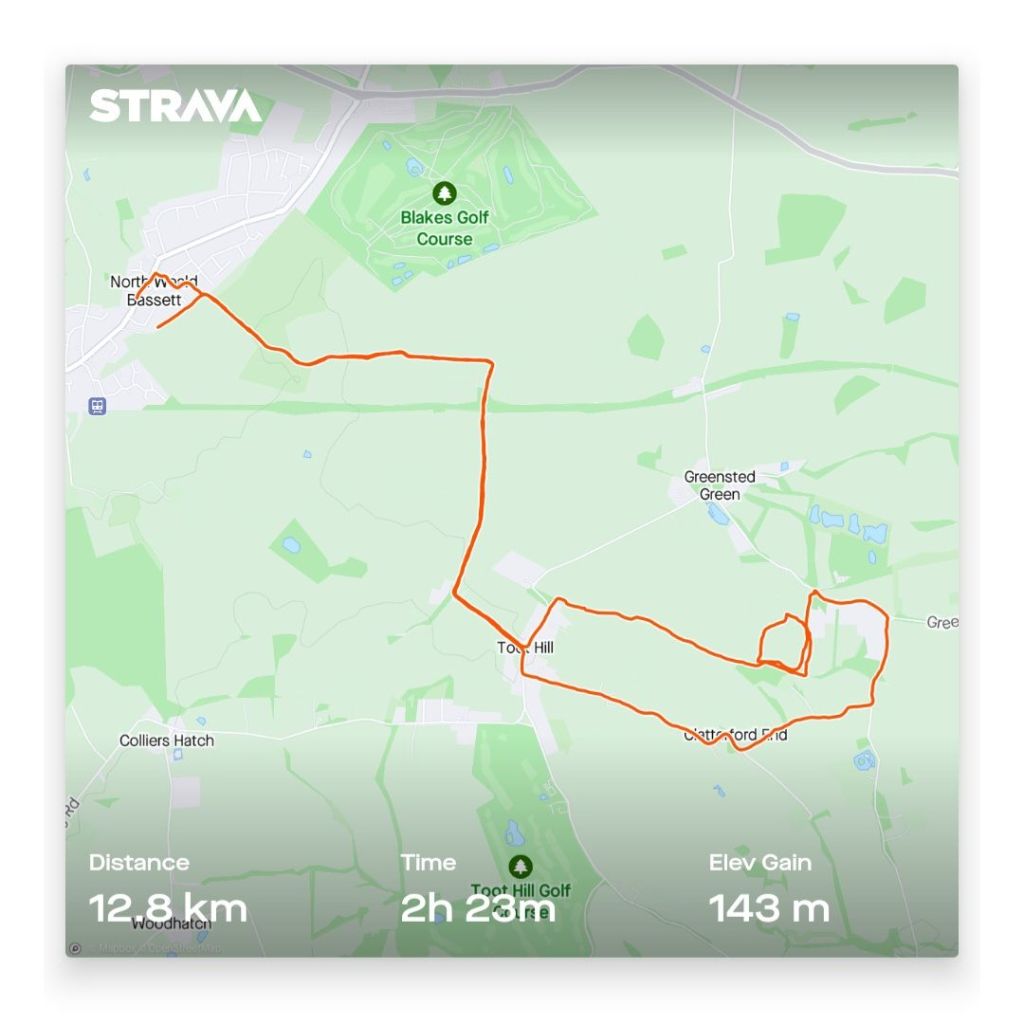
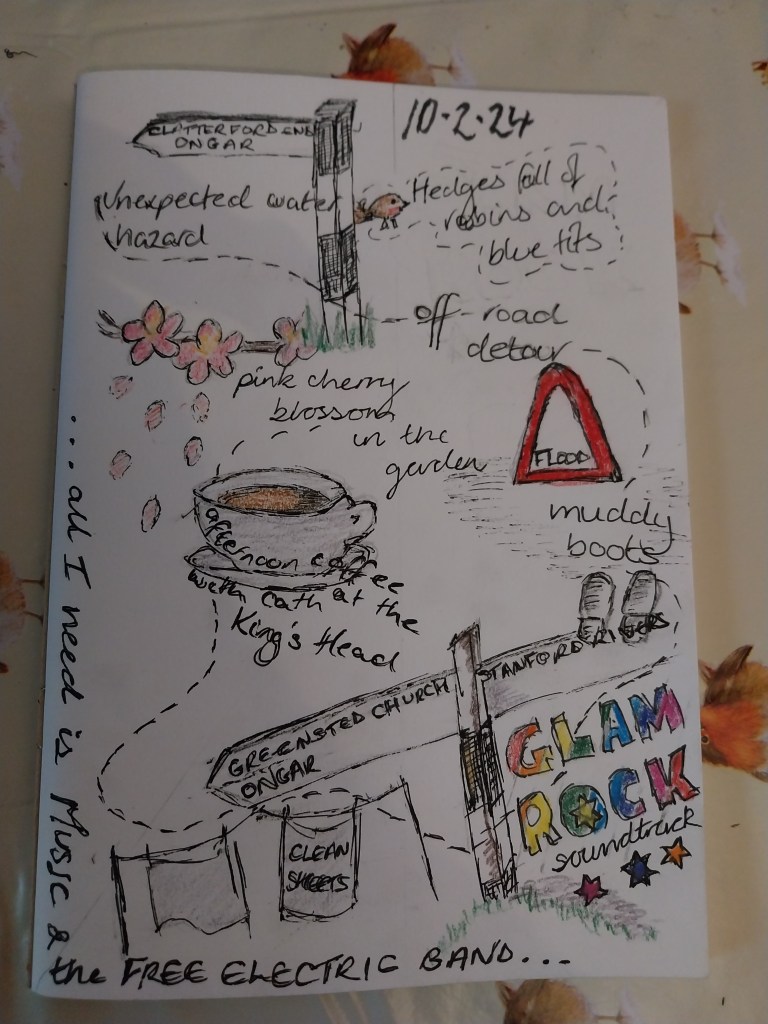
Yesterday I accidentally went on a nearly-13km walk. I’d woken up at 6am and been unable to go back to sleep, so once I’d had a cup of coffee and had a bit of a read and since it wasn’t raining I decided I’d go for a bit of a wander in search of inspiration. My plan, such as it was, was to head to the farm to say good morning to the baby cows, turn around at 2.5km, pick up some milk and be back for breakfast. Yup, that sounds pretty straightforward, I hear you say. Baby cows, milk, breakfast.

Well, once I’d said good morning to the baby cows and arrived at the 2.5km point, I was feeling full of the joys of spring, as you do when the sun is shining, the bushes are full of robins and blue tits and there’s a good playlist on Spotify (a lot of glam rock, as it goes.). 10k felt doable, so I kept going into Toot Hill and turned down towards the wonderfully Hobbitish-named Clatterford End.

This is a lane that I’ve been down before, but always turned round at 5km as I don’t really know where it goes. Clatterford End isn’t really a place at all. So – and I can pinpoint this as the moment it all got out of hand – I looked at the map. Just a little Google, I thought, to see where the road goes. I might see some interesting things to put in my sketchbook at the end of the day, at the very least, and I might find some new footpaths to explore when swamp season is over in Essex. We’ve had so much rain recently that the clay is saturated and the footpaths are running water, so offroading was very definitely not in my plan.

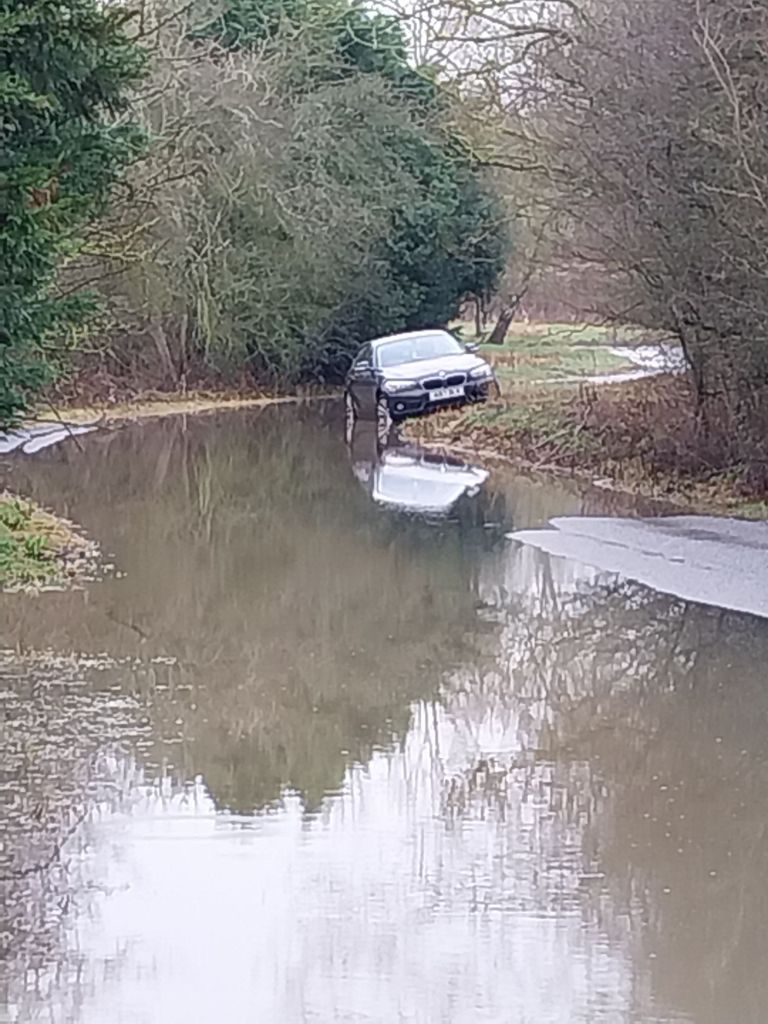
Well, it turned out that if I carried on down this lane and turned left I would end up going in a big circle back to Toot Hill and it probably wouldn’t be much more than 10k. So I carried on. It was all going well- I even knew where I was which, as it happened, was a bit of a blessing. My mental map of the area had just connected a few dots….and then there was a flood, So deep it had an abandoned car on one of the banks. I could not go over it. I could not go under it, and I damn sure wasn’t going through it.

Offroad it was then. You can see from the map that there’s a weird loop-the-loop. This is where I opened the Ordnance Survey app, found a route back to the road which would take me past the flood, only to find that the footpath was blocked by brambles and more water. So I resigned myself to a trek along the Essex Way and it was exactly as swampy, sticky, slippy and slurpy as I expected it to be in early February. I muttered and grumbled and slipped and slid slowly back through to Toot Hill, glaring at small streams and puddles and passing dogwalkers, said hello to the baby cows again and stomped back up the hill. I remembered the milk though, and treated myself to a hot bath followed by tomato soup and a Spanish hot chocolate. And a nap.

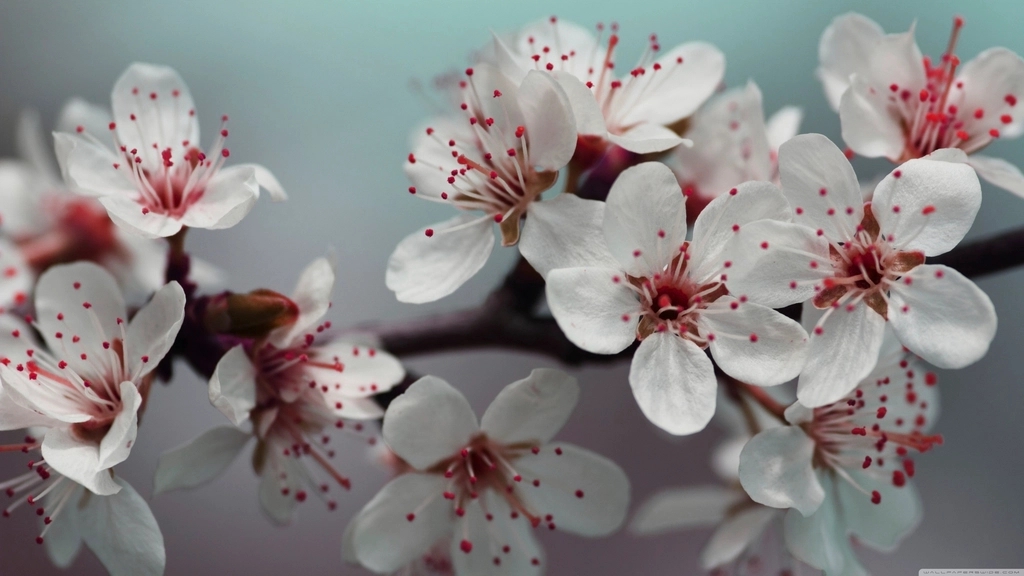
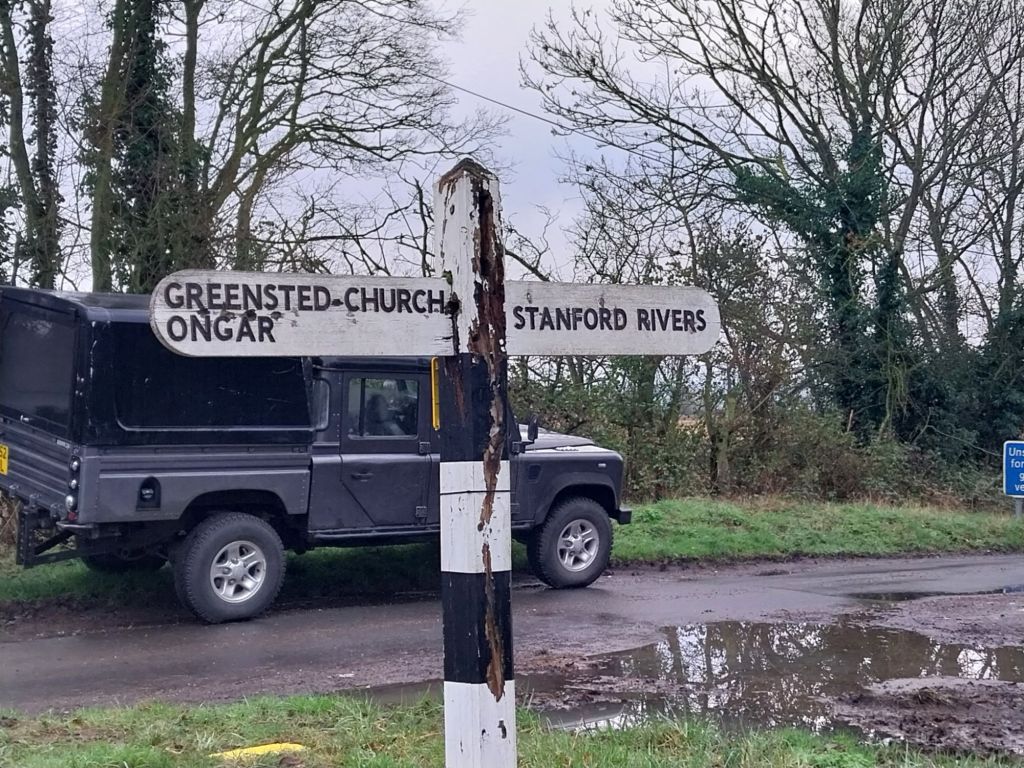
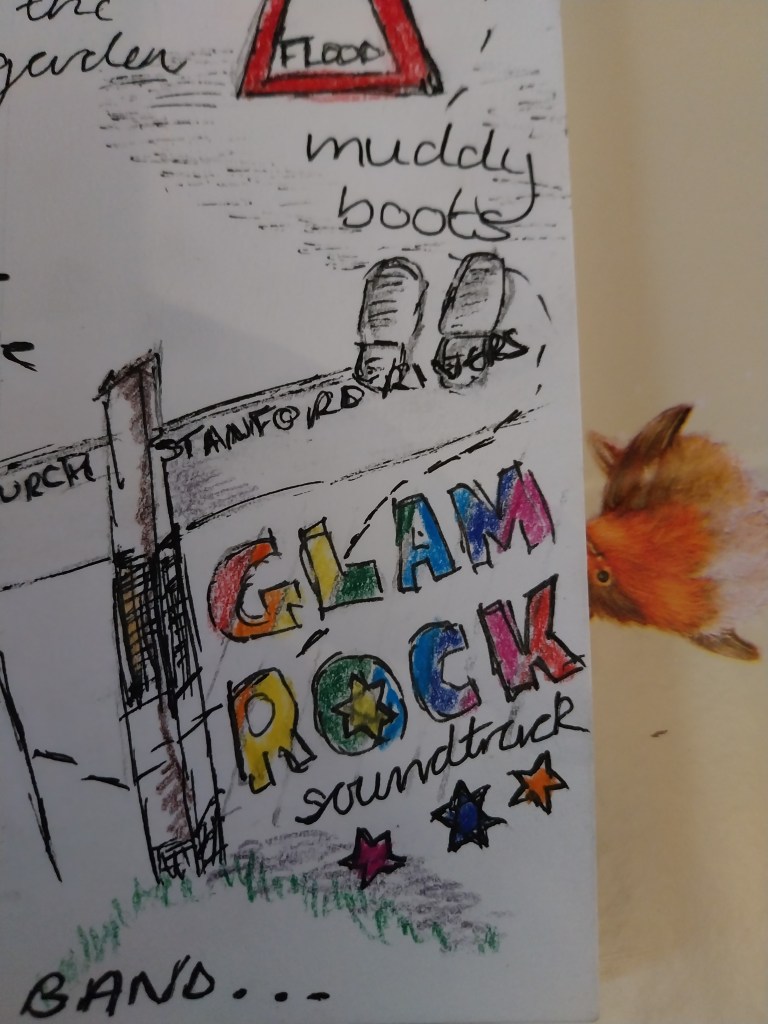
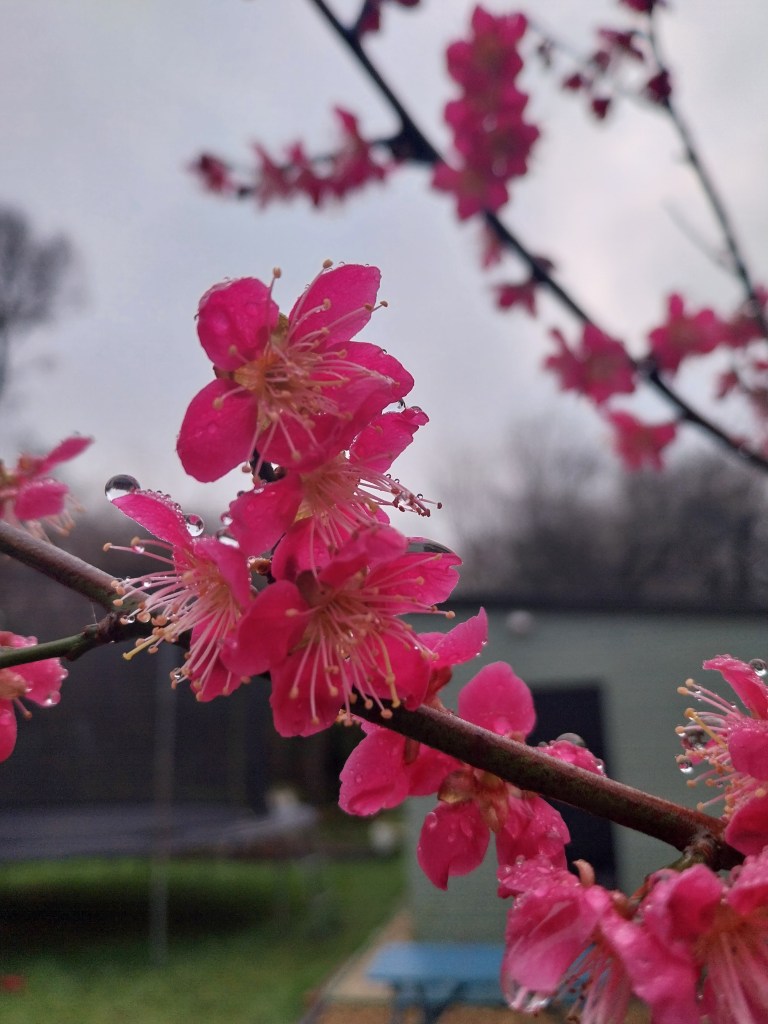
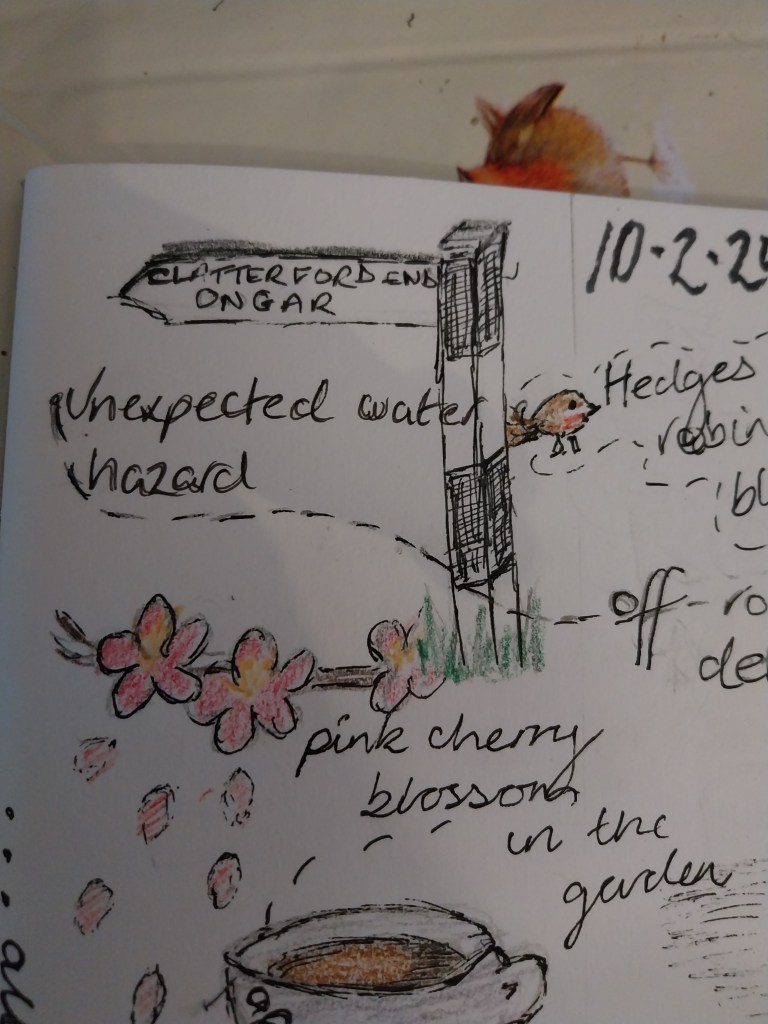
I did get to draw my day, and was quite inspired by some road signs mostly as I didn’t feel brave enough to try sketching the baby cows. I did try the cherry blossom from the garden, and noted down my soundtrack and a lyric from one of my favourite songs. Saturday is clean sheets day, so that was marked too, and I took a leaf out of Bob Ross’s book and turned my mistake into a bird. I enjoyed playing with pencils and markers and colours, and I’m quite pleased with how it turned out.

Also this week…

Last Sunday the entire clan visited Get To know Animals, a relatively new mini-zoo and animal experience centre just outside Epping. It was an interesting experience – Thing 2 ended up traumatised by seeing two ring-neck parakeets attacking a quail in the bird enclosure. Grandthing 1 handled a rabbit called Gandalf that was almost as big as he was, and Thing 3 was given a ferret experience as a birthday present from his big sisters. He and my Beloved were rolling around the floor with them.

Thing 2 loves a ferret, and feels I should love them too. Actual conversation:

Thing 2: You should hold the ferret, mum

Me: No thank you

Thing 2: No no, hold the ferret, he’s really furry

Me: I do not want to hold a ferret, thank you.

Thing 2: <puts ferret on me>

Ferret: <sinks fangs into my chin>

Me: OOOWWWWWW

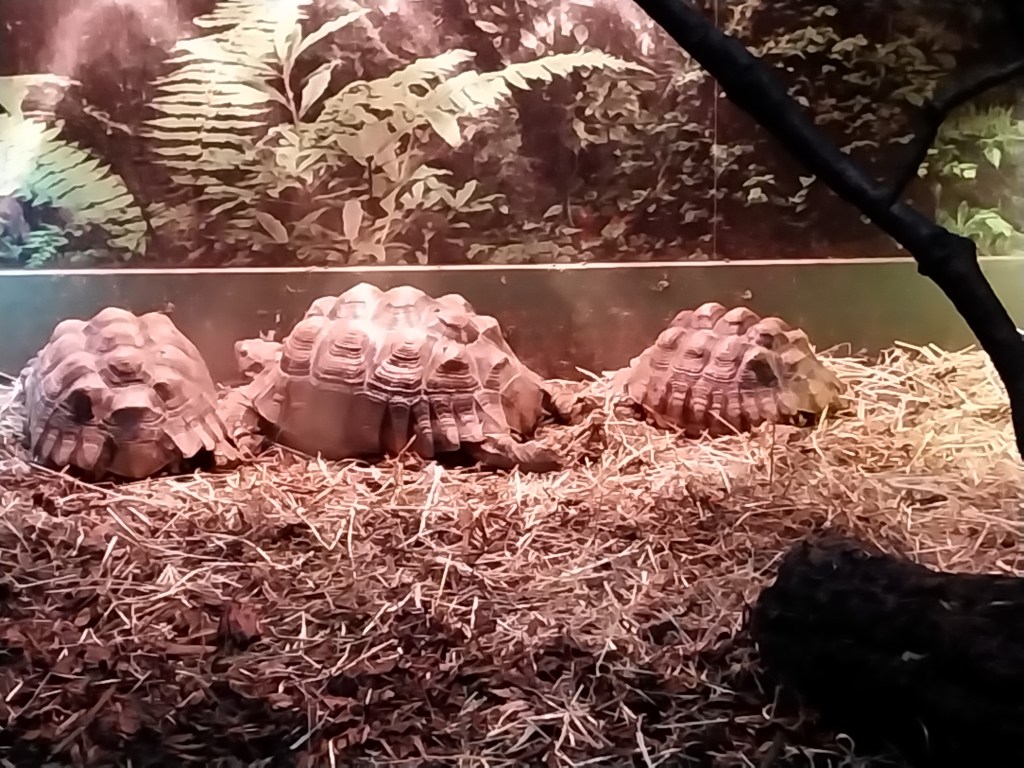
I liked the flirty alligator though and I’d happily adopt a cloud rat or take home a tortoise or two.

Thing 3 and I had a great night out seeing the RSC’s My Neighbor Totoro at the Barbican for his birthday treat – no photos are allowed, but I can say it was absolutely magical: the special effects for the Totoros, soot sprites and the Catbus were so cleverly done, and we had an amazing evening. It was his first theatre experience and it’ll be hard to beat. Thing 2 made him an amazing birthday cake.

Also…

  • Coffee and a good catch-up with an ex-Museum of London colleague
  • Taking part in a Careers Day at a school in East Ham
  • An inspiring meeting with the wonderful Parent House in Islington
  • Coffee with a friend at the King’s Head
  • Getting up to date with this year’s cross stitch temperature tracker

And that’s it for me – it’s been a pretty busy week, in and out of London and wrestling with the Central Line every day (ugh), but that does mean I have done a lot of crochet on the leafy scarf!

Same time next week then!

Kirsty x

What I’ve been reading:

Over Sea, Under Stone/The Dark is Rising/Greenwitch – Susan Cooper (Audible)

The Fever of the World/The House of Susan Lulham/The Cold Calling – Phil Rickman

Draw your Day – Samantha Dion Baker.

154: oh, darn

This week has been all about learning new skills, in the spirit of my New Year’s revolutions: an online course in pattern cutting on Sunday, with Monisola Omotoso of Pattern Cutting Deconstructed, and two in-person courses on Visible Mending with Hannah Porter of Restoration London. All of them were part of the V&A Academy offer.

Pattern cutting was a completely new skill for me, as usually I use ready made patterns from either the ‘Big Four’ pattern companies or smaller indie designers. I didn’t know what pattern cutting was or how it translated to the bits of paper I apply to fabric and cut out, so the theoretical aspects were interesting, and it also introduced me to a new fabric called aso oke, a hand woven West African material used to make gorgeous traditional wraps and robes.

Starting with a look at Moni’s own career working within the fashion industry and as a freelance cutter at companies like Alexander McQueen, the course took us through how draping in 3D translates to 2D paper patterns, how aso oke is being used on the catwalk today, before taking us through the process of creating a pattern for a top using our own measurements. Aso oke is woven in fairly narrow strips, so you work within the width of these, although the pattern could then be used with any fabric. It also comes ready hemmed, so you don’t have to finish your garment in the same way as you would a ‘by-the-metre’ fabric. I bought my fabric at Metro Textiles.

As the garment is symmetrical, you only create half a pattern which you then cut on the fold of the fabric. Moni took us through the process of pattern marking (darts, notches etc), and even managed to do a bit of on-screen sewing using the paper pattern which was apparently a first for the V&A Academy! I’d highly recommend one of these courses – short tasters, which at £15 for 90 minutes is very good value.

The second two courses – Visible Mending – were in person at the V&A yesterday, which meant I got out of the house and spent a lovely day being peacefully crafty. There were only 16 people on each course, so Hannah was able to give one-to-one help where necessary, and all materials were provided along with tea, coffee and biscuits. At £35 per course this is very reasonable.

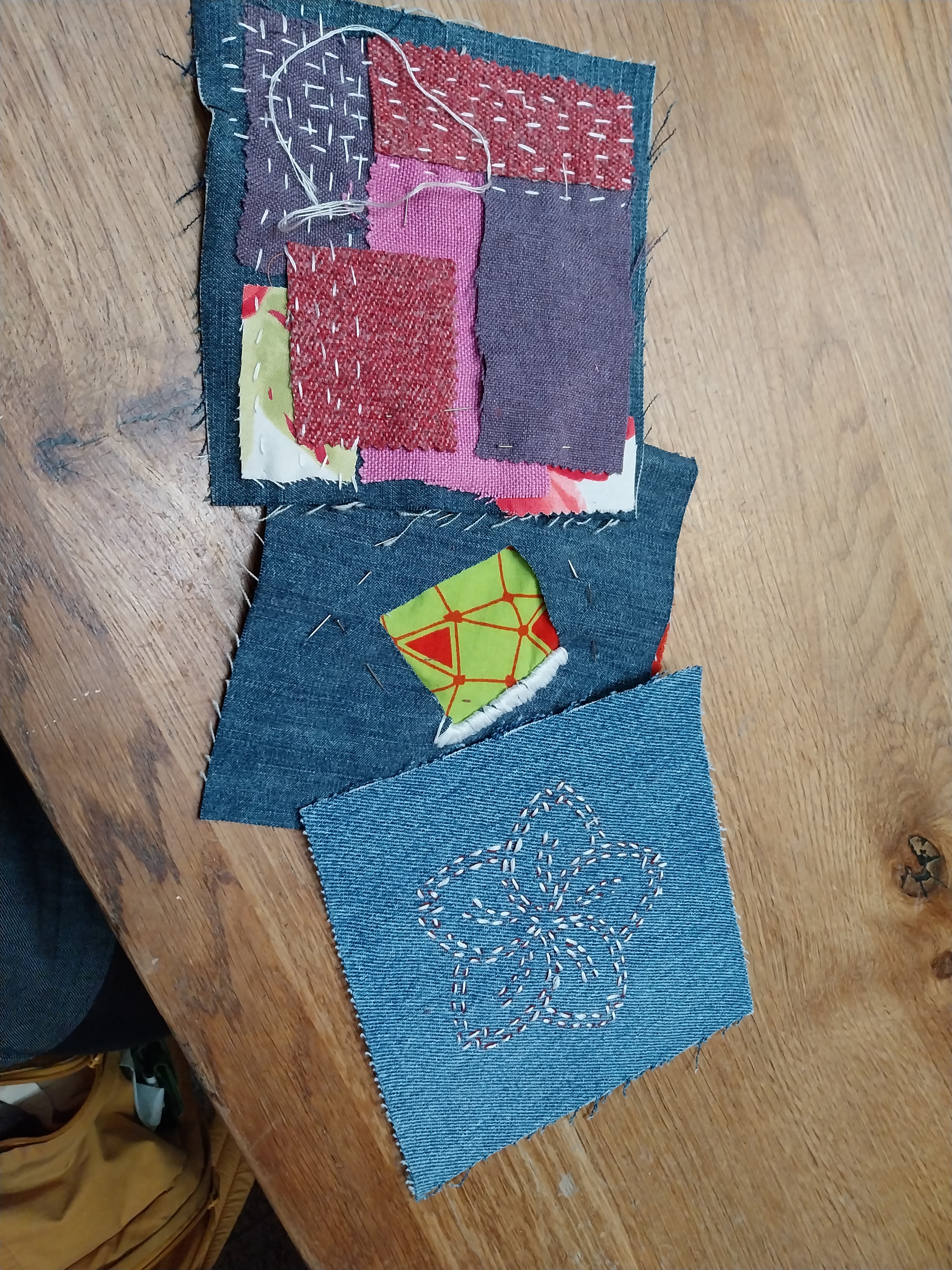
The first 90-minute course was on Sashiko stitching. I had done this course online previously, and enjoyed the opportunity to learn how to do it in person with proper materials as opposed to those I scrounged out of the shed (it says something about me that I had all the things I needed in the shed, but let’s not go there). The course covered sashiko – beautiful Japanese traditional stitching patterns – alongside satin stitch patching and boro. Sashiko means ‘little stabs’, we were told, and refers to the running stitches used to create the designs. Satin stitch is a dense coverage stitch which is used to fix patches behind holes as well as for decorative embroidery, while boro means ‘ragged’ or ‘tattered’ and refers to layering fabric patches to add warmth and strength to garments as well as for repair. Old garments would traditionally be used to create the rags when they were beyond repair, giving them further useful life. You can see my attempts below!

The second Visible Mending course was on darning, which I haven’t tried before but which is a handy skill to have if you’re going to make your own socks. Again, we were taught three techniques over the session with varying degrees of success! Materials provided included various coloured yarn, knitted samples to practice on and a square of stockinette stitch fabric.

Swiss darning was first up – also known as ‘duplicate stitch’, it can be used to add surface details to knitted pieces as well as to mend and reinforce knitted fabrics. Once I’d got the hang of it it wasn’t too tricky, but my first attempts kept going off the straight line of base knit and off on tangents.

We also tried woven darns, creating a warp and weft from yarn to cover and reinforce the holes we’d cut in the perfectly good squares. Mine were messy but did the trick which I suppose is the point! The houndstooth darn with tassels was a proper dog’s dinner, and I don’t think I’m quite ready to wear my darns with pride, but at least I can fix my socks….

Other things making me happy this week:

  • Two days with the wonderful DT classes at Ursuline Academy, retesting our ‘Design Can’ sessions and the ‘If the Shoe Fits’ session
  • A day at St Andrew’s primary in North Weald, working with the asylum seeking families currently staying in the village – so much fun and creativity
  • Walking therapy with Miriam putting my head back together
  • The Ninja Foodi thing. It’s my new best friend.
  • Finishing my dragon scale socks (then realising a) they were two different sizes and b) neither of them fitted me so I have frogged both of them back to before the heel to redo them)

Now I have to go for a training walk! Same time next week…

Kirsty x

What I’ve been reading:

Small Favour/White Knight – Jim Butcher

The Fifth Elephant/Snuff – Terry Pratchett (Audible)

124: God bless the cactuses

It’s not often that the death of someone I don’t know moves me to tears. The last time it happened it was losing Terry Pratchett in 2015, in fact. The passing of Bernard Cribbins this week was another of those moments. He’s just always been around, hasn’t he. From my childhood with The Wombles and Jackanory (more than 100 stories told there!); Albert Perks in The Railway Children; my kids’ childhood with Old Jack’s Boat; my adulthood with Doctor Who; the refrain of Right Said Fred ringing in my head after many, many meetings going over and over the same subject.

His role as Wilfred Mott in Doctor Who was beautifully done: for me, when Catherine Tate joined the cast, it was too close to her comedy show for me to take her seriously (so shouty!) and Bernard’s presence made her bearable. I have come round to her now after several rewatches, but his performance never gets outshone. Ten’s final episodes (‘The End of Time Parts I and II’) are heartbreaking: John Simm, who played The Master for Tennant’s Doctor, said this week that the hardest thing he had to do was be mean to Bernard Cribbins. He seemed like a genuinely lovely man, who has left a great body of work behind him.

Talking of interminable meetings…

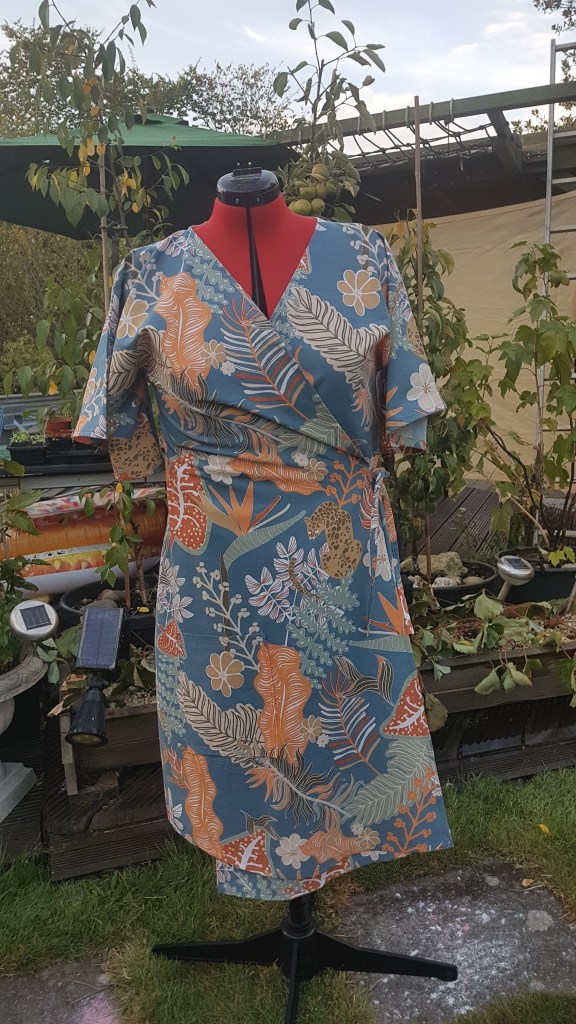
By Thursday this week I had sat through more meetings than you could shake a stick at, and while the content was interesting in many cases my brain was a bit fried and I was overcome with the urge to make something. So at the end of the day the laptop went away, the sewing machines came out, and I spent a couple of hours using a duvet cover and an old favourite pattern to make a new dress.

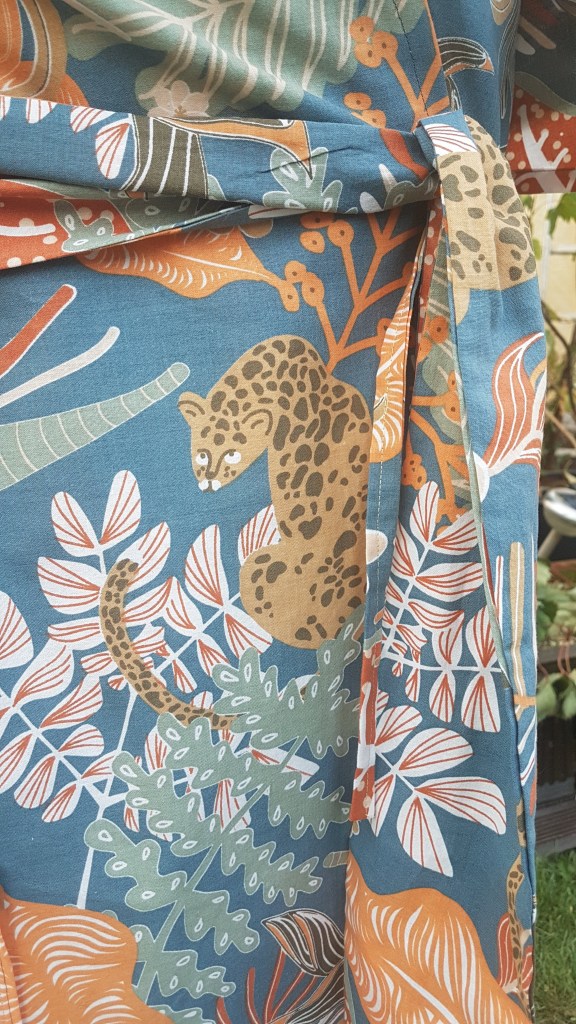
There are benefits to using a familiar pattern (in this case the Simple Sew Kimono Dress): you don’t have to cut it out, you’re not focusing on any new techniques so your mind is free to think about other things, and in this case it was a quick make. Four seams and a hem, basically, and my dress was done: the pattern is a wrap dress, which has been a wardrobe staple in this recent heat, and then I used some scraps to create the waist ties. I added a pattern-matched patch pocket, and voila! A new frock which I teamed with wedge sandals for work. I love the rather sheepish looking jaguar in the pattern!

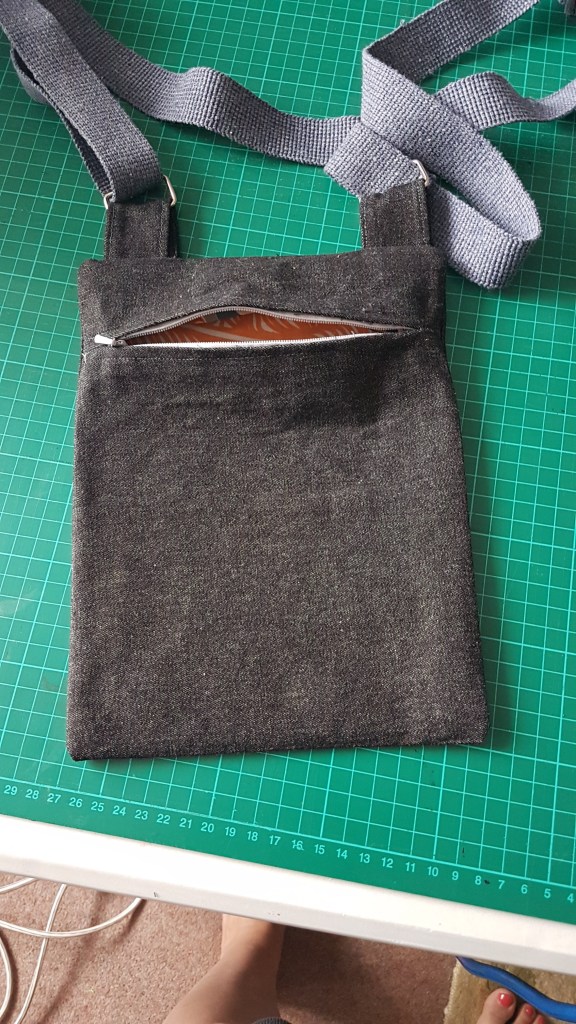
I carried on the sewing yesterday: a cross-body bag for the rare occasions I am pocketless, and a Rad Patterns Lucky Lingerie bra that I’d cut out a while ago. The bag was from The Book of Bags by Cheryl Owen, which I won in a magazine draw ages ago (I think) and that did need new techniques: inset zip and inserting a lining. Tricky but I like the end result. I also threaded my overlocker for today’s sewing, and loaded bobbins with black thread, so I am prepped for more creative adventures today!

Making me happy this week:

  1. the Africa Fashion exhibition at the V&A and seeing some of my favourite young people from Spotlight
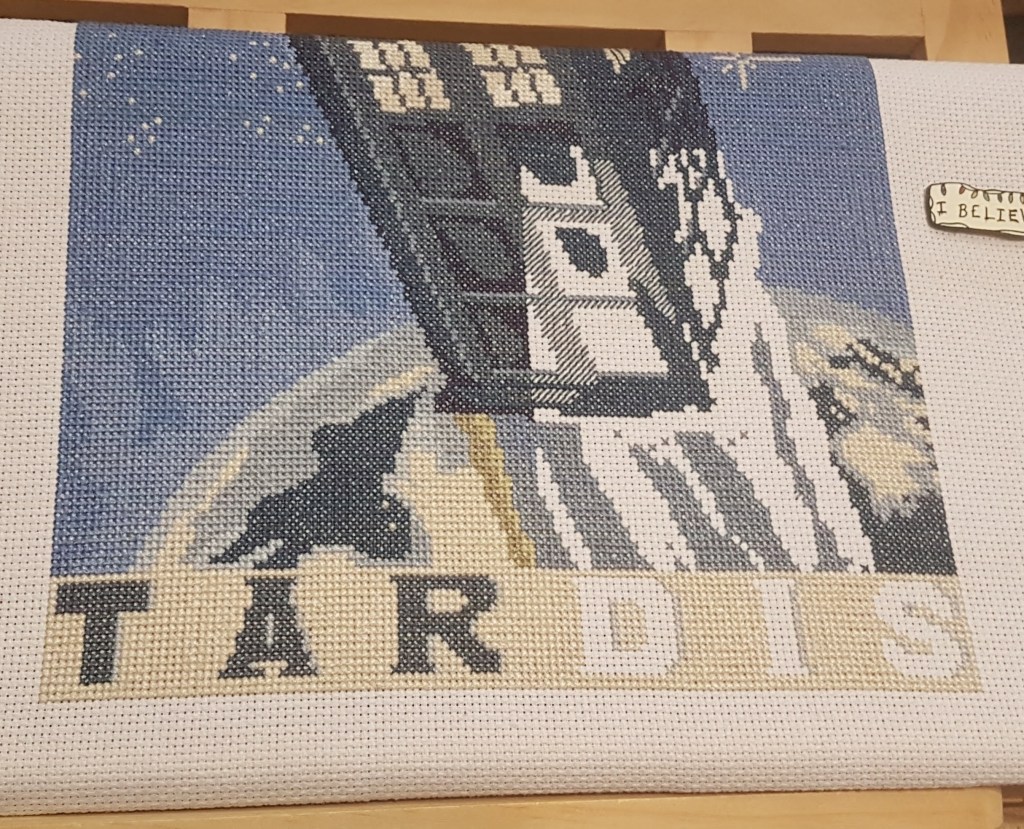
  2. Working on the Travel by Tardis cross stitch from Country Magic Stitch
  3. Seeing J’s face when I handed over his new GIANT dice bag

That’s all, folks – I have to go and get my bathers on!

Kirsty x

What I’ve been reading:

Moonglow/The Yiddish Policemen’s Union – Michael Chabon

The Running Hare – John Lewis-Stempel

103: self-indulgent sewing

This week has mostly been about resetting my brain, one way or another – as you’ll have seen in previous posts, it’s been a busy few months with various work projects and all the other things that go with being a mostly-functioning adult. I took a couple of days off mid-week, as for the first time in many years I was in danger of having too many days to carry over into the next leave year.

As these were days just for me, I took them ‘off-off’, as opposed to making a list of practical things I needed to do – you know, opticians appointments, running errands and so on – and planned a sewing project. Folkwear Patterns, one of my favourite companies for a good dramatic piece, have recently published a jacket pattern in their new Basics range which I liked the shape of. I do love a ‘statement’ piece, as fashion magazines would say.

“A collection of simple patterns based on the premise of folk clothing, these pieces are easy to sew, easy to fit, comfortable to move and work in, and are a great canvas for creativity.  Make these pieces simple and plain or embellish till your heart’s content.”

https://www.folkwear.com/collections/basics

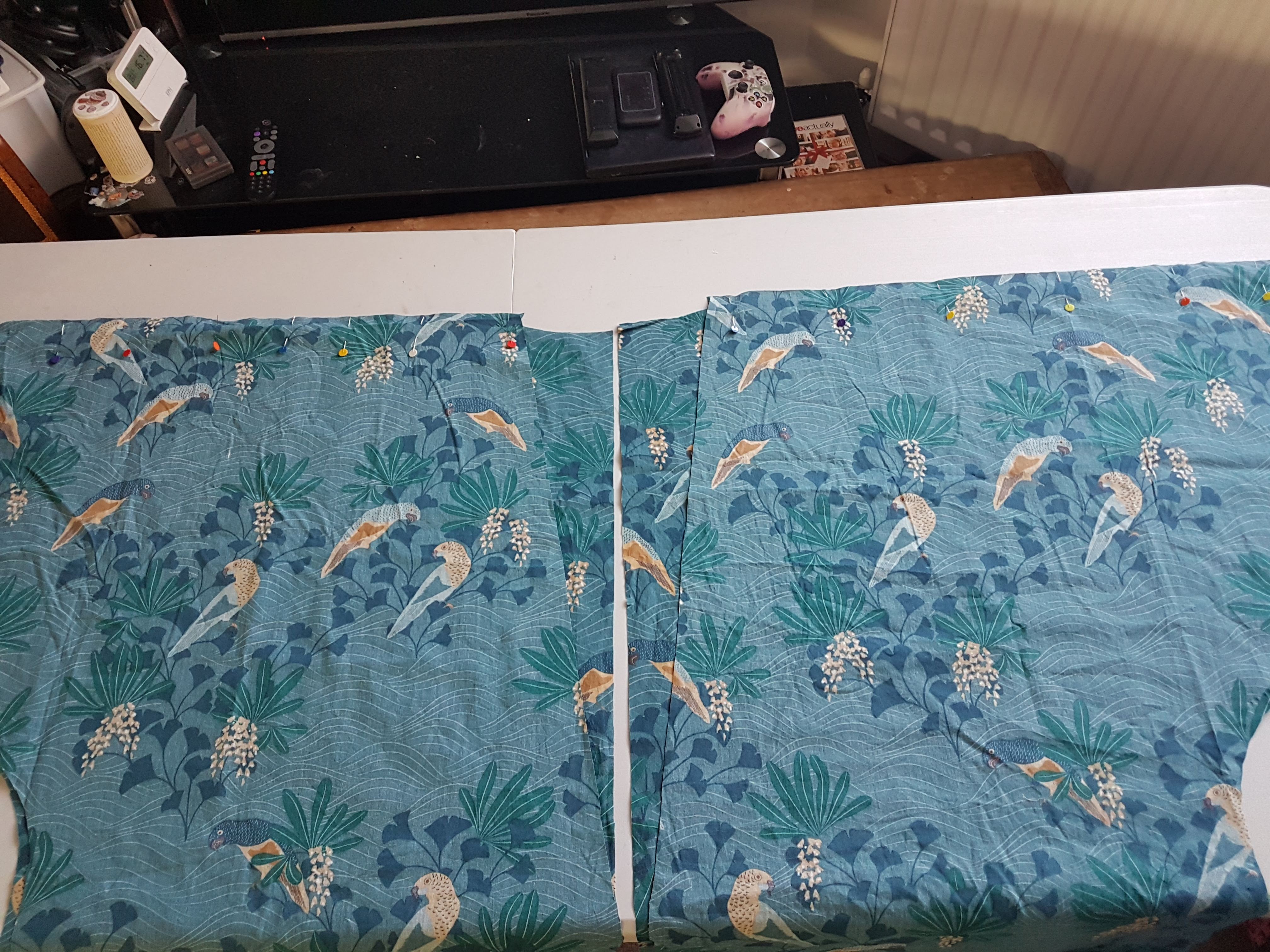
Another thing I’d been keen to try after my adventures in patchwork during lockdown was to make a quilted piece of clothing, so with a straightforward pattern this seemed a good time to try it. Seamwork, which also has an excellent range of patterns, has a link to a tutorial for making on how to quilt fabrics for garments so I headed there for some help.

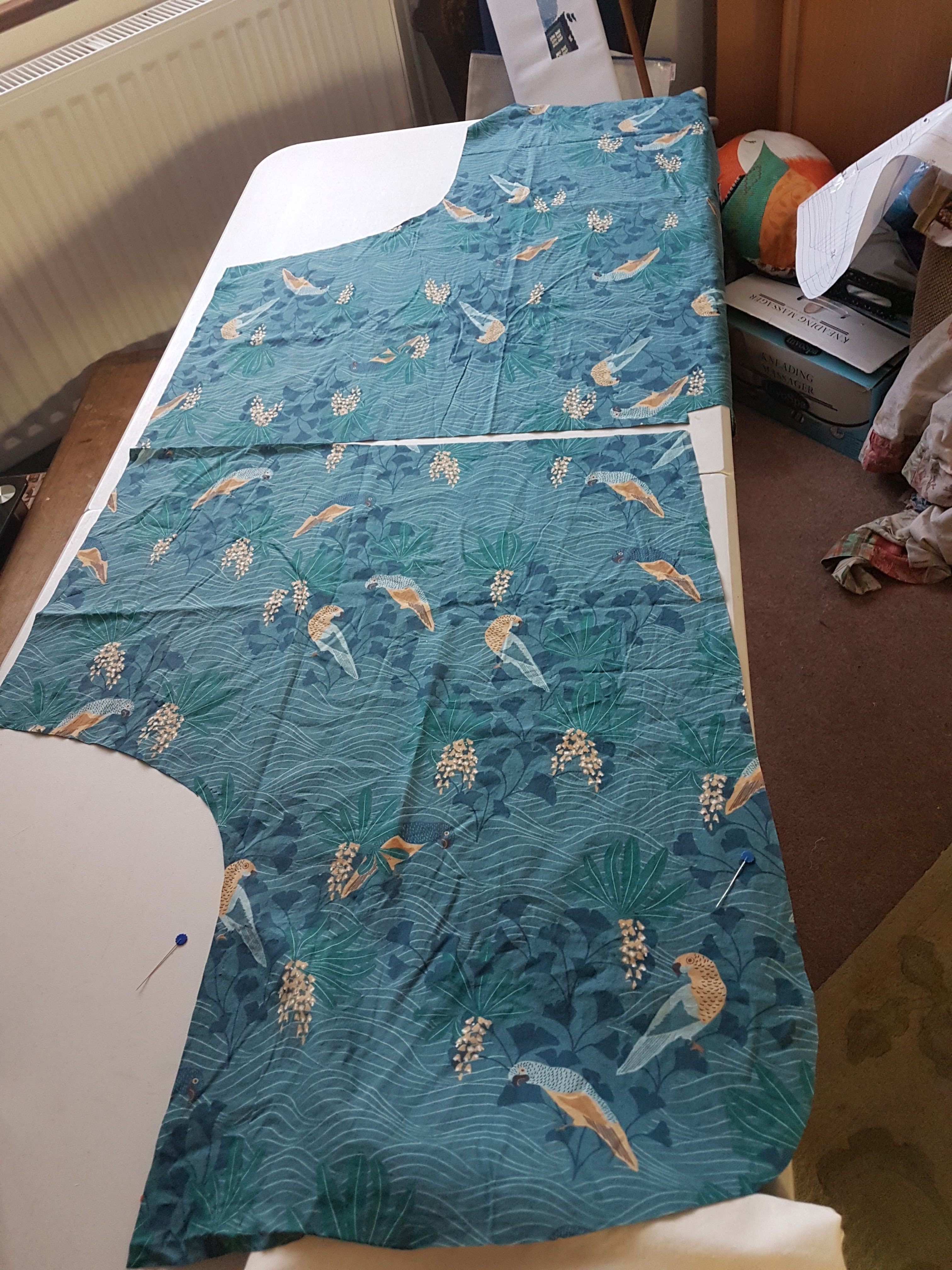
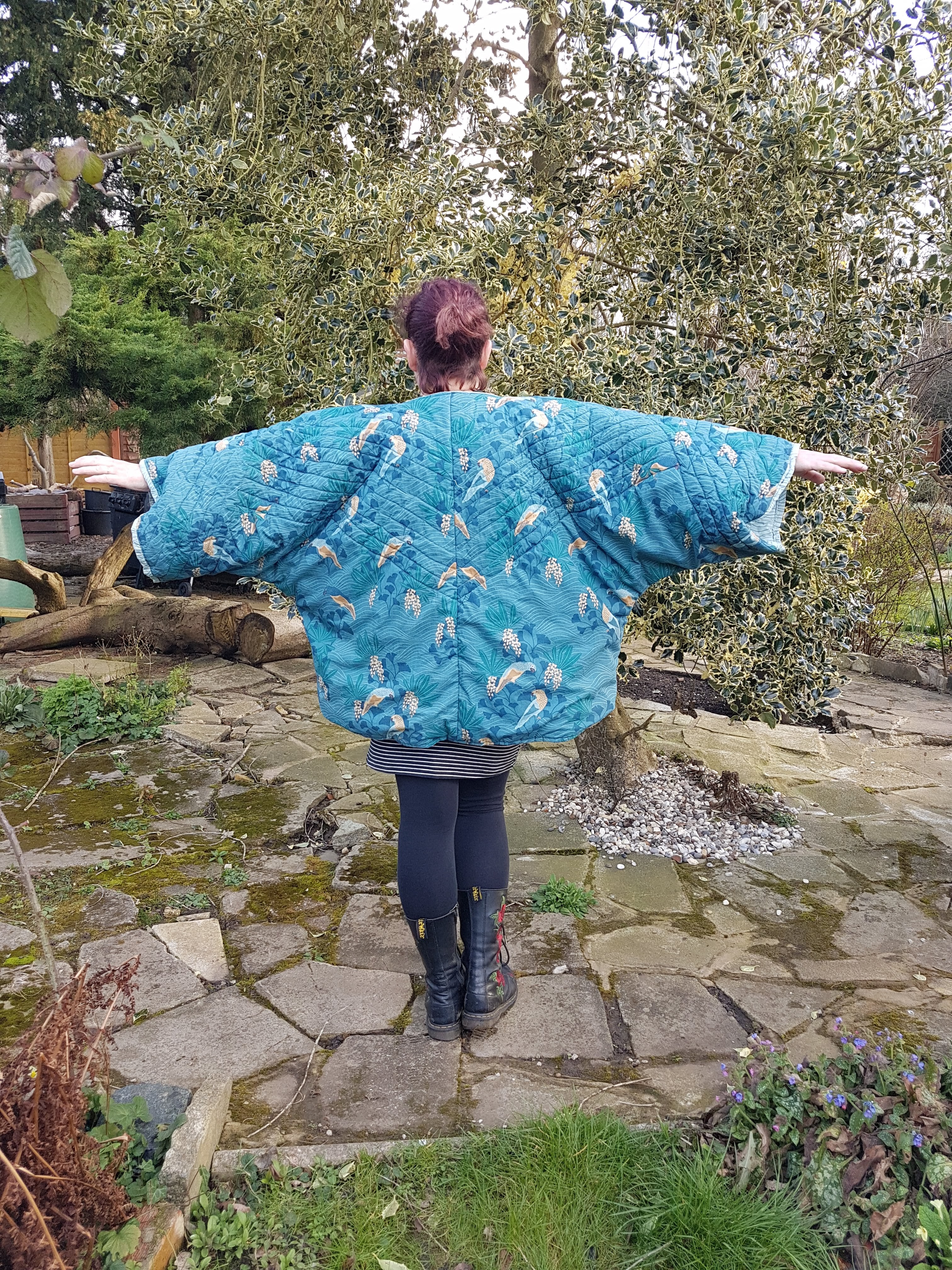
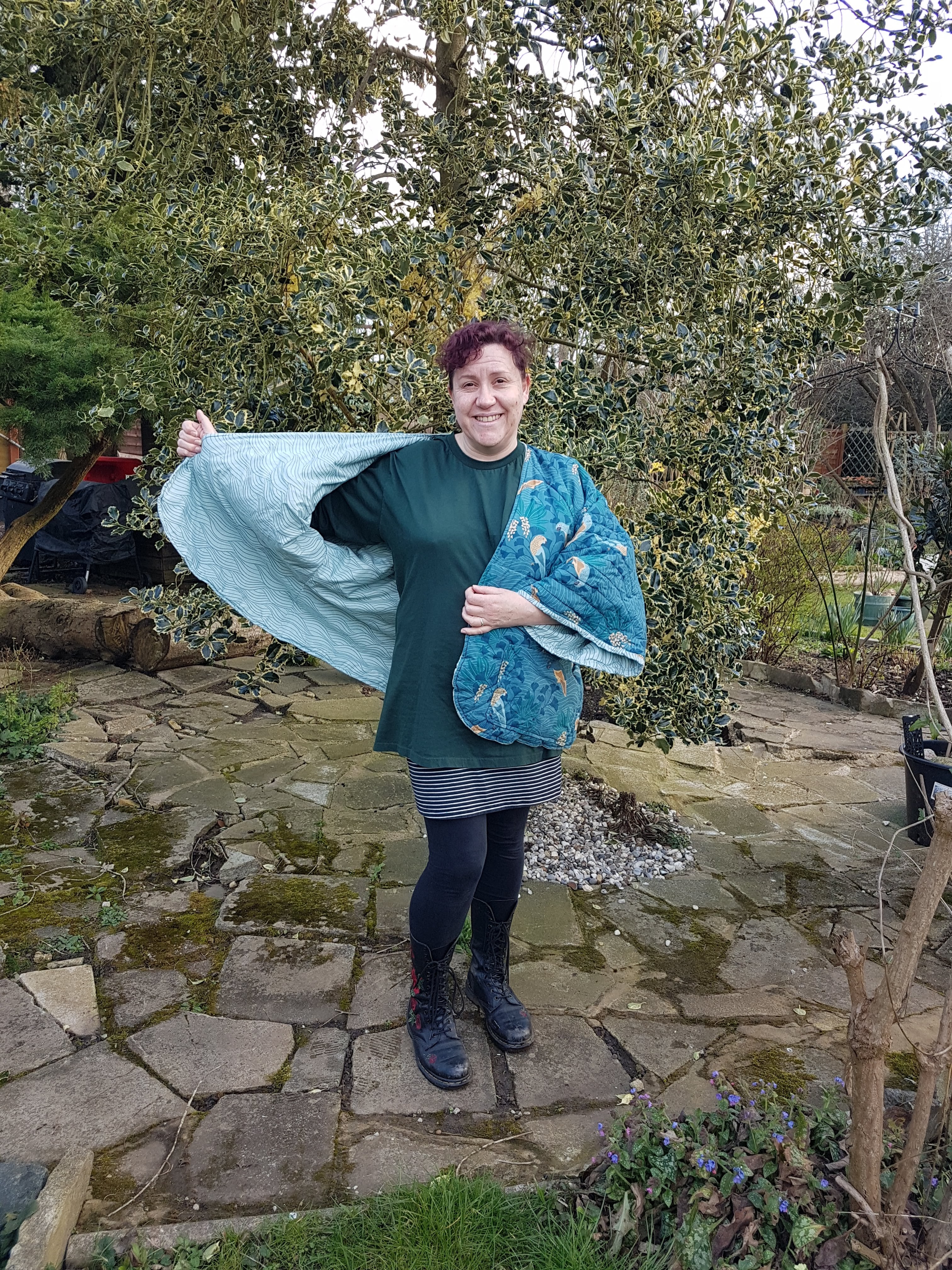
The first issue I ran into was fabric choice – the pattern, as the front and back are cut as a single piece, isn’t suitable for a one-way print. The fabric I wanted to use for the outer layer – a double duvet cover in a dark teal green, with parrots and leaves – was (of course) a one-way print so I had to do a bit of cutting and sticking before I could sew. Pretty simple – I found the shoulder line, sliced the pattern along it and cut the back and front separately before sewing them back together and treating them as a single piece. Next time, I’ll remember to cut out the lining pieces before I cut the pattern so I don’t have to stick it back together! I chose to cut two sizes larger than my actual size, as I wasn’t sure how much room I’d lose when I quilted it. For the bottom of the quilt sandwich I used a polycotton sheet, as it wouldn’t be seen and was pretty much the same weight as the outer.

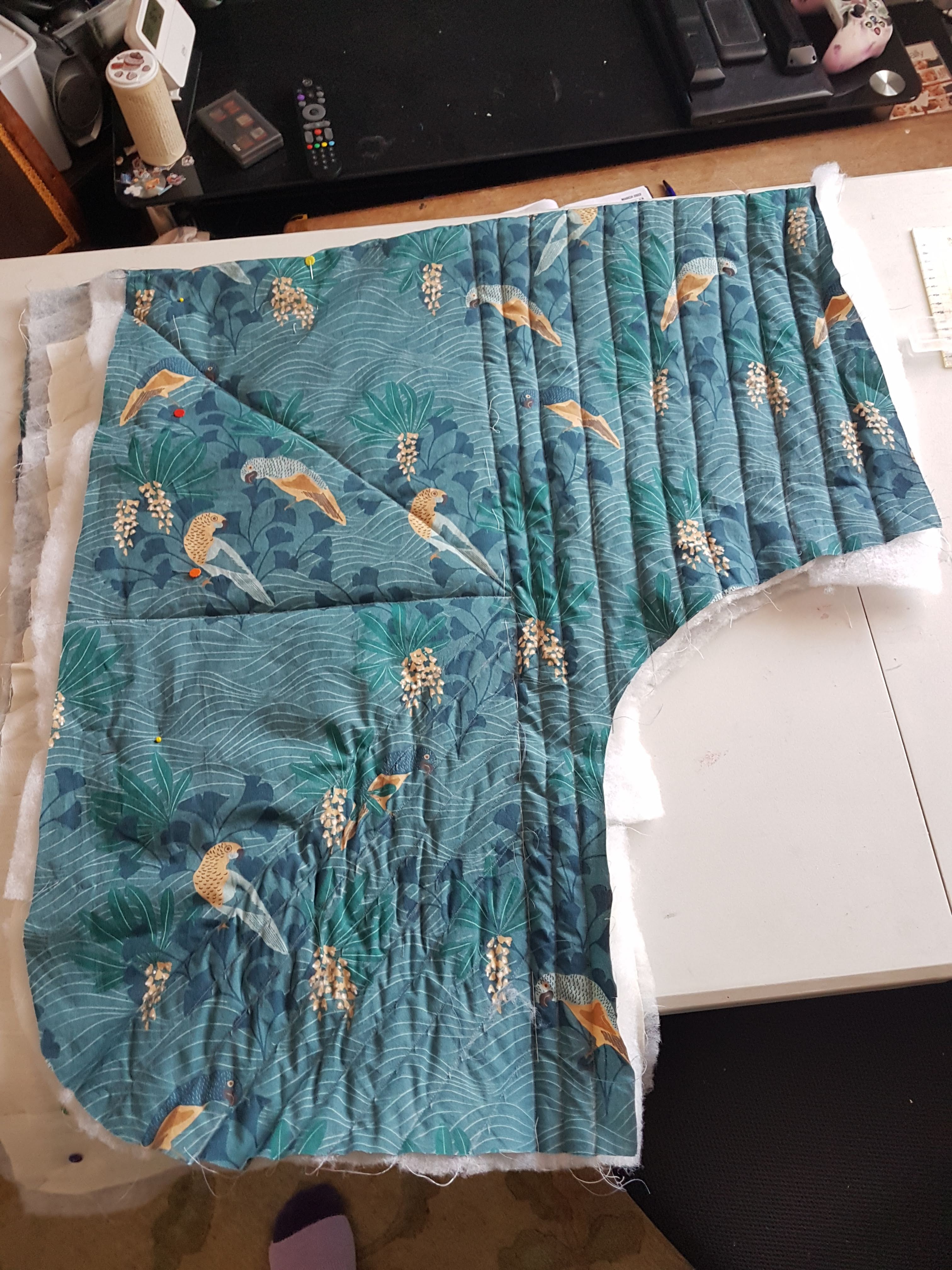
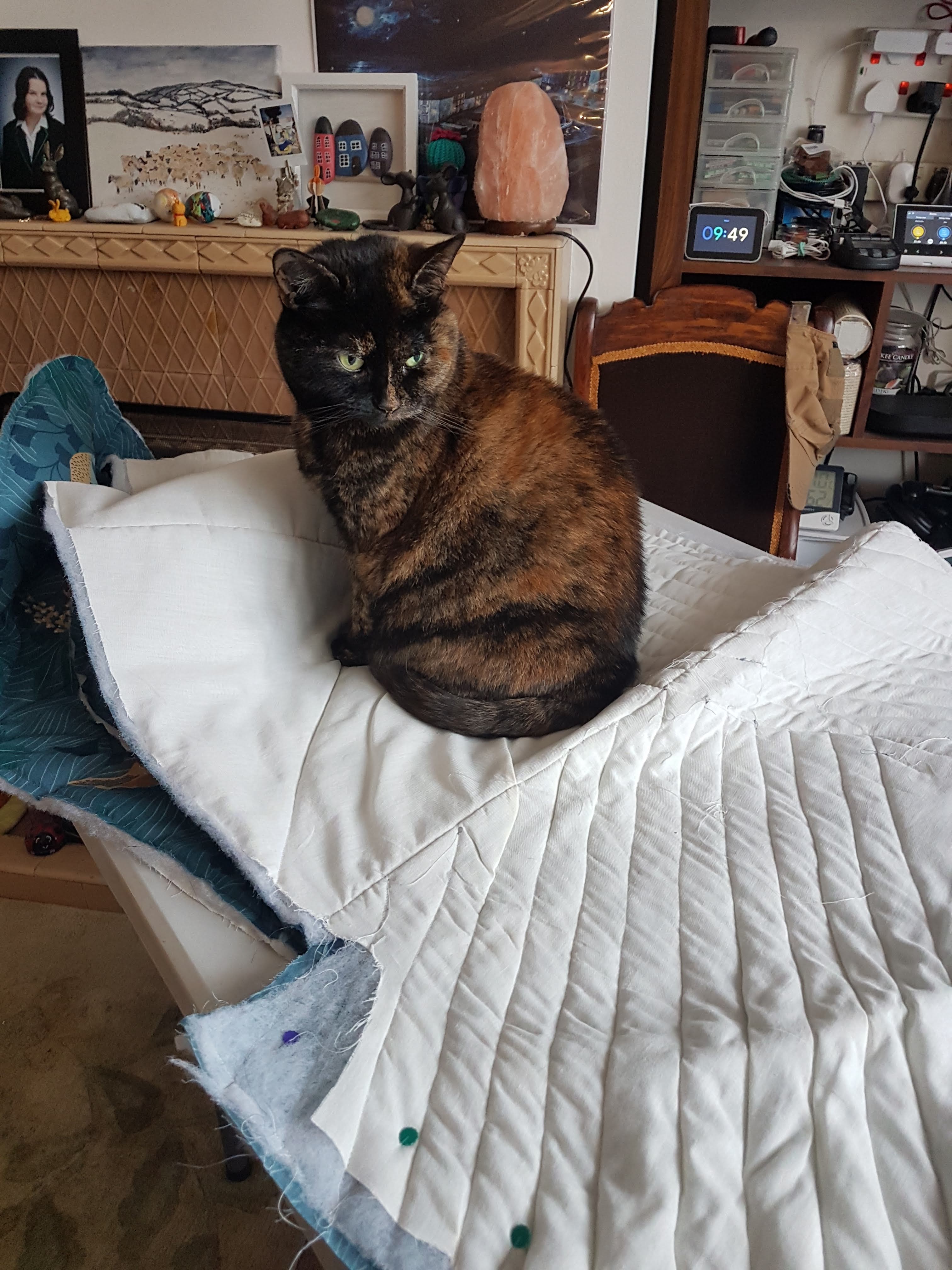
Once I’d cut all the bits out I started following the quilting tutorial, and never have I been so relieved that a garment had a full lining. I didn’t use enough pins/clips/nails/double sided sticky tape to hold the ‘sandwich’ together so the sheeting moved around like mad, bunching up and generally teaching me not to be lazy with my pinning. Luckily the aforementioned lining hides the disaster inside. I didn’t have quite enough batting to use single pieces, so one side is very much pieced together! Another reason to be glad of the lining….

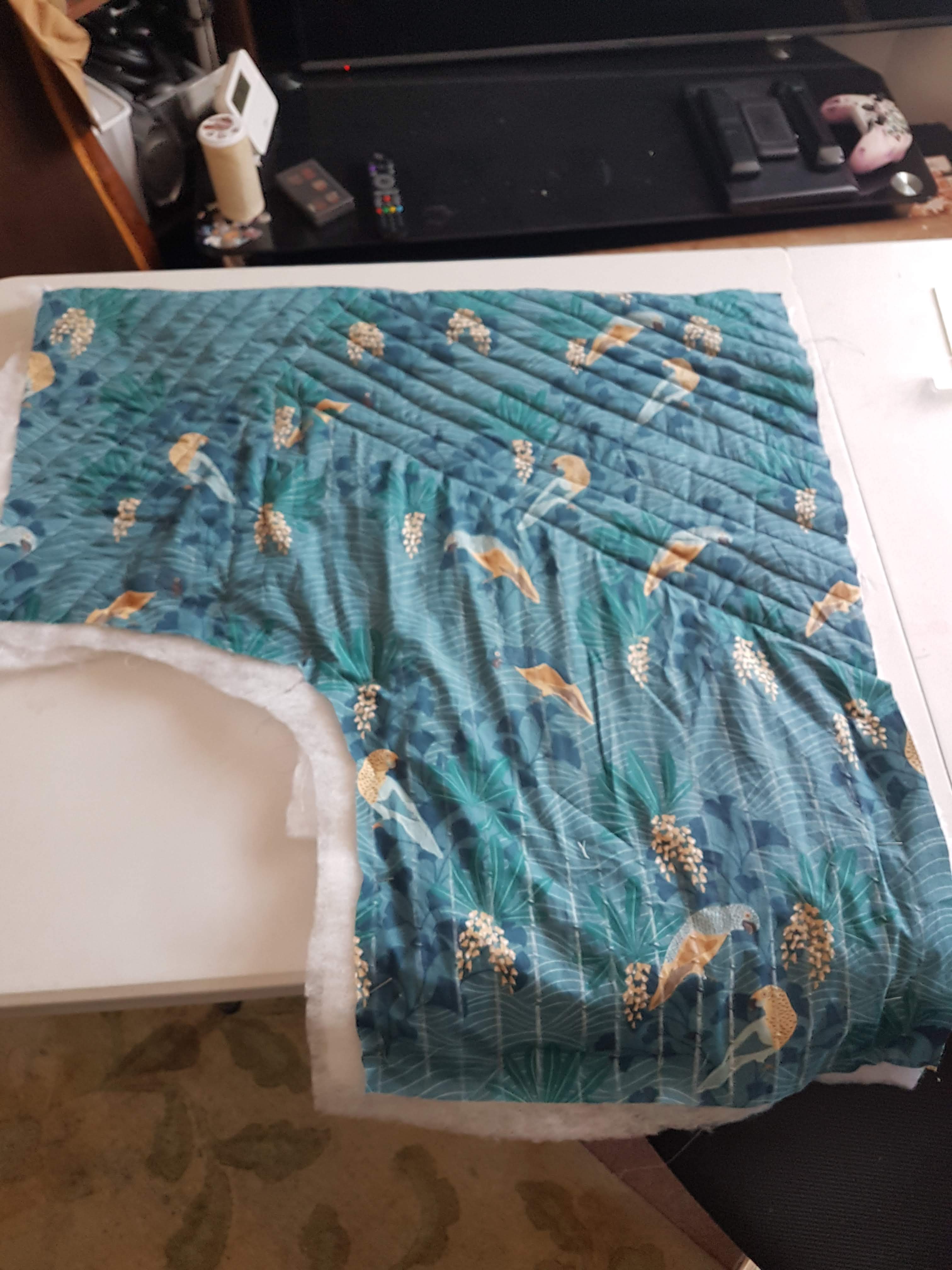
I chose to quilt in straight lines, but only did small sections at a time so I could change the direction of the lines. You can see the front and back sections above – the chalk marks on the back are where I changed my mind and decided to leave sections unquilted as I liked the effect. The angles marked on my quilting ruler were very helpful here. The pattern isn’t symmetrical across the left and right halves of the jacket but the patterns and lines are roughly the same. I really liked the vertical quilting on the front sleeves and the ‘V’ shapes on the back.

Having quilted the bottom half of the front it dawned on me that I hadn’t accounted for the pockets which would cover my lines, so before I added the pockets I lined them up, marked lines on them and stitched ‘mock quilt’ lines so they’d fit in. I decided to change the pocket opening as well, as the side opening pockets looked as if everything would fall out. They’d be great for hands but not so good for things like keys, phones, pet dragons, shiny rocks, emergency waffles and so on. I went for a top opening – they’re very generous pockets, too, which is always good.

Day two was about construction. I trimmed the lining to match the outer, to take account of the quilting. Sewing the jacket together was very straightforward with only three seams (underarm/side and back) on each layer. The lining was attached with a single seam around the neckline and bottom hem, and then the sleeves were bound and the pockets added. I topstitched all around the hemline, threw the whole thing in the washer and dryer to get rid of the chalk marks and to fluff up the batting, and then gave it a press.

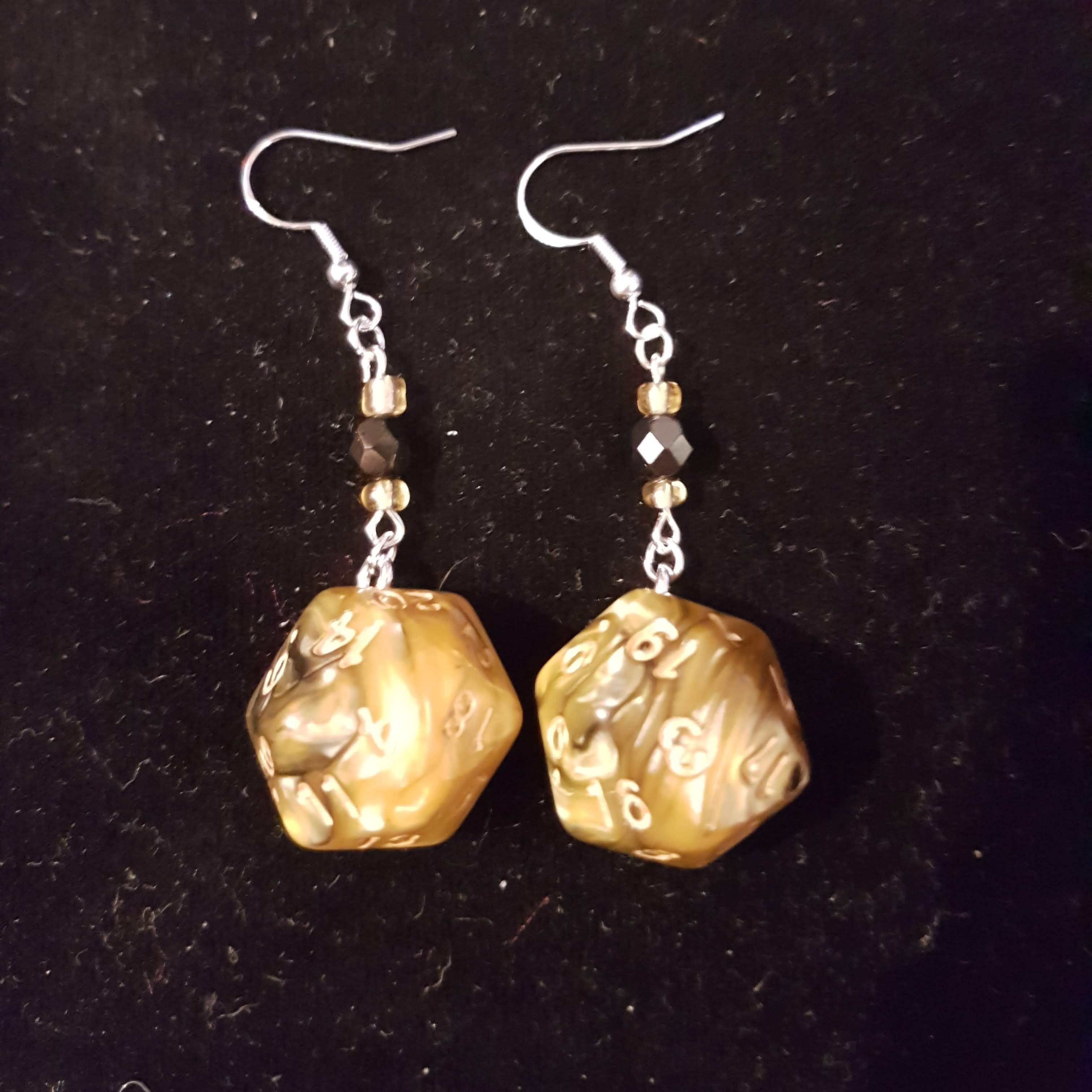
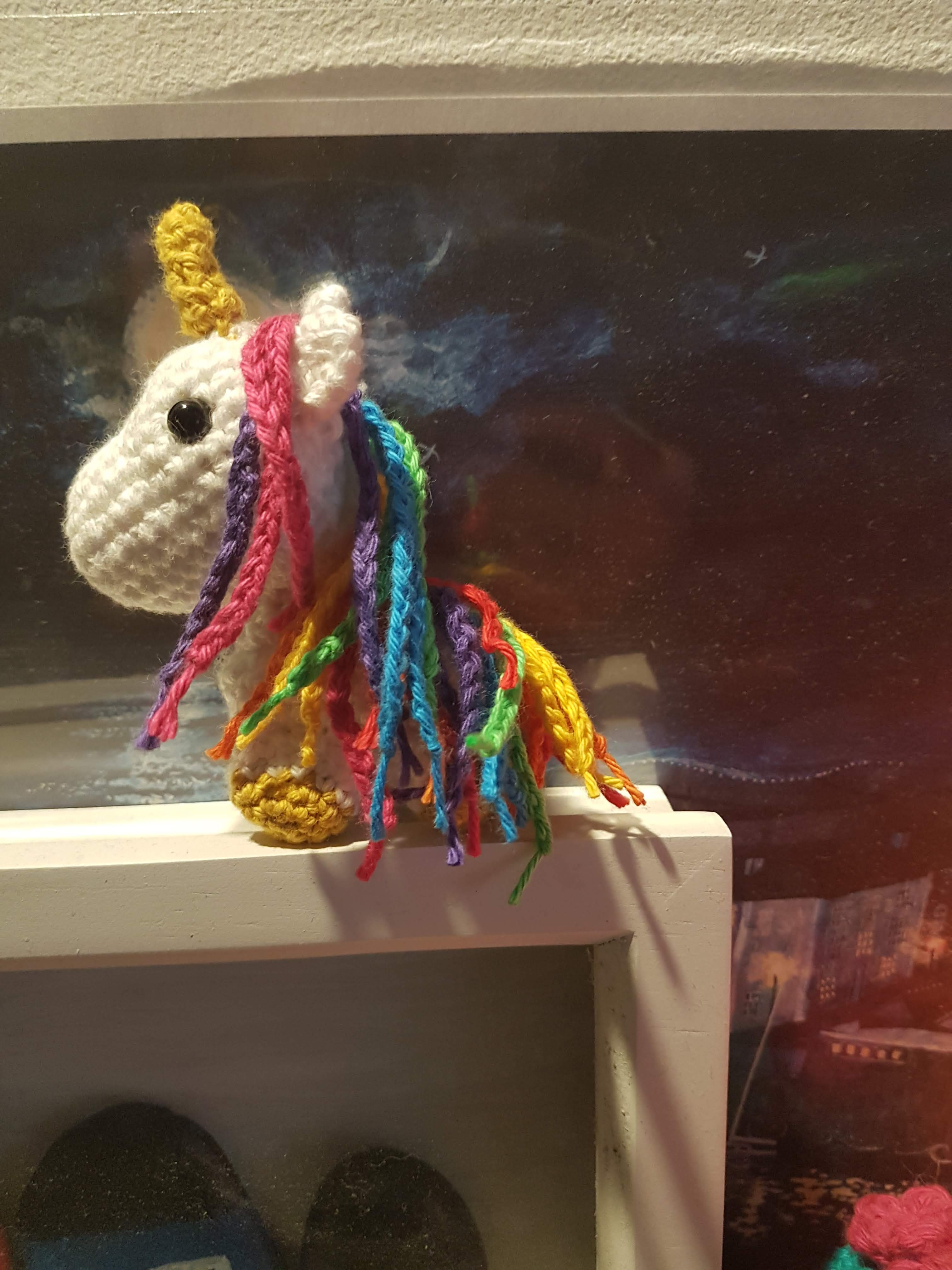
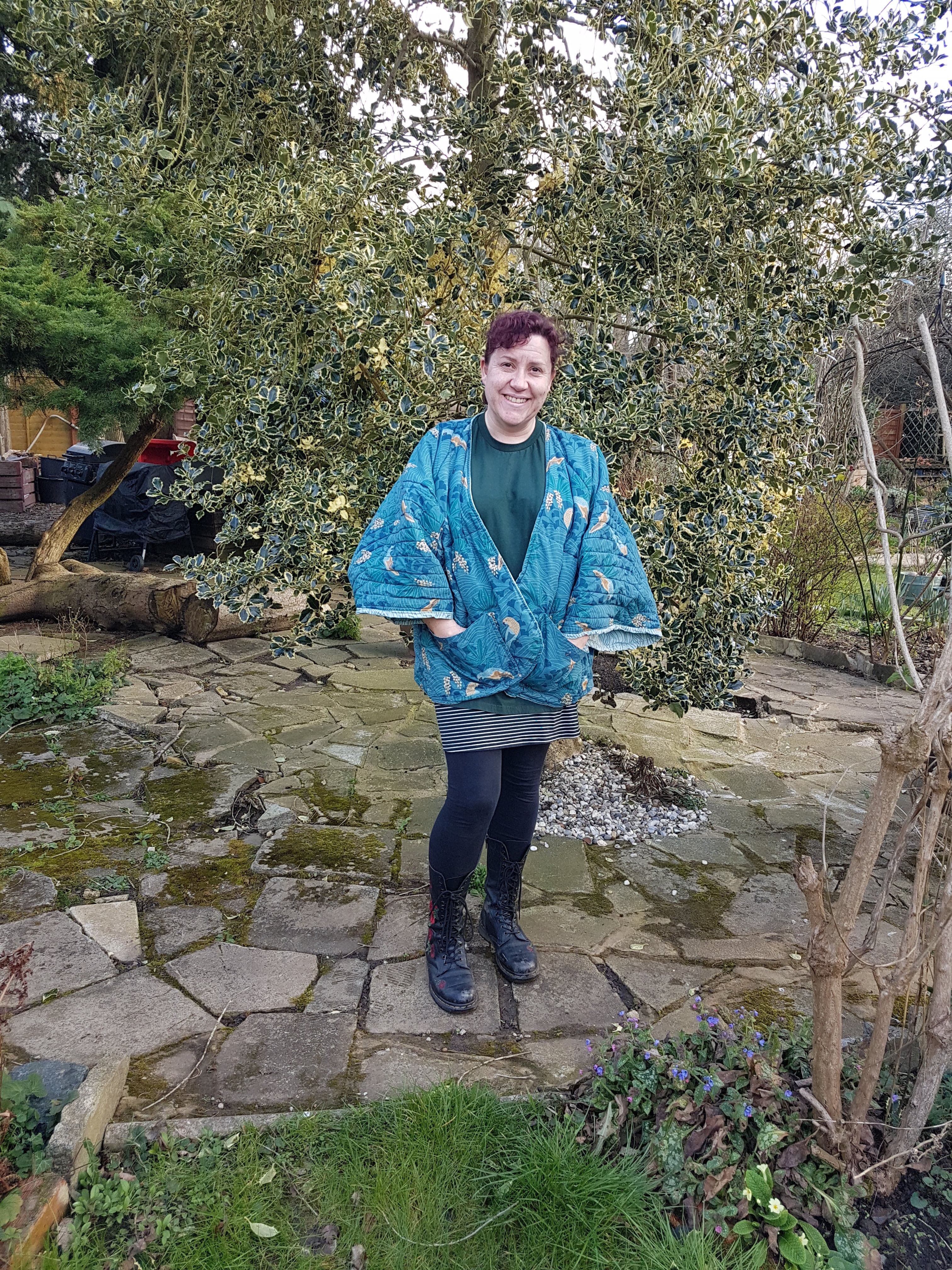
Having convinced Thing 1 to take some photos for me, I was all done – two days of singing along to loud music (classic rock and ska punk, mostly) and sewing something that’s made me really happy. It’s great to throw on, it’s lovely and warm and has big pockets as well as being dramatic enough for stalking the galleries of the V&A – you know you’ve nailed it when a visitor asks where you got it from. I teamed it with a black skater dress (also made by me) and a pair of platform boots – and new earrings also made this week. You can see them below, along with the alpaca beret (from one of the crochet mags) and a rainbow tinycorn.

I’ve also finished the Mental Health First Aid qualification I was doing, and went for a long walk with friends that ended up with toasted teacake and hot chocolate with a mountain of cream and marshmallows at the market. Last night was a meal out with some girlfriends at the local Indian restaurant – it’s been far too long since we’ve done that!

And now I’m off for a long bath….

Kirsty x

What I’ve been reading:

The Kept Woman – Karin Slaughter

The Music Shop – Rachel Joyce

Influential Magic – Deanna Chase

Doctor Who: Tenth Doctor Novels vol 2 (Audible)

100: What I did in half term

This feels like a pretty momentous week, what with it being my 100th blog post and so on, but in reality it’s been one where I have mostly been unconscious at 8.30pm every night after a full-on day – yes, even on Friday when London was being battered by Storm Eunice, for which I have been soundly told off by the clan.

As I may have mentioned once or twice before, the museum I work for is in the middle of a spectacular reinvention and part of the process is making sure we have young voices throughout the museum, reflecting what’s important to them in the 21st century and co-creating work with them which will be on display. I am attached to the Design gallery, where we are exploring some key messages – one of which is around sustainability. Our target age range (though anyone can use the space) is 11-14, and so we’re working with a local youth service called Spotlight.

Spotlight is the sort of youth space that I would have loved to have access to growing up (heck, I’m pretty keen on it now!). It has media spaces like a radio station and tech rooms, a boxing gym, dance studio, cafe, games room, fully equipped music studio, health and wellbeing services on site, friendly and accessible youth workers who have a great relationship with the young people and (where we’ve been working this week) an art and fashion studio. This last is underused, as it’s a space where the young people aren’t quite sure what they can do in there, but hopefully we’ve changed that this week!

The project kicked off on Tuesday with a trip to the V&A all the way over in South Kensington, with 15 young people, the designer Scott Ramsay Kyle who was the creative on the project, one of our freelance team, a few Spotlight staff and me all on a minicoach bringing back memories of school trips for the adults at least. In stop/start London traffic it was a miracle we only had to pull over once for a girl to be sick, but it was a close call!

The V&A is still closed to the public on Tuesdays so the young people (YP) were in VIP mode – we fed them lunch, where they were joined by our Director and some of the curatorial and learning teams, and then we took them to Gallery 38 where our collection is currently being stored and conserved in preparation for going back on display in 2023 when Young V&A opens. Katy and Trish, two of the curators, showed them some examples of historic clothes and talked them through some of the processes used to make them. The YPs were amazed that sustainability was a ‘thing’ several hundred years ago although not so much in the 1960s. I won’t go into too much detail here as I have to write an ‘official’ blog post about the project soon.

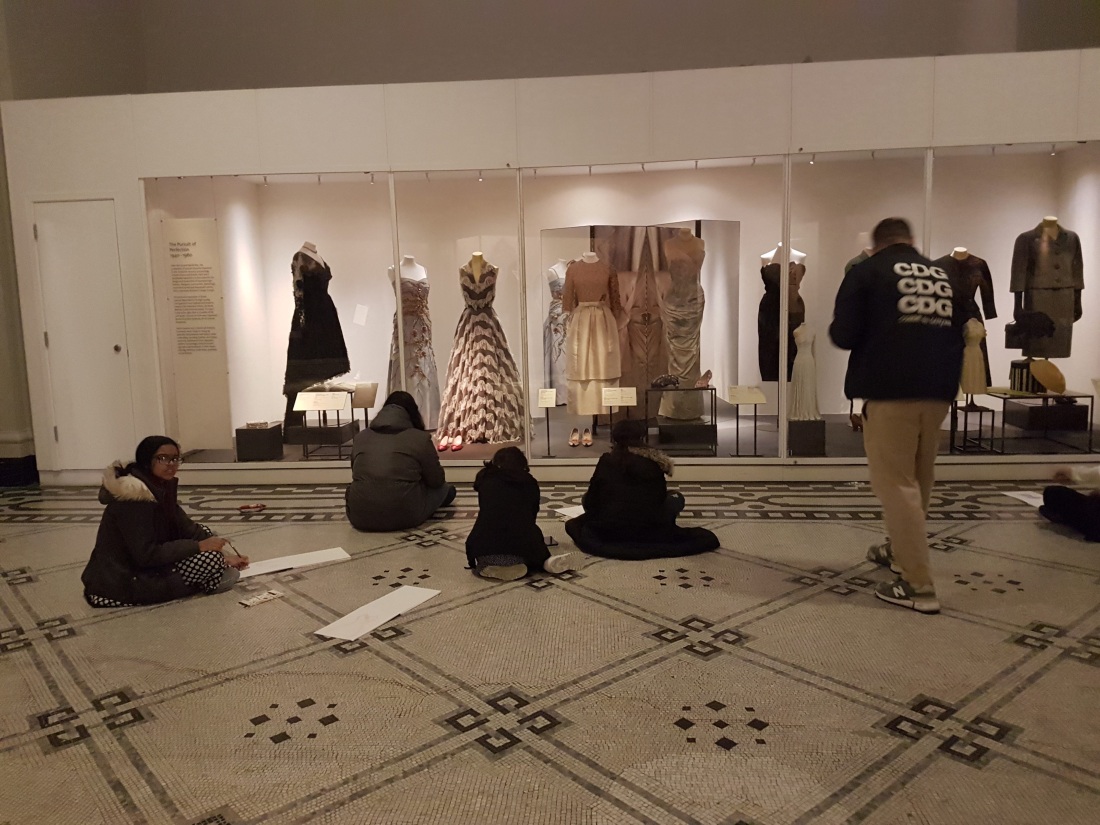
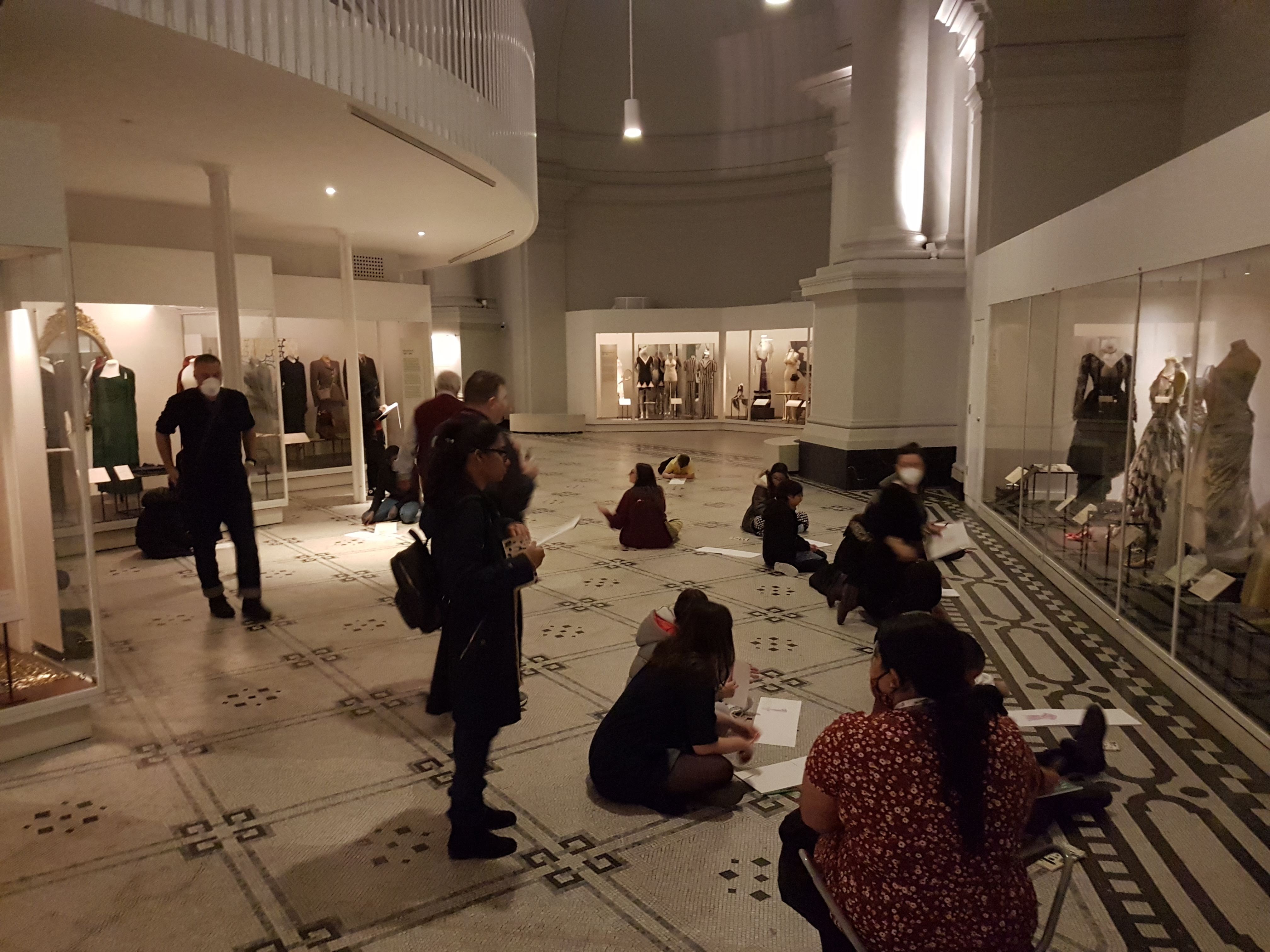
We spent some time in the fashion gallery exploring clothes through the ages, mark making in their new V&A sketchbooks and focusing on detail and embellishment. Watching children and YP make the mental connections between new and existing knowledge is always a joy – the gaggle of Year 8 Bengali girls who had been learning about the East India Company in school spotted a dress made from the very fabric they’d been learning about, which caused a twitter of excitement and recall of history lessons. Only one of the YP had been to the museum before, on the previous project so the space was very new to them. South Kensington is a long way from Poplar both physically and psychologically, and while many had been to the Science Museum or the Natural History Museum the V&A hadn’t figured. Being able to sprawl on the floor to draw, to have access to all the knowledge they needed from curators and to navigate the space on their own terms made the galleries accessible.

VIP access to the fashion gallery

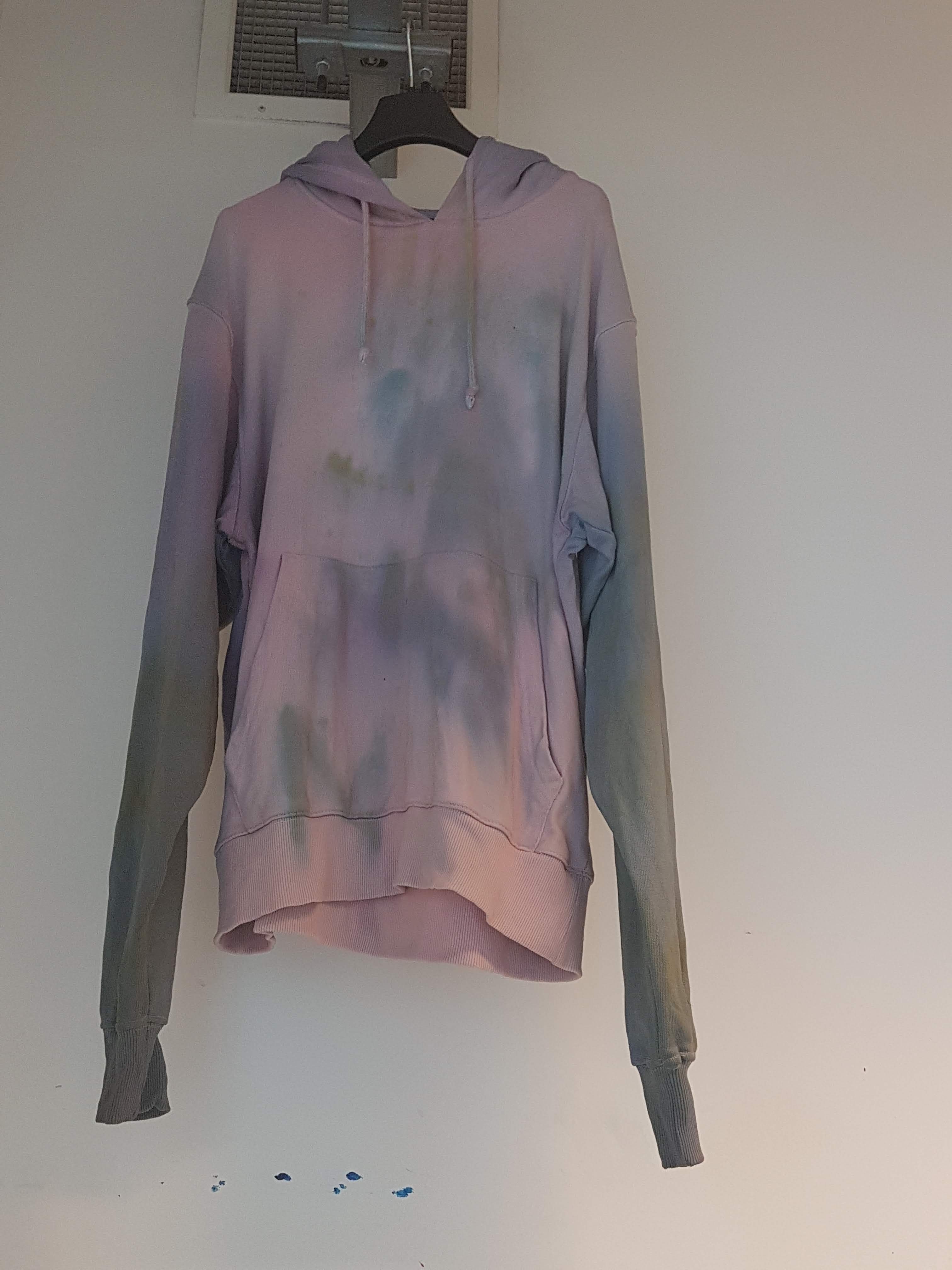
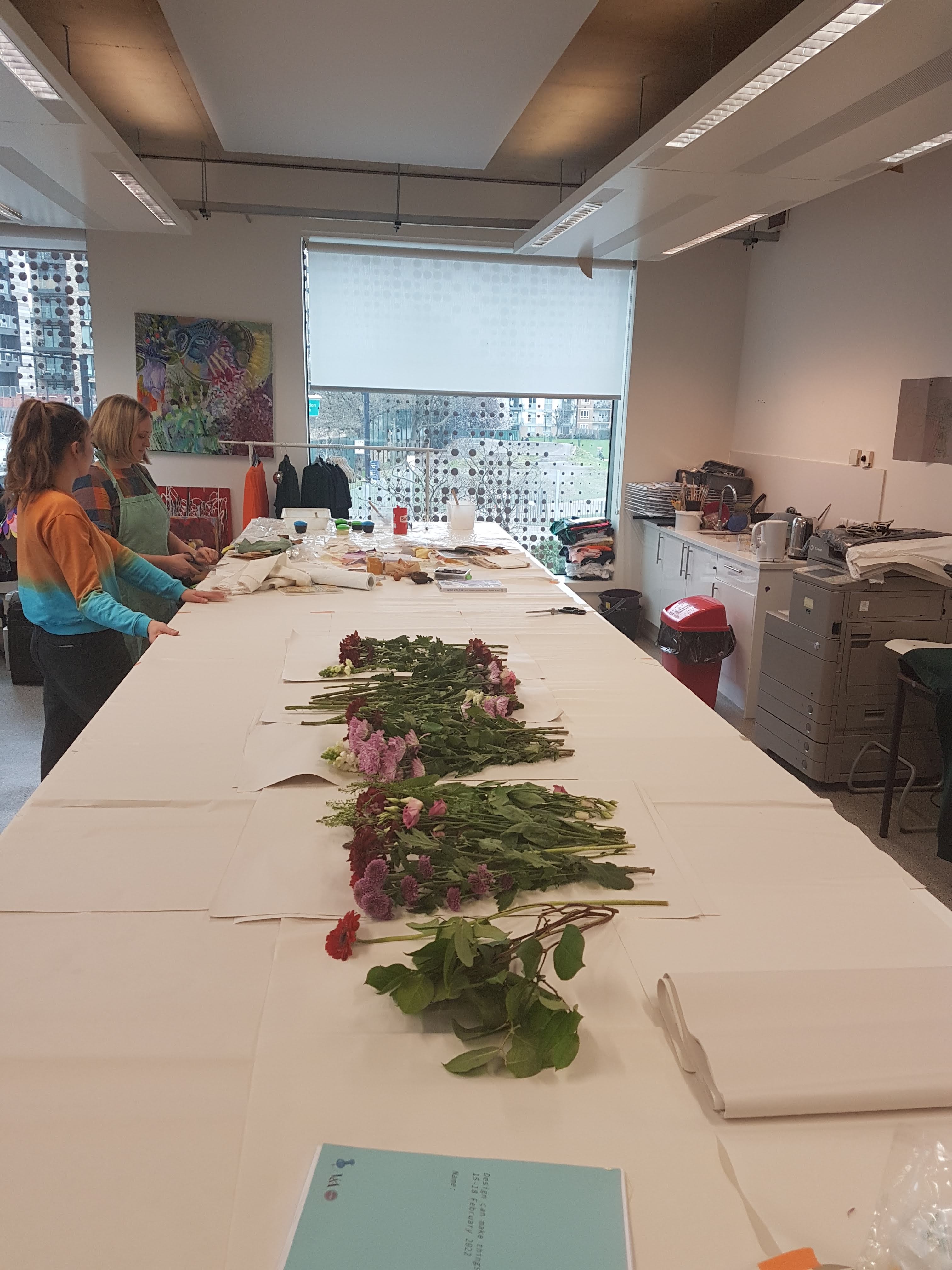
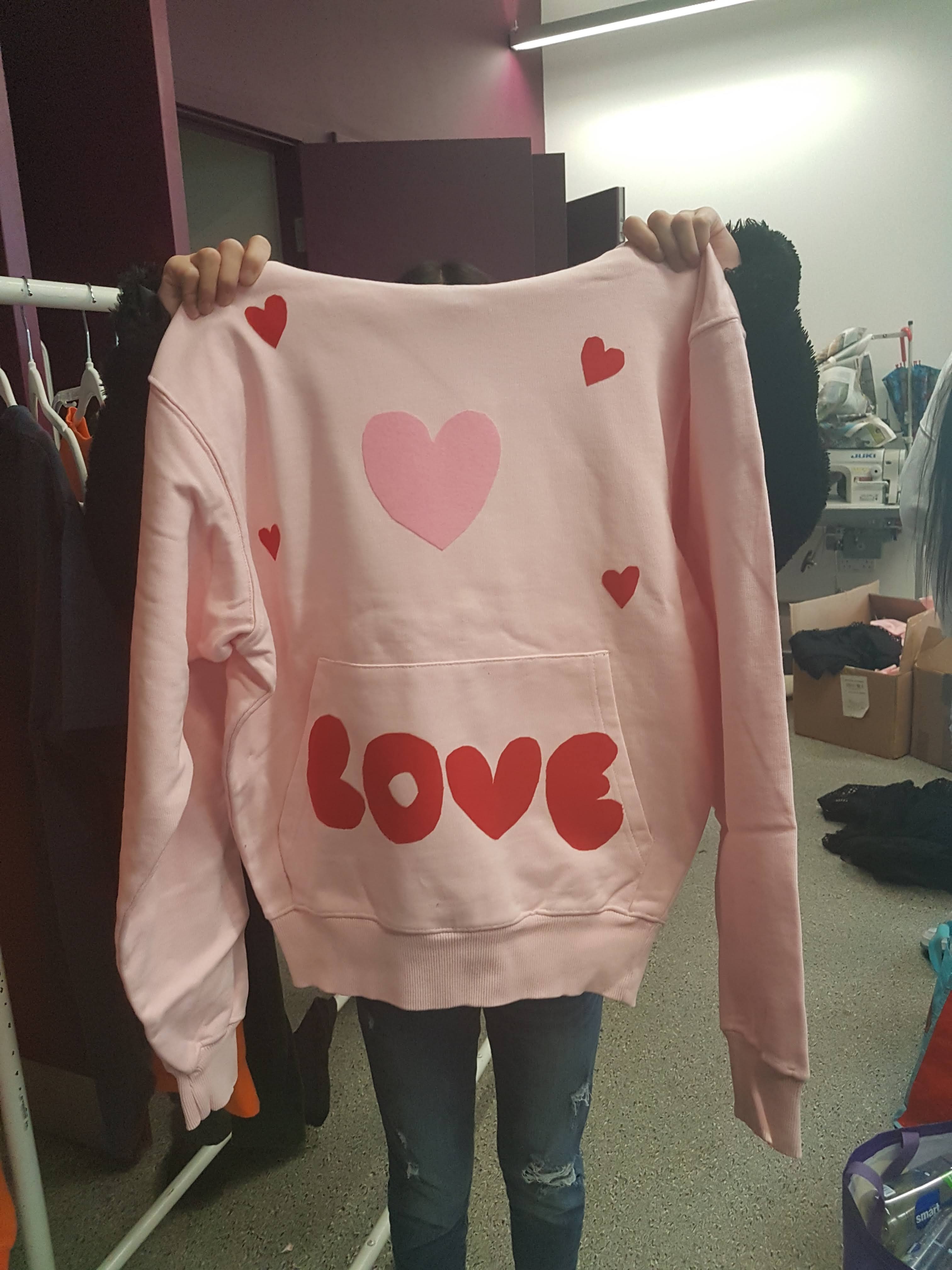
The rest of the week was back at Spotlight with fluctuating numbers of YP – but always a hard core of two or three who came along all week and surprised themselves with what they created. Wednesday was all about fashion and nature, so we worked with two creatives on different aspects of this. Hanna Whiteman explored natural dyes with the YP, helping them create swatches from red cabbage, turmeric and safflower and exploring the effects of different additives. Memunatu Barrie worked from cut flowers and textures found in the park outside, exploring how to create texture and line on paper. We finished up with a dye experiment, hanging the sleeves of a pink hoodie into the dye vats overnight. We only had four YP that day which given the messiness and excitement of the dying was probably a good thing! We were also joined by Maraid Mcewan, our inclusive designer in residence who came along for the rest of the week.

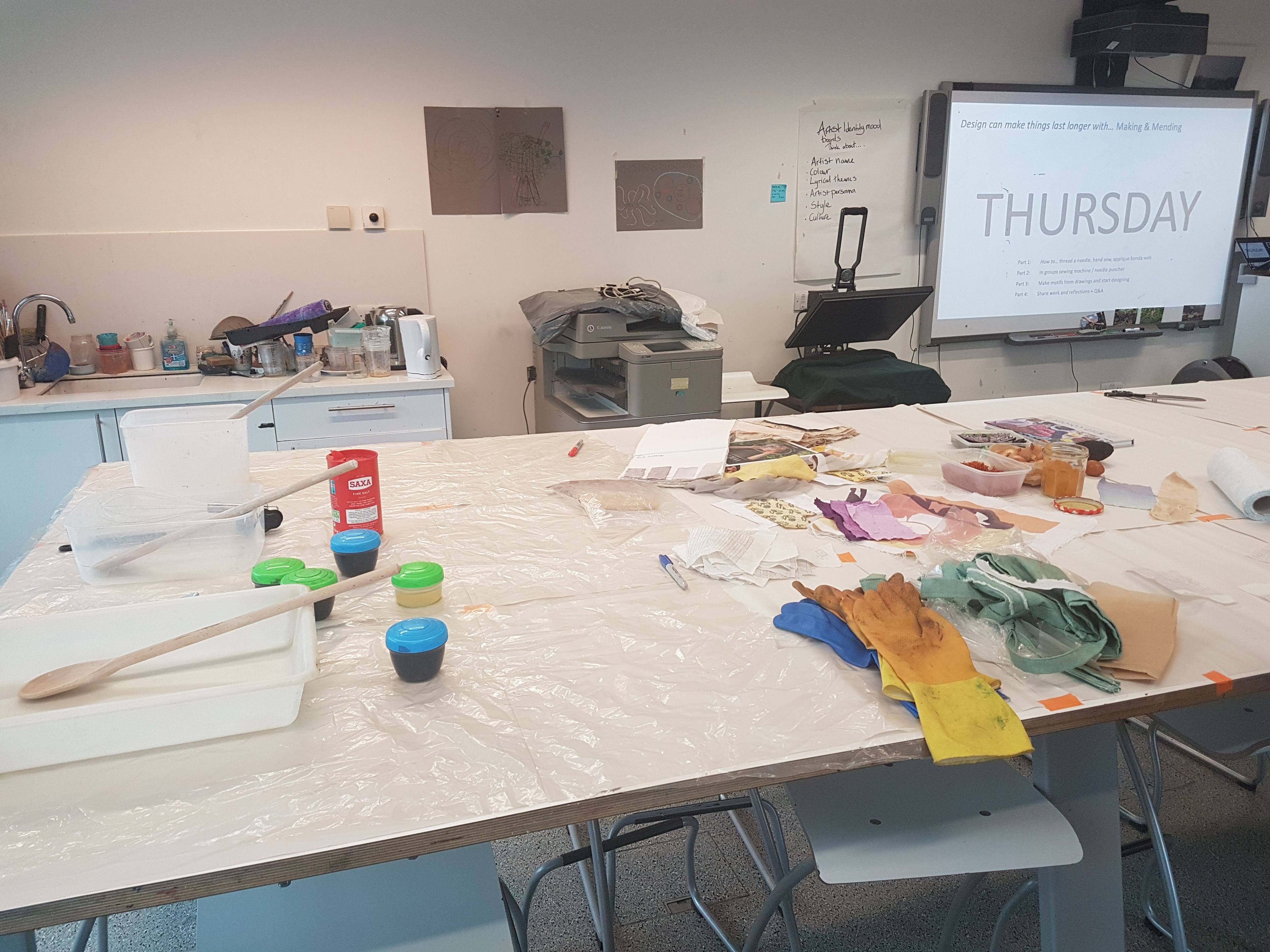
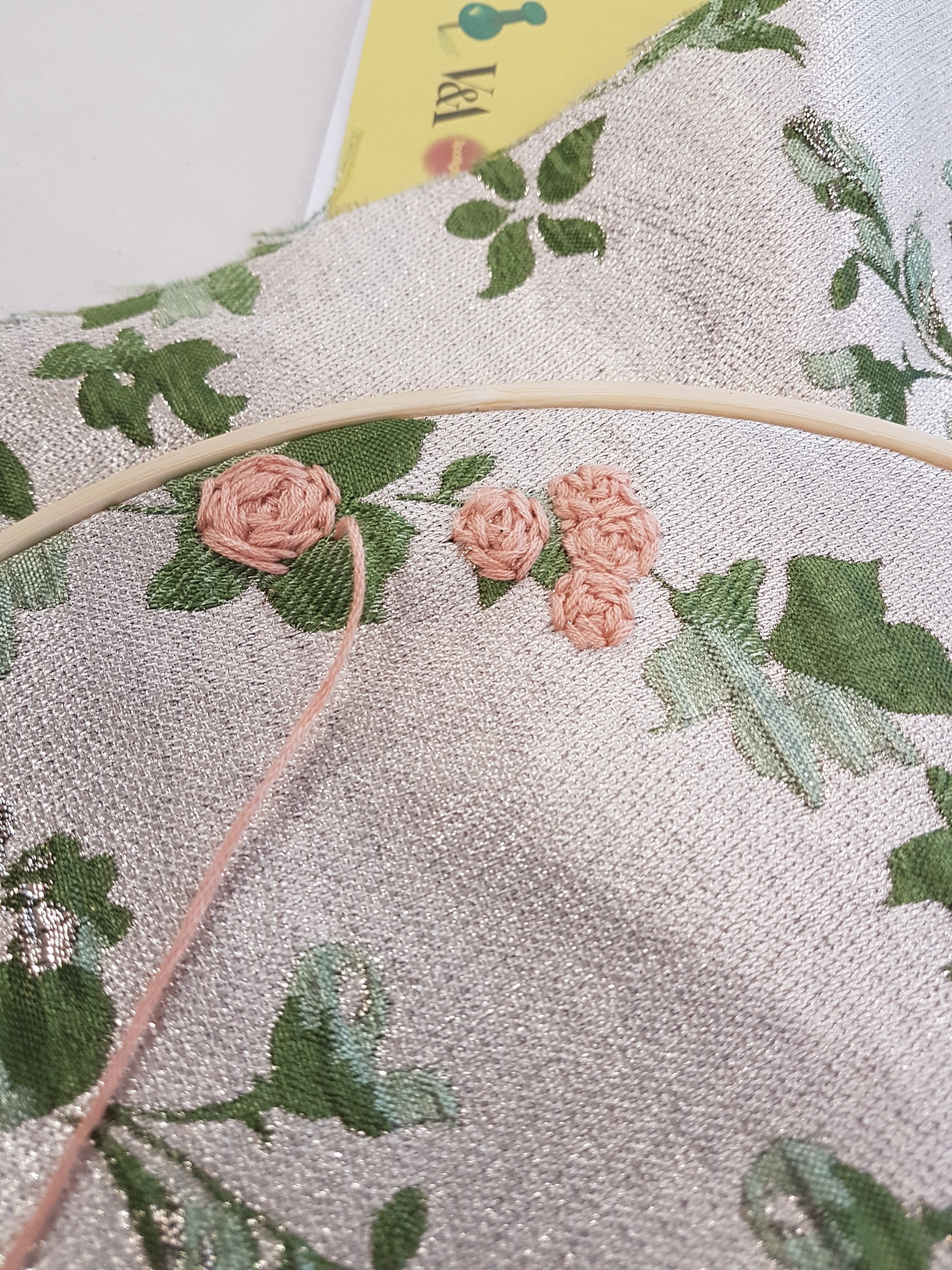
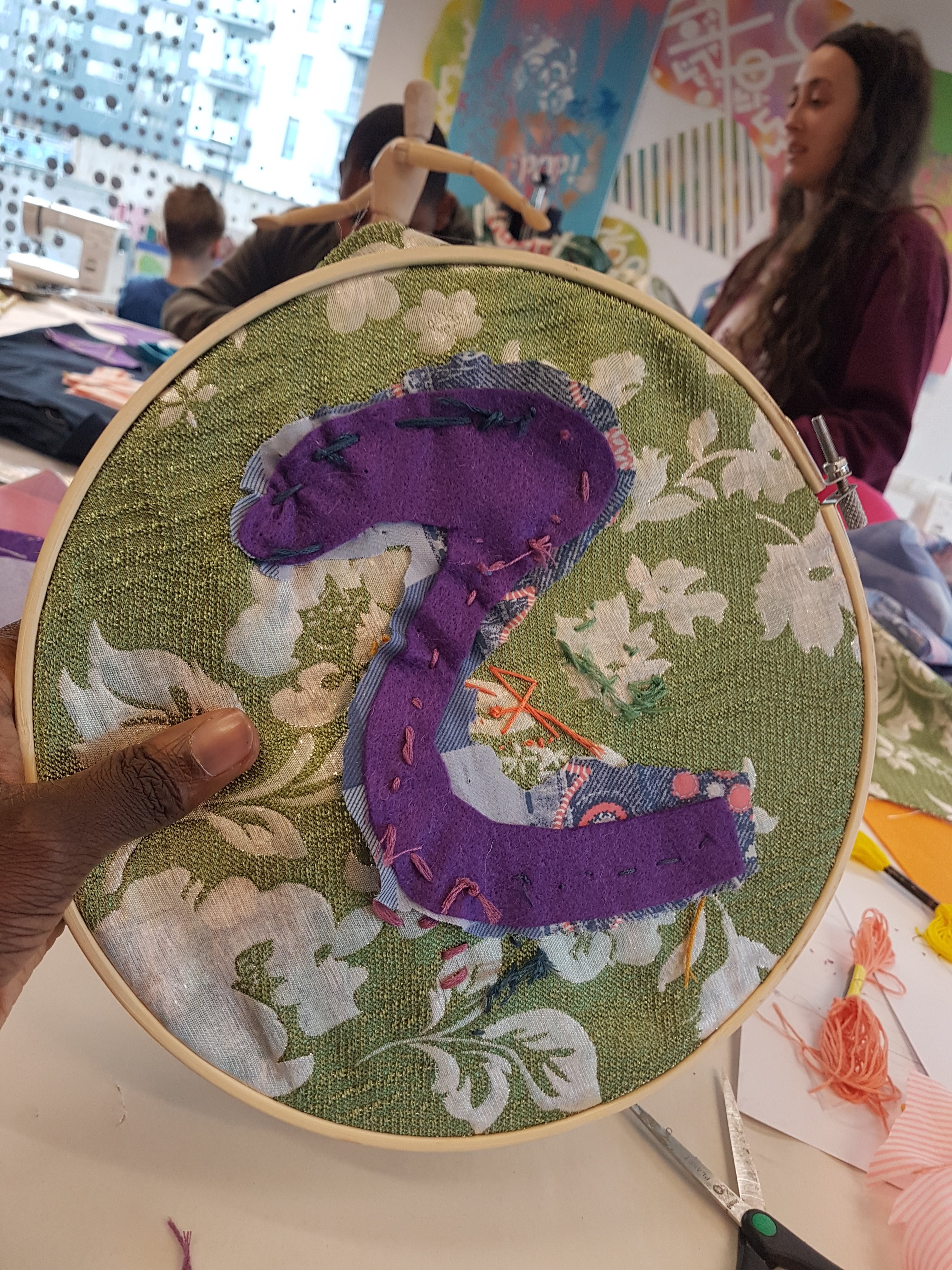
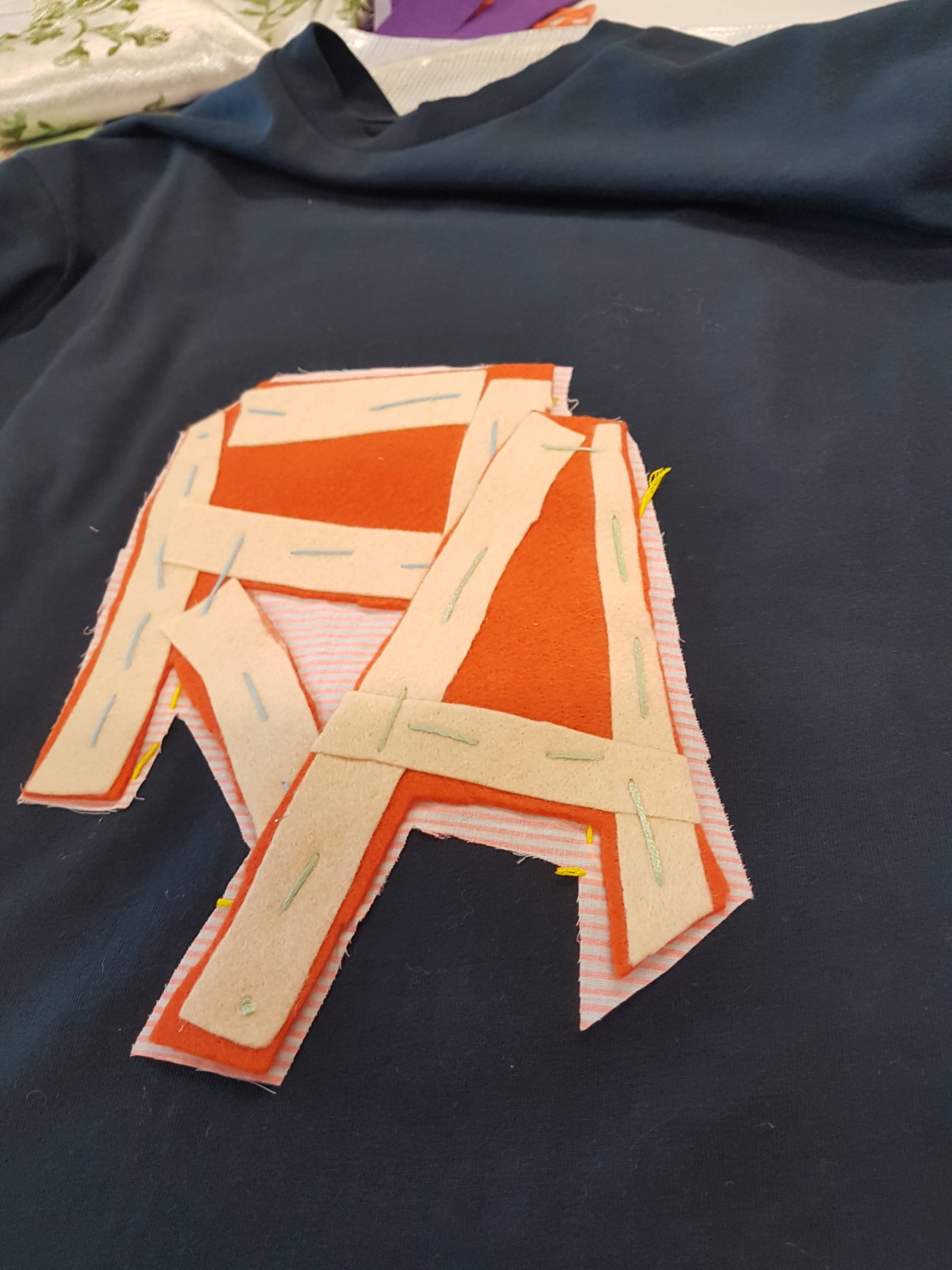
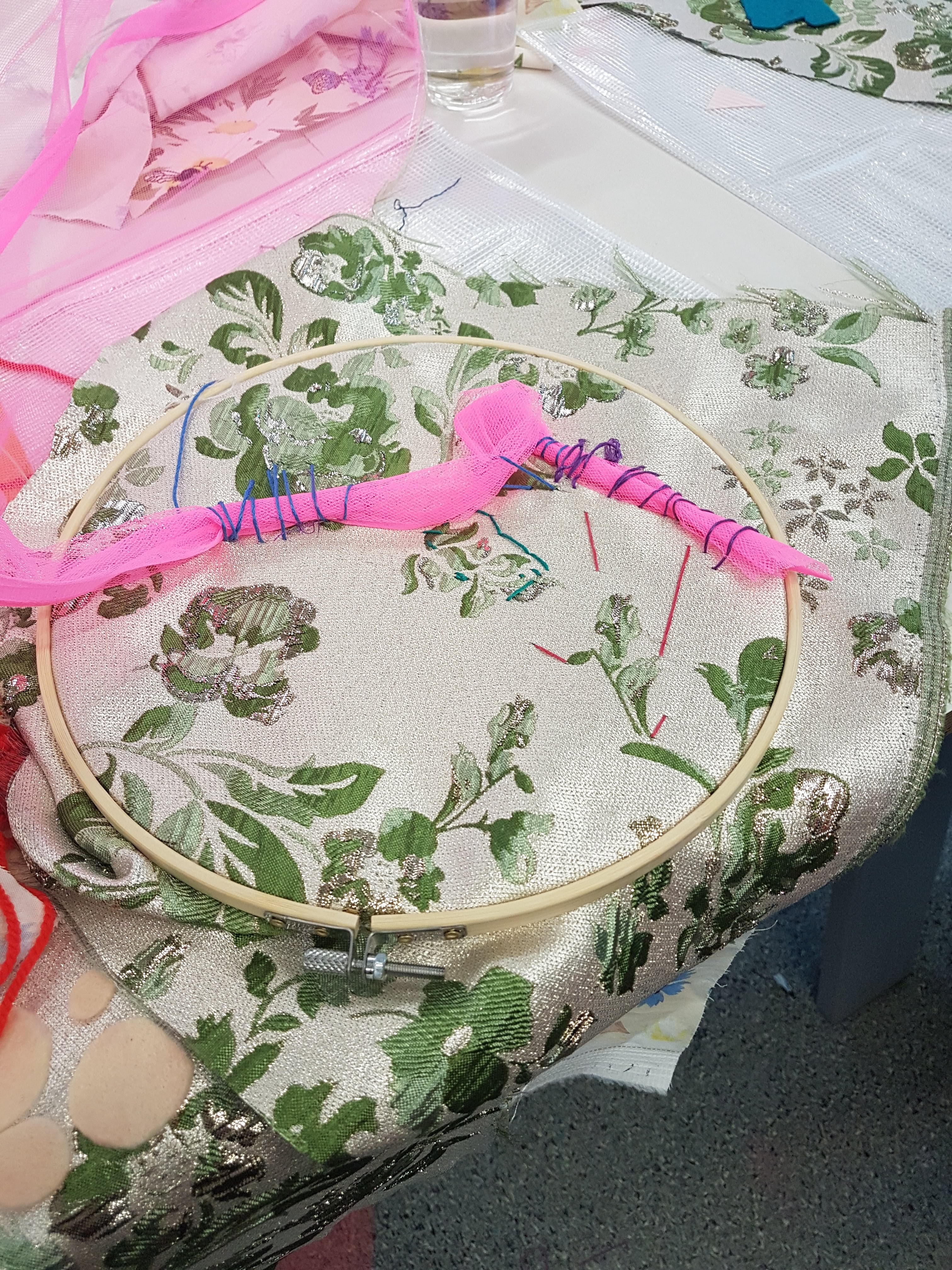
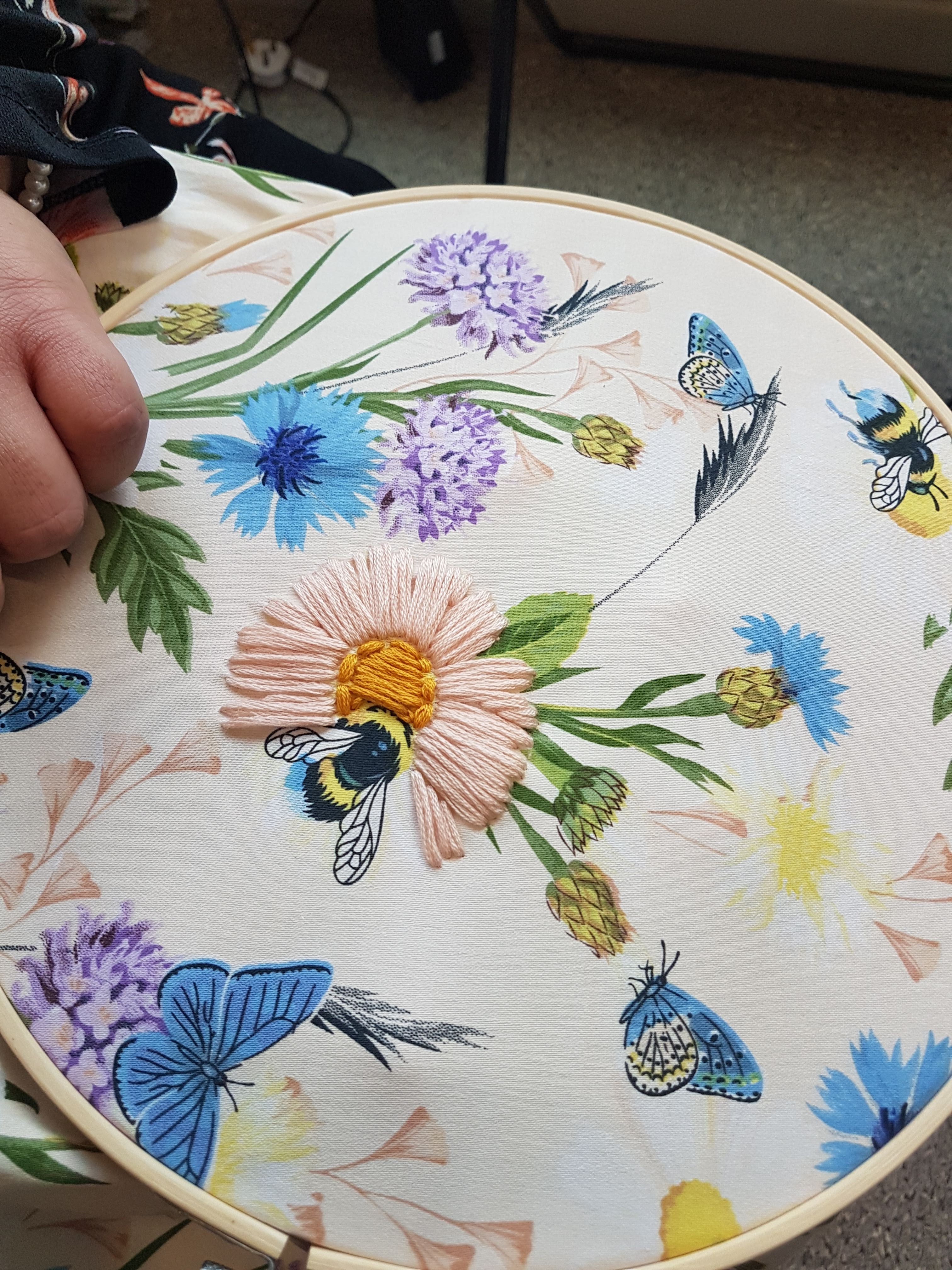
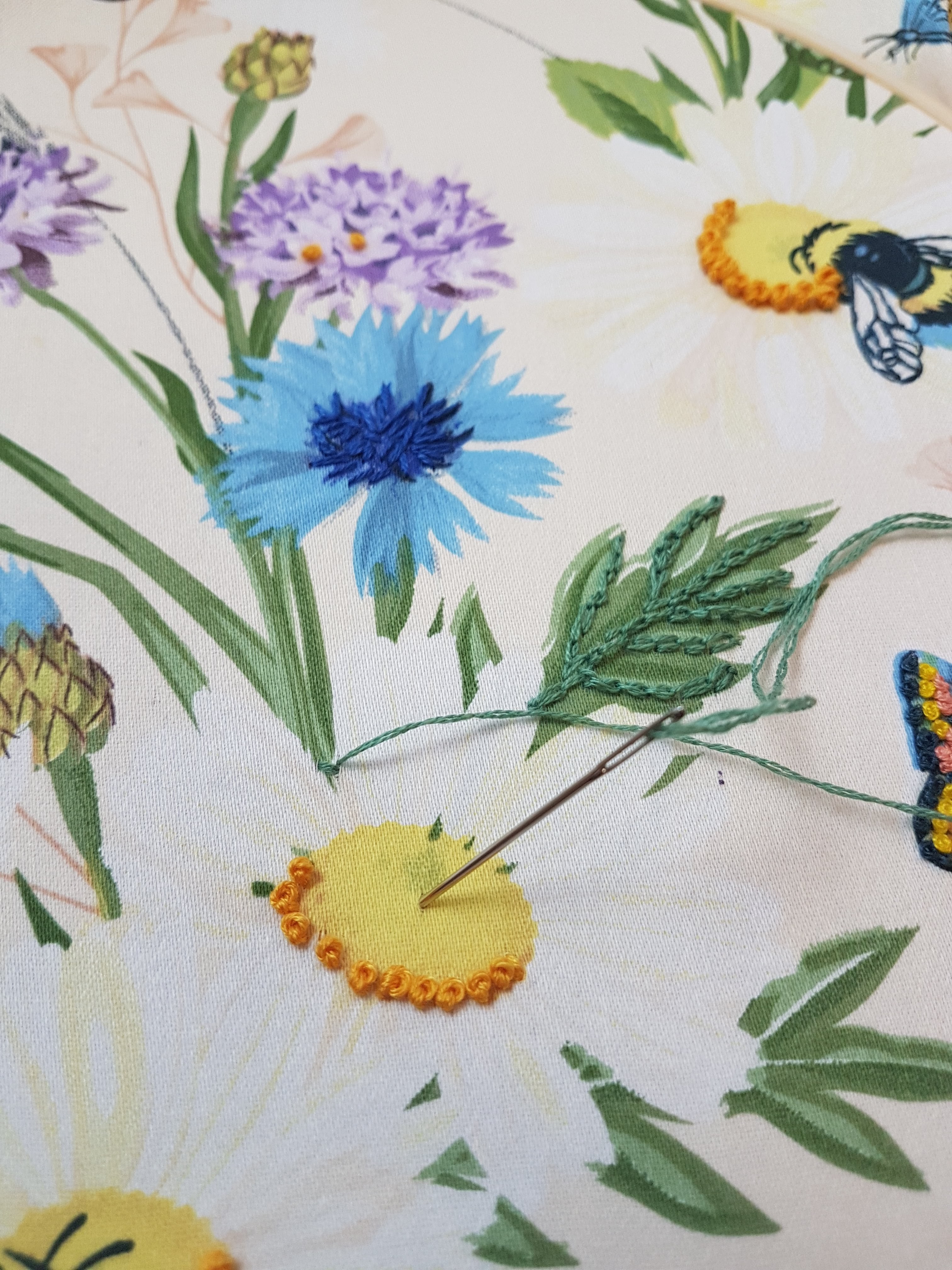
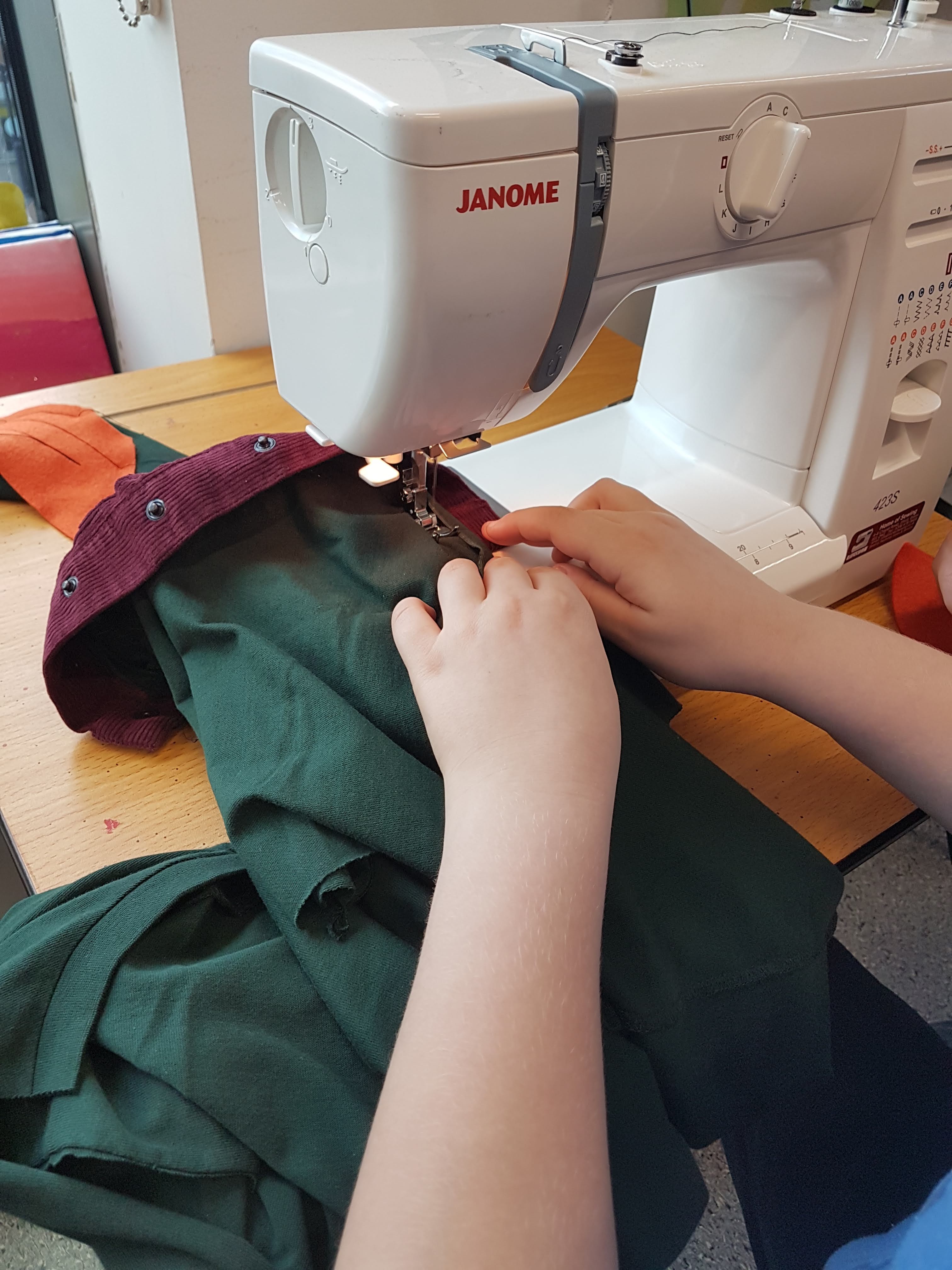
On Thursday we broke out the deadstock fabric and charity shop finds and introduced some sewing skills – curator Trish joined us again, and we explored mark making on fabric with embroidery thread and layering using bondaweb and felt. Some of the YP took their hoops and threads home to work on, as they were so engaged in the process. Trish, Maraid and I also got pretty attached to ours, as did Lydia the brilliant youth worker. There had been an SEND open day in the morning so we attracted a range of YP with different needs in the afternoon, and as there were so many adults it worked really well in terms of the level of assistance we could provide. As I know from helping the Things sew at home, it’s much easier with many pairs of hands to help thread needles and untangle knots! Although our target range for the project was 11-14, the centre works with YP with additional needs up to the age of 25 and we will be an inclusive museum so everyone was welcome to join the session.

On Friday, despite Storm Eunice making an appearance just before midday, we saw 15 YP over the day – some carrying on with their embroidery, some remaking clothes by embellishing and adding materials, some discovering the studio for the first time as they had only signed up to the centre on the previous day. There was some knitting, some draping on mannequins, fabric painting, more bondaweb as the YP customised clothes, but such a creative buzz all afternoon. We sent them all away with their hoops and embroidery (‘what – we can keep them? They’re for us?’) and the things they’d made. The injection of coffee mid afternoon from the cafe was much needed – if you find yourself down in Poplar in need of refreshment, the cafe makes quite possibly the best chocolate brownies I have ever tasted, and a good range of other food at very reasonable prices too.

Other quotes from the week included ‘I’m eleven years old and I’ve made two outfits in two days!’ (one of which was his own interpretation of a 17th century waistcoat he’d sketched on Tuesday), and ‘This is the best place EVER’ from one of the new sign-ups.

Although Scott and I were shattered by the end of the week, we were blown away by the talent and creativity we’d seen over the week and we can’t wait to go back to finish up their co-creation at Easter.

See you next week!

Kirsty x

What I’ve been reading:

Torchwood – First Born (Audible)

Ninth Doctor Novels vol 2/Tenth Doctor Novels vol 1 (Audible)

The Lost Art of Letter Writing/The Witches of Cambridge – Menna van Praag

Ink and Sigil – Kevin Hearne

88: 0/10, would not recommend

Well, that was a week of unparalleled misery, quite frankly – topped off by Thing 3 testing positive for Covid on Thursday. Thing 2 was off with the dreaded corona the week before last, I was knocked for six by labyrinthitis (which is not, sadly, a surfeit of David Bowie’s startling trousers) and now Thing 3. Enough already!

Labyrinthitis is a definite -1,000,000/10, do not recommend. It was so horrible I didn’t pick up a crochet hook for a week, or even a book for several days. That bad. NHS 111 recommended taking something called Buccastem, which is supposed to relieve nausea and vomiting related to migraine, and other people recommended Stugeron which made things infinitely worse. A tweet from a lovely museum person crediting my blog from a few weeks ago with making her feel reassured about her upcoming colposcopy made me cry, but so did the lovely Norwegian postal system’s Christmas advert celebrating 50 years since Norway decriminalised same-sex relationships.
Furry nurses are the best

It was Wednesday before I started feeling semi-human again, and Friday before I felt safe to go out of the house. My Beloved did a most excellent job with laundry and keeping the Horde alive, and the furry fiends did an excellent job of keeping me warm. Friends were amazing at relaying Thing 3 home from school, which at least we don’t need to worry about this week as he’ll be off with me isolating.

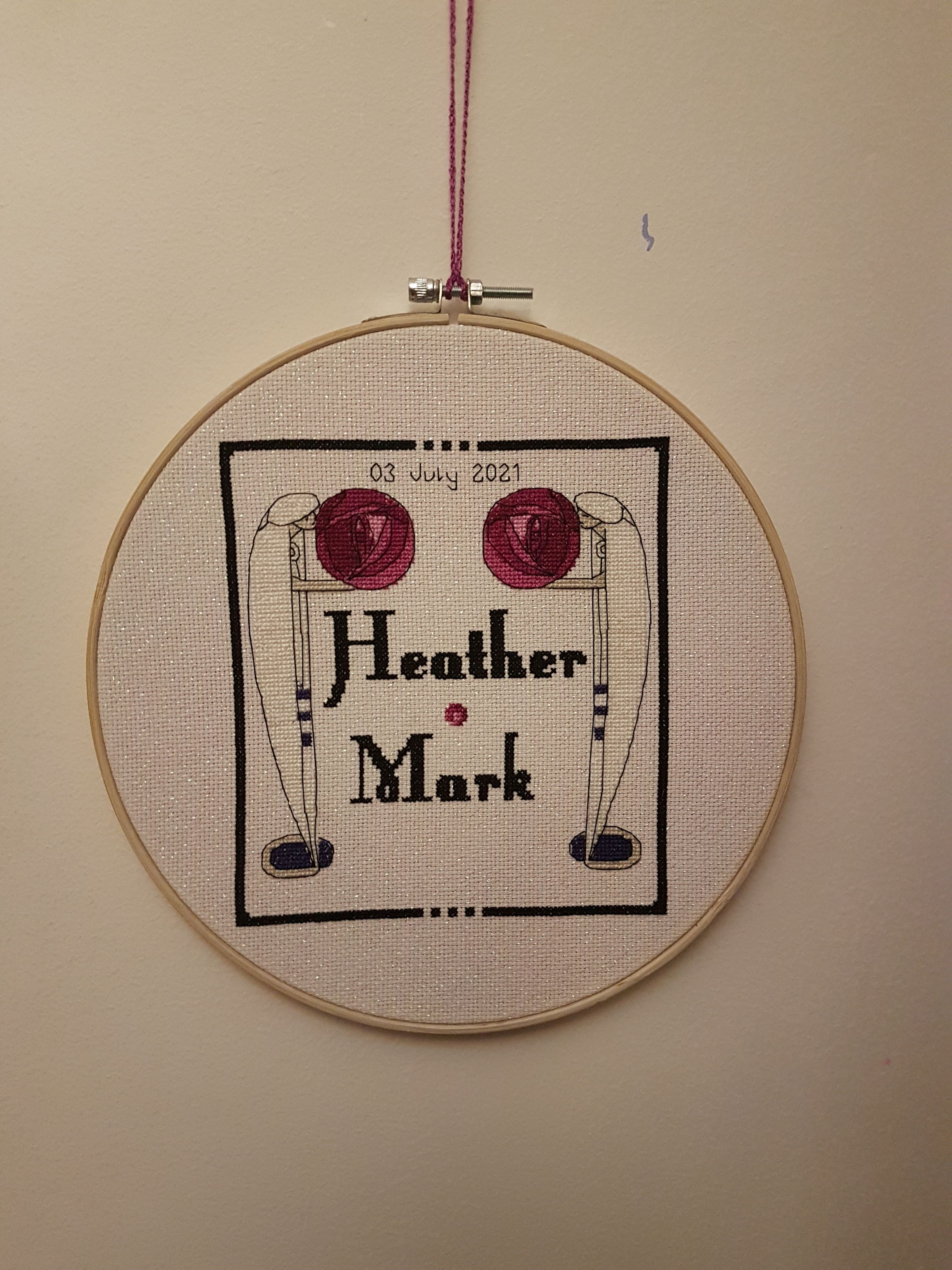
Lack of new output does, however, mean I can share a piece I finished a while ago but which only got handed over this week – despite the fact that I have seen Heather several times. We were supposed to have a ‘Grumpy People’s Supporters Club’ night out on Friday (well, they did, I stayed on the sofa watching Cowboy Bebop): the last time we saw each other all together was on the hen night back in June! The pattern can be found here and the seller was kind enough to offer to chart the names for me to personalise it as well. I’m told the bride liked it – she loves Art Deco and had a 1920s car to take her to the service, so it should be a good reminder of the day.

When I did manage to pick up a book again, it was with the intention of working through some of the digital shelf of shame on the Kindle – in the mood for something easy, I chose Colin Watson’s Flaxborough novels which were published between 1958 and 1982. Police procedurals which would probably be tagged with the awful ‘cosy mystery’ label these days, these are witty and terribly British, featuring the Viking-like Inspector Purbright and the eastern town of Flaxborough. I had three on my Kindle already and luckily the rest were cheap as I quickly got addicted.

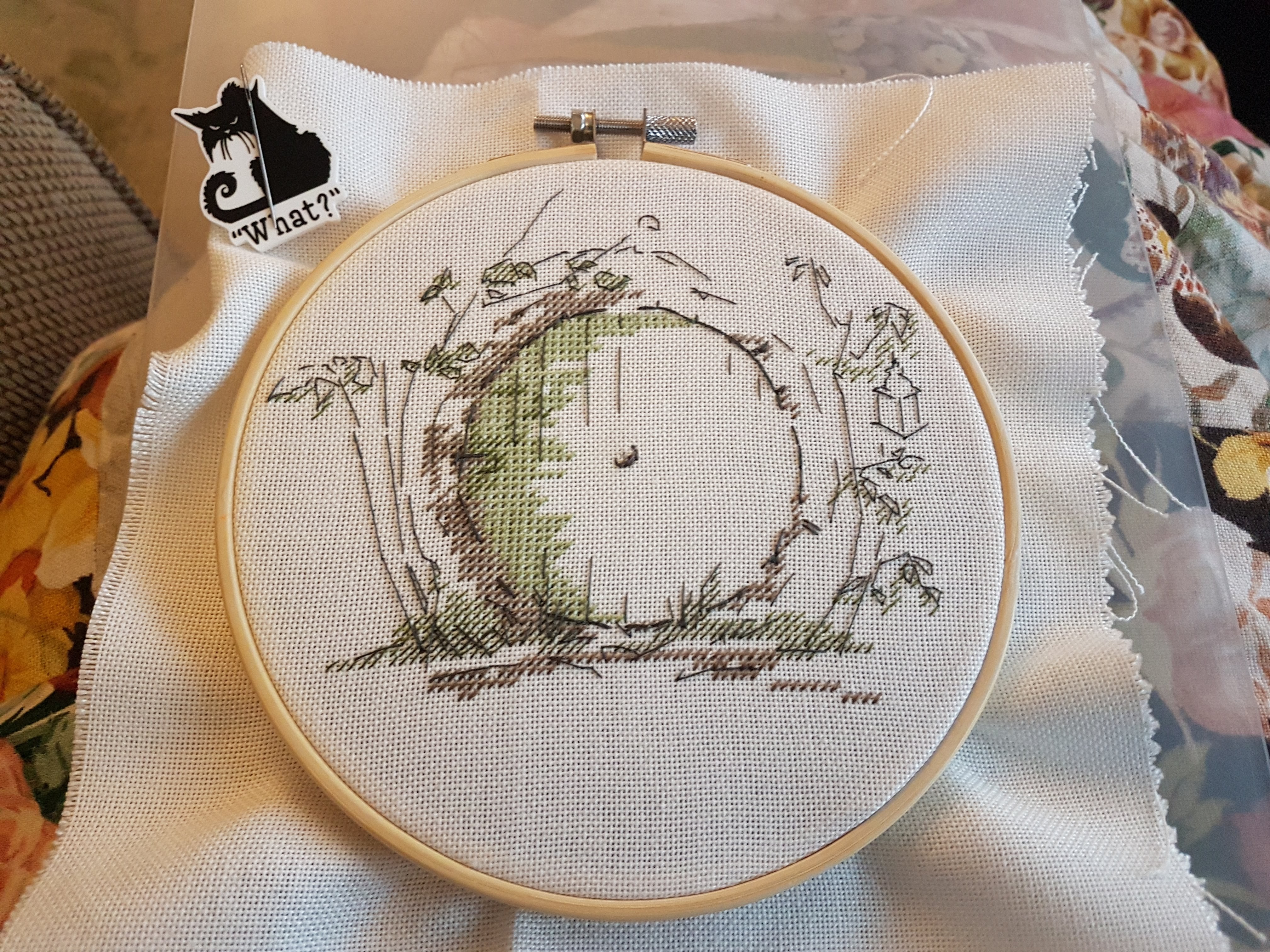
Lying in bed unable to do anything meant I had a lot of time to do mental crafting, which is at least cheaper than the normal kind. I have a head full of ideas and no way to get to them, as my crafting space (OK, the dining room) is still full of stuff we haven’t put back after the heating was put in. My beloved has taken the opportunity to do small jobs upstairs while the place is already in chaos. I’m not saying I’m getting itchy fingers here but I have things that need making! Things 2 and 3 want new pants and there’s Christmas making to be done. This Hobbit Hole piece needs finishing, too: the pattern is by Vetlanka on Etsy. It’s been a while since I’ve worked on such a high count fabric, but the effect is so delicate.

I’ve taken the opportunity to set up a Facebook page for this blog as well, where I can sell the various bits and bobs I make that aren’t destined for gifts, at least from me. You’ll be able to find it here and I really need to take some photos to get things online! Watch this space.

Anyway, I must head off – there’s PCR tests to do and a book to get back to.

Kirsty x

What I’ve been reading:

Speaking in Bones – Kathy Reich

Coffin, Scarcely Used / Bump in the Night / Hopjoy Was Here / Lonelyheart 4122 / Charity Ends at Home / The Flaxborough Crab / Broomsticks over Flaxborough / The Naked Nuns / One Man’s Meat Colin Watson (Flaxborough series)

82: thinking like designers – or possibly chickens

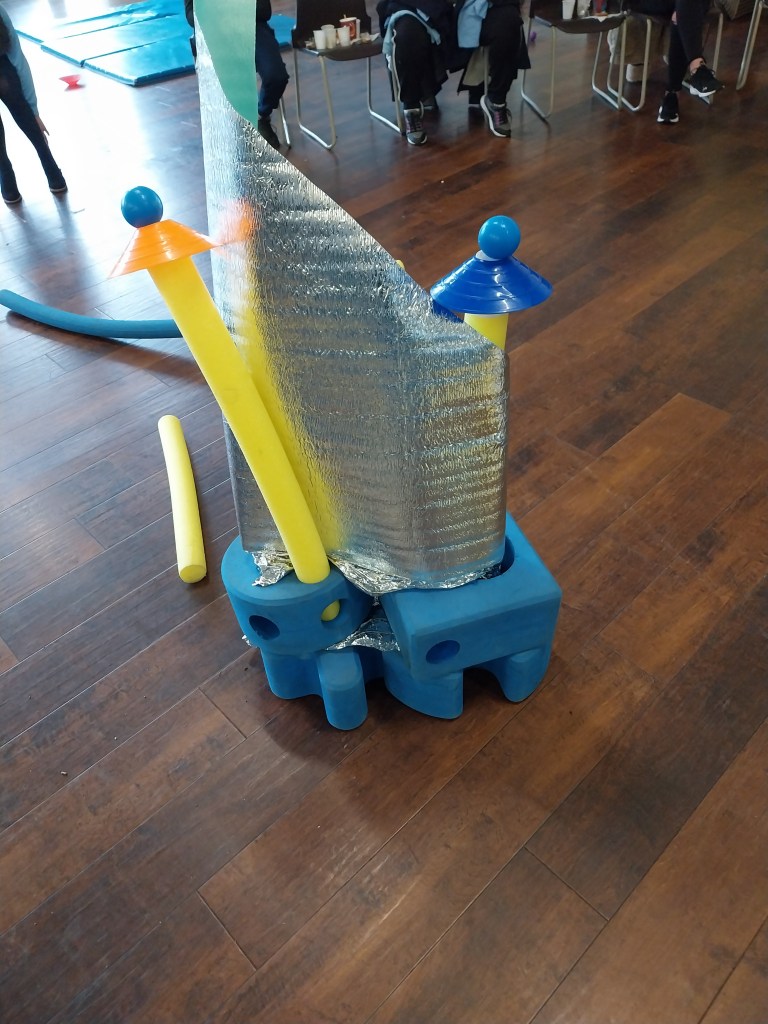
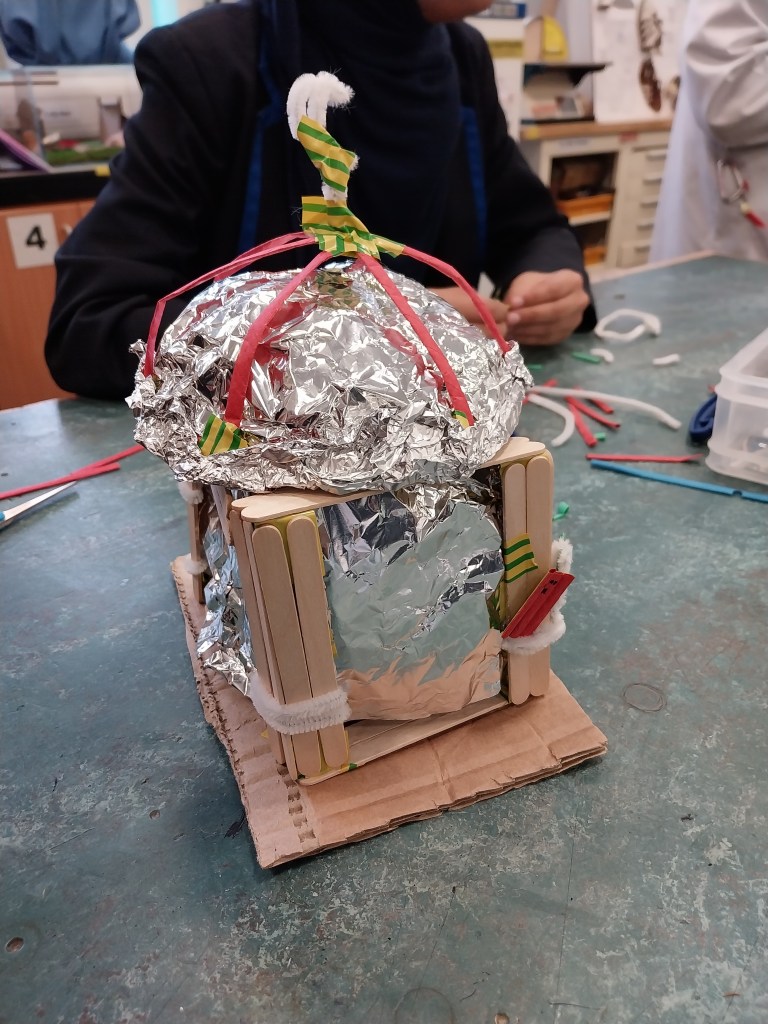
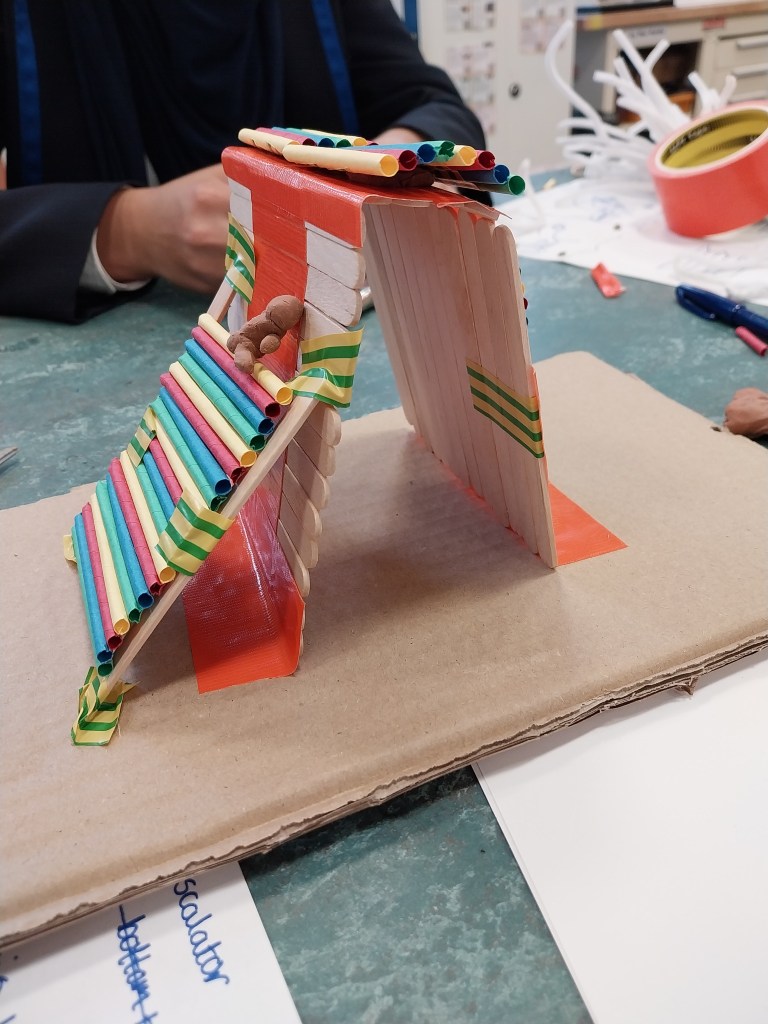
This week I took my new school session out to Thing 3’s primary school to test it on Years 5 and 6 – still playing with blue Imagination Playground blocks, but this time the tabletop version which are definitely easier to carry around. Added to these were scraps of fabrics, pipes, string and other loose parts, building on the work we’ve been doing over the summer.

The session, called ‘Think Small’, is an introduction to user-centred design, helping children to understand the iterative design process, work collaboratively and communicate ideas, and finally to work creatively with materials. These are some of the 5Cs of 21st century skills and are the some of the building blocks for learning in the new museum.

Photo and chickens courtesy of Chinami Sakai

We started by thinking about chickens, and what they need to be safe and happy: brainstorming ideas as a class, and then looking at the Eglu. The chickens in question can be seen above – Mabel, Doris and Tome, who belong to one of my colleagues and who were previously commercial egg-laying chickens. We’re in a relatively rural area, so some of the children already had experience of chickens, and were keen to share their ideas. ‘Space to play’ was the most important thing according to one child whose granny is a chicken keeper. We looked then at the Eglu, a chicken house which was designed to make it simpler to keep chickens in garden and which you can see on the left of the picture.

We moved on to talking about what pets we have at home – cats, dogs, guinea pigs, chameleons, geckos, the odd bird and tortoise, hedgehogs – and how they need different environments. I split the classes into four groups, and each team picked a mystery bag with an animal model. As a team they generated a list of things their animal needed which became their ‘client brief’. They were surprised to discover that they wouldn’t be the designing the home for their animal, but had to swap their briefs with another team. Each group then became ‘animal architects’, looking at the brief together and each child designed a home that they thought met that brief. The hardest bit, we discovered, was when the children had to decide which design from their group met the brief best and would be the one put forward to the ‘clients’. Some groups decided quickly, while others needed some support.

The materials the children were given

The clients gave feedback on the designs and then the architects used the creative kit to build the chosen design, incorporating the feedback, and finally the groups looked at all the designs while the architects talked us through them.

Over the four sessions I refined the format and changed some of the timings, and delivering it to the different year groups allowed me to see how it works with different abilities. The classes are quite small, with less than 25 in each which meant four groups in each session was viable. One thing about working with ‘animals’ was that it gave all the children a chance to shine and share prior knowledge from their out-of-school experience rather than reinforcing classroom learning.

I didn’t let them use sellotape or glue, so they had to come up with other solutions to hold objects together or in a particular shape. One boy shone as a project manager, helping his team realise the design he’d created.

Feedback from the children themselves was entertaining: one of them informed me that he didn’t know DT actually involved ‘making things’, another was keen to find out more about making structures stable. Apparently it’s harder to build than to draw, and it needs more brain power than they expected. Building with blocks takes a ‘lot of thinking’. They were surprised when they had to swap their animals to let other people build their ideas; DT is not just on a computer; and it was interesting to think about what other people need. One asked how long it takes to become an architect, so I’m counting that as a win! One wanted to know if I was really Thing 3’s ‘actual mum’.

Thing 3, of course, was mostly just concerned that I didn’t embarrass him too much…

Meanwhile…

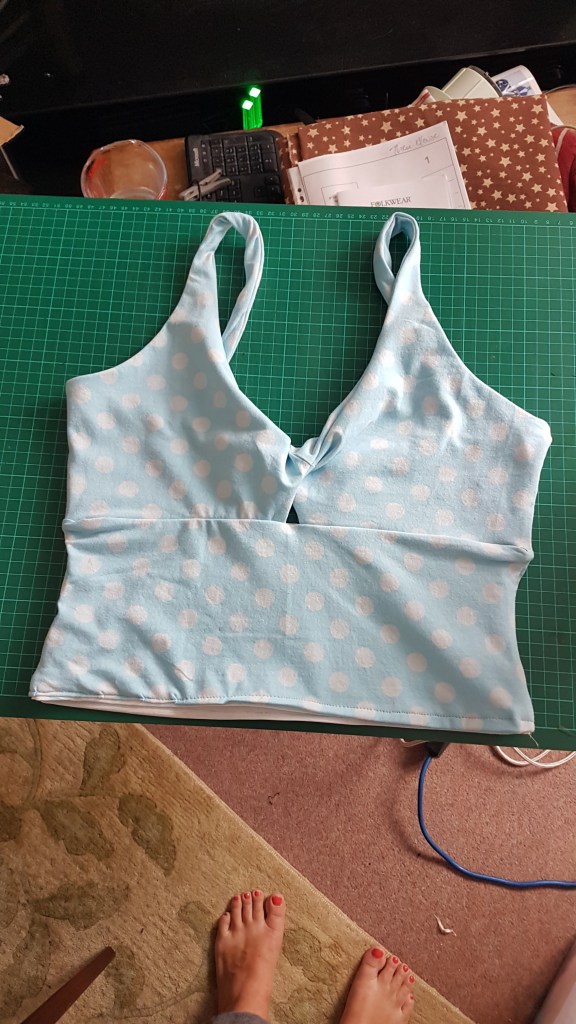
As you can see I have some sewing to be getting on with! My first foray into swimwear, for example: a two piece that will be easier to get out of in the winter swimming. The water was 12.6 degrees this morning, so we’re on our way to single figures. There’s also been cross stitch in the evenings, which I’ll share when it’s finished. See you next week…

Kirsty x

What I’ve been reading:

Forests of the Heart/The Onion Girl – Charles de Lint

Comet in Moominland – Tove Jansson (Audible)