228: magic and moonlight

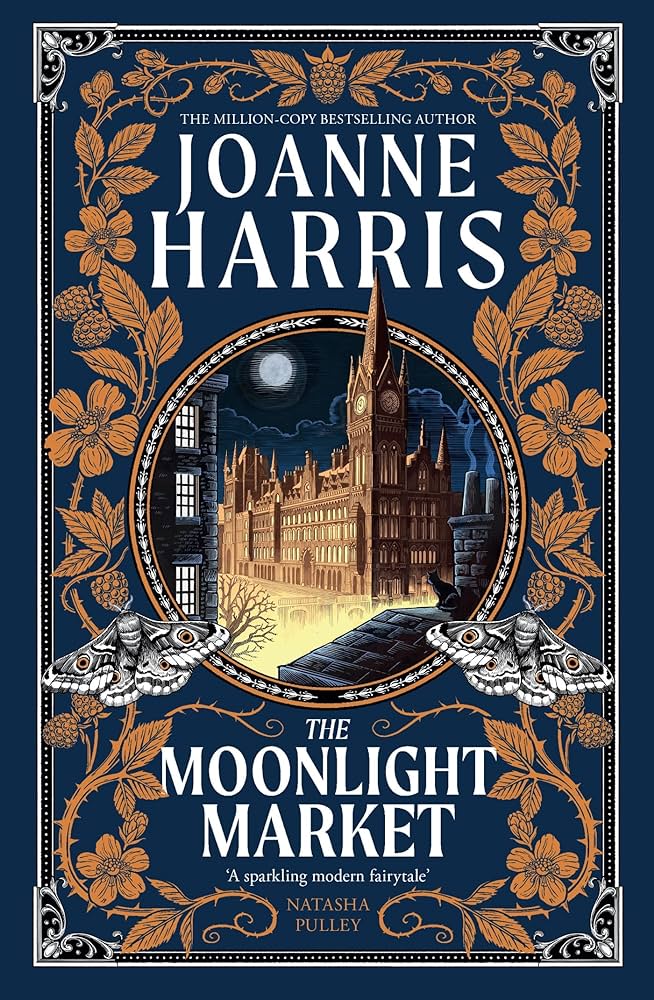
This week’s tube journeys have been accompanied by Joanne Harris’s latest novel, The Moonlight Market, which is being marketed as ‘Neverwhere meets Stardust‘ (the marketing team at her publishers are probably cursing themselves). I love both those books, and also am a huge fan of everything else by Joanne Harris, so that I was going to read this was a given.
But…it’s also set in London. London Below, London Before, London today – the London we see in front of us, the London that might be waiting for us down one of those intriguing little alleyways that the older parts of the City (and the city, I suppose) do so well, the London that might be there if you catch it in the corner of your eye. Clerkenwell and Farringdon have many of these, and I am easily distracted by the thought of magic and adventure.* I blame growing up with books where statues came to life in gardens; where forests grow in naughty children’s bedrooms and you can sail away to the land where the wild things are; where there was a permanently frosted world through the back of a wardrobe; and a house full of Civil War ghost children, ebony mice that come to life and lost jewels.

You might say London has enough stories to be going on with, without making up more, but one of the best things about a city with more than 2000 years of stories and people is that there will always be room for more. London, as Peter Ackroyd and Edward Rutherfurd have proved, is enough of a story in itself.

However, people do keep writing these stories, for which I am profoundly grateful. The Moonlight Market is a story about a London man who works in a camera shop on Caledonian Road (‘the Cally’, as it’s known locally) who falls suddenly, unexpectedly in love with a woman who is (of course) more than she seems. A photographer himself, he discovers that his negatives show things that can’t be seen in daylight, and his search for these places and people lead him to the Moonlight Market on a London Bridge that only exists on moonlit nights. Threaded through this is a fairytale about the doomed affair between the Moth King and the Butterfly Queen, and the resulting war between the Silken Folk of the day and night courts. Like her Chocolat series, magic exists and co-exists with the mundane world, and sometimes crosses over – all the best urban fantasy is filled with possibility, of course, and Harris’s books are filled with it.

If you love urban fantasy and London, here’s a few more worlds you can explore:

  • Ben Aaronovitch’s Rivers of London series
  • Mike Carey’s Felix Castor novels
  • Neil Gaiman’s Neverwhere (I am extremely disappointed in recent revelations about him, but I still love this book)
  • Benedict Jacka’s Alex Verus series
  • Paul Cornell’s Shadow Police series
  • Christopher Fowler’s Bryant and May series
  • Sarah Painter’s Crow Investigations
  • Neil Blackmore’s Soho Blue (not magical, but worlds colliding and some of the most evocative writing about post-war London I’ve ever come across)

A good writer makes the setting as much a part of the story as the characters and the action. I first understood this when I did a module at uni called ‘The City in the American Mind’, which introduced me to Sara Paretsky’s Chicago through the eyes of V.I. Warshawski. I’d probably be terribly disappointed if I visited – in my head Vic’s office is in a classic noir setting in ‘the Loop’ , there’s vast tracts of post-industrial wasteland, and there’s a Great Lake smack in the middle. Similarly, Dave Robicheaux’s swampy, louche and lush Louisiana (James Lee Burke is the author here) would not live up to my visions, and if I go to San Francisco I want it to be in Armistead Maupin’s 1970s rather than today. Clearly I need a time-travelling Doctor….but again, that’s another story.

*This probably explains why I get lost a lot on the way back from meetings….if I walk down there, surely it will lead to there (it often doesn’t, but what possibility of magic and adventure would there be if I just walked straight down St John Street to the office?

Other things making me happy this week:

  • Coffee with Brian on his last day ever at Museum of London. Hashtag end of an era or something.
  • Trip with some of the team to the Tower Bridge Experience. Team now convinced I know people EVERYWHERE as one of the bridge hosts is a double-ex colleague from both MoL Docklands and V&A.
  • Finishing week four of C25K without injury. Crossing fingers, touching wood etc, and sticking everything together with RockTape.
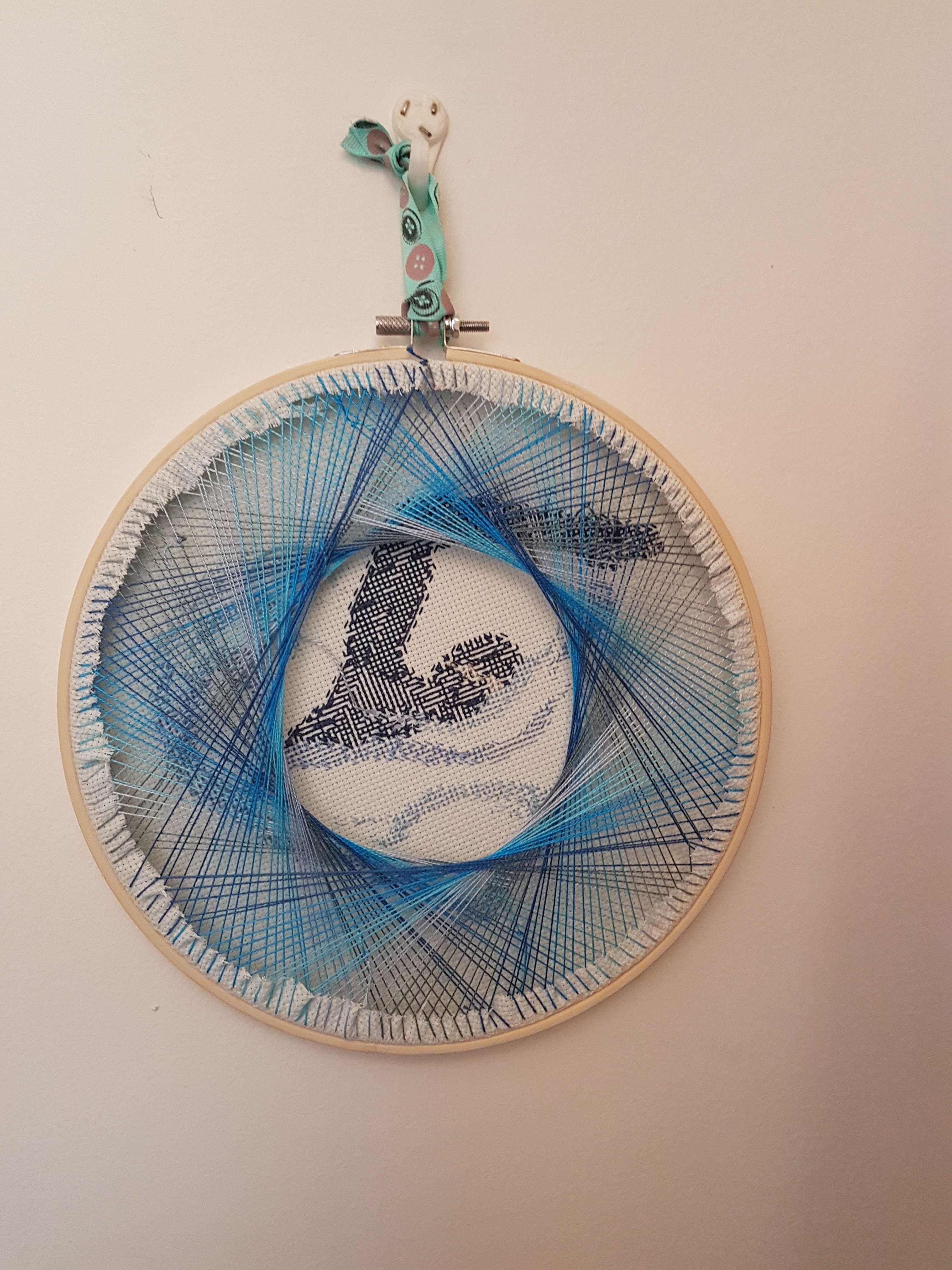
  • Finishing a sashiko-stitched cat bag
  • Being able to sit in the garden and work surrounded by plants and sunshine. My Beloved’s new garden shelter is coming on well.
  • Taking the lovely Matt Shaw round the site in preparation for a new project, watched by this pretty fox.
  • Cinnamon buns for breakfast courtesy of Thing 2

Things making me fall about laughing this week:

The Museum of London’s new logo. Sorry, London Museum. I can see what you were thinking but sparkly guano and a discombobulated flying rat aren’t doing it for me.

Still, I spotted the model when I was out with the team at Tower Bridge:

What do they want, glitter on it?

Today I am off for a swim with Isla, and I might even make something. You never know….

Kirsty x

Cover image: Network Rail

What I’ve been reading:

The Life of a Scilly Sergeant – Colin Taylor

The Secret Hours – Mick Herron

The Children of Green Knowe/The River at Green Knowe/The Chimneys of Green Knowe/An Enemy at Green Knowe – Lucy M. Boston

The Moonlight Market – Joanne Harris (Audible)
203: a wander through the realms of imagination

This week my team and I headed to the British Library to see the Fantasy: Realms of Imagination exhibition before it closes later this month. As I may have mentioned once or twice over the course of this blog, I love a bit of SF/F, so I was very excited about seeing this show.

Entering the space through a sparkling, fairy-lit forest portal (I knew it was going to be good) and avoiding the first hazard in the shape of a couple of school groups, we were immediately immersed in the very beginnings of fantasy through ‘Fairy and Folk Tales’. Highlights for me were glorious Arthur Rackham illustrations, a 1918 ‘Ancient Mappe of Fairyland’ by Bernard Sleigh and an earpiece playing Steeleye Span’s Thomas the Rhymer. It’s easy to dismiss fairy tales – especially if you grew up with the later, heavily sanitised Ladybird ‘Read it Yourself’ versions - but the original stories as written down by people like the Brothers Grimm were, well…. grim. One of my favourite childhood books, Alan Garner’s The Owl Service, was featured here along with a plate from the service which inspired it.

‘Epics and Quests’ was the second section, and of the things I liked about this exhibition was that it delved far deeper than the the European traditional forms of fantasy and ‘sword’n’sorcery’ tropes. Studio Ghibli’s Princess Mononoke appeared here, along with more of my all-time favourites in the shape of The Dark is Rising by Susan Cooper, T.H.White’s The Sword in the Stone, Tolkien in book and film (Gandalf’s staff!), and Warhammer. Tove Jansson’s illustrations for the Swedish translation of The Hobbit were included, with a rather trollish Gollum facing off with a behatted Bilbo Baggins. Apparently her depiction of Gollum caused Tolkien to amend his description to include the word ‘small’ in future editions! Dungeons and Dragons also popped up here, Livingstone and Jackson’s Fighting Fantasy series, and a marked up script for Monty Python and the Holy Grail. I refrained from quoting large swathes of the film, as I’d like my team not to think I’m a complete geek. Ha.

Section three covered ‘Weird and Uncanny’Valentina and I had great fun in the interactive wibbly wobbly space where you appeared as if by magic and went all swirly. Here there was also a game called Fallen London, a text-based RPG set in a London stolen by bats. Of course! Philippa Pearce’s Tom’s Midnight Garden was included, along with Neil Gaiman discussing The Sandman and the power of being a writer. H.P Lovecraft’s Cthulhu (that’s hard to spell) featured, and the board game A Study in Emerald based on a Neil Gaiman story.

Section four, ‘Portals and Worlds’, explored the alternative realities built by fantasy writers and artists. Here was Terry Pratchett’s Discworld Map, and a whole lot of schoolchildren building their own worlds with the help of a gallery educator. We had to step over them to see Elphaba’s costume from Wicked, as they were worldbuilding all over the floor. I felt there were some gaps - not enough urban fantasy which, given the quality of work in this genre over the last 30 years or so by people like Charles de Lint and Ben Aaronovitch, felt like a real missed opportunity. Finally there were some Live Action Role Play costumes including a spectacular dryad.

It was inevitable that I was going to leave the exhibition with a reading list! Uprooted by Naomi Novik and Gods of Jade and Shadow by Silvia Moreno-Garcia are the ones that caught my imagination.

I was quite disappointed to reach the end of the exhibition, which came far too quickly. The exhibition design was atmospheric, and managed to stay away from the whimsical in the main. It finishes later this month so get in quick!

Other things making me happy this week:

  • Mooch round the market with Miriam
  • A D&D game where I got to call down a lightning storm and be all Dr Strange
  • A birthday trip for Thing 3 on Saturday night to see My Neighbour Totoro at the Barbican, which I’ll write about next week
  • Starting a new scarf as my portable project, using this pattern. I had to adapt it as working into slip stitches all the time would be a nightmare. This is using a Stylecraft DK yarn that I bought in a sale a while ago.
  • Good progress on the temperature stitch for the year – I’m still not ready to start the books but the shelves are nearly done!

Now I must get up and make a banana cake….

Kirsty x

What I’ve been reading:

Friends of the Dusk/All of a Winter’s Night/The Fever of the World – Phil Rickman

The Chalice – Phil Rickman (Audible)

Over Sea, Under Stone– Susan Cooper (Audible)

Map Addict – Mike Parker

Draw Your Day – Samantha Dion Baker

67: the book is always better?

Regular visitors to my little corner of cyberspace will have spotted that I am a big fan of books and reading in general. I love fantasy, and magic, and supernatural thrillers; different worlds, sideways views of our own world, the idea that there are things we can’t see (and, in the case of Stephen King, that we don’t want to see). I don’t love it when some bright spark decides to take one of these books and turn it into a film or a TV series, unless they are people who can be trusted to do it properly. Simon Pegg and Nick Frost, I think, can be trusted with Ben Aaronovitch’s Rivers of London books, but the teams responsible for The Seeker: The Dark is Rising (from the novel by Susan Cooper) and Midwinter of the Spirit (from Phil Rickman’s Merrily Watkins series) should never have been allowed near the productions.

I can almost imagine the conversation in The Seeker‘s production meeting: “Yeah, so we’ve got Eccleston as the bad guy and McShane as the wizard, right, but we gotta make it relevant to American kids, we can’t have another magic English kid, Harry Potter and all that, let’s make the kid and his family American, let’s transplant them to England, fish outta water stuff…”. Just, no. You killed the story. Suffice to say they didn’t get the go-ahead to film the rest of the novels.

Midwinter of the Spirit suffered from some of the same problems: the brilliant Anna Maxwell Martin cast in the main role was a great choice, but they hammered a long novel into a short series in a very heavy-handed way, losing a lot of the suspense and also – by choosing not to start the series with the first novel – a lot of the context. Shame, because these are brilliantly written, unputdownable books.

The one notable exception is William Goldman’s The Princess Bride, possibly because by 1973 when the novel was published he was already an Academy Award-winning screen writer for Butch Cassidy and the Sundance Kid (Best Original Screenplay) and he also adapted the novel for the screen. It’s still one of my favourite films and books, and finding another fan almost always means finding a new friend. Not that having the original author on board is always a good thing, of course, because then you run the risk of making, say, eight long films from seven long books (I’m looking at you, J.K.Rowling, you and your ‘direct assistance’ in the screenwriting).

(As an aside, Twilight and The Vampire Diaries were actually better than the books but only because they could not have been worse. So it does work both ways. Sometimes).

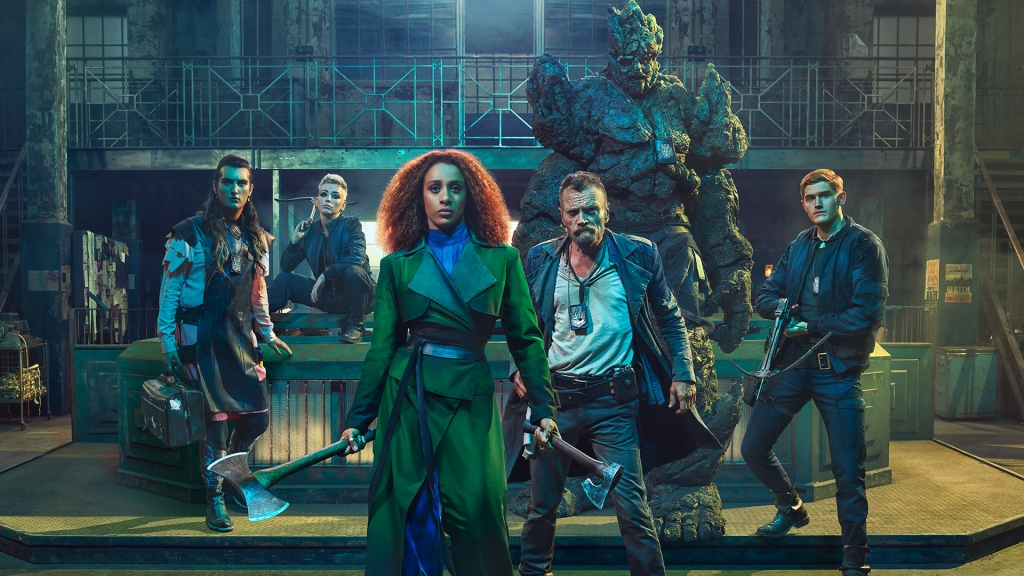
It was with some trepidation. therefore, that I headed to BBC iPlayer this week to check out The Watch, ‘inspired by’ characters from Terry Pratchett’s Discworld. BBC2 has the tagline “In a world where crime is legal, a group of chaotic misfit cops rise up to save their city from catastrophe. A punk rock comedy thriller inspired by Terry Pratchett’s Discworld.” The buzz on the Pratchett fan pages has been almost entirely negative. Outrage around the casting has been prominent: a woman as Lord Vetinari (Anna Chancellor)? A short person (Marama Corlett) as Angua? A tall person (Jo Eaton-Kent) as Cheery? A black woman (Lara Rossi) as Sybil Ramkin? Other than Carrot, who remains true to Pratchett’s vision, the casting producer has created a hugely diverse and entertaining ensemble. Richard Dormer, cast as Vimes, is guilty of gurning too much and perhaps too much comedy has been written in for him, but he was a good choice. Matt Berry and Paul Kaye are always good value, too.

Image © Radio Times

Part of the outrage has also come from a fierce loyalty to Terry Pratchett and, latterly, to his daughter Rhianna. She very diplomatically tweeted that “It’s fairly obvious that The Watch shares no DNA with my father’s Watch. This is neither criticism nor support. It is what it is.” Den of Geek has more on the controversy here. Funnily enough, Good Omens wasn’t criticised in the same way, perhaps because Neil Gaiman is Pratchett-adjacent and David Tennant is similarly adored for his time as the Tenth Doctor. The news this week on hearing that a second series of Good Omens in in the works should probably have provoked outrage as there isn’t a book, but once you’re in the Pratchett family, you’re in and you can pretty much do no wrong.

Previous big-budget adaptations of the Discworld novels have tended to be by Sky, who filmed the first two novels as The Colour of Magic, then did Hogfather and Going Postal. These weren’t perfect in terms of casting, either, but also weren’t terribly revolutionary. Charles Dance was perfectly cast as Vetinari, Tim Curry made an excellent wizard. Sean Astin was OK as Twoflower but David Jason was utterly wrong for Rincewind (he did make a great Albert in Hogfather, to give him his dues). The problem with filming such beloved novels is that readers have a very clear vision of who they think would be the best actor for the role, and are vociferous on the subject. The constant ‘casting posts’ on the various fan pages are annoying in the extreme, so one learns the art of scrolling.

Suffice to say that none of the actors in The Watch have featured in any of these posts. Was this possibly a deliberate decision, in the sense of ‘we’ll never get it right, so let’s have some fun’?

So, I went into the series knowing that the production company had played merry hell with the storylines, the characters and the sacred Discworld canon. And, you know what? I really enjoyed it. I left my Discworld expectations back on Roundworld and went along for the ride. The writers have picked bits from any number of the novels, not just the Watch series: Soul Music, Guards Guards, Night Watch, The Light Fantastic, Thud! to name a few, and they really have had fun with them. Many of the puns have been lost, and the addition of a gloriously camp dance routine came a bit out of leftfield, but it’s still thoroughly bonkers, funny and sweet in places. It does look as if most of the filming took place in the Elephant and Castle shopping centre, but you don’t get much more dystopian than that. The soundtrack is great, Cheery is an absolute delight, and the ending leaves it open for more….though as yet series 2 hasn’t been commissioned, sadly.

We’ve also watched Katla this week – gloomy, spooky and Nordic – and a 2018 series called Requiem, chosen because we like most things Joel Fry does.

What is there in this world that makes living worthwhile?

A surprise birthday present arrived this week from my lovely work colleagues, combining Pratchett, cross stitch and cats – three of my favourite things! I love getting handmade gifts and, believe it or not, it’s quite a rarity. I don’t know who made it but I LOVE it.

I also packed off the gift I couldn’t share last week: I could not get it straight in the hoop, so I gave up in the end. The pattern is by Climbing Goat Designs on Etsy.

This week I have been working on another gift, and another Totoro baby lovey – this time a commission. My cross stitch is on 18 count fabric and it’s getting to the point where I can’t see the holes in the fabric any more so may need to invest in one of those magnifying lights! Old age is creeping up fast…

This week I am looking forward to doing some delivery in schools, which I have really missed, and hopefully the sun will come out at some point!

See you next week

Kirsty x

What I’ve been reading:

The Museum of Broken Promises – Elizabeth Buchan

The Wisdom of Sally Red Shoes – Ruth Hogan

The Mermaid and Mrs Hancock – Imogen Hermes Gowar

Guards, Guards – Terry Pratchett

Lundy, Rockall, Dogger, Fairisle – Matthew Clayton and Anthony Atkinson