It’s Saturday evening and I am typing this in an advanced state of ‘is it nap time yet?’ after a day at the British Library’s ‘Marvellous Me!’ Family Day. This was the last of our pop-up appearances for the summer and I was joined by illustrator Beth Suzanna and Marina from our Artistic and Creative team. We were making paper portraits using collage in Beth’s signature style which is full of bold colour and opportunities for families to add as much detail as they liked. We had a great day, meeting more than 100 people and seeing some amazing creations – one of the families from our summer play project came to see us, too.
The BL runs three family days a year, and this one is in partnership with the British Museum and the Frank Barnes School for the Deaf – an opportunity for D/deaf and hearing families to learn together. There were interpreters on hand, performances by a signing choir, BSL storytelling and sensory spaces and the whole day felt inclusive and welcoming. I had a wonderful conversation with the mobile evaluator team and will definitely be stealing their ideas – and inviting them to be part of our access panel. We spoke about the need for 360 degree reflection at the end of projects, and the importance of understanding why things go wrong sometimes.
I say this every time, but…. yes, I am absolutely shattered, but I’ve met 100 people of all ages, from babies up to grandparents, and every single one of them reminded me why we do what we do (and why we bloody love it),
In other work news, we had a fundraising event at our new site – the last one before we start the build, which is PRETTY FLIPPING EXCITING – and despite promising myself I would not be completely overexcited at meeting illustrators I failed. It was all fine until Nick Butterworth, creator of Percy the Park Keeper and Tiger and Jasper’s Beanstalk turned up and Tom Gauld, whose cartoons for Guardian Books speak to me very loudly.
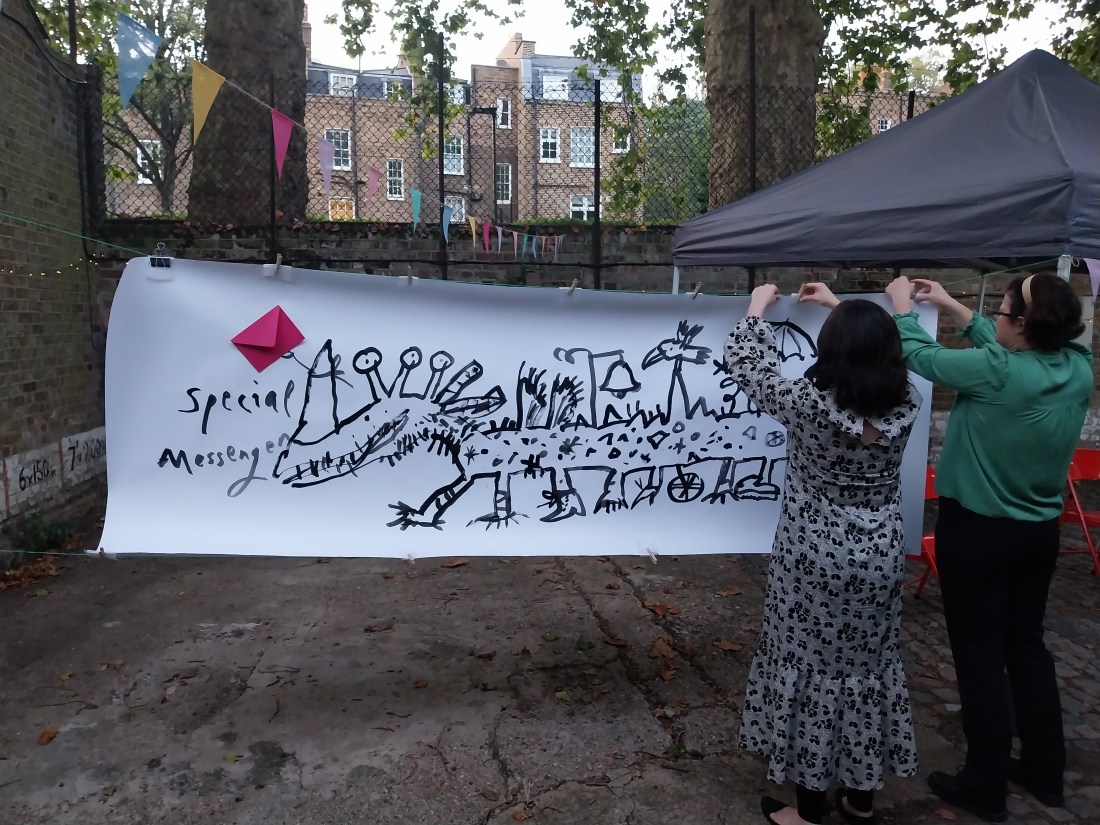
There were delicious macarons, and Quentin Blake sent us a special message via monster.
On the less happy side, we also said goodbye that evening to our lovely Head of Comms and Content who is off on a seaside adventure – but I did get to hand over her leaving gift. I will miss her very much!
Coffee with my LEN (Lovely Ex-Neighbour) Emma after WAY too long. Our midkids (aka Bonnie and Clyde) have been besties basically since birth, and we used to open the gate between our gardens and drink wine while they rampaged.
A Sunday morning swim
Finding a lot of Eddie Izzard included in my Audible subscription and laughing out loud on the tube
The cat being signed off as healthy by the vet. We knew she was better when she savaged a small visiting child but it’s nice to have the official word
Right! My family require feeding… have a good week!
Kirsty x
What I’ve been reading:
The Distant Echo -Val McDermid
That Mitchell and Webb Sound (and various Suzy Eddie Izzard shows) (Audible)
One of the things we believe at work is that – given the right tools – everyone is an illustrator, and we don’t limit illustration to picture books which is the answer virtually all school children give me when I ask ‘what is illustration?’ at the start of a session. That includes the Year 10s I worked with last week, and even post-graduate illustration students seem puzzled when I ask them how they’d define illustration.
We say it’s art with a job to do, the art we see all around us, the art which helps us make sense of the world. It’s art that communicates without words – though typography is part of illustration – and it’s art that’s been around since before words. There’s a lovely animation here that illustrates (see what I did there?) all this much more eloquently that I have.
I love all these definitions and the learning strategy I’m currently writing has this as its mission, and I’m quite prepared to think of myself as an illustrator but…not a very good one, and I’d never apply the word ‘artist’ to myself. For that I blame school. Art, after second year comprehensive, was for people who were ‘good at’ art. I was not ‘good at’ art – the best mark I ever got was a B- for a drawing of mum’s avocado plant which I was very proud of, but that mark was all the feedback I got – nothing constructive, no next steps, no ‘try doing this’. I don’t remember ever being taught to draw, or indeed to use watercolours, to try typography, or collage, or any other art form – these were things you either could or couldn’t do, and no real effort was made to change this state of being. Presumably this changed when you got to do art GCSE, but I don’t know – maybe the teachers gave that sort of feedback then as exam results depended on a certain level, but also there was an expectation that if you were doing the subject you were already good at it. This still makes me sad, and I can see the impact that this sort of school experience has had on a lot of the adults we engage with: ‘I haven’t done this since school’, ‘I used to love painting in school but I was no good at it.’
Thing 1 did art at GCSE, and Thing 2 is in her first year of GCSEs and she gave me a tour of her sketchbook the other day – I was very impressed. I am biased but they’re a talented pair – they get it from their Dad, who did Art to A-level, and who is able to help them with this subject. I was impressed with their teacher, who didn’t require that they should be ‘good at’ the subject, only that they were passionate about it and prepared to put the time in. This, I think, is the right way to think. How will young people ever find out if they are artists (of any calibre) if they never get the chance to find out? Even if they find out that they aren’t ‘good at it’, they might find they get great joy out of it – mot a quantifiable outcome but still a very valid one.
The artist Bob and Roberta Smith said that every school should be an art school, and even Ofsted said last year that ‘art should command an important place in every school’. I’ve written about the importance of creativity – not just on wellbeing but on general thinking – previously and posed the query ‘what happens if you replace the word craft with the word art?’ Obviously I understand the pressures on the curriculum (which sadly begins in the early years, just when children should be free to explore all the amazing art and craft materials around them) and the pressures for schools to achieve certain levels of GCSEs and A-levels, and the EBacc, blah blah blah, but I also understand the importance of being given the space to create and explore and scribble and doodle (sorry, boss) and generally play with art and craft materials, even if you’re not ‘good at it’. I understand, too, that at primary school in particular the majority of teachers are not art specialists, and have been given only the most minimal training in how to deliver the subject.
The creative industries contributed £115.9billion to the UK economy in 2023 – OK, this is only 0.4% of UK GDP, 260,000 full time jobs, but this is growing year on year. The soft skills that come with creative learning – empathy, creative thinking and problem solving among others – are among those most highly valued by employers according to research by the Edge Foundation. Unfortunately the current pressures from government, tightening budgets throughout the education, bad PR around ‘creative’ degree subjects and more are drying up the pipeline of young people into these industries.
All this, by the way, was just a lengthy preamble to what I’ve been attempting to do this week, which is to try and draw the things I’ve seen around me – from Sunday to Tuesday I did the ‘draw my day’ thing but on the days I was in London I didn’t have time. I took photos of the things I saw on my travels though – I am finding myself drawn (if you’ll pardon the pun) to signage and buildings, as well as my usual plants, Landscapes are nice but I have no urge to draw them – I like small details rather than the big pictures, it seems. I don’t think I’ll be any threat to the livelihoods of any artists out there but I am really enjoying stopping and looking and then spending time focusing on details. So keep your B-, Mrs Allan, I’m having a go at drawing whether I’m any good at it or not.
A week spent whirling from place to place, so this week you get some nice pictures and not many words.
Lena’s wallpaper going up
Monday was spent mostly at Angel Central, where we’d been lent an empty shop for the week and had lots to do. Here’s our Artistic Director Olivia putting up vinyl wallpaper designed especially for National Illustration Day by Lena Yokoyama. This was a proper team activity, with various members of the team footing ladders, plastering ourselves against walls while trying to hold up rolls of vinyl, and trying to match up the overlap. Next year we’ll get the printers to install it.
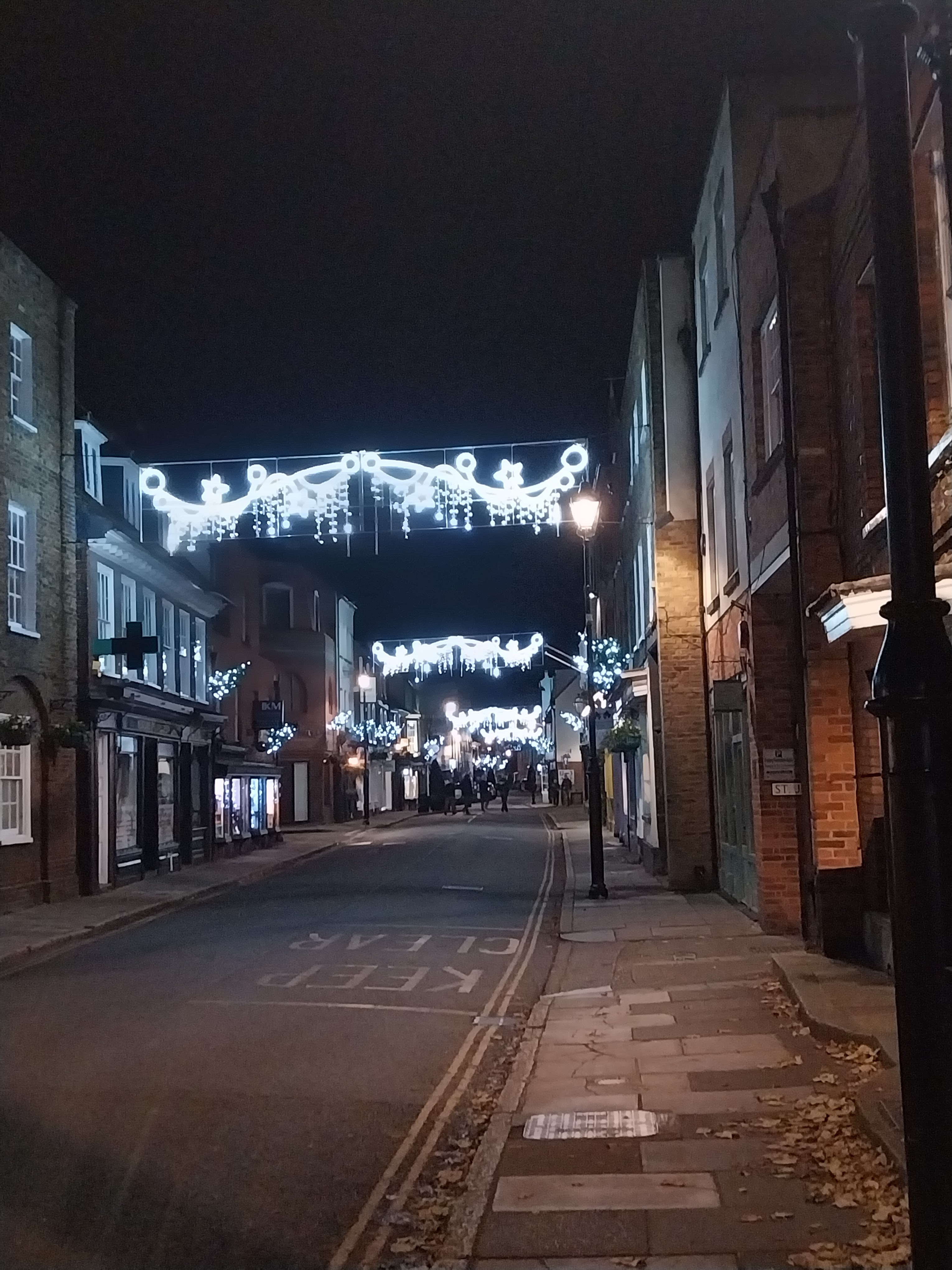
Eton’s tasteful Christmas lights
My annual stint as an external adviser at Eton College Collections– a meeting followed by a nice dinner. Celeriac soup, something chickeny, poached pears with hazelnut meringue and a sour cherry sauce. I sat between the charming Vice-Provost and the curator of antiquities and was highly entertained. I stayed at London sister’s overnight and was shouted at by owls, who nest in the tree outside her flat.
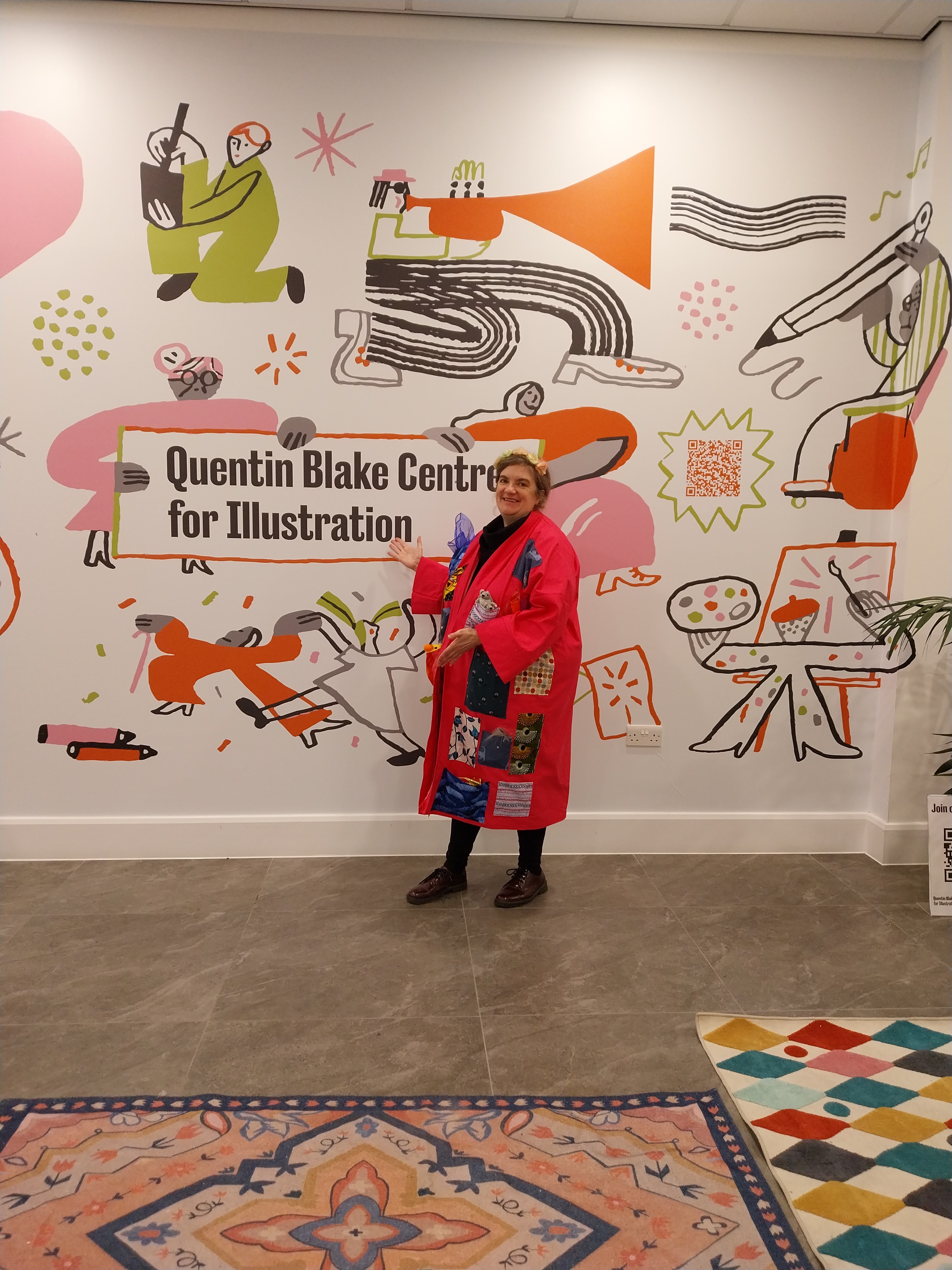
Wonderful Olivia Armstrong wearing the coat of many pockets
Finally the new schools session inspired by Quentin Blake’s book Angelica Sprocket’s Pockets was launched, starring Olivia Armstrong as the storyteller who forgot her coat and had to borrow Angelica’s. Featuring stories of the New River and local history, it went down a storm with the schools.
In the evening my Beloved was watching a Liam Neeson film when I fell asleep on the sofa and he was still watching it when I woke up three hours later. According to him it was a completely different film, but it looked remarkably similar to me.
Angel Central with Lena Yokoyama’s amazing window displays
More of Lena’s work, this time boards for window displays for the BIG DAY on Friday. You can just see the Mayor of Islington through the door. We invited lots of people through the door to help us celebrate. We asked schools to share what they made, and on social media we asked people to share the illustrations that were important to them. At one point we were trending 6th on X/Twitter and had almost 800 uses of the #nationalillustrationday hashtag on Instagram. We made the Radio 4 Today show, who had a live illustrator and interviewed Lauren Child. Illustrations made in the shop were scanned and added to our online gallery.
My contribution to our Angel Central gallery
Here’s my contribution to the online gallery – a self-portrait! Saturday saw more than 300 people come through the doors, including a visit from Amanda and an old college housemate. Hopefully Sunday will be just as busy.
A week post-Race to the Stones and my feet are almost back to normal size, although luckily I haven’t had to test this by putting anything like shoes on! The only day I’ve left the village was Thursday, when we went on a work team outing to Cambridge where the University Library is showing our exhibition Raymond Briggs: A Retrospective until late August.
Cambridge isn’t somewhere I have spent a great deal of time – I went to a humanist naming ceremony there once, and while Timeshare Teenager 1 was at Anglia Ruskin we popped up to see her, but other than a two-hour delay on a train back from somewhere where we got to sit in the station that’s been it. My very efficient Public Programmes Producer Jo organised the day, finding out about trains and buses, which was much appreciated by myself and the other member of the team Valentina.
Jo knows about things like group save tickets, and so we met at Kings Cross to catch the train and grab breakfast from Leon. Miraculously the trains were well-behaved all day (unlike the tube on the way home). Cambridge University Library is an impressive 1930s building which reminded us all of a power station – which makes sense now that I have discovered the architect, Giles Gilbert Scott, also worked on Battersea Power Station (and the red telephone box, which is cool).
The gallery is tucked away to the side of the main library entrance; quite a small space but the exhibition is full of sketches, roughs and proofs from some of Briggs’s best known-works like The Snowman and Father Christmas as well as from his longer graphic novels like When The Wind Blows and Ethel and Ernest. My sister’s favourite, Fungus the Bogeyman, also featured – I’d forgotten all the wonderful words in this one, and how endearing Fungus was.
We liked the simple sketch/make trails, especially playing with scale and getting messy with the giant’s footprint. We were amazed at the different illustration styles Briggs used over the years, and at the neatness of his typography for Fungus’s pages. The scrawled notes like ‘no full frontal nudity for Father Christmas’ made us laugh. When The Wind Blows brought back memories of the 80s and the very real fear of nuclear war, and The Tin-pot Foreign General and the Old Iron Woman was a stark look at the Falklands War.
If you’re in the area do go and see it – free entry and you also get to marvel at the University Library.
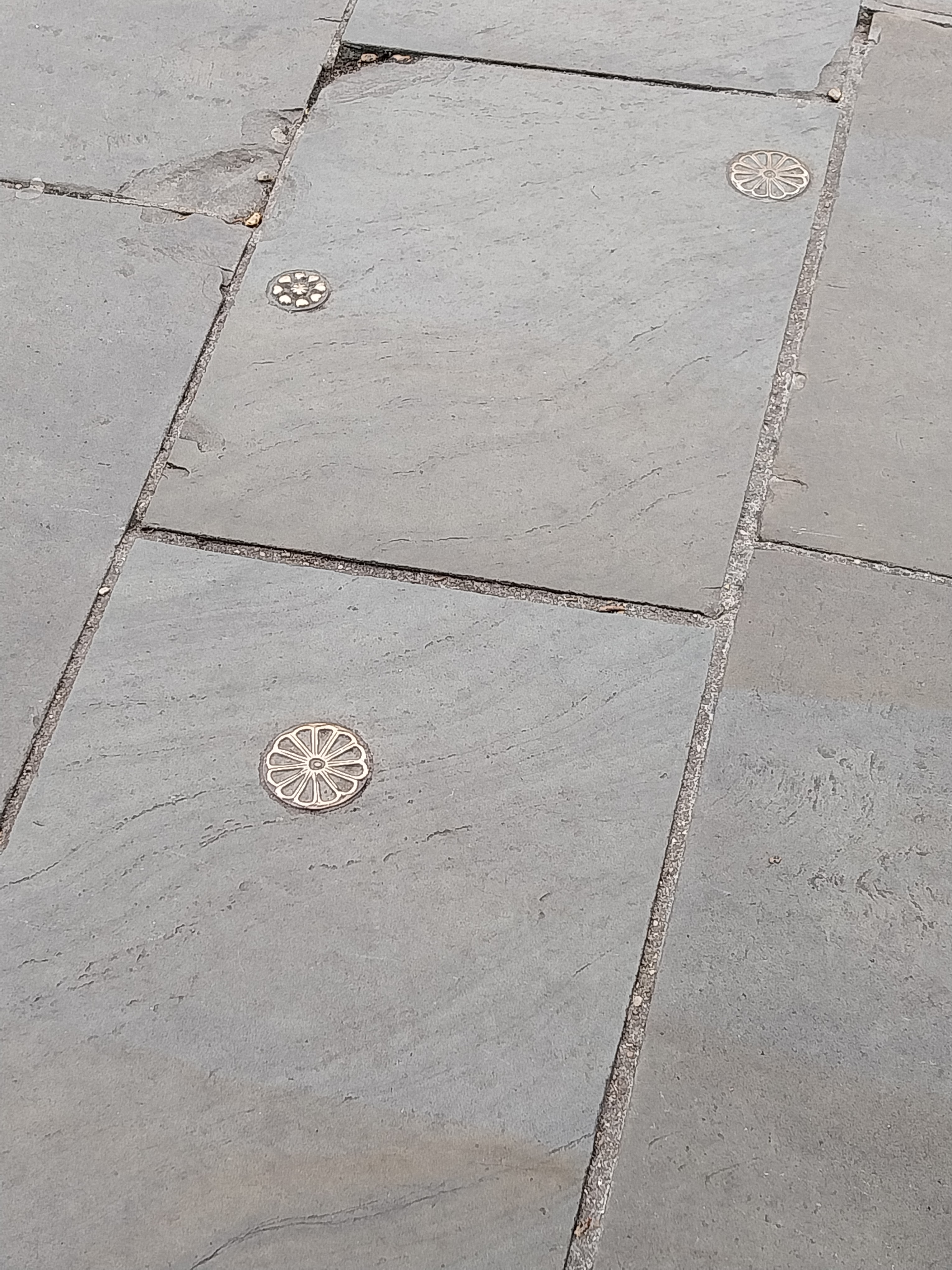
After leaving the library we walked through the grounds of one of the colleges, watching people punting and a fashion shoot with preppy clothes on the banks of the Cam, and made our way to Kettle’s Yard where we were planning to have lunch and a look at the Palestinian embroidery exhibition. The pavement on the way was scattered with bronze flowers, which Google informed us was the Cambridge Core and Flower Trail, inspired by a medieval coin hoard found by Anglian Water workers.
Lunch was a salad with hummus and falafel, with a lemon and ginger lemonade, while Jo and Valentina had huge vegetarian wraps. Jo tried the sticky toffee cake too, while I resisted the delicious-looking date flapjack.
Material Power
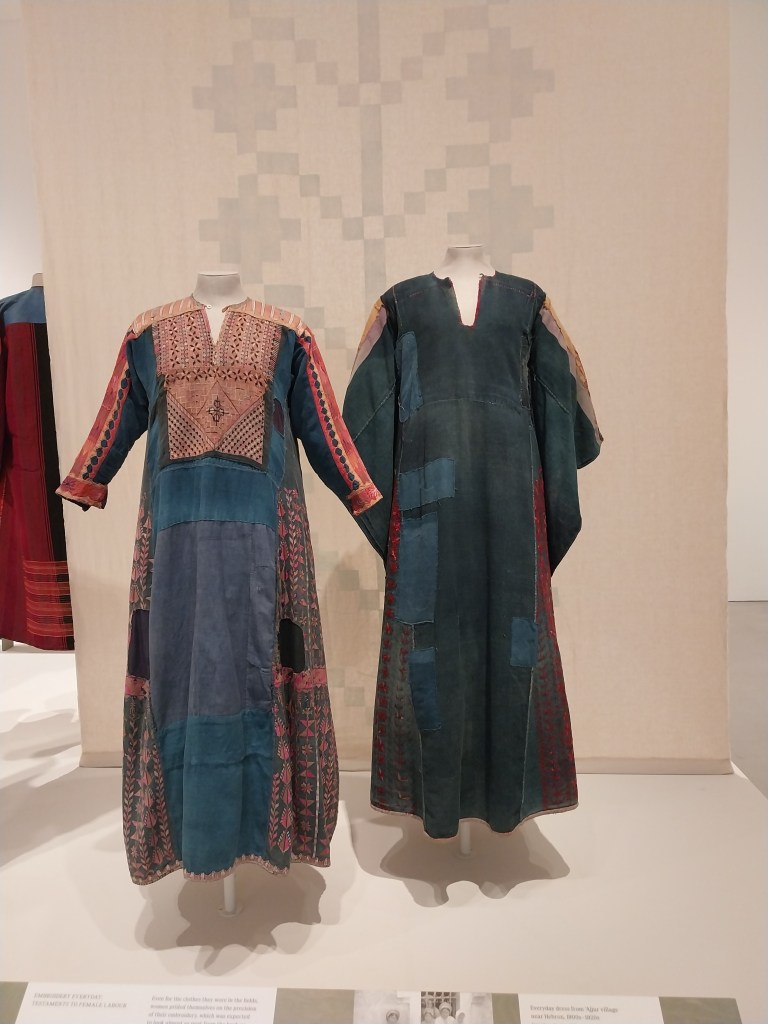
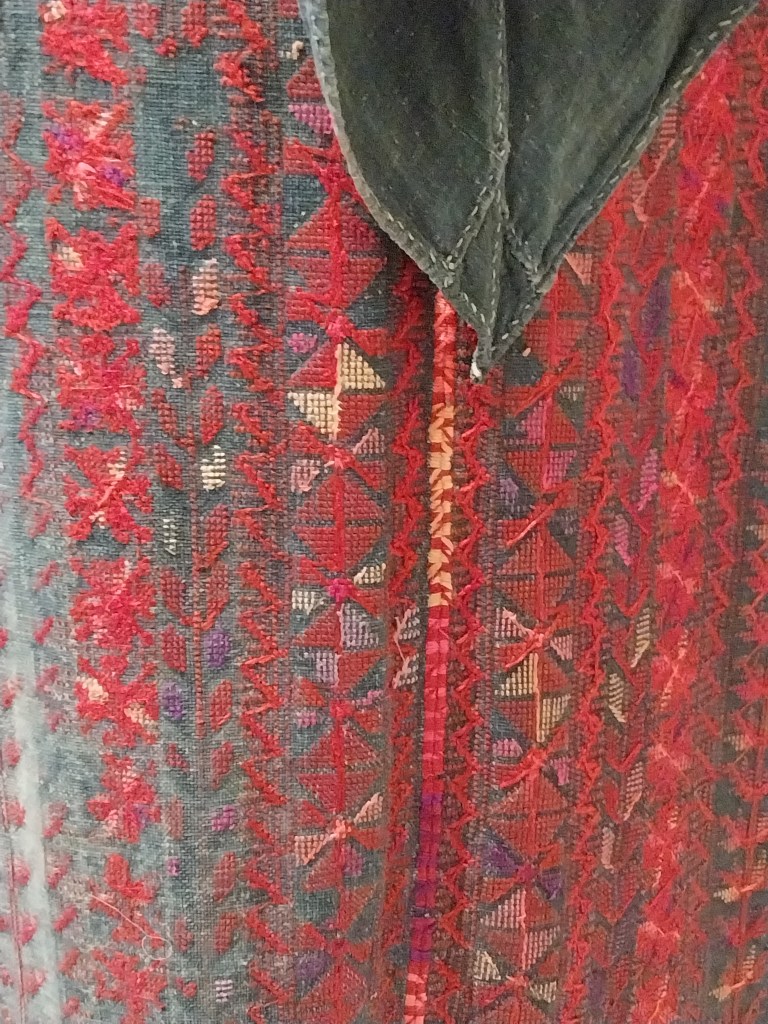
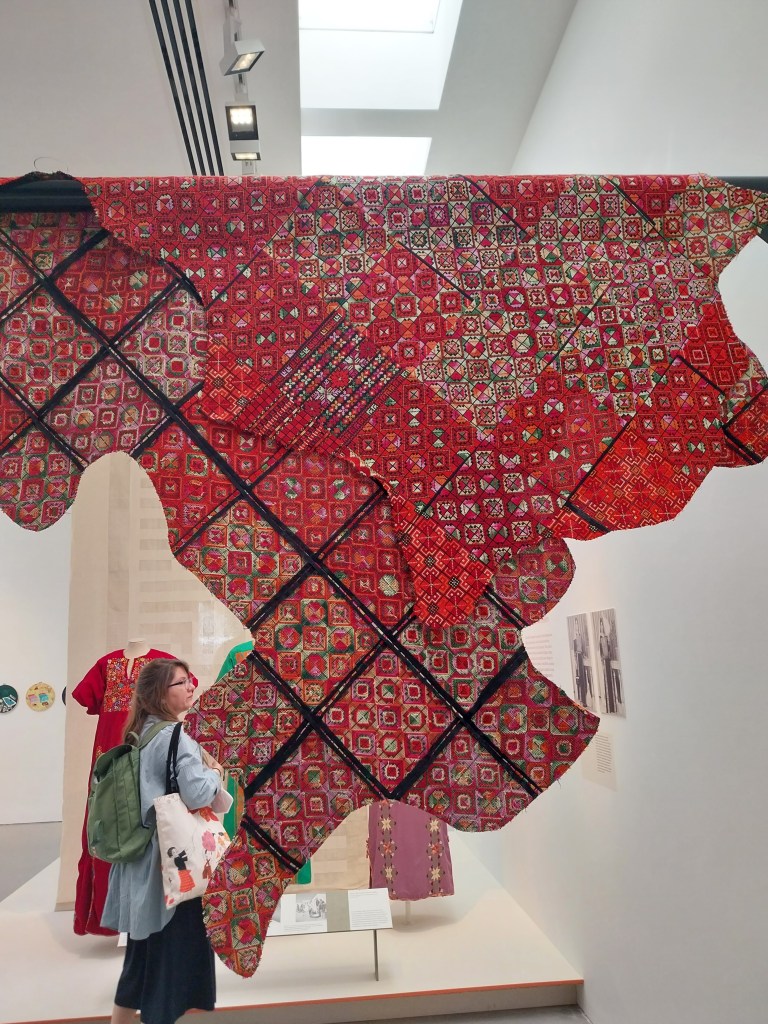
Our slot to visit the house was at 2pm, so we visited the Material Power exhibition first. The show covers both historic and modern dress, and the role of embroidery as a social signifier and a form of protest and resistance. As a cross-stitcher and very basic embroiderer, the amount of work and detail in the gorgeous garments left me speechless (I know!), especially the inside out garment where the back of the work was spectacularly neat. The image of the ’embroidered woman’ in the PLO material was striking. Upstairs was more modern clothing, and we were struck by the foregrounding of Palestinian women’s voices by simply having their video playing out loud, while the curator had to be listened to on headphones. Valentina has Palestinian ancestry, so the exhibition held personal meaning for her.
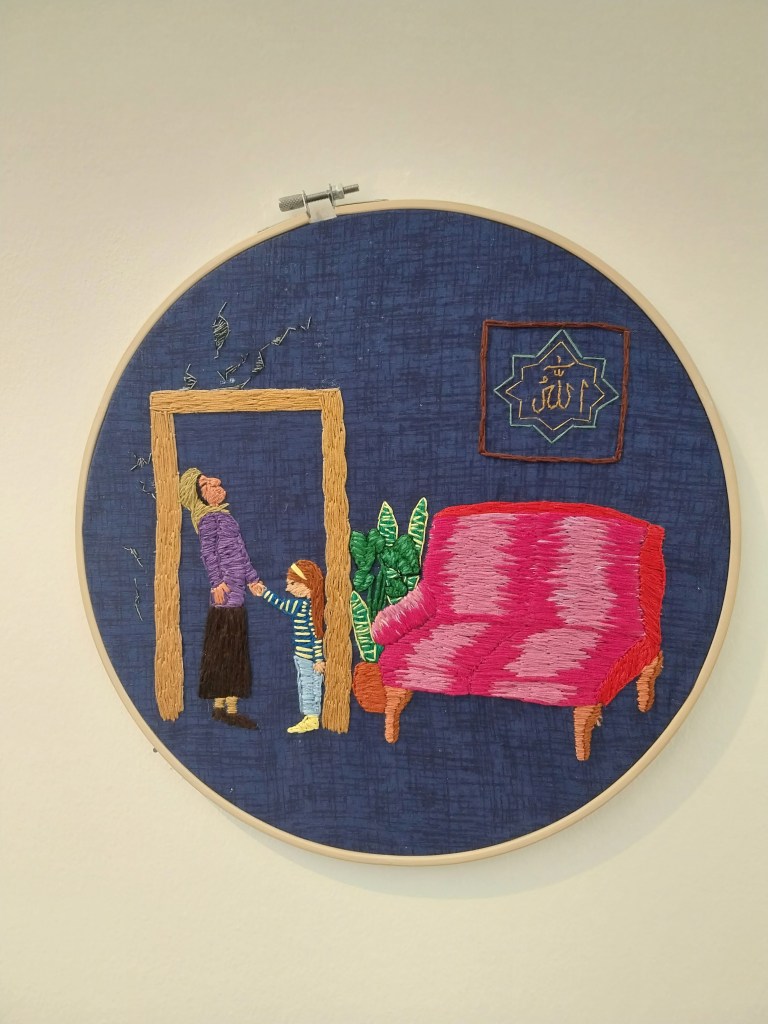
DressesThis is the inside!HeadpiecesA gorgeous bolero jacketembroidered mapsHoop embroidery: Door FrameAya Haidar’s Safe Space series, 2023
The piece that moved me most was the one above, Aya Haidar’s Safe Space series: a set of six hoop embroideries documenting her mother’s memories of growing up on Lebanon in the Civil War (1975-1990), and the steps people took to stay safe from everyday violence. Saucepan helmets and bullet proof vests, sleeping under beds, piling furniture to protect from flying glass, captured in a ‘domestic’ craft.
Finally we popped up to look at the ‘reflection and response’ space which turned out to be a corner in a corridor. The rest of the exhibition was so well done that I was a bit disappointed by this, though space is obviously an issue. There was a lot to reflect on and this felt like an afterthought.
To the house!
I’d heard of Kettle’s Yard as someone on my MA course was a volunteer there, but didn’t know much about it so had no idea what to expect. I was completely enchanted from the moment we walked in.
The website says, ‘Kettle’s Yard is the University of Cambridge’s modern and contemporary art gallery. Kettle’s Yard is a beautiful House with a remarkable collection of modern art.’ This does not do it justice. You can take a virtual tour here, but if you’re in Cambridge – perhaps to see the Raymond Briggs Retrospective! – go and visit. It’s magical in the same way that Dennis Severs’s House is: out of time, and with the sense that someone has just left the rooms. Apparently Helen and Jim Ede welcomed visitors and fed them tea and toast, and this spirit of home remains.
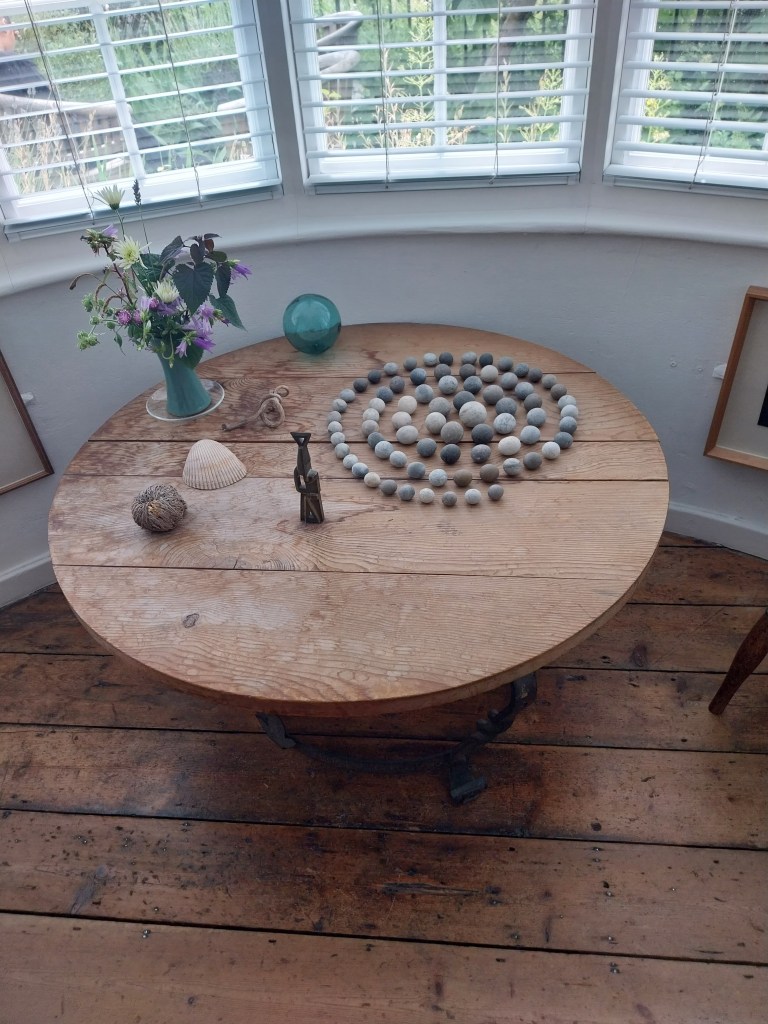
When your timeslot arrives you are escorted to the house where you ring a bellpull and are greeted by an incredibly knowledgeable person who clearly loves their role. You can sit in any of the chairs but you can’t touch any of the exhibits, which was frustrating for someone likes me who loves a pebble and a found object.
Alfred WallisBoy with Cat – Christopher Wood
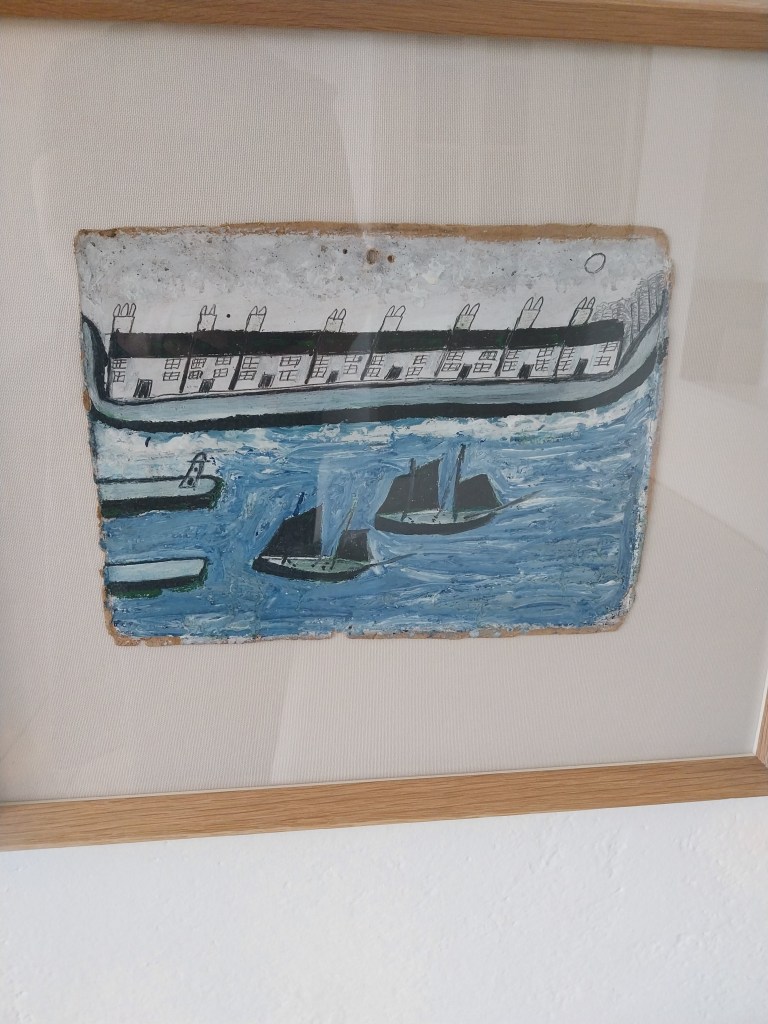
This being me, I gravitated to the packed bookshelves in Helen Ede’s room where I found such old friends as Lucy M. Boston’s Green Knowe stories (set in Huntingdon) and Sellars & Yeatman’s 1066 and All That. I wanted to find a chair and read for a while. The whole house exerts a sense of calm that I usually get from being at the seaside. Many of the paintings that called to me were seascapes, particularly Seascape with Two Boats by Winifred Nicholson where my eye was caught by the small child exploring the rocks and the Alfred Wallis Five Ships, Mount Bay which reminded me of Aberaeron.
Seascape with Two Boats – Winifred NicholsonDetailFive Ships, Mount Bay – Alfred WallisCornelia Parker, Verso, 2016
I also liked Cornelia Parker’s Verso series – photographs of the reverse of button cards from a museum collection, which highlight the work of the seamstresses who had to mount these buttons.
You can read more about Jim Ede and Kettle’s Yard here and here. If I go missing, you’ll find me tucked in a corner of his house with one of Helen’s books.
Next week will be a crafty update as I have been busy with crochet creatures, cross stitch and a make and share for the new issue of Tauko magazine. Here’s a teaser…
Kirsty x
What I’ve been reading:
Overboard– Sara Paretsky
The Ward Witch – Sarah Painter
Moon Over Soho/Whispers Underground – Ben Aaronovitch (Audible)
Emily Wilde’s Encyclopaedia of Fairies – Heather Fawcett












 What Kirsty did next