
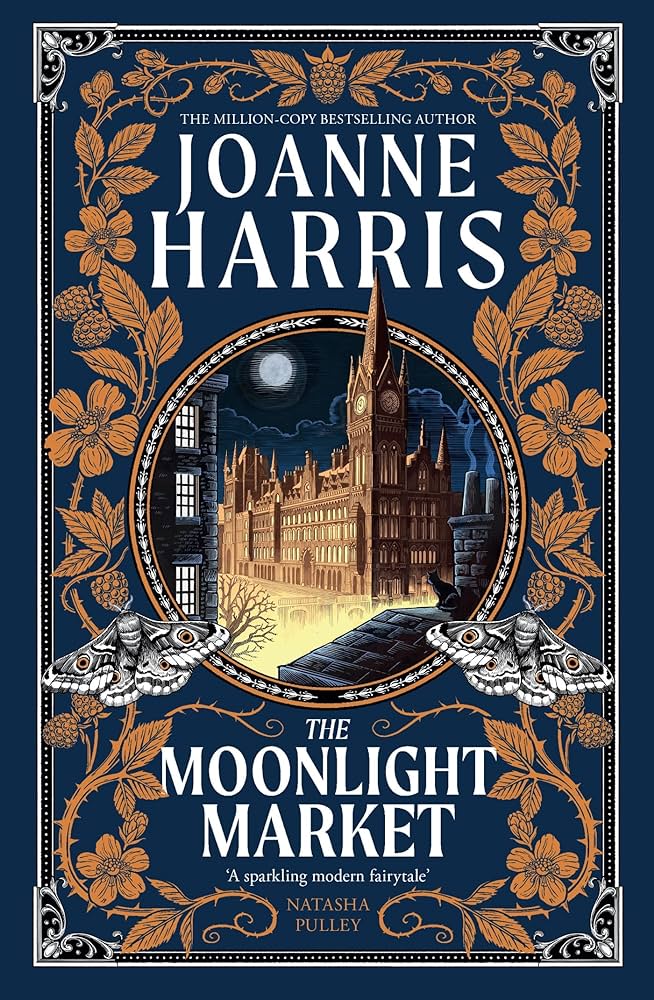
This week’s tube journeys have been accompanied by Joanne Harris’s latest novel, The Moonlight Market, which is being marketed as ‘Neverwhere meets Stardust‘ (the marketing team at her publishers are probably cursing themselves). I love both those books, and also am a huge fan of everything else by Joanne Harris, so that I was going to read this was a given.
But…it’s also set in London. London Below, London Before, London today – the London we see in front of us, the London that might be waiting for us down one of those intriguing little alleyways that the older parts of the City (and the city, I suppose) do so well, the London that might be there if you catch it in the corner of your eye. Clerkenwell and Farringdon have many of these, and I am easily distracted by the thought of magic and adventure.* I blame growing up with books where statues came to life in gardens; where forests grow in naughty children’s bedrooms and you can sail away to the land where the wild things are; where there was a permanently frosted world through the back of a wardrobe; and a house full of Civil War ghost children, ebony mice that come to life and lost jewels.
You might say London has enough stories to be going on with, without making up more, but one of the best things about a city with more than 2000 years of stories and people is that there will always be room for more. London, as Peter Ackroyd and Edward Rutherfurd have proved, is enough of a story in itself.
However, people do keep writing these stories, for which I am profoundly grateful. The Moonlight Market is a story about a London man who works in a camera shop on Caledonian Road (‘the Cally’, as it’s known locally) who falls suddenly, unexpectedly in love with a woman who is (of course) more than she seems. A photographer himself, he discovers that his negatives show things that can’t be seen in daylight, and his search for these places and people lead him to the Moonlight Market on a London Bridge that only exists on moonlit nights. Threaded through this is a fairytale about the doomed affair between the Moth King and the Butterfly Queen, and the resulting war between the Silken Folk of the day and night courts. Like her Chocolat series, magic exists and co-exists with the mundane world, and sometimes crosses over – all the best urban fantasy is filled with possibility, of course, and Harris’s books are filled with it.
If you love urban fantasy and London, here’s a few more worlds you can explore:
- Ben Aaronovitch’s Rivers of London series
- Mike Carey’s Felix Castor novels
- Neil Gaiman’s Neverwhere (I am extremely disappointed in recent revelations about him, but I still love this book)
- Benedict Jacka’s Alex Verus series
- Paul Cornell’s Shadow Police series
- Christopher Fowler’s Bryant and May series
- Sarah Painter’s Crow Investigations
- Neil Blackmore’s Soho Blue (not magical, but worlds colliding and some of the most evocative writing about post-war London I’ve ever come across)
A good writer makes the setting as much a part of the story as the characters and the action. I first understood this when I did a module at uni called ‘The City in the American Mind’, which introduced me to Sara Paretsky’s Chicago through the eyes of V.I. Warshawski. I’d probably be terribly disappointed if I visited – in my head Vic’s office is in a classic noir setting in ‘the Loop’ , there’s vast tracts of post-industrial wasteland, and there’s a Great Lake smack in the middle. Similarly, Dave Robicheaux’s swampy, louche and lush Louisiana (James Lee Burke is the author here) would not live up to my visions, and if I go to San Francisco I want it to be in Armistead Maupin’s 1970s rather than today. Clearly I need a time-travelling Doctor….but again, that’s another story.
*This probably explains why I get lost a lot on the way back from meetings….if I walk down there, surely it will lead to there (it often doesn’t, but what possibility of magic and adventure would there be if I just walked straight down St John Street to the office?
Other things making me happy this week:
- Coffee with Brian on his last day ever at Museum of London. Hashtag end of an era or something.
- Trip with some of the team to the Tower Bridge Experience. Team now convinced I know people EVERYWHERE as one of the bridge hosts is a double-ex colleague from both MoL Docklands and V&A.
- Finishing week four of C25K without injury. Crossing fingers, touching wood etc, and sticking everything together with RockTape.
- Finishing a sashiko-stitched cat bag
- Being able to sit in the garden and work surrounded by plants and sunshine. My Beloved’s new garden shelter is coming on well.
- Taking the lovely Matt Shaw round the site in preparation for a new project, watched by this pretty fox.
- Cinnamon buns for breakfast courtesy of Thing 2
Things making me fall about laughing this week:
The Museum of London’s new logo. Sorry, London Museum. I can see what you were thinking but sparkly guano and a discombobulated flying rat aren’t doing it for me.
Still, I spotted the model when I was out with the team at Tower Bridge:

Today I am off for a swim with Isla, and I might even make something. You never know….
Kirsty x
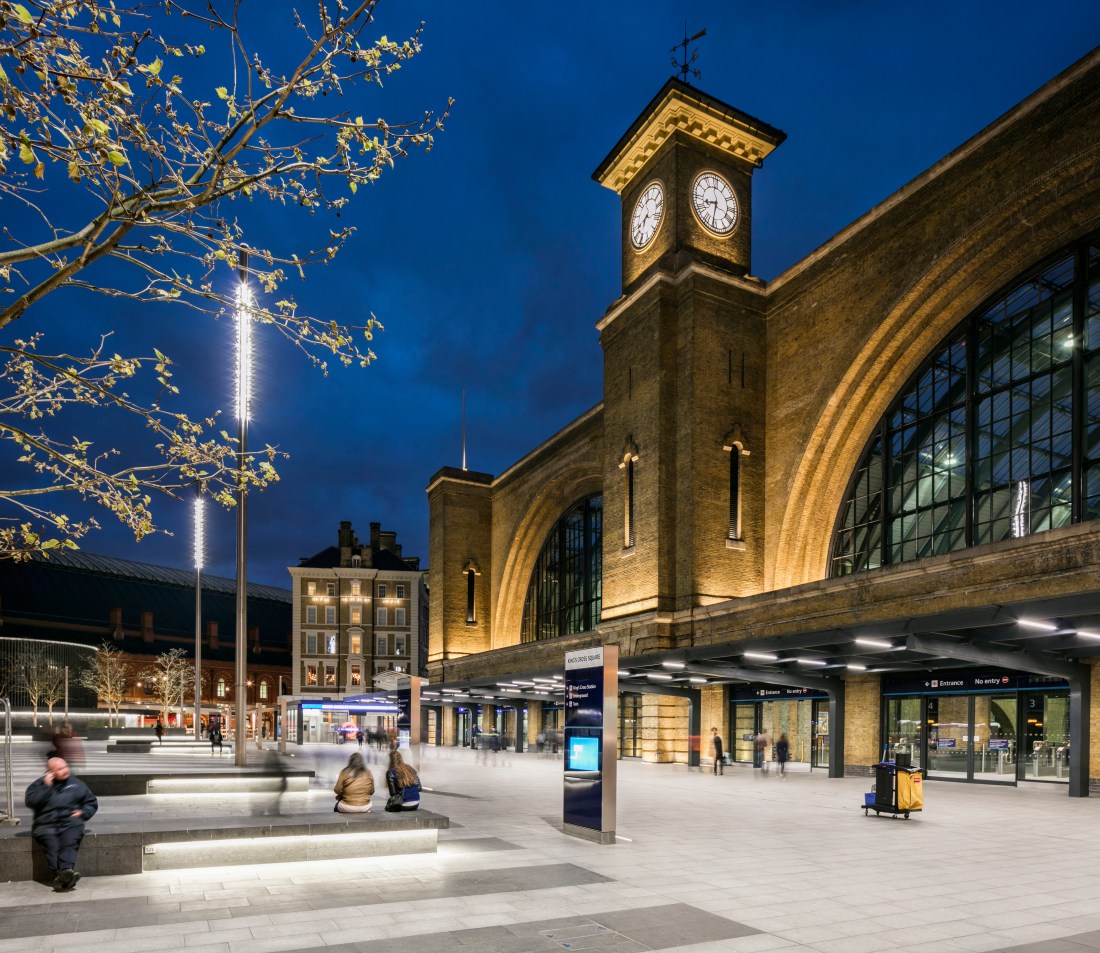
Cover image: Network Rail
What I’ve been reading:
The Life of a Scilly Sergeant – Colin Taylor
The Secret Hours – Mick Herron
The Children of Green Knowe/The River at Green Knowe/The Chimneys of Green Knowe/An Enemy at Green Knowe – Lucy M. Boston
The Moonlight Market – Joanne Harris (Audible)
 What Kirsty did next