

I’ve just wandered over here from LinkedIn — as you do — where I have been reading a post about using em dashes — or not — in writing. Apparently they are an indicator that AI has written whatever it is you’re reading. This is most definitely not the case here, I assure you.
I am a big fan of an em dash. Emily Dickinson was a big fan of the em dash. My ex-line manager at London Museum was a big remover of my em dashes, bless his little cotton socks, although I could forgive him for that. (It was harder to forgive the director who used to uncapitalise ‘Second World War’ every time he saw it in my brochure text, despite the fact that it’s a specific historical event. He annoyed me.)

In this blog I have usually used the en dash (-) instead of — purely because I write on a laptop and it doesn’t have a number pad which is what you need to insert the — symbol. To get your em dash on a laptop requires pressing the windows and full stop keys to bring up the emoji menu, and there’s a ‘special characters’ menu there. I may be a lover of the — but I’m also lazy, so please forgive my grammatical quirks.
Punctuation — as well as the words I wrap it around — may be one of my favourite things. When I write talks and sessions, especially if other people will be delivering them, using dashes (and parentheses) and the odd semi-colon make my writing more human, not less; giving life to words which are going to be spoken aloud. Can you imagine how dreary things would be if everything was short sentences and full stops, with no emphasis or asides?

At the other punctuational extreme is one of my all-time favourite poets, the wonderful e e cummings, more of whose work can be found here. A literary sort once said that his poetry transformed the word to transform the world. A lot of his poems use broken, scattered or run-on lines to create emphasis, such as the one above which featured in a school poetry anthology. He played with typography, space and shape to provide tone and punctuation, and — to paraphrase his response to a critic on one of his plays — wanted to know why people couldn’t just relax and see what happened rather than demanding to know what things mean all the time. My thoughts exactly.
When I left university in 1994, after 17 years of schooling of one kind or another, I decided that I was only going to read things I wanted to; I’d been asked to analyse dozens of texts and poems over the years which stripped all the joy out of the language and the stories. What I want to read may on occasion be considered as ‘literature’ (in at least the GCSE syllabus sense) but the point is that I’m reading it for the sheer joy of it. It took me another 20-odd years to be able to not finish a book I’d started if I wasn’t enjoying it but that’s a different matter. I am not picky about genre and a good trip to the library or the local Oxfam Books & Music takes in a wander around all the shelves and an eclectic haul.
This decision to read books based on interest has led me back to books like Graham Swift’s Waterland, which as a 17-year old A-level student I thoroughly disliked but as an adult I loved: I went back to it after visiting the Fens, where it’s set, and understood it far more. I was lucky enough not to have been made to read some of the classic GCSE and A-level texts – Gatsby, Mockingbird, Catcher – so came to them independently in the school library and loved them for themselves. I have a colleague who’s also an eclectic reader and we recommend books to each other – Cahokia Jazz, by Francis Spufford, was a recommendation from him and it’s one of the best books I’ve read in years. I tried another of Spufford’s books and couldn’t get into it at all, so I took it back to the library unfinished.
2026 has been named the National Year of Reading and the idea is to encourage a love of reading for pleasure. I think this is a great idea. However, I can’t help thinking that we — this is the policy-making, government-level, educational we, not a personal we — have spent the last 12 or so years building a generation which doesn’t love reading for a very good reason.
I have a cunning plan, though. Let’s refresh the National Curriculum and allow teachers to stop stripping texts back to their component parts from a very early age in school. Stop insisting on seeing sentences as no more than examples of spelling, punctuation and grammar and then children might start to love reading for its own sake. Teachers might also be happier.
Let’s put storytelling back into teacher training courses and make it a compulsory part of the school day. Let’s dedicate some time in colleges and on SCITT schemes to sessions with professional storytellers like Olivia Armstrong and show teachers how to bring a story to life with your voice. Help them share the joy of the language and the rhymes and the jokes; the sad bits and the happy bits and the sheer pleasure of being transported to a different world for half an hour at the end of the school day. Give teachers the confidence to do the accents and the voices and to pull the faces, and leave the children wanting more – perhaps to pick up the book themselves and have a go without seeing every sentence as a challenge or a task to be completed. If a teacher isn’t confident, there’s audio books galore out there read by people who are paid to do the voices. David Tennant read a CD of all the Hairy McLairy books and it’s wonderful. Hugh Grant reading Dickens’ A Christmas Carol. And Michael Sheen reading – well, anything, up to and including a shopping list, but start with Philip Pullman’s The Book of Dust.
I wrote last month about Frank Cottrell-Boyce’s campaign as Children’s Laureate to make hearing stories part of every child’s life, and this leads on from that: give them joy not grammar. Teach them to love words, and their vocabulary will expand as a result. They’ll see punctuation as they read and will learn to use it as they go, and I guarantee you they won’t even realise they’re learning it. Tell them about libraries, where they let you take books away to read and have thousands of different ones, and they’ll never be short of entertainment. Even better, tell them about librarians, as the good ones will be able to suggest books and the really good ones will know what to read when they’ve finished that one. They’ll be unstoppable.
Things making me happy this week
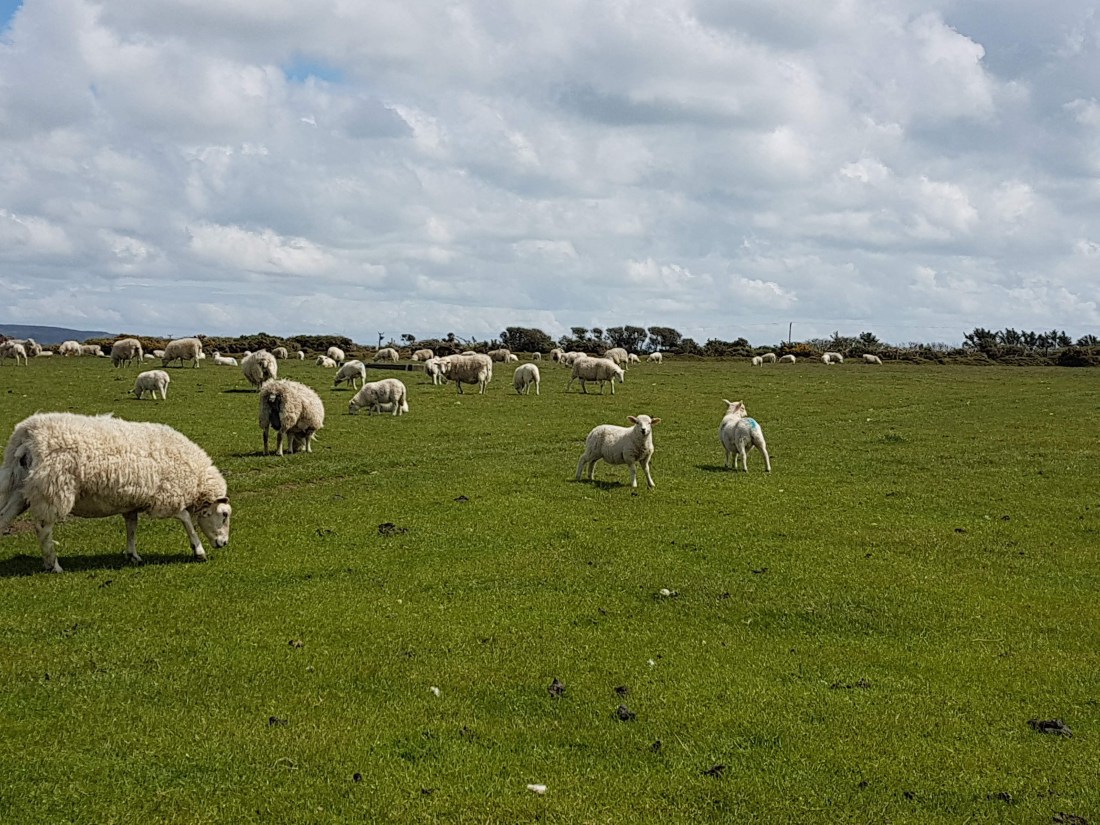
- A good ramble through the fields on Saturday morning, except for the bit where I got lost and my legs got shredded by fierce brambles.
- This rainbow bunny – it’s the Toft Emma pattern again from Ed’s Menagerie.
- Untamed – a new Netflix series with Eric Bana, Sam Neill and excellent scenery.
- New haircut
- End of term for Thing 3, so I don’t have to make sure he’s out of bed for a few weeks before I leave for work
- A crocheted meerkat from a pattern by Planet June
That’s it from me. If no one minds, I’ll be reading my book.
Kirsty x
What I’ve been reading:
Blood Debt/Summon the Keeper/The Second Summoning – Tanya Huff
Between the Stops – Sandi Toksvig
Shadowlands – Matthew Green
Edgelands – Paul Farley & Michael Symmons Roberts
 What Kirsty did next