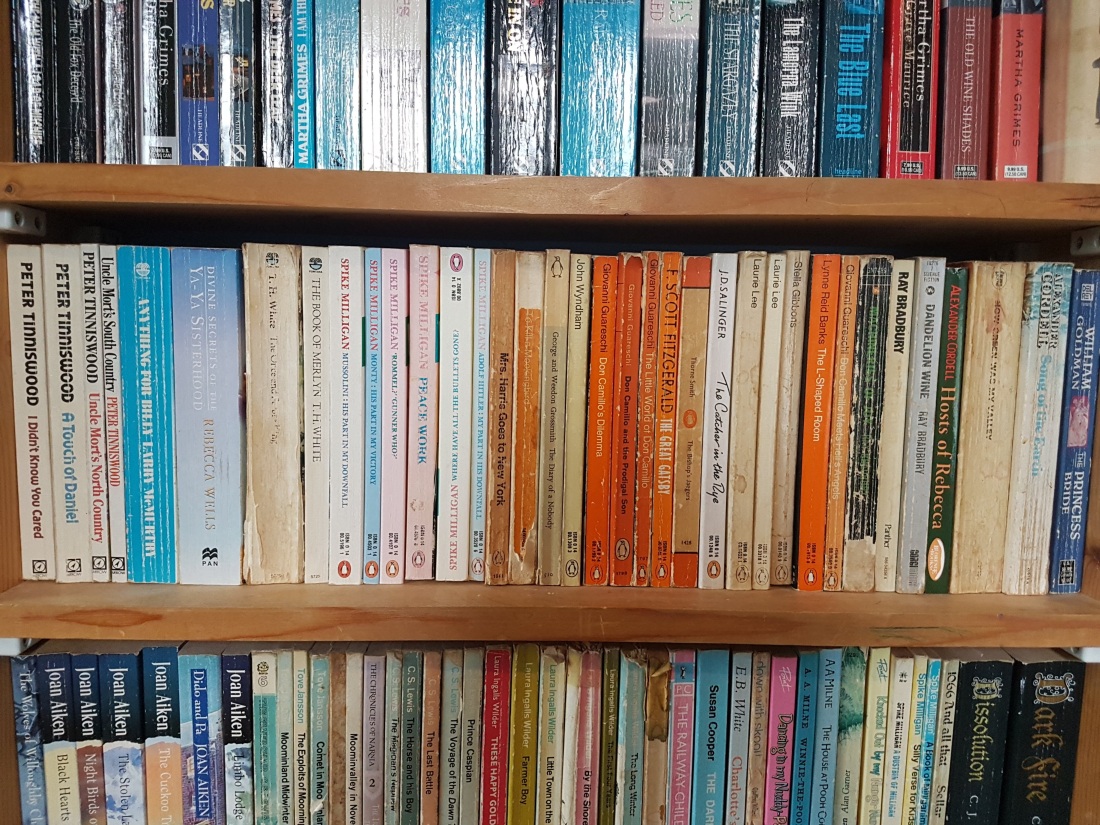
Last week I mentioned that I was reading The Wolves of Willoughby Chase sequence again and quite a few of you lovely people have commented in various places about how they’d loved these books (well, obvs, as I have excellent taste). So, in the spirit of this I shall be sharing more of my childhood favourite series for your education and entertainment or something. I still have all of them on my shelves upstairs or on my Kindle. What have I missed though?
The Dark is Rising sequence – Susan Cooper. Quite Arthurian, set in Cornwall, Wales and Buckinghamshire. Do not watch the film, which was bloody awful despite a good cast.
Little House series – Laura Ingalls Wilder. Pioneering America, heavily romanticised. As an adult all that moving around must have been quite stressful for poor Ma, but it seemed exciting at the time.
The Maggie books – Joan Lingard. For older children, set in Scotland with a side quest to Canada.
Anne of Green Gables series – L. M. Montgomery. Poor Anne-with-an-E, with the carrotty hair and the trials and tribulations.
The Moomins series – Tove Jansson. Family-oriented trolls living in Moominvalley, hibernating through the winter and surviving Hemulens, Grokes and the Hobgoblin. If I ever have a craft shop it’ll be called The Hobgoblin’s Hat. I already named one of the Things after the author.
The Narnia books – C.S.Lewis. I spent a lot of time looking in old wardrobes but failed to find the lamp-post.
The Worst Witch series – Jill Murphy. Poor Mildred Hubble. I don’t blame her for turning Ethel into a pig. She deserved it.
Nancy Drew mysteries – Carolyn Keene. All of these were returned to me a couple of years ago and there will be a full reread. Nancy Drew is still about in various forms but I’m very old school about these and have no truck with them.
The Green Knowe books – Lucy M. Boston. Still haven’t managed to visit.
Willard Price’s Adventure series. So exciting. Everything I know about how to capture birds of paradise is thanks to Hal and Roger Hunt. So far I haven’t had a chance to use this knowledge. I don’t still have these, and suspect that they may not have aged well.
There were many more, of course, and lots of standalone novels that live in my memory and occasionally bubble up (meaning I need to go and find them again and re-read) – but that will be a post for another day.
This week has a private view at the Soane, Thing 2 promising to cook on Monday, shortlisting for our Community Gardener, starting the Attic24 Wildshore Blanket CAL – it’s all go!
This has been a very therapeutic week, making the most of the end of the year and the beginning of the new one before diving back into the inevitable maelstrom of the last phase of a capital project. I’ve spent many hours in my attic lair surrounded by piles of fabric, reading lots of books, dipping in and out of Grey’s Anatomy with Thing 1, and eating way too much of the Christmas cake.
The sewing hasn’t always been successful. Monday’s project – the Sewing Therapy Hanbok Skirt (a reversible pleated wrap skirt) turned into Tuesday’s project as well, when I unmade it, removed a third of the width and used the removed panel to add seven inches to the length. Floofy skirts that sit just below the knee are really not me, and this one made me feel like a Victorian tea table which I am sure was not the intention. I used a black pinstriped fabric that was perhaps too bulky for the style. I may make a summer version with something much lighter.
The written sewing instructions are sparse but useable, as the designer offers detailed video tutorials instead. As I discovered previously when making the Stitchless TV Bucket Coat, I don’t like video tutorials. Pausing and restarting and faffing about with laptops when I want to sew is a pain. Old style sewing patterns with all their nice clear illustrations and written instructions are much more me and a designer who offered both old-school and video would probably be very popular (definitely with me).
The second make was the Madswick Ginkgo Pinafore, a wrap dress (there may be a theme here) which can be worn several ways and which is a version of a black linen pinafore I use for layering when I am in need of extra pocketses. I used a king sized duvet cover for fabric, with a print of stars and fireflies so this will be for days when I require whimsical pocketses. This had good instructions although I cheated on the last step as burrito-ing the skirt panels felt unnecessarily complicated when a good stitch-in-the-ditch would do the job nicely.
I haven’t been able to do any sewing for ages so I also have a pile of unfinished quilting projects which I now have the space (and will find the time) to get to! The lair is going to be a productive place. I have also stocked up on biscuits.
Reading stuff
I’ve been indulging in a bit of nostalgia over Christmas, working my way through Joan Aiken’s wonderful Wolves of Willoughby Chase sequence, which is set in an alternative history where all those King Georges never made it to the throne. Following the adventures of Dido Twite and her friend Simon, it takes in wolves who’ve made it through the Channel Tunnel, dastardly Hanoverian plots, Arthurian legends, evil fake aunties and much more. When I started to re-collect these novels as an adult I was thrilled to discover that Aiken had filled in some of the gaps in Dido’s story and carried it on past the books I’d loved when younger. Pat Marriott’s dark, scratchy illustrations bring a sense of menace to the early novels, with their looming villains. I can feel a reread of the Dark is Rising sequence coming on afterwards.
I’ve also been learning about the history of footpaths in England and Wales with Jack Cornish’s The Lost Paths – long term readers will know that I love a long walk, and look forward to wandering down new footpaths when I’m out and about. This book looks at why and how many of our footpaths developed across time, what impact events like war and enclosure as well as natural events have on our access to the countryside, and why some paths just stop for no logical reason. It’s taken me ages to get through it (it’s not really a pick up and put down book) but having time off has hooked me right in.
Seeing in the New Year surrounded by the usual friends and family, ridiculous trivia quizzes and Jill retaining her cereal box game crown despite competition from the teens…
Meeting an excellent kitten (who I didn’t kidnap as Lulu would probably have eaten him)
Snuggling babies in the form of sleepy twins on Saturday morning
Frosty walks with friends and hounds
The final episode of Stranger Things, and yes I cried.
The Holdovers – a film recommended by a work colleague, which manages to look as if it was filmed in the 70s.
Thing 2 making dinner on Saturday night
Resolving not to make any resolutions I can’t keep
Tomorrow is back to work, although at least from home for the first couple of days to ease back in! Happy New Year all.
Kirsty x
What I’ve been reading:
The Stolen Lake/Limbo Lodge/The Cuckoo Tree/Dido and Pa – Joan Aiken
Strange Days – Violet Fenn
The Dead of Winter – Sarah Clegg
The Magus of Hay/Friends of the Dusk/All of a Winter’s Night – Phil Rickman (Audible)
I’ve just wandered over here from LinkedIn — as you do — where I have been reading a post about using em dashes — or not — in writing. Apparently they are an indicator that AI has written whatever it is you’re reading. This is most definitely not the case here, I assure you.
I am a big fan of an em dash. Emily Dickinson was a big fan of the em dash. My ex-line manager at London Museum was a big remover of my em dashes, bless his little cotton socks, although I could forgive him for that. (It was harder to forgive the director who used to uncapitalise ‘Second World War’ every time he saw it in my brochure text, despite the fact that it’s a specific historical event. He annoyed me.)
‘I’m nobody! Who are you?’ Emily Dickinson, em dash lover
In this blog I have usually used the en dash (-) instead of — purely because I write on a laptop and it doesn’t have a number pad which is what you need to insert the — symbol. To get your em dash on a laptop requires pressing the windows and full stop keys to bring up the emoji menu, and there’s a ‘special characters’ menu there. I may be a lover of the — but I’m also lazy, so please forgive my grammatical quirks.
Punctuation — as well as the words I wrap it around — may be one of my favourite things. When I write talks and sessions, especially if other people will be delivering them, using dashes (and parentheses) and the odd semi-colon make my writing more human, not less; giving life to words which are going to be spoken aloud. Can you imagine how dreary things would be if everything was short sentences and full stops, with no emphasis or asides?
At the other punctuational extreme is one of my all-time favourite poets, the wonderful e e cummings, more of whose work can be found here. A literary sort once said that his poetry transformed the word to transform the world. A lot of his poems use broken, scattered or run-on lines to create emphasis, such as the one above which featured in a school poetry anthology. He played with typography, space and shape to provide tone and punctuation, and — to paraphrase his response to a critic on one of his plays — wanted to know why people couldn’t just relax and see what happened rather than demanding to know what things mean all the time. My thoughts exactly.
When I left university in 1994, after 17 years of schooling of one kind or another, I decided that I was only going to read things I wanted to; I’d been asked to analyse dozens of texts and poems over the years which stripped all the joy out of the language and the stories. What I want to read may on occasion be considered as ‘literature’ (in at least the GCSE syllabus sense) but the point is that I’m reading it for the sheer joy of it. It took me another 20-odd years to be able to not finish a book I’d started if I wasn’t enjoying it but that’s a different matter. I am not picky about genre and a good trip to the library or the local Oxfam Books & Music takes in a wander around all the shelves and an eclectic haul.
This decision to read books based on interest has led me back to books like Graham Swift’s Waterland, which as a 17-year old A-level student I thoroughly disliked but as an adult I loved: I went back to it after visiting the Fens, where it’s set, and understood it far more. I was lucky enough not to have been made to read some of the classic GCSE and A-level texts – Gatsby, Mockingbird, Catcher – so came to them independently in the school library and loved them for themselves. I have a colleague who’s also an eclectic reader and we recommend books to each other – Cahokia Jazz, by Francis Spufford, was a recommendation from him and it’s one of the best books I’ve read in years. I tried another of Spufford’s books and couldn’t get into it at all, so I took it back to the library unfinished.
2026 has been named the National Year of Reading and the idea is to encourage a love of reading for pleasure. I think this is a great idea. However, I can’t help thinking that we — this is the policy-making, government-level, educational we, not a personal we — have spent the last 12 or so years building a generation which doesn’t love reading for a very good reason.
I have a cunning plan, though. Let’s refresh the National Curriculum and allow teachers to stop stripping texts back to their component parts from a very early age in school. Stop insisting on seeing sentences as no more than examples of spelling, punctuation and grammar and then children might start to love reading for its own sake. Teachers might also be happier.
Let’s put storytelling back into teacher training courses and make it a compulsory part of the school day. Let’s dedicate some time in colleges and on SCITT schemes to sessions with professional storytellers like Olivia Armstrong and show teachers how to bring a story to life with your voice. Help them share the joy of the language and the rhymes and the jokes; the sad bits and the happy bits and the sheer pleasure of being transported to a different world for half an hour at the end of the school day. Give teachers the confidence to do the accents and the voices and to pull the faces, and leave the children wanting more – perhaps to pick up the book themselves and have a go without seeing every sentence as a challenge or a task to be completed. If a teacher isn’t confident, there’s audio books galore out there read by people who are paid to do the voices. David Tennant read a CD of all the Hairy McLairy books and it’s wonderful. Hugh Grant reading Dickens’ A Christmas Carol. And Michael Sheen reading – well, anything, up to and including a shopping list, but start with Philip Pullman’s The Book of Dust.
I wrote last month about Frank Cottrell-Boyce’s campaign as Children’s Laureate to make hearing stories part of every child’s life, and this leads on from that: give them joy not grammar. Teach them to love words, and their vocabulary will expand as a result. They’ll see punctuation as they read and will learn to use it as they go, and I guarantee you they won’t even realise they’re learning it. Tell them about libraries, where they let you take books away to read and have thousands of different ones, and they’ll never be short of entertainment. Even better, tell them about librarians, as the good ones will be able to suggest books and the really good ones will know what to read when they’ve finished that one. They’ll be unstoppable.
Things making me happy this week
A good ramble through the fields on Saturday morning, except for the bit where I got lost and my legs got shredded by fierce brambles.
This rainbow bunny – it’s the Toft Emma pattern again from Ed’s Menagerie.
On Wednesday I attended – from the comfort of my living room – a session of the What Next? culture group. This is a wide-ranging, first-thing-in-the-morning, ‘free-to-access movement that brings together small and large organisations and freelancers to debate and shape arts & culture in the UK’. I don’t get to attend them very often as Wednesdays are usually my later-into-the-office days due to teenager wrangling responsibilities.
Anyway, this week’s was about the power and importance of reading to small children from a very early age. One of the speakers was the Children’s Laureate Frank Cottrell-Boyce who pledged at the start of his Laureateness (Laureacy?) to campaign to reduce reading inequality through the Reading Rights campaign. The first report has recently been published, calling on national and local leaders in early years, health, education and culture to come together and make reading a part of daily life for every child in the first seven years of life.
Mr C-B spoke about visiting the Babylab at Queen Mary’s in East London, where he watched in real time as a mother and baby were wired up to a brainwave thingy and the mother read a story to the baby on her knee. The act of being read to by a loved one visibly calmed the baby’s chaotic brain waves, their heart rate, and their breathing came into sync. He called it ‘love at a synaptic level’. From this mum’s point of view, too, there is nothing quite like the feeling of a warm, sleepy baby or toddler snuggling in for a story at the end of the day. I recognise, too, that the act of reading is also a privilege.
“If you’ve been read to, as a child, by someone who cares about you, you have been given an enormous invisible privilege. If you haven’t been given that privilege, then you’ve been left with an enormous mountain to climb.”
Frank Cottrell-Boyce
According to BookTrust’s research, 95% of families know that reading is really important but only 42% of children in lower-income families get a regular bedtime story. There are a whole lot of reasons for that – aside from parents possibly not having that experience themselves as a child, or lacking the confidence in their own reading skills to read a story ‘properly’ – but a key reason is that living in poverty or need is really, really hard. You spend time in meetings with benefits people. You spend time getting to places on public transport getting to meetings or the supermarket with the cheapest food, or on hold to government organisations, or sorting out housing, or working one or more minimum wage jobs, or worrying about your electric or gas or other bills. All this as well as caring for your small person…. the mental bandwidth this all takes up is enormous and things like bedtime stories aren’t always top of the list. Survival is.
Those of us who grew up with being read to nightly – and, with the benefit of younger siblings to listen in on later – for many years are lucky. I did the same with my own children – I was certainly still reading chapter books to my reluctant reader Thing 2 when she was eight or nine and Things 1 and 3 were listening in. M.M.Kaye’s The Ordinary Princess was a favourite, as was Jill Tomlinson’s The Owl Who Was Afraid Of The Dark which we took on holiday and I read a chapter a night to my three and my niece. Bedtime story time was one of the joys of being a parent, honestly, even when I was in the depths of PND and could barely function. It was a moment of peace and routine in what were some very hard days, but then books are my own go-to moment of sanity as an adult so this makes sense for me. Admittedly there were days when the fifth or sixth reading of the same book got a little wearing, but there we are.
Cottrell-Boyce also made the excellent point that children who aren’t read to at home then encounter books for the first time when they get to school and they’re suddenly being asked to sit down and decode things they have no experience of. Books become difficult and scary, and not something to be experienced as a joy: these children aren’t making the connection between the words in front of them and the pictures on the page because they don’t have the literacy capital to do so. He likened this experience of reading as being presented with a recipe to cook before you have ever experienced food – the pain without the pleasure, as it were. Illustrations are the first encounters with visual art that children have. Illustration – as I say a lot to people in my day job – is art with a job to do, it’s art that communicates.
The wonderful BookTrust are working with Cottrell-Boyce on this campaign. The BookStart scheme, which provides families with free books via health visitors and libraries, is the last man standing from the brilliant SureStart scheme that was one of the great successes of the New Labour government. Early Years provision has been steadily eroded over the last 14 years which has removed an enormous and incredibly important level of support from the people who desperately needed it. Increasing free childcare is all very well, (before someone says ‘but they’re doing this for parents’) but – in reality – that’s aimed at getting adults back into work and isn’t a benefit for the family. The other problem with increasing free childcare provision, of course, is that it’s not properly funded so early years settings are closing as they can’t actually afford to pay the staff to provide the care. That’s a rant for another day, however – another conversation this week was about the cost of childcare.
In our local Tesco’s they have a ‘free children’s books’ stand by the checkouts, which is brilliant – adult books are offered for a donation but for small people they are free. There are Little Free Libraries popping up in disused phone boxes and bus shelters and train stations. Libraries – thank the lord – are still free and anyone can use them, even if (like my local one) they’re only open two days a week. Librarians – a big shout out to this amazing bunch of people – still do free RhymeTime or Storytime sessions. But if people haven’t grown up with libraries as part of their lives they may not have the confidence to go in – like museums and galleries, there’s an ‘is this for me?’ barrier to get through. I’m not sure what the answer is, but this campaign might be a good start. I’m in a position to be part of the change as I start to plan what our Early Years and Families programme will look like when we open in 2026: there has always been a plan for regular storytime, sharing books and illustrations with our visitors, but now I can back it up with science and stuff. Hurray!
A catch up with Emma T on Friday, covering cats, small people, and what’s going on in the world of museum research. She’d been to Cardiff the weekend before to visit a mutual friend, and she also got to meet one of my force-of-nature cousins. Honestly, we are EVERYWHERE.
An afternoon at Copped Hall last Sunday, chasing around the GT2. I am out of practice at the toddler thing!
Salad. I like salad. A lot.
This Pangolin amigurumi – I love pangolins! They always look like they need to tell you something very important.
A happy commuter moment on Friday when I was crocheting on the tube, finishing off a little apple amigurumi. A family opposite me were off on a day trip and the little girl was very excited watching me give the apple a leaf and a mouth. When I’d finished it I gave her the apple and I think it made my day. They were off to Paddington Station to see the bear statue and then to see the Natural History Museum, so I extracted a solemn promise that she’d say hello to Paddington and give him a marmalade sandwich. ‘We’ve GOT marmalade sandwiches!’ she said in very serious tones. I hope they had a good day – I know I did after this joyful exchange.
The strawberries coming ripe in the garden in large quantities.
Meeting Oliver Jeffers, who wrote one of our all-time favourite bedtime stories. I probably should be a bit more chilled about these things by now but I’m not. I was very well behaved though.
Things I am withholding judgement on this week include Thing 2’s prom skirt which she had a very clear plan for and which I am making from duchesse satin with an embroidered tulle overskirt, and (of course) pockets. I may try and negotiate on the pockets and provide a matching wrist bag instead. She also wants a ‘train’ so no one can see her feet, despite the invention of shoes. I’m glad I fitted a tissue paper toile on her yesterday morning as the size we’d printed going on her measurements wasn’t big enough, so I could reprint at the next size up and do another fit check before cutting the fabric. I’ve bought from this designer before and have always had to contact her about missing instructions, or fabric quantities, and the instructions always assume a lot of prior knowledge so I wouldn’t buy from her as a beginner. The one moment of joy (for me, at least) is that she was hoping a pair of my glam and presumably now vintage heels would fit her but NO, they’re all too small. Actually – I’m also quite joyful that she bought the corset top and didn’t ask me to make that. She had a very clear idea about what she wanted to wear, and what colour, and of course she couldn’t find the perfect thing in the shops… this summer I will be teaching her to use a sewing pattern. It would have been more helpful if she’d stayed home with me so I could start sewing, but nooooooo…..that’s my day gone today then!
Things not making me happy this week include the doctor’s surgery. By Wednesday evening I had spent more than two hours on hold to the surgery just waiting to speak to the reception team. Phone call one had been in mid-May, where I’d asked for a prescription to be updated to reflect an increase in my medication prescribed by their out of hours doc. The surgery just reissued the existing prescription. Phone call two – Monday – repeated request. They texted me and said the prescription had been issued. Chemist says yes but it’s two separate prescriptions so you need to pay twice, phone the surgery again and ask for them to be issued as a single script. Phone call three – explain again that I don’t actually want to pay £20 for what’s basically one prescription, could they issue this as one script with the full dose on it. This apparently made sense to me and the receptionist, but not to the doctor whose response – not to me, of course – was that they don’t make 30mg pills. I discovered this in phone call four, which was where I channelled my inner Dad and explained that I was FINE taking a 20mg and a 10mg tablet at the same time but I’d rather not be charged twice. Yes, said the receptionist, I understand and it shouldn’t have taken this many phone calls. Phone call five after waiting for eight hours wasn’t answered after 1 hr 40 minutes even though surgery was open. Phone call six, the following morning, was with YET ANOTHER receptionist (how many do they have?) who was adamant that what I was asking couldn’t be done even though I’d been assured that it could by our amazing village pharmacist – who presumably knows what can and can’t be done with a prescription and who I’d phoned in sheer desperation. He offered to send a note to the surgery explaining the problem in case it helped. I asked to speak to a doctor, who phoned me back two hours later, and three minutes and three seconds later (including pleasantries) I had the prescription, it was sent to the chemist and was ready for me when I tumbled through their door four minutes before closing. It should not have been so hard….
So, I am fully medicated, and today I will be finishing the prom skirt (I hope!). Watch this space…
Kirsty x
What I’ve been reading:
Shadowlands – Matthew Green
Woodston – John Lewis-Stempel
Between the Stops – Sandi Toksvig
Ring the Hill – Tom Cox (Audible)
Greetings from Bury Park – Sarfraz Manzoor (Audible)
Over the last few weeks I have been immersing myself in the Herefordshire countryside courtesy of the writings of John Lewis-Stempel who farms in the border hills (Merrily country, for fans of the late Phil Rickman) and who writes beautiful prose about the most prosaic of things. Who would have thought – speaking as someone bored rigid by the few Young Farmers Club meetings I attended – that the life of a wood or a year in a field would be so interesting? I admit my original interest was piqued by the fact that he’d written a book with a picture of a hare on the front, but that’s me…
His books are pragmatic but interspersed with poetry by people like Edward Thomas and Robert Frost, both of whom spent a lot of time in the area before the First World War. He delves into local language and folklore and in Woodston he traces the history of the land from the earliest hunter-gatherers onwards.. He’s realistic about what it takes to conserve a wood or a field; he shoots grey squirrels (non-native) to allow native birds to thrive as the squirrels steal whole clutches of eggs. There are no ‘oh no, my sheep broke its legs in a ditch, the vet must work miracles!’ moments – the sheep gets shot too.
There’s no woolly ‘rewilding’ although there is an experimental love of traditional methods which bring back wildlife to the area – not by adding beavers but by farming without pesticides for a year, for example, or by managing woods through coppicing, and allowing sheep, pigs and cows to forage and in doing so fertilise and turn over the land, bringing back insects and the larger animals that feed on them. It reminded me very much of the old lady that swallowed the fly, in fact. There is no anthropomorphization of trees and animals – Tolkien’s Ents don’t come into his equation. Trees are trees are trees. Animals do what animals do, and this is right. I get the feeling that Lewis-Stempel genuinely loves the land and cares for it in much the same way as his ancestors – who also farmed in the area – have done for the past seven centuries. He describes himself as a countryside writer rather than a nature writer as he’s writing about the land and the life it supports.
Eyes down, a shadow giantess
traverses faultlines
mapped into Essex clay.
Hooves have printed fossils in the tilth.
She looms over bean trees,
scattering spiders as she goes
while plough-shattered flints
heliograph the sun.
I’ve been doing a lot of field trails in the last couple of months as I’ve been training for various walks – at least once they dried out a bit – and I’ve found myself more interested in the hedges and edges as a result of this reading. A local site on the north of Epping Forest has been bought by Nattergal to be restored as wildlands, and at some point I’ll get round to visiting and hopefully learning a bit more. I may even try to walk there. I have one of those custom OS maps which is proving very useful indeed – where we live is inconveniently placed on the official maps so putting North Weald at the centre allows me to plot walks in advance so I know roughly where I want to go. Last week I traced a footpath I’d spotted when we were on our way to collect Thing 3.
I’ve also been listening to Tom Cox on Audible. I first encountered Cox via his Twitter account which featured his sad cat, The Bear, and then I found one of his extremely funny books in our local Oxfam. I’ve since read all his cat (and golf and music) books. He began to write about walking and the countryside about ten years ago – still with added cats and his VERY LOUD DAD – but in a psychogeography mode as he wasn’t attempting to farm the land; only to live in it. His 21st Century Yokel, Ring the Hill and Notebook are non-fiction, and Help the Witch is sometimes a weird blur of short story and semi-autobiography. He’s graduated into strangely psychedelic novels which I also enjoy, but I do prefer his walking books.
I think my love of reading about nature probably stemmed from Cicely Mary Barker’s Flower Fairies books, which were botanically extremely realistic – well, probably not the fairies, but definitely the flowers. These allowed me to identify flowers confidently, if not accurately as my mother insists on saying 40+ years later. This, by the way, is a very useful skill for both teachers and parents, and has even been known to work on my Beloved who is now very suspicious of all my pronouncements.
To be fair – and almost certainly as a result of spending way too much time on trains, the top of buses and roaming the streets of the city – I’m also equally likely to be reading books about the history or psychogeography of London (Iain Sinclair is a favourite). Right now my work reading at lunchtime is Sandi Toksvig’s Between the Stops, which is as much about the history of Dulwich and wider London as it is about herself. People are interesting, and so are places. The stories of people in places are even better.
Delivering the last of the sea creatures to the British Library – now making mini jellies and looking forward to making some new stock for summer stalls
A gorgeous swim with the ladies last Sunday
A ten-mile trek exploring a new footpath on Monday
Our first Access Panel on Friday morning
Dinner out with quite a lot of the family on Friday
The library reserves and loans system
This morning I may get out for a walk but GT2 is staying over while his Mama TT2 and Thing 1 are off at a festival. I have not missed being woken up by a small foot in my face, I can tell you. He is a very mobile sleeper, this one, but at least we have a new airbed and I’m not trying to share the sofa with him this time. I may be forced to wake up Thing 2 and hand the little octopus over for the morning…
See you next week!
Kirsty x
What I’ve been reading:
The Wood/Woodston – John Lewis-Stempel
Vianne – Joanne Harris
21st Century Yokel/Ring the Hill – Tom Cox (Audible)
Well, my feet have just about stopped aching after last Sunday’s Goring Gap half-marathon walk along the Thames, although stairs were definitely not my favourite thing until at least Thursday. I came in 119th out of 124 (and last in my age group!) but since I knocked 22 minutes off my predicted time I am quite happy with that. I quite like a half marathon distance as if you start in the morning you can be done by lunchtime and the rest of the day’s your own. Tan finished in two and a quarter hours, and I was in at three hours and eight minutes. There was some unscientific jogging in the first 5k (because I felt like it!) but mostly it was fast walking.
The weather was perfect for a walk – sunny and warm but not too hot, and the route was mostly flat. The worst bit of climb was the railway bridge at Purley at 10k which went up from the Thames to quite far up a steep slope. The last couple of kilometres weren’t a lot of fun either, on a flint path with a long slow climb. Even the field full of alpacas couldn’t improve it. It was a well-organised event with good signage and friendly volunteers at the two feed stations, and I got to see lots of cygnets, goslings, red kites and friendly hounds.
The cheese and ham sandwich and bag of Frazzles produced by Tan when we got back to her flat was the tastiest food ever!
Later in the week I was back over in Ealing with the rest of the team to catch a bus to Brentford for a tour of the London Museum of Water and Steam. We started with a team picnic in Waterman’s Park, watched by a the usual London throng of optimistic pigeons and overlooking the river where a heron stalked the island shallows, geese shared my crisps and a coot bobbled up and down pecking at weed.
We were taken on a tour of the steam engines which were HUGE and which raised questions about how these would have been oriented in our own little engine house in Clerkenwell. These water pumping engines have several storeys of water below ground, and rise up three storeys too. One of the water tanks has a population of goldfish, and another has a wonderful crop of ferns.
We met the museum cat, Piper, who lives in the office during the day and roams the museum at night keeping the mice down. Mice are inevitable in buildings unpopulated at night – I have never worked in a museum without them – so a cat is an excellent idea. We haven’t quite persuaded our Director yet but we’re working on it….
I was extremely excited to see the tailfeathers of one of the standpipe tower’s peregrine falcons peeking over the edge. The ‘Splashzone’ watery play area is immediately below – naturally we tested it! – and apparently the peregrines have a habit of dropping parakeet heads off the tower into the play area which can be a bit disconcerting for young visitors. You can see me below making the archimedes screw move water up – taken by one of my colleagues.
The museum is fascinating, telling the story of steam and clean water in London, and the sheer monumental size of the engines is awe-inspiring. When they were installed they apparently brought the beams in and then engineered them downwards. They have to be perfectly straight otherwise the pistons will catch on the sides and wear down so the level of precision needed for these huge machines is startling. The engines weren’t ‘in steam’ sadly but they do have steam weekends monthly which I bet are great fun. If you visit between now and October you can also see the beautiful interventions by artist-in-residence Dr Jasmine Pradissitto in the ‘Tender Machines‘ displays.
Other things making me happy this week
On Tuesday I joined Such Stories (aka Laura and Jo) for a family workshop, where we saw some of last year’s play project participants and made some new friends.
Discovering Resident Alien on Netflix (an excellent turn by Alan Tudyk) – very funny indeed.
Seasons 4-6 of Northern Exposure all appearing on Amazon Prime
A surprise parcel at work which turned out to be a Quentin Blake original from Kids in Museums – QB had drawn the ‘Museum of his Dreams’, and they thought we might like it.
The new Joanne Harris novel (a new sequel to Chocolat) appearing on my Kindle.
John Lewis-Stempel’s gorgeous nature writing. I love his books about his Herefordshire home.
Finishing Cahokia Jazz by Francis Spufford. A recommendation from a colleague, this has turned out to be one of the best books I’ve read in years. One of those books that – when you finish it – leaves you sitting there thinking about it. The ones that leave you feeling like Holden Caulfield in the Salinger quote below.
“What really knocks me out is a book that, when you’re all done reading it, you wish the author that wrote it was a terrific friend of yours and you could call him up on the phone whenever you felt like it. That doesn’t happen much, though.”
JD Salinger, The Catcher in the Rye
At some point this weekend I’ll go for a walk – I spotted a new footpath when we went up to collect Thing 3, which I looked up on my map and worked out a route back through to Ongar. I need to keep up my speed for Cardiff in October. I’d like to break the three hour mark!
Same time next week, gang. I don’t think I’ve got any river-related activities planned but you never know…
A three day week is an excellent thing, affording some solid naps and some good reading time – although my reading over the week has degenerated from some quite good crime novels to some absolutely rubbishy magical romances, which I have thoroughly enjoyed in a frothy sort of way. I use Kindle Unlimited and also subscribe to BookBub which sends me a daily email with lots of 99p offers, where many of these things pop up. Fairies, dragons, dashing heroes who start off extremely bad-tempered and then become reluctantly heroic. Feisty heroines. Bridgerton with mythical beasties. Jane Austen with jinxes. Alliterative titles. That sort of thing.
This is whole-box-of-Ferrero-Rocher-to-yourself sort of reading, if you know what I mean. Indulgent. Nothing that requires any brain power at all. On the other hand, I’ve also been reading a Japanese classic recommended by a colleague, set in Osaka just before the Second World War which focuses on manners, Japanese societal expectations of women, and doesn’t have cats or books in. It’s not frothy at all, and probably bears more resemblance to Austen in the way characters and society are drawn than any of the Regency-set froth I’ve been reading. One of my VI form teachers, Mr Bradley, introduced us to Austen by declaring that he’d have married her.
One of my cousins asked a few weeks ago whether he was the only person in the family who read more than one book at once, and the answer was a fairly unanimous no, we’re all at it. I always have an upstairs book, a portable book and a downstairs book on the go and quite often one I’m dipping in and out of – short stories or poetry, for example. Sometimes I’ll put a book down and circle back to it, especially if its one that takes thinking about. But one book at a time is never enough.
A family outing to Audley End. Pretty spring flowers, a walled garden, a large screw embedded in the tyre – the car jinx strikes again. Last time the suspension went.
Making my annual Simnel cake. I could make them more often, but I don’t.
Finishing the first five of the sea creature commission. I like this turtle best so far.
Being kidnapped by Miriam and Jill on Saturday afternoon – they were a bottle of prosecco down, I stuck to tea.
An excellent walk to Ongar this morning. I saw a large stag, a sparrowhawk and some baby bunnies – went to Sainsburys and got the bus home with tomorrow’s roast!
Binging a series called North of North which we laughed like drains at – and which led to Northern Exposure nostalgia so now I’m watching that and remembering how excellent it was (especially Chris in the Morning). I’d really like to go to Alaska. I may have to reread all the Kate Shugak novels (which all seem to have arrived on Kindle Unlimited if you haven’t read them).
A few months back my friend Jill, who knows I love a good crime novel, handed over a book called The Raging Storm and told me I’d really enjoy it. I was aware of the author, Ann Cleeves, as I spend a lot of time perusing the crime section in libraries and charity shops, but for some reason I hadn’t read any. This one, one of the ‘Two Rivers’ series which focus on Detective Matthew Venn, sat on the TBR pile for a while until I was in the mood for something new.
The story is set in a small Cornish fishing village, close to where the detective was brought up in a very strict religious sect. A local celebrity is found horribly murdered in a storm, and then another body follows on the same beach. Venn, with the assistance of his colleagues, are tasked with finding the culprit. For the first few days this was my upstairs book (as opposed to my downstairs book or my portable book), and then I was hooked and it got carried around with me – I didn’t work out the murderer until the reveal. By about half way through I’d ordered several more from the library, was rummaging in the charity shops and checking out the Kindle deals.
The first book in this series was filmed as The Long Call, a four parter available on ITVx, and I watched it in one sitting yesterday afternoon. We’ve also been binging one of her other series, Shetland (BBC iPlayer) in the evenings. I am heavily invested in this now, not least because the main character – Detective Jimmy Perez – is played by Douglas Henshall.
I have had a bit of a soft spot for Mr Henshall since Primeval, where he negotiated anomalies and prehistoric creatures in very practical fashion. If I was in danger of finding myself threatened by dinosaurs I could think of no one I’d rather wrestle them with, quite honestly.
However, as we’ve progressed through the series I have become increasingly interested in how cuddly he looks in his trademark crewneck jumpers and I am having worrying Mrs. Doyle-esque thoughts – as in the Father Ted episode Night of the Nearly Dead. I’ve always thought of myself as more of a Father Dougal so this is a concerning progression. In this episode Mrs Doyle (the brilliant Pauline McLynn) wins a poetry competition where the prize is a visit from daytime TV host Eoin McLove (Patrick McDonnell). McLove, a Daniel O’Donnell caricature, is beloved of old ladies across Ireland and known for his love of jumpers and cake.
Rest assured I will not be writing odes to Mr Henshall’s knitwear or, indeed, baking a cake. However, this is not the normal progress of my occasional celebrity crushes – I have never been tempted to send John Cusack lists of my top five break-up songs, for example, or to crochet guitar cosies for Mr Springsteen. Also, I have never had a favourite jumper in a TV series before (it’s the dark green one, if you’re interested). Not even referring to it as CSI: Balamory is helping.
I think I may need to go and watch videos of Robert Plant circa 1976 until I feel better. Or plan a trip to Lerwick.
A midweek visit to The Goldsmiths Centre to see their Interwoven: Jewellery Meets Textiles exhibition. They always have lovely shows on and there’s an excellent cafe attached.
Excellent progress on the Hexie Cardigan while watching Shetland. (I can’t see Detective Perez in this one.). This is such a relaxing project.
Starting on the cream granny squares for my portable project
A five-mile walk with Thing 2 this morning, at least until she started complaining about the wind, the stitch, the uphills, the drawstrings on her jumper…
The one cat (Teddy) that just walks into the cat carrier and sits down, without requiring a pincer movement and a pre-planned strategy (Lulu) or a short wrestling match (Bailey)
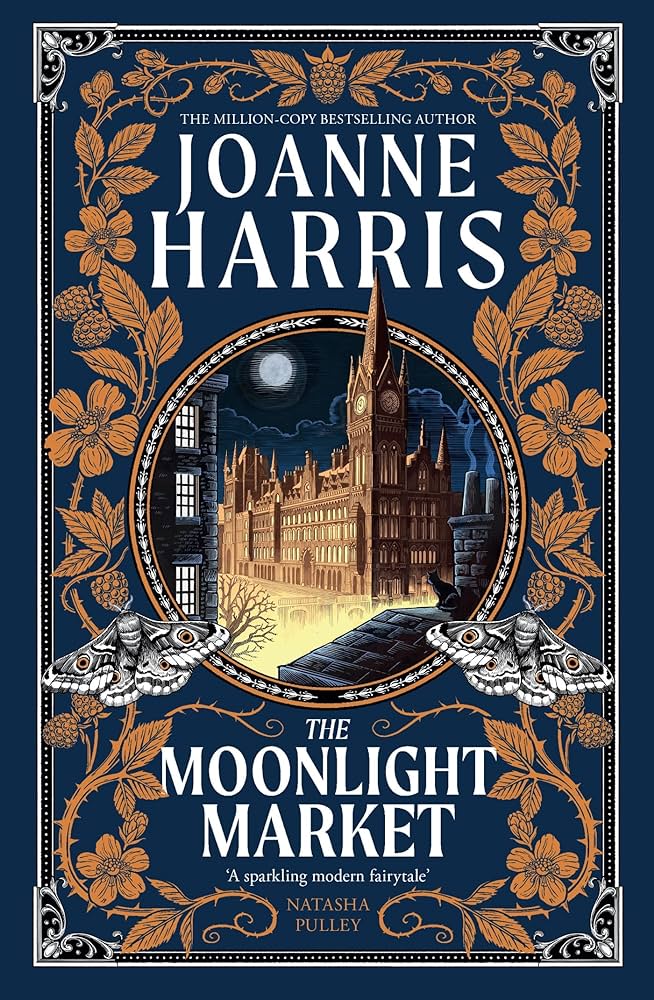
This week’s tube journeys have been accompanied by Joanne Harris’s latest novel, The Moonlight Market, which is being marketed as ‘Neverwhere meets Stardust‘ (the marketing team at her publishers are probably cursing themselves). I love both those books, and also am a huge fan of everything else by Joanne Harris, so that I was going to read this was a given.
But…it’s also set in London. London Below, London Before, London today – the London we see in front of us, the London that might be waiting for us down one of those intriguing little alleyways that the older parts of the City (and the city, I suppose) do so well, the London that might be there if you catch it in the corner of your eye. Clerkenwell and Farringdon have many of these, and I am easily distracted by the thought of magic and adventure.* I blame growing up with books where statues came to life in gardens; where forests grow in naughty children’s bedrooms and you can sail away to the land where the wild things are; where there was a permanently frosted world through the back of a wardrobe; and a house full of Civil War ghost children, ebony mice that come to life and lost jewels.
You might say London has enough stories to be going on with, without making up more, but one of the best things about a city with more than 2000 years of stories and people is that there will always be room for more. London, as Peter Ackroyd and Edward Rutherfurd have proved, is enough of a story in itself.
However, people do keep writing these stories, for which I am profoundly grateful. The Moonlight Market is a story about a London man who works in a camera shop on Caledonian Road (‘the Cally’, as it’s known locally) who falls suddenly, unexpectedly in love with a woman who is (of course) more than she seems. A photographer himself, he discovers that his negatives show things that can’t be seen in daylight, and his search for these places and people lead him to the Moonlight Market on a London Bridge that only exists on moonlit nights. Threaded through this is a fairytale about the doomed affair between the Moth King and the Butterfly Queen, and the resulting war between the Silken Folk of the day and night courts. Like her Chocolat series, magic exists and co-exists with the mundane world, and sometimes crosses over – all the best urban fantasy is filled with possibility, of course, and Harris’s books are filled with it.
If you love urban fantasy and London, here’s a few more worlds you can explore:
Ben Aaronovitch’s Rivers of London series
Mike Carey’s Felix Castor novels
Neil Gaiman’s Neverwhere (I am extremely disappointed in recent revelations about him, but I still love this book)
Benedict Jacka’s Alex Verus series
Paul Cornell’s Shadow Police series
Christopher Fowler’s Bryant and May series
Sarah Painter’s Crow Investigations
Neil Blackmore’s Soho Blue (not magical, but worlds colliding and some of the most evocative writing about post-war London I’ve ever come across)
A good writer makes the setting as much a part of the story as the characters and the action. I first understood this when I did a module at uni called ‘The City in the American Mind’, which introduced me to Sara Paretsky’s Chicago through the eyes of V.I. Warshawski. I’d probably be terribly disappointed if I visited – in my head Vic’s office is in a classic noir setting in ‘the Loop’ , there’s vast tracts of post-industrial wasteland, and there’s a Great Lake smack in the middle. Similarly, Dave Robicheaux’s swampy, louche and lush Louisiana (James Lee Burke is the author here) would not live up to my visions, and if I go to San Francisco I want it to be in Armistead Maupin’s 1970s rather than today. Clearly I need a time-travelling Doctor….but again, that’s another story.
*This probably explains why I get lost a lot on the way back from meetings….if I walk down there, surely it will lead to there (it often doesn’t, but what possibility of magic and adventure would there be if I just walked straight down St John Street to the office?
Coffee with Brian on his last day ever at Museum of London. Hashtag end of an era or something.
Trip with some of the team to the Tower Bridge Experience. Team now convinced I know people EVERYWHERE as one of the bridge hosts is a double-ex colleague from both MoL Docklands and V&A.
Finishing week four of C25K without injury. Crossing fingers, touching wood etc, and sticking everything together with RockTape.
Finishing a sashiko-stitched cat bag
Being able to sit in the garden and work surrounded by plants and sunshine. My Beloved’s new garden shelter is coming on well.
Taking the lovely Matt Shaw round the site in preparation for a new project, watched by this pretty fox.
The Museum of London’s new logo. Sorry, London Museum. I can see what you were thinking but sparkly guano and a discombobulated flying rat aren’t doing it for me.
Still, I spotted the model when I was out with the team at Tower Bridge:
What do they want, glitter on it?
Today I am off for a swim with Isla, and I might even make something. You never know….
Kirsty x
Cover image: Network Rail
What I’ve been reading:
The Life of a Scilly Sergeant – Colin Taylor
The Secret Hours – Mick Herron
The Children of Green Knowe/The River at Green Knowe/The Chimneys of Green Knowe/An Enemy at Green Knowe – Lucy M. Boston
This week one of my manymanymany cousins posed the following ridiculous question over on FB: what are your two favourite novels?
Well, honestly – where do you even start answering a question like that? I thought about it for a bit and asked for clarification along the lines of ‘what, this week or always?’ The two novels you’d most read, apparently. This did not, for some reason, narrow it down at all, even when children’s books were eliminated from the equation.
At age 10 this would still have been a hard question but I could at least have narrowed it down to a Nancy Drew, one of the Little House books or something by L.M. Montgomery. At 50 and as an avid reader this question ranks right up there with the meaning of life or one hand clapping or something equally conundrous (that’s not a word, according to the spellcheck but it’s my blog and I can make up words if I want. It’s a good word. Conundrous. Try it.)
Novels most read? I read my way through Terry Pratchett’s Discworld at least once a year, with probably Night Watch and Hogfather being most read. But then I also pick up the Moomin books with the same frequency. There are novels – series – I go back to and read through before the new one comes out (Ben Aaronovitch’s Rivers of London series, or Elly Griffith’s Ruth Galloway books.
What about novels that have stayed with you even though you’ve only read them once? The Travelling Cat Chronicles by Hiro Arikawa, for example, or The Cat and the City by Nick Bradley, both fairly recent reads but which I’ve been recommending to all my friends who like cats and/or books.
Do short story collections count? If so, some of Stephen King’s collections or any of Charles de Lint’s Newford stories have been in heavy rotation for years – and there are novels in this series too.
Also, favourite novel for what – a good mystery? For when you need a good cry? When you just need to remember that magic is out there, when you’re feeling nostalgic or in need of a good belly laugh? For when you’ve just been dumped? When you want something that you know you’re going to enjoy but don’t want to spend too much brainpower on it?
I did manage to settle on one novel – The Outsiders by S.E. Hinton.. It’s what people would call ‘YA’ these days, but is still one of my all-time favourites, and now Things 1 and 2 also love it. I’ll have to come back to you on the other one.







 What Kirsty did next