267: stop the week I want to get off

Last week’s paean to four-day weeks (or three, at least) has been overtaken by the experience of this week’s four-day week which didn’t go nearly as well. Not for any specific reason, but…

…on Tuesday I took Lulu to the vets for her annual inspection – this minimises the actual experience of my Beloved and I acting in a pincer movement to wrestle her into the cat carrier, me forcibly lifting her out again as she clings to the sides like the facehugging xenomorph from Alien so she can be weighed and checked over, and watching her slinking back in in an attempt to make herself invisible afterwards. I popped to the library to pick up my holds (another recommendation from a colleague and a couple of Ann Cleeves), came home, set up my table, logged in…..and realised I was supposed to be in the office as we were interviewing in the afternoon. Cue throwing tidy clothes and my face on, racing for the bus and heading for the office. The Central Line was misbehaving with delays on both journeys. On the way home I had to get rescued from South Woodford by my Beloved as there were no trains and luckily he wasn’t far away.

The rest of the week continued to fluster me: never quite working out what day it was, not being able to finish one thing before starting the next. Part of it is the continued joy of menopausal brain fog, part of it is just trying to do too much at once on too many different things (but they all need doing!). Whatever it is, this week wasn’t working for me. I did get to meet some interesting interview candidates – I like interviewing – and had coffee with Amanda on Thursday.

Friday was great, on the other hand. As my communities colleague was off on her holidays I got to sit in on the first session of our new co-creation project. This is the third project of four before we open the Centre next year, and this one is in partnership with Islington Centre for Refugees and Migrants and the artist MURUGIAH. These are a series of projects exploring heritage and what it means to people. MURUGIAH grew up in South Wales (like me!) with Sri Lankan parents (not like me!), and our participants yesterday came from the Ukraine, Cameroon, the Democratic Republic of Congo, Morocco and Turkey. Their co-ordinator is Polish/British so we had a broad set of heritages to draw on. MURUGIAH’s work builds worlds of colour and shape, and always reminds me of the Beatles’ Yellow Submarine.

We thought about the things that make us ‘us’ – memories, language, family, food, music, the journeys we have made, the things that have happened to us. One of the things that I love about these projects is sitting with the group, working alongside them as they’re drawing their stories. Done, from Turkey, drew her childhood garden and told me about climbing the mulberry tree to pick the fruits from the top as she sat in the branches. She drew baskets of cherries, birds coming the eat the mulberries – she liked the sour ones rather than the sweet – and the bees who’d come to the flowers. There was a green house with a red roof, and she missed the garden when they moved to the city. The Ukrainian pair drew big blowsy poppies and sunflowers, flower headdresses framing blue sky and golden wheatfields, rivers – there are always rivers, they said – and a soldier standing to attention. Herve, from Cameroon, drew flags and a monument; our Congolese participant shared her memories of beach parties where they’d dance and catch tilapia to eat cooked in banana leaf parcels, and the colourful clothes they wear. Our Moroccan lady drew things from her country and their London equivalents – taxis, trains and buses, food, flags and more. It started quietly and as they started to draw the stories came out, and our two hours flew by – I’m not usually in on Fridays but I’d quite like to drop in on these sessions. Regular readers will remember previous experiences working with refugees and asylum seekers have made a massive impact on me (and also that this is why I am doing the Cardiff Half Marathon in October for the Choose Love charity, and any pennies you can spare towards my target are much appreciated! I have £170 to go….).

I also got to catch up briefly with Jhinuk Sarkar, another of our community illustrators who is delivering a co-creation project at Bethany House – this is a supported housing project for women from Islington experiencing homelessness/houselessness for a wide variety of reasons. They’re making bunting and flags and I can’t wait to see them – enough to stretch from Bethany House to the Centre is the ambition!

Other things making me happy this week

  • An Easter Monday swim with Jill and Rachel followed by simnel cake and hot chocolate
  • More Northern Exposure – we’re up to Season 3 now and I can’t find my Season 4 box set anywhere
  • Crocheted jellyfish. Curiously satisfying to make with their curly tentacles! I like the neon green one – the photo doesn’t do it justice!
  • Running into TT2 with GT2 at the station on Wednesday – how is he two already? It’s his party today and Thing 2 has created a gorgeous birthday cake.
  • Seeing the trampoline populated by bouncing kids – next door’s small people like to come and run round our garden and see what my Beloved is up to, as well as say hi to the cats
  • A ten mile ramble through fields on Saturday in a wide loop around Toot Hill, Stanford Rivers and Tawney Common. Not too warm, with a lot of geese around for some reason, a muntjac, a bouncy deer (without benefit of trampoline) and a lot of consulting of my OS map.
  • Being talked into signing up for another half marathon next month – it took Tan all of five minutes to convince me,

That’s all, folks! Have a good week.

Kirsty x

What I’ve been reading:

The Makioka Sisters – Tanizaki

The Trouble with the Cursed/Demons of Good and Evil – Kim Harrison

A Letter to the Luminous Deep – Sylvie Cathrall

Talismans, Teacups and Trysts – K Starling

The Last Continent – Terry Pratchett
74: peekaboo, I see you

Afghanistan has been all over the news for the last couple of weeks, as the Taliban take over the country once more and the US and UK evacuate troops and civilians in an unplanned, chaotic dash – but not, in many cases, other people who have links to them and who will now be left vulnerable in their home country. Activists, for example, promoting women’s rights or democracy: according to some reports, the Taliban are going house to house seeking out people with links to foreigners and the government. Twelve people have died simply trying to reach the airport in Kabul to get out of the country this week, from stampedes or gunshots.

You may be reading this and wondering what this has to do with my usual ramblings, and may be inclined to point out that this is hundreds – possibly thousands, given my tenuous grasp of world geography – of miles away.

You may be reading this and wondering why I am venturing into the world of international politics, given that I am usually going on about crochet and dressmaking and lovely ‘hello clouds, hello sky’ walks, with only the occasional rant about free school meals and things.

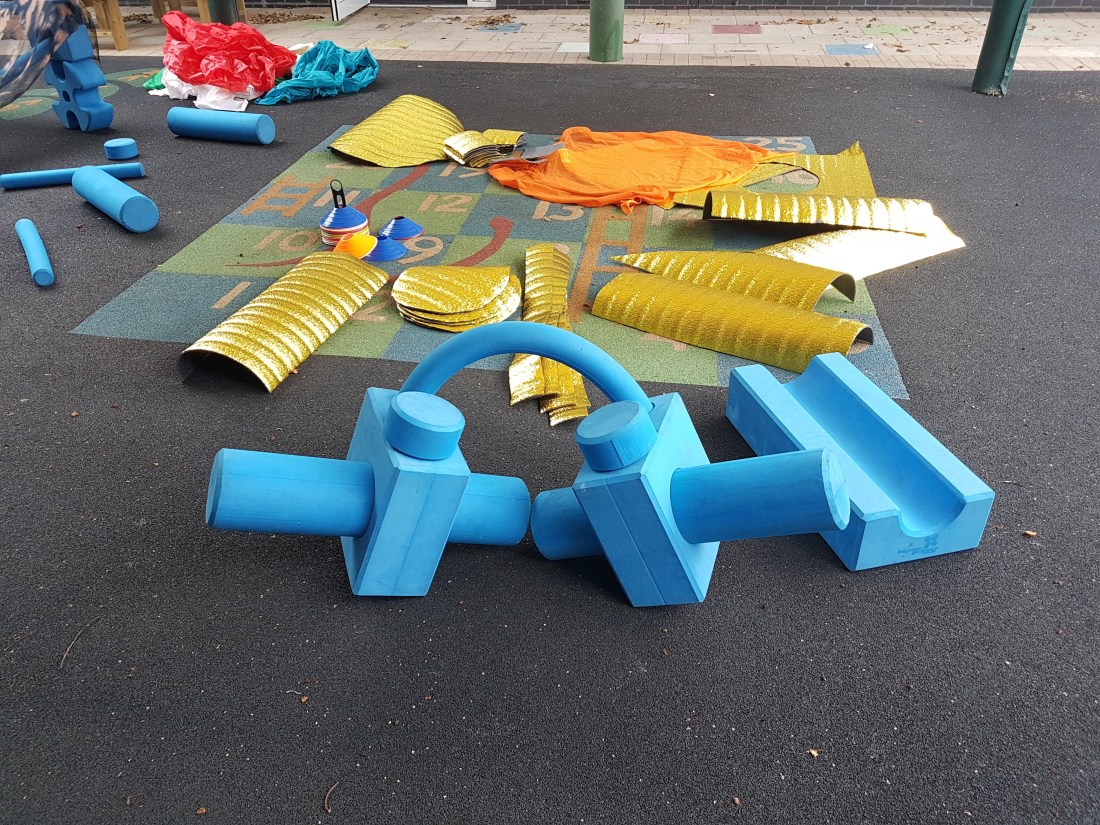
Well, this week I had one of those moments when world politics ended up within a few feet of me, in the shape of a small girl and her dad, and a pile of those blue blocks my colleagues and I have been carting round east London since the beginning of July.

This week we were at a children’s centre in Whitechapel, at a family play day, meeting children and parents from the local area to do some building and playing. The majority of the children we encountered were pre-schoolers: very small when the pandemic started, who had missed out on many of the baby groups to which they would usually have had access. Language and social delays are common.

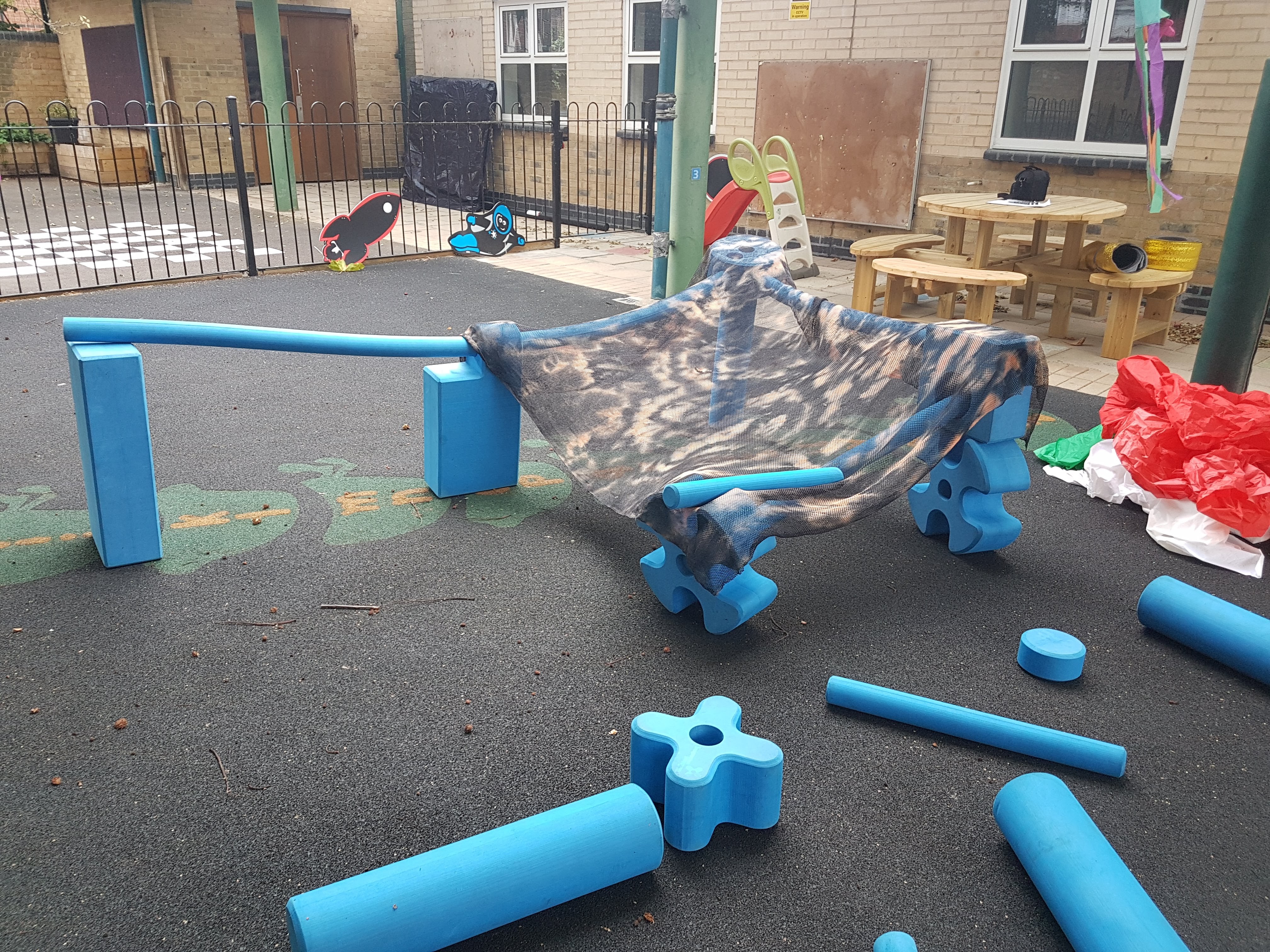
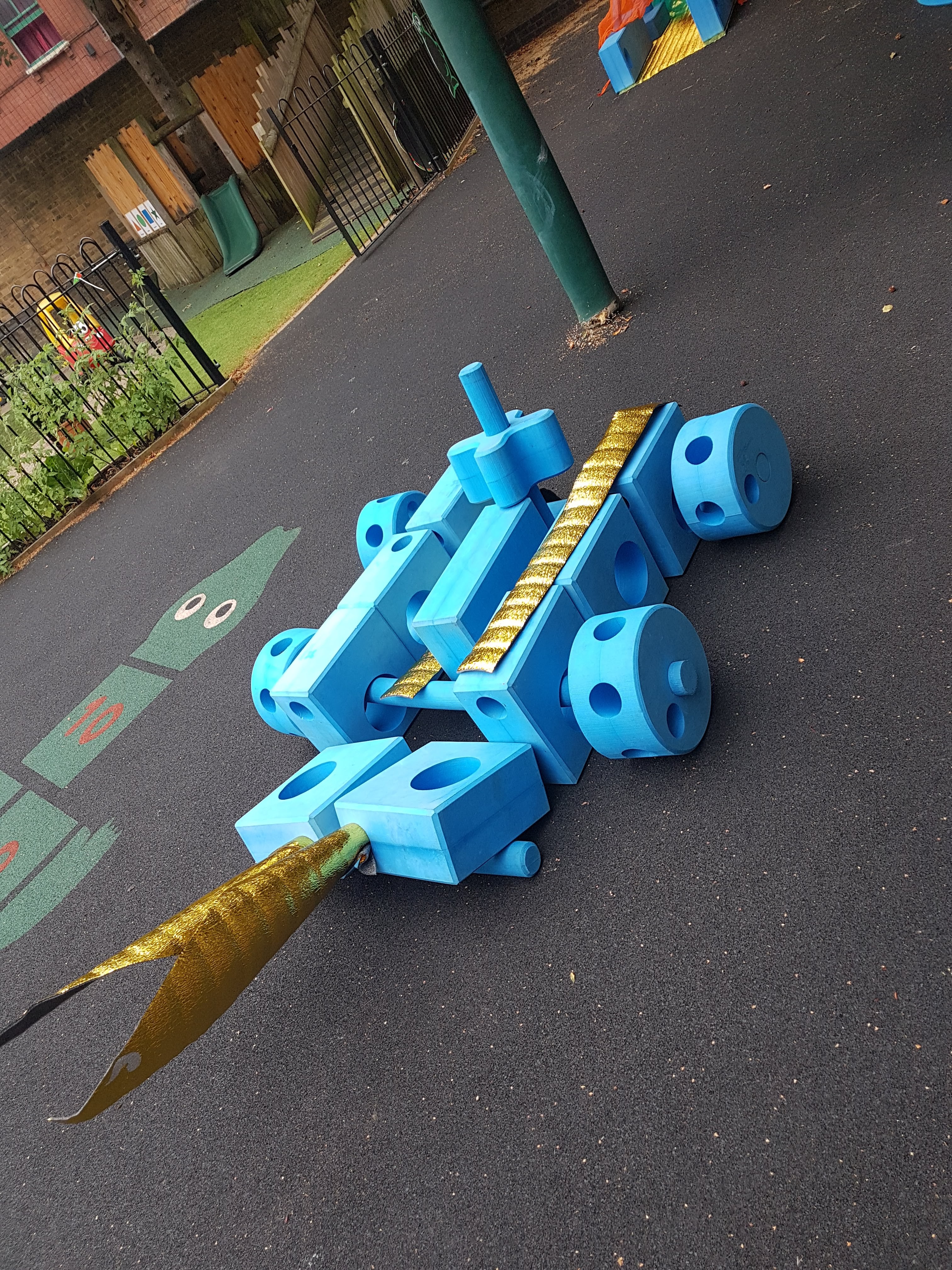
We set up the session with figurative structures, which they could either interact with as they were or rebuild to make something else. We had a rocket car, a tunnel, a den, and I had great fun building a castle. We built very tall things and knocked them down, we engaged in Godzilla games, we made a finish line and cheered when people came through it. We wondered where you could go in a rocket car and we pantomimed and clowned around.

After a while a dad and his daughter arrived. She was clutching a doll which she wouldn’t let go of and her dad was trying to get her to build something with him, which is quite hard to do one-handed. So I began to build a castle, big enough to get inside. One girl from another family decided it needed a door, so she added one and after going in and out a few times she wandered off.

The finished castle

The dad came and started helping me to build the castle taller, checking it was OK: of course it was, and we built it taller and taller and then added a fabric roof. His little girl crept into the castle and stood there with her doll, so I began to play ‘peepo’ with her through the gaps between the blocks and the holes in them. It took a while to get her to respond, although she watched me very seriously to see where I would pop up next. Eventually she smiled when I appeared in a different hole and even, at one point, giggled.

My castle needed something to make it less blue, so I started using the gold foil cutouts to link some of the holes and to make tubes. Marble runs had been very popular, so I found the small plastic balls and began to roll them through the tubes. At first, my new friend just pushed them out through the gaps between the blocks, but after a few minutes of watching me roll them through different tubes each time she started to join in, and to try and push the balls back to me before they could drop. I added a second ball and she put the doll down so she would have both hands free to play.

Her dad began to talk to me: he had very little English, and he told me that her name was Raya, and her English was better but she didn’t talk much. She knew the animals and colours, he said, and she talked at home. She didn’t know many people. This was the first time she had been able to play outside safely, he said. She’s three. I assumed this was because of Covid – isn’t everything, after all?

After a while Raya came out of her castle, leaving the doll behind, and came over to her dad for a cuddle. He picked her up, so I made another foil tube and used it as a telescope – dad joined in the game and moved her closer and further away from the end, and she giggled some more. It’s hard to resist a giggling child, so we carried on playing.

A pair of the bigger boys – Eastern European, again with very little English – asked me using gestures whether it was OK to knock the castle down. Of course, I said, and we cheered as they demolished it thoroughly.

‘That is what they are doing in my country, too,’ observed the dad. ‘In Afghanistan. They knock things down.’

As we were packing away the kit, one of the children’s centre managers came over for a chat and was telling us that they had been phoning a local hotel where a group of newly arrived refugees from Afghanistan were staying, to try and get them to come along, but she didn’t think any had. The penny dropped and we talked about Raya and her dad, and how it had taken a while to engage the little girl but we’d got there in the end.

A new country. A new language. Three years without being able to play safely outside. Three years.

Raya and her dad, and our play session, have stayed with me all week. This country isn’t perfect, heaven knows, but I can take my kids to the park and they can play outside. They haven’t been displaced from their home, although if you listened to them for the first couple of years I’d ruined their lives by making them change schools.

What else has remained with me is that play truly is the universal language: you don’t need words to play peekaboo, or peepo, or whatever its name is where you live. And that sometimes the world lands on your doorstep in the shape of a small girl and her dad.

Normal service will resume next week, I’m sure.

Kirsty x

What I’ve been reading:

Moving Pictures /Small Gods – Terry Pratchett

The Sandman – Neil Gaiman (Audible)

Addlands – Tom Bullough (from the Shelf of Shame)