280: the joy of text

I’ve just wandered over here from LinkedIn — as you do — where I have been reading a post about using em dashes — or not — in writing. Apparently they are an indicator that AI has written whatever it is you’re reading. This is most definitely not the case here, I assure you.

I am a big fan of an em dash. Emily Dickinson was a big fan of the em dash. My ex-line manager at London Museum was a big remover of my em dashes, bless his little cotton socks, although I could forgive him for that. (It was harder to forgive the director who used to uncapitalise ‘Second World War’ every time he saw it in my brochure text, despite the fact that it’s a specific historical event. He annoyed me.)

‘I’m nobody! Who are you?’ Emily Dickinson, em dash lover

In this blog I have usually used the en dash (-) instead of — purely because I write on a laptop and it doesn’t have a number pad which is what you need to insert the — symbol. To get your em dash on a laptop requires pressing the windows and full stop keys to bring up the emoji menu, and there’s a ‘special characters’ menu there. I may be a lover of the — but I’m also lazy, so please forgive my grammatical quirks.

Punctuation — as well as the words I wrap it around — may be one of my favourite things. When I write talks and sessions, especially if other people will be delivering them, using dashes (and parentheses) and the odd semi-colon make my writing more human, not less; giving life to words which are going to be spoken aloud. Can you imagine how dreary things would be if everything was short sentences and full stops, with no emphasis or asides?

At the other punctuational extreme is one of my all-time favourite poets, the wonderful e e cummings, more of whose work can be found here. A literary sort once said that his poetry transformed the word to transform the world. A lot of his poems use broken, scattered or run-on lines to create emphasis, such as the one above which featured in a school poetry anthology. He played with typography, space and shape to provide tone and punctuation, and — to paraphrase his response to a critic on one of his plays — wanted to know why people couldn’t just relax and see what happened rather than demanding to know what things mean all the time. My thoughts exactly.

When I left university in 1994, after 17 years of schooling of one kind or another, I decided that I was only going to read things I wanted to; I’d been asked to analyse dozens of texts and poems over the years which stripped all the joy out of the language and the stories. What I want to read may on occasion be considered as ‘literature’ (in at least the GCSE syllabus sense) but the point is that I’m reading it for the sheer joy of it. It took me another 20-odd years to be able to not finish a book I’d started if I wasn’t enjoying it but that’s a different matter. I am not picky about genre and a good trip to the library or the local Oxfam Books & Music takes in a wander around all the shelves and an eclectic haul.

This decision to read books based on interest has led me back to books like Graham Swift’s Waterland, which as a 17-year old A-level student I thoroughly disliked but as an adult I loved: I went back to it after visiting the Fens, where it’s set, and understood it far more. I was lucky enough not to have been made to read some of the classic GCSE and A-level texts – Gatsby, Mockingbird, Catcher – so came to them independently in the school library and loved them for themselves. I have a colleague who’s also an eclectic reader and we recommend books to each other – Cahokia Jazz, by Francis Spufford, was a recommendation from him and it’s one of the best books I’ve read in years. I tried another of Spufford’s books and couldn’t get into it at all, so I took it back to the library unfinished.

2026 has been named the National Year of Reading and the idea is to encourage a love of reading for pleasure. I think this is a great idea. However, I can’t help thinking that we — this is the policy-making, government-level, educational we, not a personal we — have spent the last 12 or so years building a generation which doesn’t love reading for a very good reason.

I have a cunning plan, though. Let’s refresh the National Curriculum and allow teachers to stop stripping texts back to their component parts from a very early age in school. Stop insisting on seeing sentences as no more than examples of spelling, punctuation and grammar and then children might start to love reading for its own sake. Teachers might also be happier.

Let’s put storytelling back into teacher training courses and make it a compulsory part of the school day. Let’s dedicate some time in colleges and on SCITT schemes to sessions with professional storytellers like Olivia Armstrong and show teachers how to bring a story to life with your voice. Help them share the joy of the language and the rhymes and the jokes; the sad bits and the happy bits and the sheer pleasure of being transported to a different world for half an hour at the end of the school day. Give teachers the confidence to do the accents and the voices and to pull the faces, and leave the children wanting more – perhaps to pick up the book themselves and have a go without seeing every sentence as a challenge or a task to be completed. If a teacher isn’t confident, there’s audio books galore out there read by people who are paid to do the voices. David Tennant read a CD of all the Hairy McLairy books and it’s wonderful. Hugh Grant reading Dickens’ A Christmas Carol. And Michael Sheen reading – well, anything, up to and including a shopping list, but start with Philip Pullman’s The Book of Dust.

I wrote last month about Frank Cottrell-Boyce’s campaign as Children’s Laureate to make hearing stories part of every child’s life, and this leads on from that: give them joy not grammar. Teach them to love words, and their vocabulary will expand as a result. They’ll see punctuation as they read and will learn to use it as they go, and I guarantee you they won’t even realise they’re learning it. Tell them about libraries, where they let you take books away to read and have thousands of different ones, and they’ll never be short of entertainment. Even better, tell them about librarians, as the good ones will be able to suggest books and the really good ones will know what to read when they’ve finished that one. They’ll be unstoppable.

Things making me happy this week

  • A good ramble through the fields on Saturday morning, except for the bit where I got lost and my legs got shredded by fierce brambles.
  • This rainbow bunny – it’s the Toft Emma pattern again from Ed’s Menagerie.
  • Untamed – a new Netflix series with Eric Bana, Sam Neill and excellent scenery.
  • New haircut
  • End of term for Thing 3, so I don’t have to make sure he’s out of bed for a few weeks before I leave for work
  • A crocheted meerkat from a pattern by Planet June

That’s it from me. If no one minds, I’ll be reading my book.

Kirsty x

What I’ve been reading:

Blood Debt/Summon the Keeper/The Second Summoning – Tanya Huff

Between the Stops – Sandi Toksvig

Shadowlands – Matthew Green

Edgelands – Paul Farley & Michael Symmons Roberts

273: stories are a superpower

A selection of illustrated children's books

On Wednesday I attended – from the comfort of my living room – a session of the What Next? culture group. This is a wide-ranging, first-thing-in-the-morning, ‘free-to-access movement that brings together small and large organisations and freelancers to debate and shape arts & culture in the UK’. I don’t get to attend them very often as Wednesdays are usually my later-into-the-office days due to teenager wrangling responsibilities.

Anyway, this week’s was about the power and importance of reading to small children from a very early age. One of the speakers was the Children’s Laureate Frank Cottrell-Boyce who pledged at the start of his Laureateness (Laureacy?) to campaign to reduce reading inequality through the Reading Rights campaign. The first report has recently been published, calling on national and local leaders in early years, health, education and culture to come together and make reading a part of daily life for every child in the first seven years of life.

Mr C-B spoke about visiting the Babylab at Queen Mary’s in East London, where he watched in real time as a mother and baby were wired up to a brainwave thingy and the mother read a story to the baby on her knee. The act of being read to by a loved one visibly calmed the baby’s chaotic brain waves, their heart rate, and their breathing came into sync. He called it ‘love at a synaptic level’. From this mum’s point of view, too, there is nothing quite like the feeling of a warm, sleepy baby or toddler snuggling in for a story at the end of the day. I recognise, too, that the act of reading is also a privilege.

“If you’ve been read to, as a child, by someone who cares about you, you have been given an enormous invisible privilege. If you haven’t been given that privilege, then you’ve been left with an enormous mountain to climb.”

Frank Cottrell-Boyce

According to BookTrust’s research, 95% of families know that reading is really important but only 42% of children in lower-income families get a regular bedtime story. There are a whole lot of reasons for that – aside from parents possibly not having that experience themselves as a child, or lacking the confidence in their own reading skills to read a story ‘properly’ – but a key reason is that living in poverty or need is really, really hard. You spend time in meetings with benefits people. You spend time getting to places on public transport getting to meetings or the supermarket with the cheapest food, or on hold to government organisations, or sorting out housing, or working one or more minimum wage jobs, or worrying about your electric or gas or other bills. All this as well as caring for your small person…. the mental bandwidth this all takes up is enormous and things like bedtime stories aren’t always top of the list. Survival is.

Those of us who grew up with being read to nightly – and, with the benefit of younger siblings to listen in on later – for many years are lucky. I did the same with my own children – I was certainly still reading chapter books to my reluctant reader Thing 2 when she was eight or nine and Things 1 and 3 were listening in. M.M.Kaye’s The Ordinary Princess was a favourite, as was Jill Tomlinson’s The Owl Who Was Afraid Of The Dark which we took on holiday and I read a chapter a night to my three and my niece. Bedtime story time was one of the joys of being a parent, honestly, even when I was in the depths of PND and could barely function. It was a moment of peace and routine in what were some very hard days, but then books are my own go-to moment of sanity as an adult so this makes sense for me. Admittedly there were days when the fifth or sixth reading of the same book got a little wearing, but there we are.

Cottrell-Boyce also made the excellent point that children who aren’t read to at home then encounter books for the first time when they get to school and they’re suddenly being asked to sit down and decode things they have no experience of. Books become difficult and scary, and not something to be experienced as a joy: these children aren’t making the connection between the words in front of them and the pictures on the page because they don’t have the literacy capital to do so. He likened this experience of reading as being presented with a recipe to cook before you have ever experienced food – the pain without the pleasure, as it were. Illustrations are the first encounters with visual art that children have. Illustration – as I say a lot to people in my day job – is art with a job to do, it’s art that communicates.

The wonderful BookTrust are working with Cottrell-Boyce on this campaign. The BookStart scheme, which provides families with free books via health visitors and libraries, is the last man standing from the brilliant SureStart scheme that was one of the great successes of the New Labour government. Early Years provision has been steadily eroded over the last 14 years which has removed an enormous and incredibly important level of support from the people who desperately needed it. Increasing free childcare is all very well, (before someone says ‘but they’re doing this for parents’) but – in reality – that’s aimed at getting adults back into work and isn’t a benefit for the family. The other problem with increasing free childcare provision, of course, is that it’s not properly funded so early years settings are closing as they can’t actually afford to pay the staff to provide the care. That’s a rant for another day, however – another conversation this week was about the cost of childcare.

In our local Tesco’s they have a ‘free children’s books’ stand by the checkouts, which is brilliant – adult books are offered for a donation but for small people they are free. There are Little Free Libraries popping up in disused phone boxes and bus shelters and train stations. Libraries – thank the lord – are still free and anyone can use them, even if (like my local one) they’re only open two days a week. Librarians – a big shout out to this amazing bunch of people – still do free RhymeTime or Storytime sessions. But if people haven’t grown up with libraries as part of their lives they may not have the confidence to go in – like museums and galleries, there’s an ‘is this for me?’ barrier to get through. I’m not sure what the answer is, but this campaign might be a good start. I’m in a position to be part of the change as I start to plan what our Early Years and Families programme will look like when we open in 2026: there has always been a plan for regular storytime, sharing books and illustrations with our visitors, but now I can back it up with science and stuff. Hurray!

Things making me happy this week

  • A catch up with Emma T on Friday, covering cats, small people, and what’s going on in the world of museum research. She’d been to Cardiff the weekend before to visit a mutual friend, and she also got to meet one of my force-of-nature cousins. Honestly, we are EVERYWHERE.
  • An afternoon at Copped Hall last Sunday, chasing around the GT2. I am out of practice at the toddler thing!
  • Salad. I like salad. A lot.
  • This Pangolin amigurumi – I love pangolins! They always look like they need to tell you something very important.
  • A happy commuter moment on Friday when I was crocheting on the tube, finishing off a little apple amigurumi. A family opposite me were off on a day trip and the little girl was very excited watching me give the apple a leaf and a mouth. When I’d finished it I gave her the apple and I think it made my day. They were off to Paddington Station to see the bear statue and then to see the Natural History Museum, so I extracted a solemn promise that she’d say hello to Paddington and give him a marmalade sandwich. ‘We’ve GOT marmalade sandwiches!’ she said in very serious tones. I hope they had a good day – I know I did after this joyful exchange.
  • The strawberries coming ripe in the garden in large quantities.
  • Meeting Oliver Jeffers, who wrote one of our all-time favourite bedtime stories. I probably should be a bit more chilled about these things by now but I’m not. I was very well behaved though.

Things I am withholding judgement on this week include Thing 2’s prom skirt which she had a very clear plan for and which I am making from duchesse satin with an embroidered tulle overskirt, and (of course) pockets. I may try and negotiate on the pockets and provide a matching wrist bag instead. She also wants a ‘train’ so no one can see her feet, despite the invention of shoes. I’m glad I fitted a tissue paper toile on her yesterday morning as the size we’d printed going on her measurements wasn’t big enough, so I could reprint at the next size up and do another fit check before cutting the fabric. I’ve bought from this designer before and have always had to contact her about missing instructions, or fabric quantities, and the instructions always assume a lot of prior knowledge so I wouldn’t buy from her as a beginner. The one moment of joy (for me, at least) is that she was hoping a pair of my glam and presumably now vintage heels would fit her but NO, they’re all too small. Actually – I’m also quite joyful that she bought the corset top and didn’t ask me to make that. She had a very clear idea about what she wanted to wear, and what colour, and of course she couldn’t find the perfect thing in the shops… this summer I will be teaching her to use a sewing pattern. It would have been more helpful if she’d stayed home with me so I could start sewing, but nooooooo…..that’s my day gone today then!

Things not making me happy this week include the doctor’s surgery. By Wednesday evening I had spent more than two hours on hold to the surgery just waiting to speak to the reception team. Phone call one had been in mid-May, where I’d asked for a prescription to be updated to reflect an increase in my medication prescribed by their out of hours doc. The surgery just reissued the existing prescription. Phone call two – Monday – repeated request. They texted me and said the prescription had been issued. Chemist says yes but it’s two separate prescriptions so you need to pay twice, phone the surgery again and ask for them to be issued as a single script. Phone call three – explain again that I don’t actually want to pay £20 for what’s basically one prescription, could they issue this as one script with the full dose on it. This apparently made sense to me and the receptionist, but not to the doctor whose response – not to me, of course – was that they don’t make 30mg pills. I discovered this in phone call four, which was where I channelled my inner Dad and explained that I was FINE taking a 20mg and a 10mg tablet at the same time but I’d rather not be charged twice. Yes, said the receptionist, I understand and it shouldn’t have taken this many phone calls. Phone call five after waiting for eight hours wasn’t answered after 1 hr 40 minutes even though surgery was open. Phone call six, the following morning, was with YET ANOTHER receptionist (how many do they have?) who was adamant that what I was asking couldn’t be done even though I’d been assured that it could by our amazing village pharmacist – who presumably knows what can and can’t be done with a prescription and who I’d phoned in sheer desperation. He offered to send a note to the surgery explaining the problem in case it helped. I asked to speak to a doctor, who phoned me back two hours later, and three minutes and three seconds later (including pleasantries) I had the prescription, it was sent to the chemist and was ready for me when I tumbled through their door four minutes before closing. It should not have been so hard….

So, I am fully medicated, and today I will be finishing the prom skirt (I hope!). Watch this space…

Kirsty x

What I’ve been reading:

Shadowlands – Matthew Green

Woodston – John Lewis-Stempel

Between the Stops – Sandi Toksvig

Ring the Hill – Tom Cox (Audible)

Greetings from Bury Park – Sarfraz Manzoor (Audible)

207: listen very carefully, I shall say zis only once

You may have noticed that I love an audiobook. As an accompaniment to the continuing chaos of a Central Line commute (along with a crochet project) it can’t be beaten – it’s like someone reading bedtime stories, especially with the right voice. Kobna Holdbrook-Smith is perfect for the Rivers of London series; Neil Gaiman narrating his own books is a joy; Michael Sheen could read me a shopping list, quite frankly; Esme Young reading her autobiography; Stephen Fry reading the Hitchhikers series; Zara Ramm reading The Chronicles of St Mary’s; and many others. This week I’ve started listening to Bill Bryson reading his own At Home book about the history of all the things in our houses.

The wrong reader can kill a book – the person who narrated Mike Carey’s Felix Castors series was awful, and there were a few of Lindsey Davis’s Falco books with the ‘wrong’ narrator. Tony Robinson was wrong for Discworld, Nigel Planer was a bit better, Stephen Briggs and Celia Imrie were great but the new Penguin versions with people like Richard Coyle, Andy Serkis, Katherine Parkinson, Indira Varma, Sian Clifford and others – all with Peter Serafinowicz as Death and the glorious Bill Nighy as the Footnotes – were perfect.

And then there’s accents. Sometimes – done well, and done appropriately – they can add to the listening experience, but sometimes they’re excruciatingly inappropriate and give you what the kids call ‘the ick’. Posh white readers doing ‘generic Chinese’, for example (as my lovely colleague was horrified by the other week) or posh English people doing cod Welsh, which quite ruined the final instalment of Susan Cooper’s The Dark is Rising sequence. This particular voice belonged to an actor I rather like, usually – known for playing quite posh people – but oh lord, he mangled the Welsh accents in Silver on the Tree and had clearly made no attempt to find out how to pronounce the Welsh placenames he was reading (despite the fact that in the previous book he’d narrated a section where the Welsh character taught the English one how to say them). It was painful to hear, and I apologise to anyone who saw me grimacing every time he mentioned Machynlleth or Aberdyfi.

Things making me happy this week

  • Catching up with this year’s temperature tracker cross stitch
  • Getting a good start on Country Magic Stitch ‘Welcome to Rivendell’
  • Coffee with Amanda
  • A chatty evening on Wednesday instead of D&D
  • A chilly but sunny walk on Monday morning (and a rainy one on Saturday morning)
  • Harry in Silent Witness
  • A chilly but refreshing swim at the lake

What I’ve been reading:

Hedge Witch – Cari Thomas

The Book Keeper – Sarah Painter

The Wild Rover– Mike Parker

Silver on the Tree – Susan Cooper (Audible)

The Owl Service – Alan Garner (Audible)

The Familiars – Stacy Halls

Practical Magic/The Rules of Magic – Alice Hoffman

At Home: A Short History of Private Life – Bill Bryson (Audible)

53: I like big books and I cannot lie

And small books, and middle sized books. Audio books, graphic novels, comic books. Fiction and non-fiction, picture books and wordy books. I just like books. The house is full of them: the two things I have far too many of, according to my beloved and the kids, are books and shoes.

“Books are a uniquely portable magic.”

Stephen King, On Writing: A Memoir of the Craft

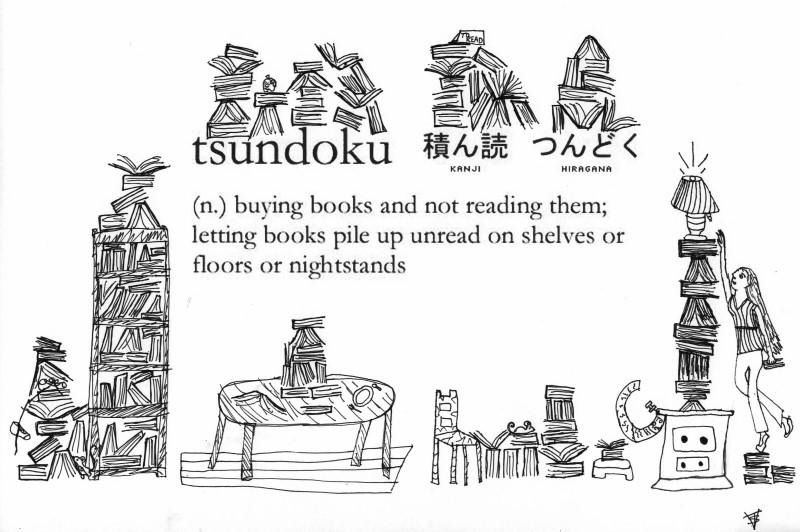
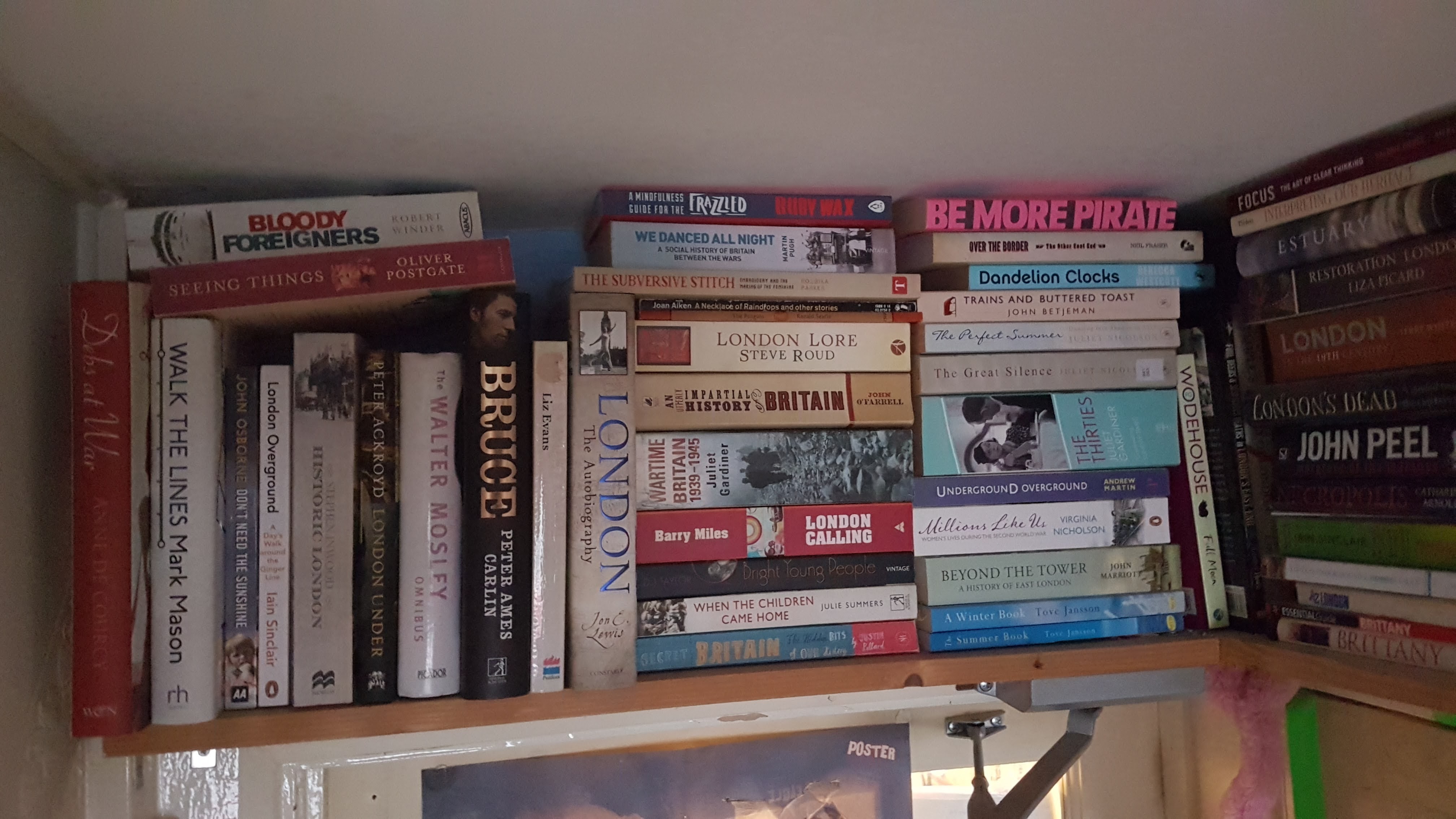
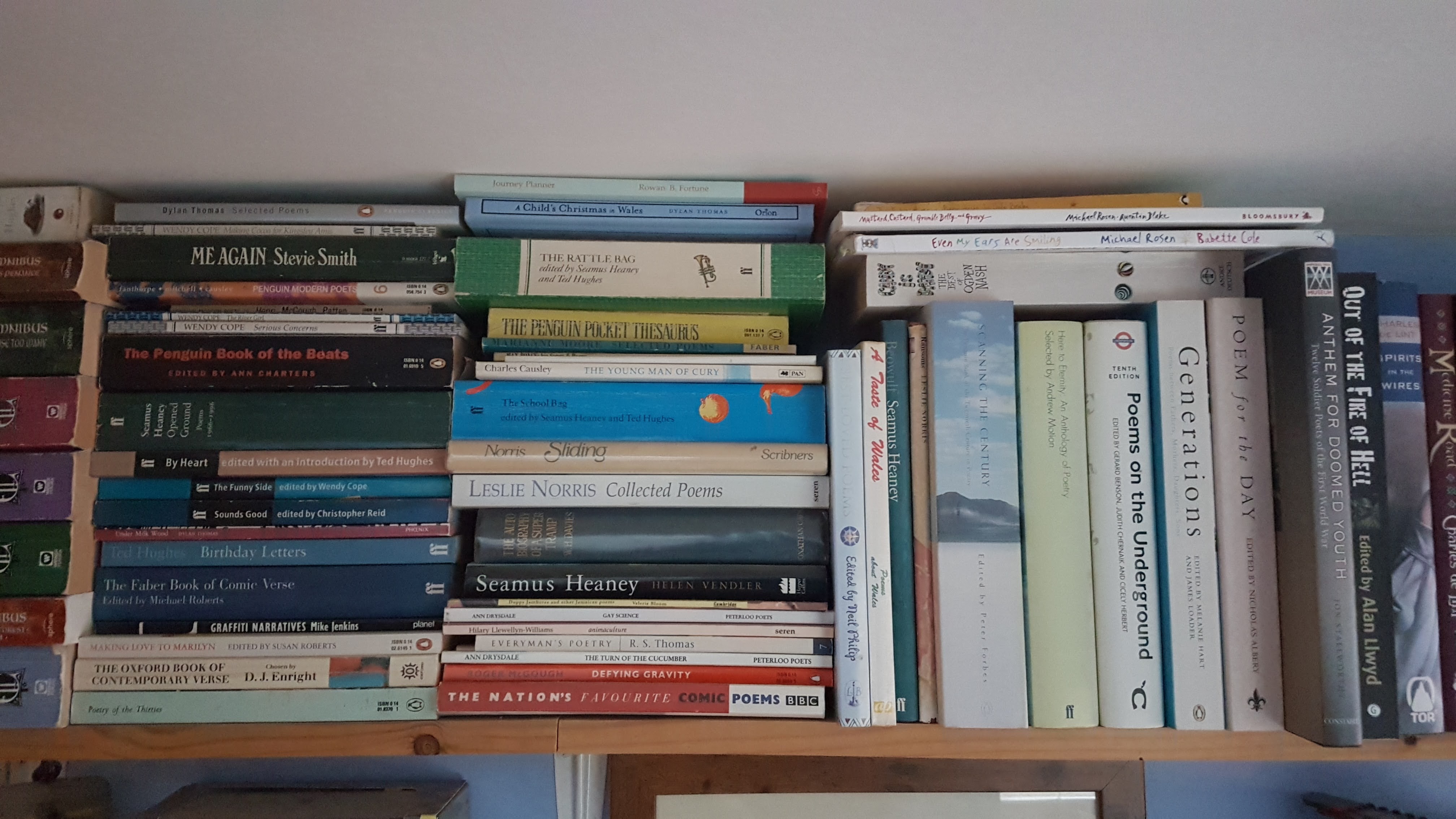
Some shelves are more organised than others, of course: Terry Pratchett (although he has started to roam), Charles de Lint, Phil Rickman, poetry, the shelf(ves) of shame waiting to be read, Ian Rankin, Michael Connelly, my childhood favourites, crime novels by author, Penguin classics. Leave me alone in your living room and I’ll hit the bookshelves first and then your music collection. Leave me alone for longer than the time it takes you to make a cup of coffee (instant is fine, thanks) and I’ll start reading. A question I have heard more times than I can count is, ‘what a lot of books! Have you read them all?’ and the answer is always ‘no, and that means there’s something new to discover’. I keep books I love, and if I know I’m not likely to read them again I pass them on to friends or send them to the charity shops so someone else can discover them.

Image: openculture.com

I grew up surrounded by books and was rarely told what I could or couldn’t read, which means my taste is eclectic, to say the least. I love discovering new authors: I have devoured Tom Cox’s books – even the ones about golf – this year, having picked up one of his cat books in Oxfam. Being able to order new books in advance on Kindle and have them appear as if by magic on publication day is like having many Christmases and birthdays every year. The only problem is that often you get two or even three books appearing on the same day, and then you have to decide which to read first. That happened last week, with Ben Aaronovitch’s new Rivers of London novella What Abigail Did That Summer and Tom Cox’s Notebook arriving at once. Both were very different but equally delicious. Kindle is also wonderful in that if you really love a book and know that one of your friends will like it too you can buy them a copy as well. I subscribe to BookBub, who send me an email every day with daily 99p books that you can filter to the genres you want.

I am not precious about my books. I bend the corners down on paperbacks, and use the slipcovers as bookmarks on hardbacks. Books are meant to be read, not idolised: sometimes they are both. I have some books that have been read so many times they are quite literally falling apart. I possess a lot of bookmarks but can never find them. I love finding fellow fans of series: there are a lot of Discworld fans in museums, I have found, and then you know you have a new reading enabler who you can swap new finds with.

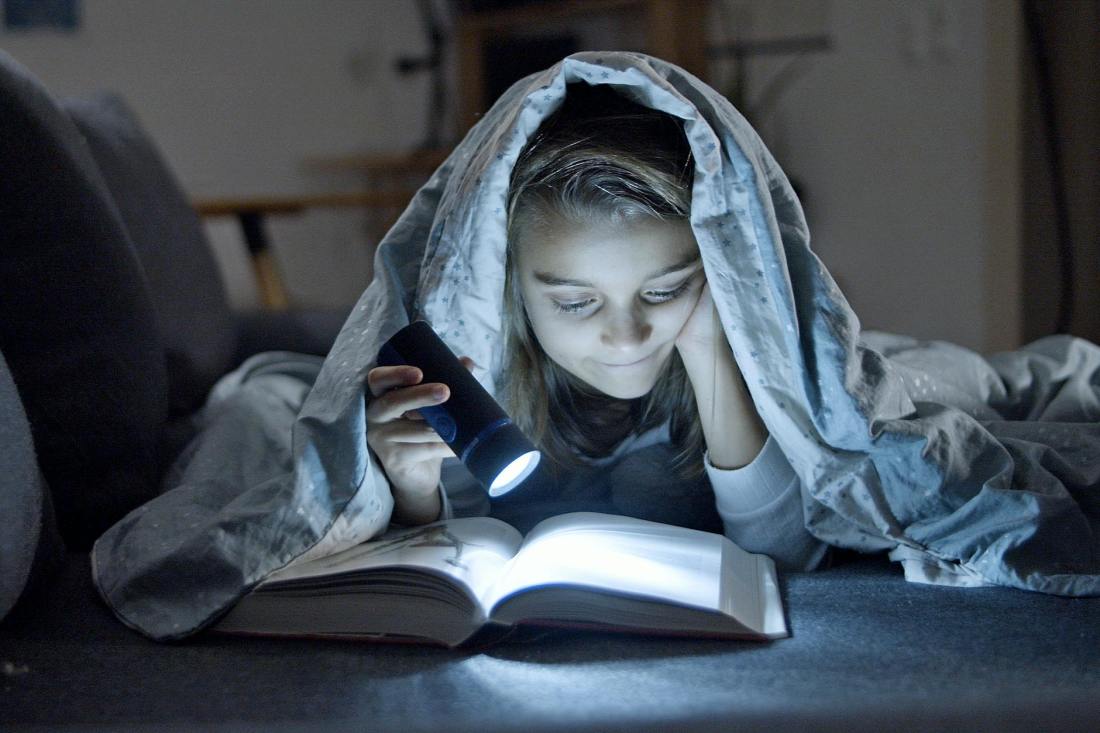
I disappear into books. Once I’m in the story, the kids know that if they want me to hear anything they need to get my attention first, or they have no chance. A good book, for me, is one that makes you want to go and find everything else that author has ever written and read that too, even if its about golf. Some books blaze across your imagination, burning in images that stay with you long after you’ve put the book down. Some authors excel at short stories, others at full length novels. Some do both: Stephen King is one, and Joanne Harris is another.

“What really knocks me out is a book that, when you’re all done reading it, you wish the author that wrote it was a terrific friend of yours and you could call him up on the phone whenever you felt like it. That doesn’t happen much, though.”

J.D. Salinger, The Catcher in the Rye

When I was a Key Stage 1 teacher I loved the moment when a child suddenly clicked with reading, and started to work their way through books for pleasure and not for phonics. Some children needed more help than others: one little boy wasn’t interested in the Oxford Reading Tree so I lent him my own book of children’s Arthurian legends because he was obsessed with King Arthur. He started reading them with his mum, and by the final story he was unstoppable and reading independently. I loved story time at the end of the day, and when I had the same class again in year 3 we read a chapter a day before home time. I read to the children nightly, in the same way that I was read to by my parents, and read many of the same books to them as I had as a child. I can’t bear to part with these childhood treasures, even now.

You can learn to do pretty much anything from books, too: over the years I have taught myself to crochet, to (sort of) knit, to sew, to quilt. When I was growing up my Dad’s household manual was the Reader’s Digest Repair Manual (I believe he still has it) and when anything broke he would refer to this bible. I was overjoyed to find a copy of the Reader’s Digest Complete Guide to Sewing the other week, and then I tracked down the Guide to Needlework on Amazon. I may never need all these techniques – I can’t see myself doing bobbin lace or tatting, for example, but I’ll know exactly where to look if I decide I want to give them a try. A colleague asked me (as I carried my treasure off in triumph) how many sewing books I had. I don’t know, but I did organise them by craft a few weeks ago so at least I can find them when I need to!

I like to crochet or cross stitch and listen to audio books at the same time: that’s multitasking at its best. My book is the last thing I put down at night: sometimes I wake myself up when the book falls out of my hand. My commute is pure pleasure as long as I have a seat: a Central Line delay? No problem, there’s time for an extra chapter. If I have a rough morning at work, you can find me and my Kindle in KFC – the ultimate lunchtime cure-all.

So if you need me, I’ll be reading….

…and/or making stuff

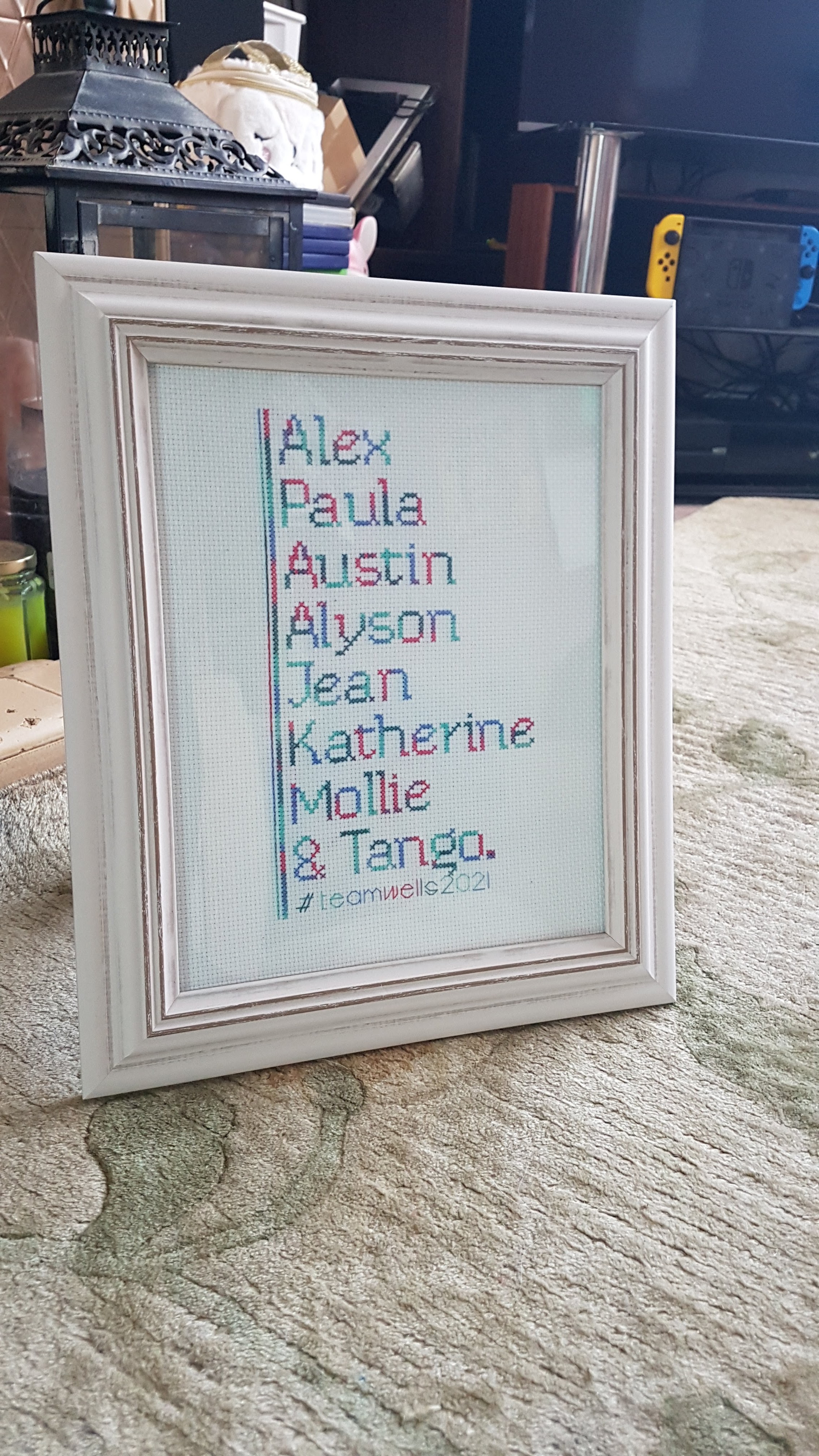
This week I have handed over a handmade gift to a friend who’s just moved house, combining her family with her mother-in-law and taking on a renovation project. 3 adults, 2 kids and 3 hounds! I designed this one, using an alphabet from Lord Libidan and DMC Coloris thread. I’m working on two other gifts as well, which should be finished and sent off soon!

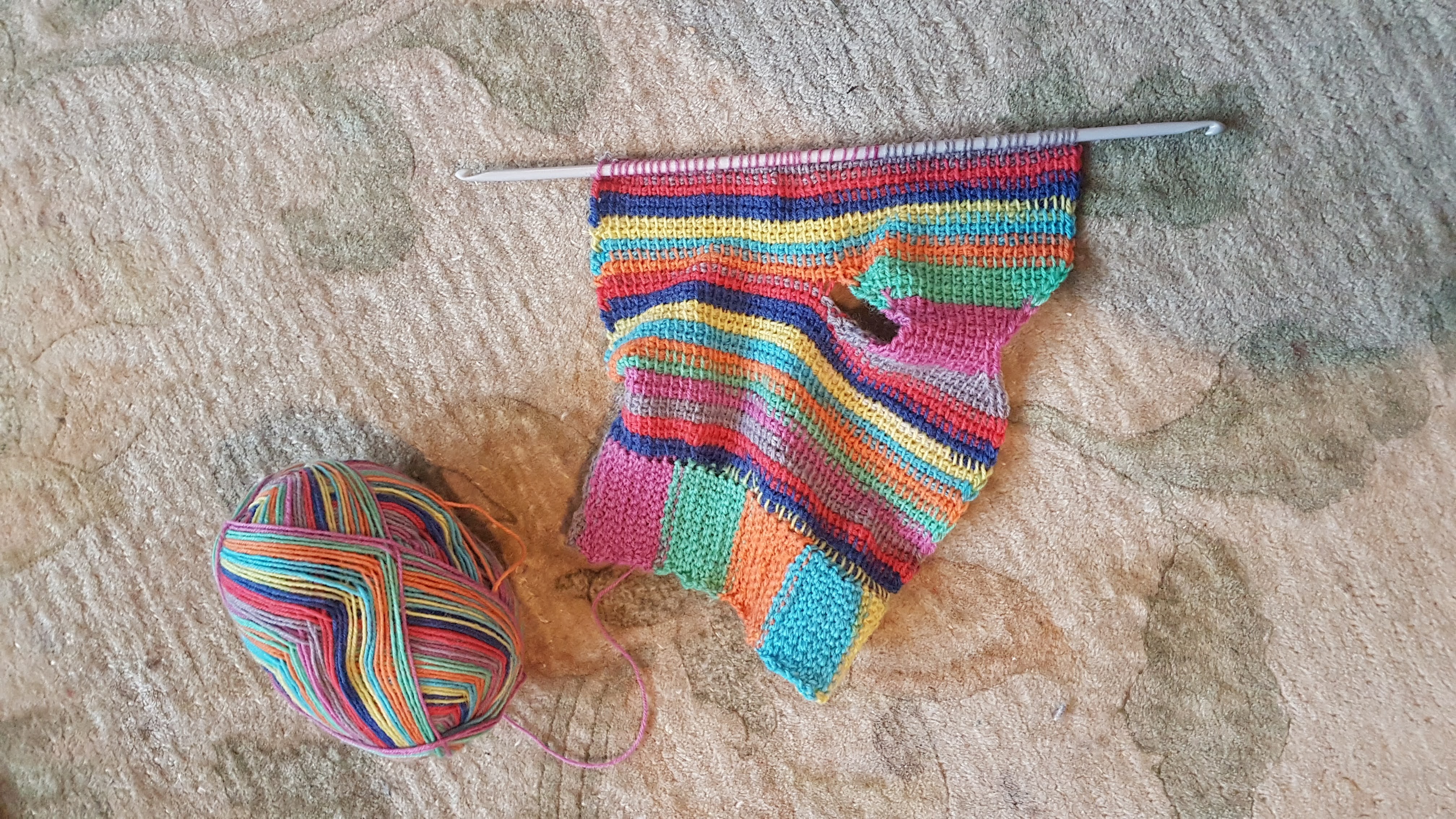
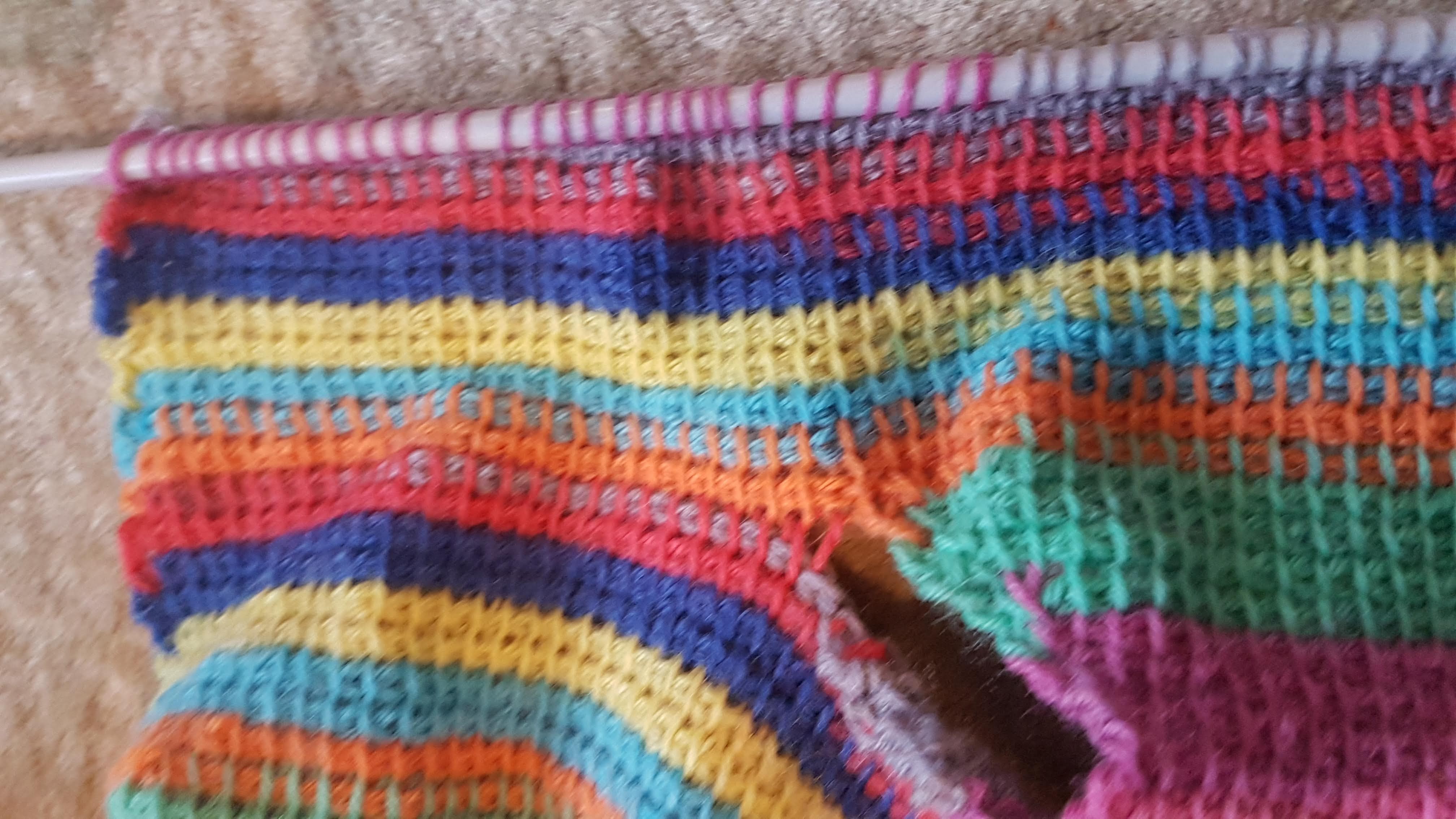
The Tunisian sock is coming on nicely, and is starting to look a bit more socky, which is reassuring! I like this stitch as it’s really easy to count the rows! The fabric has a more knitted look than normal crochet, so these will be stretchier, I hope.

This week’s cover photo is the museum fox sunning herself outside my office window – when we lifted the containers this week we discovered five cubs, which we think she’s found a new earth for. She’s so confident: the grounds are her territory, and since the building is closed she must feel very safe.

So that’s it from me for the week! Looking forward to the lake reopening tomorrow and getting back in the water and to seeing more than one friend at once as restrictions start to lift.

Kirsty x

What I’ve been reading:

Cold Case/Flashpoint (Carlotta Carlyle) – Linda Barnes

London Particular (BBC Radio Drama) – Nick Perry (Audible)

What Abigail Did That Summer – Ben Aaronovitch (Audible)