272: a walk on the wild side

Over the last few weeks I have been immersing myself in the Herefordshire countryside courtesy of the writings of John Lewis-Stempel who farms in the border hills (Merrily country, for fans of the late Phil Rickman) and who writes beautiful prose about the most prosaic of things. Who would have thought – speaking as someone bored rigid by the few Young Farmers Club meetings I attended – that the life of a wood or a year in a field would be so interesting? I admit my original interest was piqued by the fact that he’d written a book with a picture of a hare on the front, but that’s me…

His books are pragmatic but interspersed with poetry by people like Edward Thomas and Robert Frost, both of whom spent a lot of time in the area before the First World War. He delves into local language and folklore and in Woodston he traces the history of the land from the earliest hunter-gatherers onwards.. He’s realistic about what it takes to conserve a wood or a field; he shoots grey squirrels (non-native) to allow native birds to thrive as the squirrels steal whole clutches of eggs. There are no ‘oh no, my sheep broke its legs in a ditch, the vet must work miracles!’ moments – the sheep gets shot too.

There’s no woolly ‘rewilding’ although there is an experimental love of traditional methods which bring back wildlife to the area – not by adding beavers but by farming without pesticides for a year, for example, or by managing woods through coppicing, and allowing sheep, pigs and cows to forage and in doing so fertilise and turn over the land, bringing back insects and the larger animals that feed on them. It reminded me very much of the old lady that swallowed the fly, in fact. There is no anthropomorphization of trees and animals – Tolkien’s Ents don’t come into his equation. Trees are trees are trees. Animals do what animals do, and this is right. I get the feeling that Lewis-Stempel genuinely loves the land and cares for it in much the same way as his ancestors – who also farmed in the area – have done for the past seven centuries. He describes himself as a countryside writer rather than a nature writer as he’s writing about the land and the life it supports.

Eyes down, a shadow giantess

traverses faultlines

mapped into Essex clay.

Hooves have printed fossils in the tilth.

She looms over bean trees,

scattering spiders as she goes

while plough-shattered flints

heliograph the sun.

I’ve been doing a lot of field trails in the last couple of months as I’ve been training for various walks – at least once they dried out a bit – and I’ve found myself more interested in the hedges and edges as a result of this reading. A local site on the north of Epping Forest has been bought by Nattergal to be restored as wildlands, and at some point I’ll get round to visiting and hopefully learning a bit more. I may even try to walk there. I have one of those custom OS maps which is proving very useful indeed – where we live is inconveniently placed on the official maps so putting North Weald at the centre allows me to plot walks in advance so I know roughly where I want to go. Last week I traced a footpath I’d spotted when we were on our way to collect Thing 3.

I’ve also been listening to Tom Cox on Audible. I first encountered Cox via his Twitter account which featured his sad cat, The Bear, and then I found one of his extremely funny books in our local Oxfam. I’ve since read all his cat (and golf and music) books. He began to write about walking and the countryside about ten years ago – still with added cats and his VERY LOUD DAD – but in a psychogeography mode as he wasn’t attempting to farm the land; only to live in it. His 21st Century Yokel, Ring the Hill and Notebook are non-fiction, and Help the Witch is sometimes a weird blur of short story and semi-autobiography. He’s graduated into strangely psychedelic novels which I also enjoy, but I do prefer his walking books.

I think my love of reading about nature probably stemmed from Cicely Mary Barker’s Flower Fairies books, which were botanically extremely realistic – well, probably not the fairies, but definitely the flowers. These allowed me to identify flowers confidently, if not accurately as my mother insists on saying 40+ years later. This, by the way, is a very useful skill for both teachers and parents, and has even been known to work on my Beloved who is now very suspicious of all my pronouncements.

To be fair – and almost certainly as a result of spending way too much time on trains, the top of buses and roaming the streets of the city – I’m also equally likely to be reading books about the history or psychogeography of London (Iain Sinclair is a favourite). Right now my work reading at lunchtime is Sandi Toksvig’s Between the Stops, which is as much about the history of Dulwich and wider London as it is about herself. People are interesting, and so are places. The stories of people in places are even better.

Other things making me happy this week

  • Delivering the last of the sea creatures to the British Library – now making mini jellies and looking forward to making some new stock for summer stalls
  • A gorgeous swim with the ladies last Sunday
  • A ten-mile trek exploring a new footpath on Monday
  • Our first Access Panel on Friday morning
  • Dinner out with quite a lot of the family on Friday
  • The library reserves and loans system

This morning I may get out for a walk but GT2 is staying over while his Mama TT2 and Thing 1 are off at a festival. I have not missed being woken up by a small foot in my face, I can tell you. He is a very mobile sleeper, this one, but at least we have a new airbed and I’m not trying to share the sofa with him this time. I may be forced to wake up Thing 2 and hand the little octopus over for the morning…

See you next week!

Kirsty x

What I’ve been reading:

The Wood/Woodston – John Lewis-Stempel

Vianne – Joanne Harris

21st Century Yokel/Ring the Hill – Tom Cox (Audible)

Between the Stops – Sandi Toksvig

O Caledonia – Elspeth Barker

53: I like big books and I cannot lie

And small books, and middle sized books. Audio books, graphic novels, comic books. Fiction and non-fiction, picture books and wordy books. I just like books. The house is full of them: the two things I have far too many of, according to my beloved and the kids, are books and shoes.

“Books are a uniquely portable magic.”

Stephen King, On Writing: A Memoir of the Craft

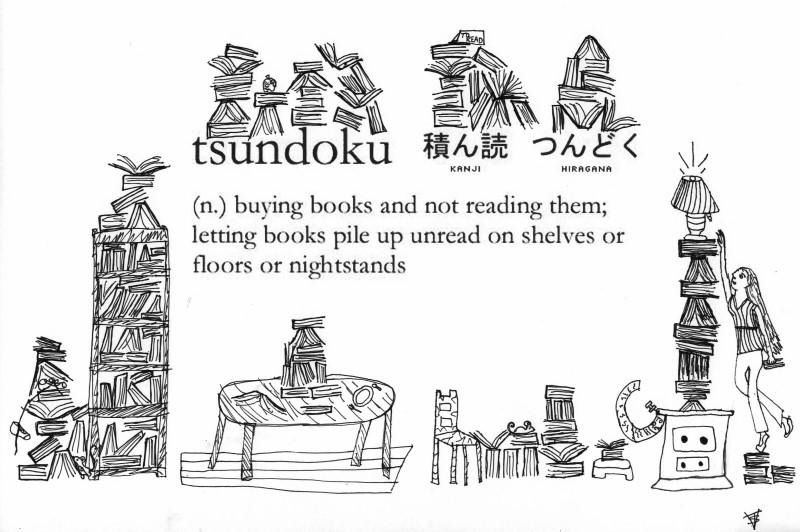
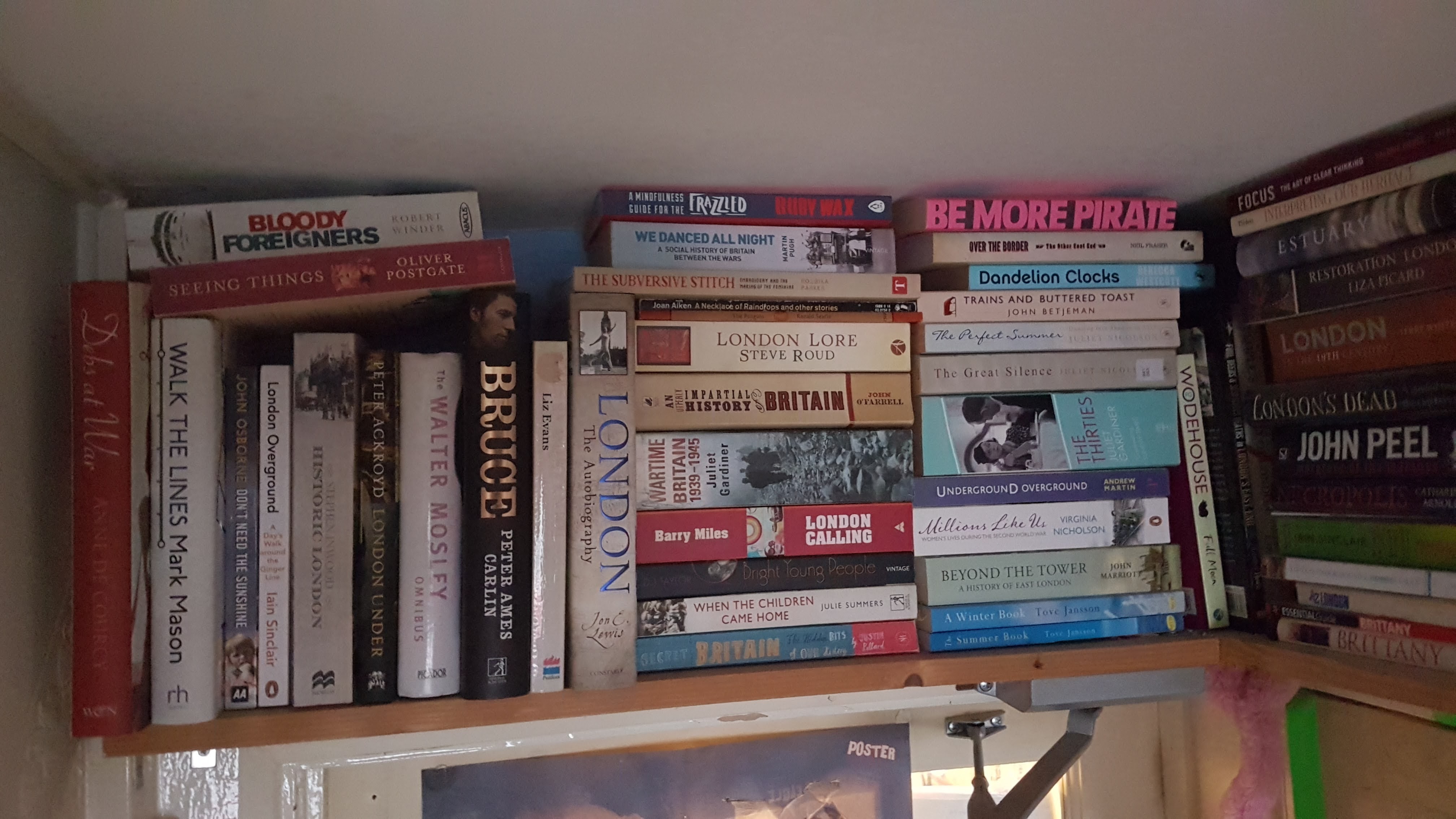
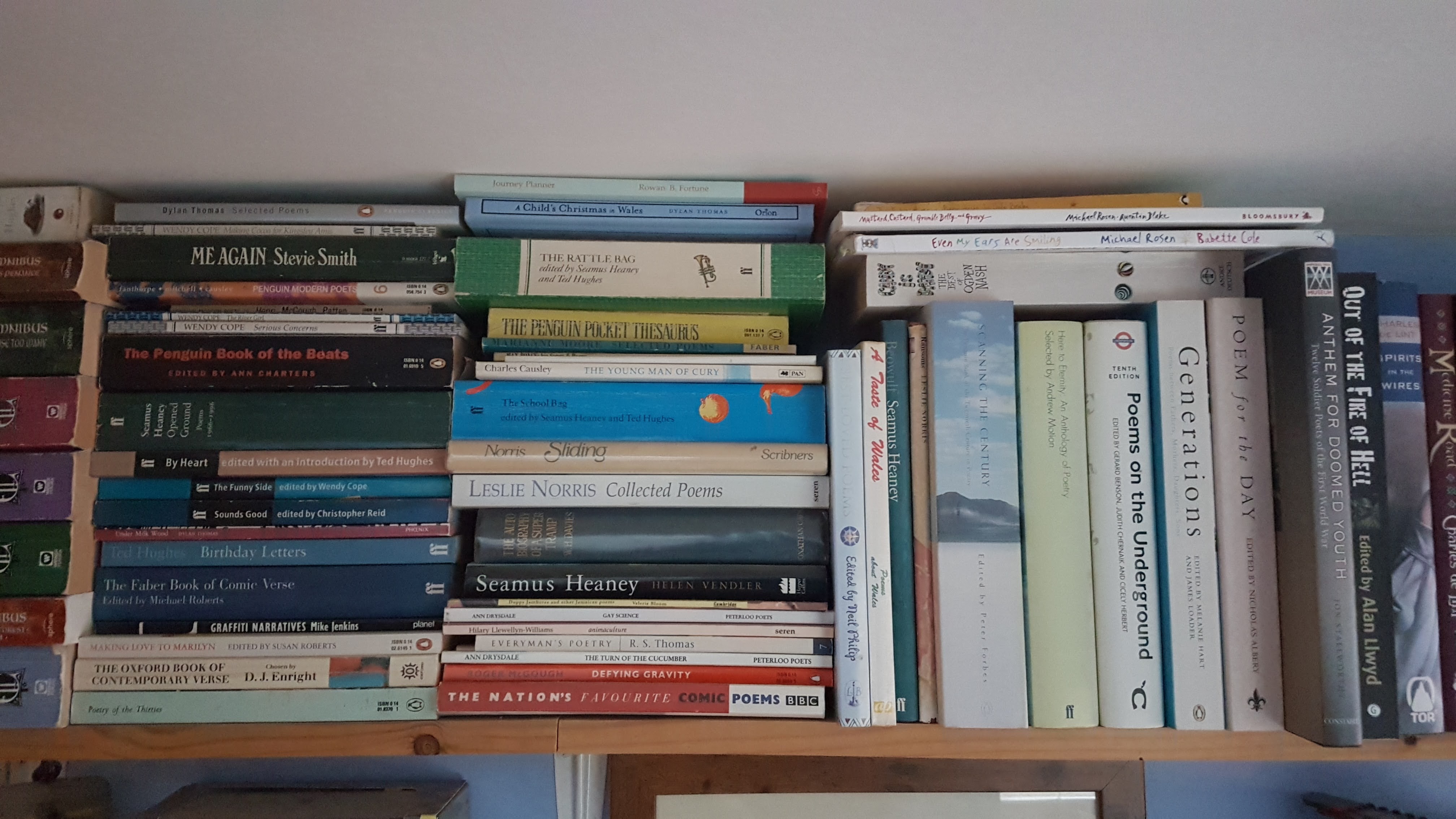
Some shelves are more organised than others, of course: Terry Pratchett (although he has started to roam), Charles de Lint, Phil Rickman, poetry, the shelf(ves) of shame waiting to be read, Ian Rankin, Michael Connelly, my childhood favourites, crime novels by author, Penguin classics. Leave me alone in your living room and I’ll hit the bookshelves first and then your music collection. Leave me alone for longer than the time it takes you to make a cup of coffee (instant is fine, thanks) and I’ll start reading. A question I have heard more times than I can count is, ‘what a lot of books! Have you read them all?’ and the answer is always ‘no, and that means there’s something new to discover’. I keep books I love, and if I know I’m not likely to read them again I pass them on to friends or send them to the charity shops so someone else can discover them.

Image: openculture.com

I grew up surrounded by books and was rarely told what I could or couldn’t read, which means my taste is eclectic, to say the least. I love discovering new authors: I have devoured Tom Cox’s books – even the ones about golf – this year, having picked up one of his cat books in Oxfam. Being able to order new books in advance on Kindle and have them appear as if by magic on publication day is like having many Christmases and birthdays every year. The only problem is that often you get two or even three books appearing on the same day, and then you have to decide which to read first. That happened last week, with Ben Aaronovitch’s new Rivers of London novella What Abigail Did That Summer and Tom Cox’s Notebook arriving at once. Both were very different but equally delicious. Kindle is also wonderful in that if you really love a book and know that one of your friends will like it too you can buy them a copy as well. I subscribe to BookBub, who send me an email every day with daily 99p books that you can filter to the genres you want.

I am not precious about my books. I bend the corners down on paperbacks, and use the slipcovers as bookmarks on hardbacks. Books are meant to be read, not idolised: sometimes they are both. I have some books that have been read so many times they are quite literally falling apart. I possess a lot of bookmarks but can never find them. I love finding fellow fans of series: there are a lot of Discworld fans in museums, I have found, and then you know you have a new reading enabler who you can swap new finds with.

I disappear into books. Once I’m in the story, the kids know that if they want me to hear anything they need to get my attention first, or they have no chance. A good book, for me, is one that makes you want to go and find everything else that author has ever written and read that too, even if its about golf. Some books blaze across your imagination, burning in images that stay with you long after you’ve put the book down. Some authors excel at short stories, others at full length novels. Some do both: Stephen King is one, and Joanne Harris is another.

“What really knocks me out is a book that, when you’re all done reading it, you wish the author that wrote it was a terrific friend of yours and you could call him up on the phone whenever you felt like it. That doesn’t happen much, though.”

J.D. Salinger, The Catcher in the Rye

When I was a Key Stage 1 teacher I loved the moment when a child suddenly clicked with reading, and started to work their way through books for pleasure and not for phonics. Some children needed more help than others: one little boy wasn’t interested in the Oxford Reading Tree so I lent him my own book of children’s Arthurian legends because he was obsessed with King Arthur. He started reading them with his mum, and by the final story he was unstoppable and reading independently. I loved story time at the end of the day, and when I had the same class again in year 3 we read a chapter a day before home time. I read to the children nightly, in the same way that I was read to by my parents, and read many of the same books to them as I had as a child. I can’t bear to part with these childhood treasures, even now.

You can learn to do pretty much anything from books, too: over the years I have taught myself to crochet, to (sort of) knit, to sew, to quilt. When I was growing up my Dad’s household manual was the Reader’s Digest Repair Manual (I believe he still has it) and when anything broke he would refer to this bible. I was overjoyed to find a copy of the Reader’s Digest Complete Guide to Sewing the other week, and then I tracked down the Guide to Needlework on Amazon. I may never need all these techniques – I can’t see myself doing bobbin lace or tatting, for example, but I’ll know exactly where to look if I decide I want to give them a try. A colleague asked me (as I carried my treasure off in triumph) how many sewing books I had. I don’t know, but I did organise them by craft a few weeks ago so at least I can find them when I need to!

I like to crochet or cross stitch and listen to audio books at the same time: that’s multitasking at its best. My book is the last thing I put down at night: sometimes I wake myself up when the book falls out of my hand. My commute is pure pleasure as long as I have a seat: a Central Line delay? No problem, there’s time for an extra chapter. If I have a rough morning at work, you can find me and my Kindle in KFC – the ultimate lunchtime cure-all.

So if you need me, I’ll be reading….

…and/or making stuff

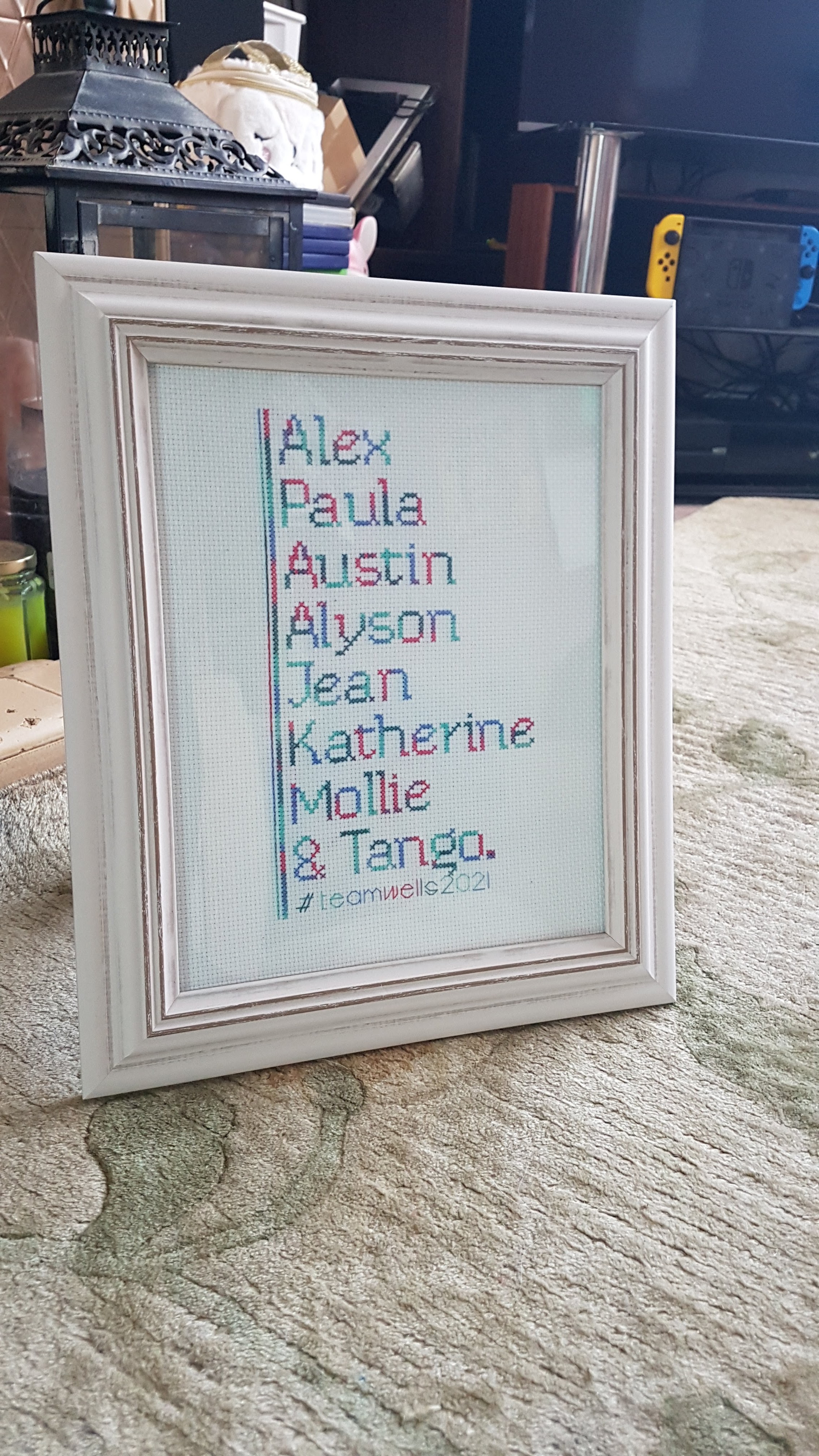
This week I have handed over a handmade gift to a friend who’s just moved house, combining her family with her mother-in-law and taking on a renovation project. 3 adults, 2 kids and 3 hounds! I designed this one, using an alphabet from Lord Libidan and DMC Coloris thread. I’m working on two other gifts as well, which should be finished and sent off soon!

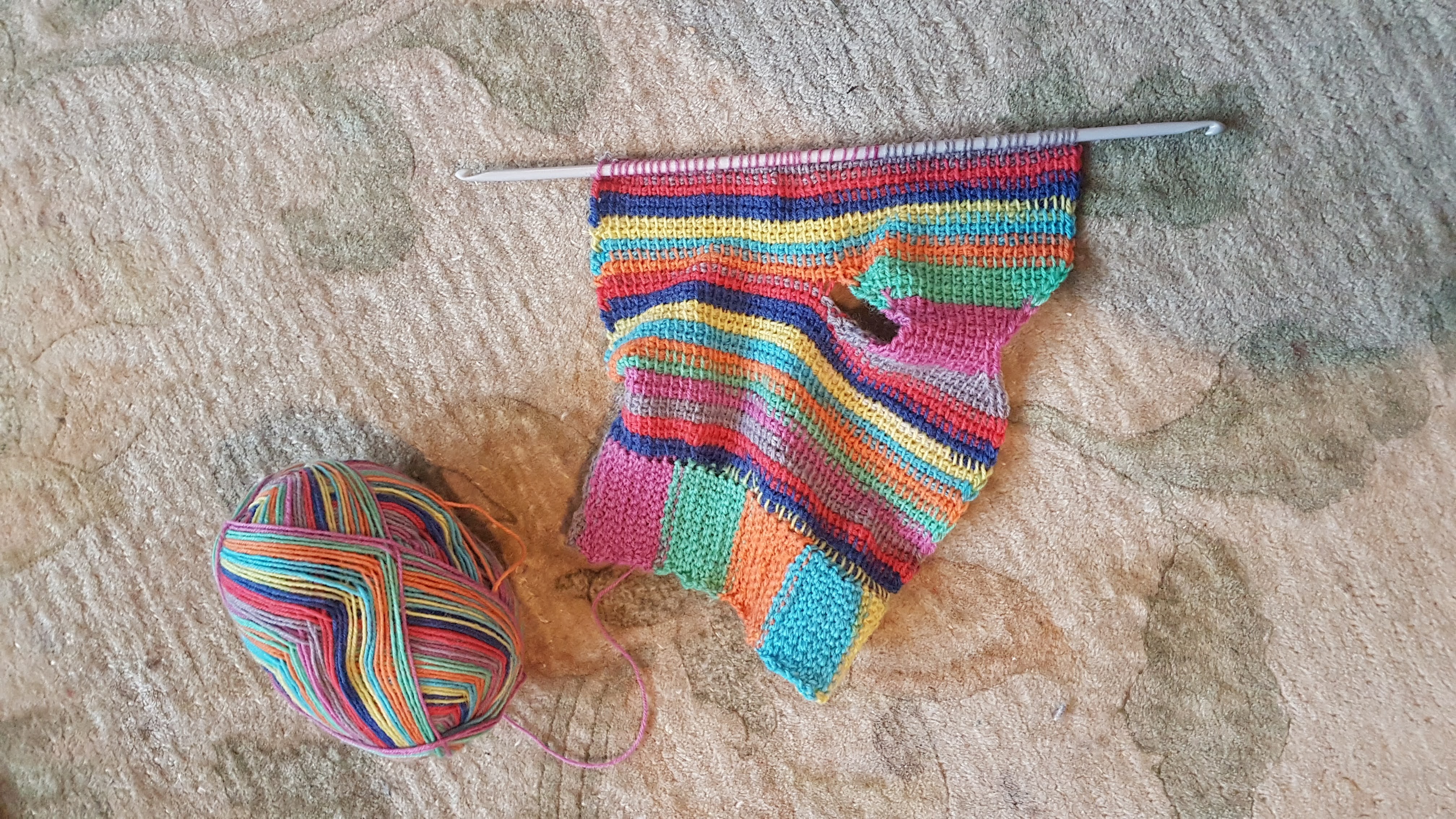
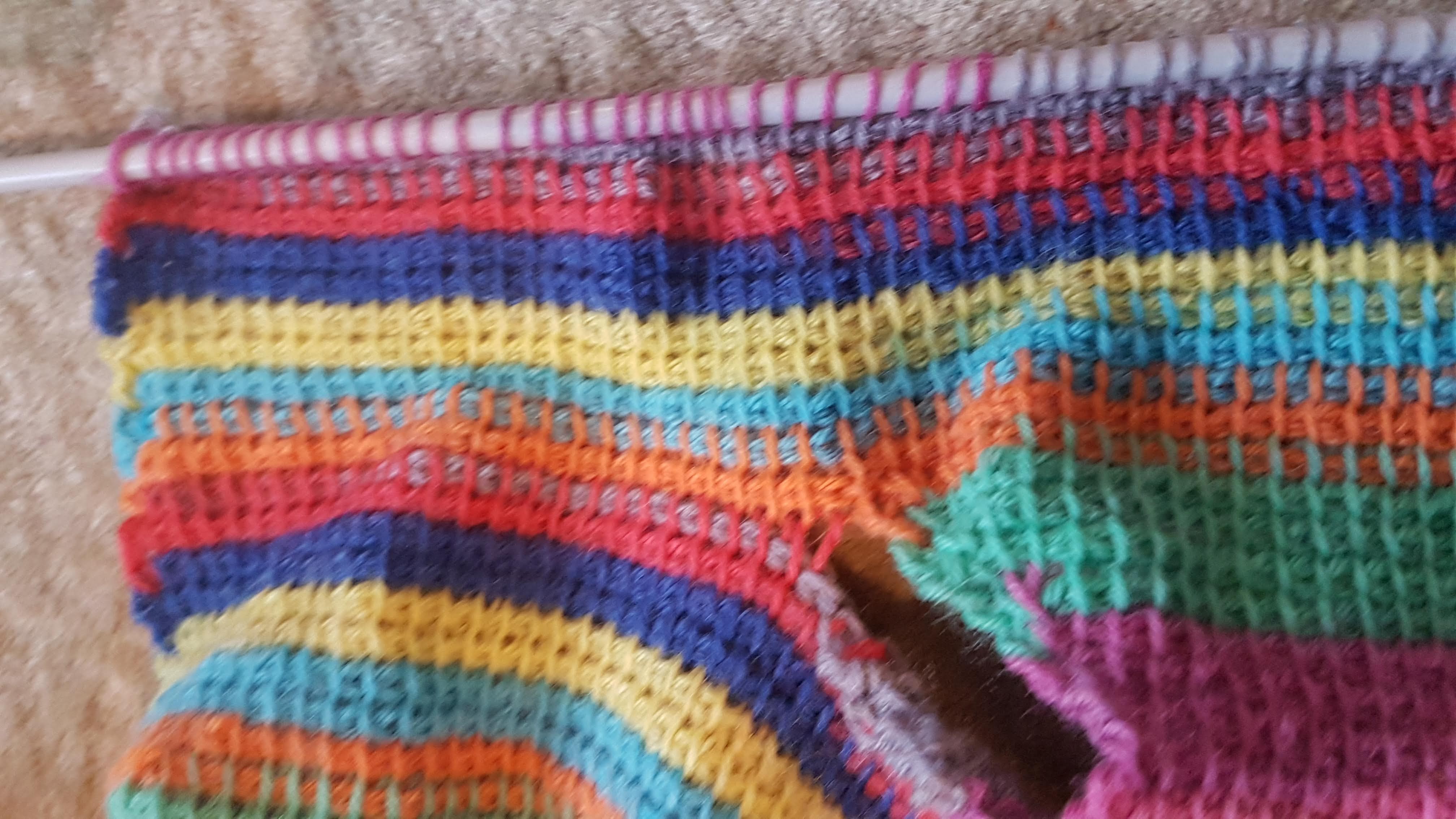
The Tunisian sock is coming on nicely, and is starting to look a bit more socky, which is reassuring! I like this stitch as it’s really easy to count the rows! The fabric has a more knitted look than normal crochet, so these will be stretchier, I hope.

This week’s cover photo is the museum fox sunning herself outside my office window – when we lifted the containers this week we discovered five cubs, which we think she’s found a new earth for. She’s so confident: the grounds are her territory, and since the building is closed she must feel very safe.

So that’s it from me for the week! Looking forward to the lake reopening tomorrow and getting back in the water and to seeing more than one friend at once as restrictions start to lift.

Kirsty x

What I’ve been reading:

Cold Case/Flashpoint (Carlotta Carlyle) – Linda Barnes

London Particular (BBC Radio Drama) – Nick Perry (Audible)

What Abigail Did That Summer – Ben Aaronovitch (Audible)