222: a nettle-strewn hellscape, you say?

Last Sunday afternoon London sister Tan and I went for our first long walk for aaaaages – well, since the ludicrously long one we did last July. She’s been running a lot (marathons and half marathons) while I have been doing weekend wanders and hoping that at some point the rain will stop long enough for the footpaths to dry out.

Despite her belief that Essex is a fly-blown wasteland, Tan trekked over to my ‘ends’ and we did the Moreton and the Matchings circular walk that I’d tried a couple of times last year. It takes in a few pretty churches and villages, and – as it turned out – a LOT of nettles that haven’t been cut back. These were head height in places, with added brambles, and some farmers haven’t cut the crossfield paths so many detours were taken. I spent some time on Monday morning reporting all this to the council, who may or may not get round to looking at it in an estimated nine weeks or so. Add the detours to my legendary (lack of) sense of direction, and the 17k walk came in at just under 20k.

You can just see the top of my head – this was a waymarked footpath!

We stopped for a snack break (Mini Cheddars, Snickers and coffee) on the green at Matching, next to the very pretty medieval marriage feast house and the church, facing an oak tree that was planted for Queen Victoria’s jubilee in 1887. The friendly vicar came along and very helpfully told us that they had a toilet, which made us happy. We saw kestrels, heard a lot of pheasants, snuck up on a few bunnies and a muntjac, and apart from the extremely hardcore nettles it was a good ramble. We finished with a look inside the 13th century St Mary the Virgin church in Moreton, where we’d parked the car, and then she refused to take my directions on the way home and insisted on using the satnav. Honestly!

Still, Tan’s opinion of Essex has changed – it’s now a nettle-strewn hellscape. Which is nice.

So how’s that skirt coming along?

Very well, thank you for asking! Having definitely said last week that I wasn’t going to do any boro patching as it would be too cottagecore for words, I remembered that not only did I have some Japanese prints in the stash, I had a boro inspiration pack from Japan Crafts that some lovely Secret Santa gave me a couple of years ago when the Young V&A theme was ‘blue’ so clearly DESTINY was saying DO A PATCH.

Derived from the Japanese boroboro, meaning something tattered or repaired, boro refers to the practice of reworking and repairing textiles (often clothes or bedding) through piecing, patching and stitching, in order to extend their use.

Also, the skirt doesn’t have pockets, and I NEED pockets, so I made a boro patch as a pocket. I used some of the indigo fabrics, some scraps from the V&A sample sale, and a square of cotton as a base, and lined it to make a patch pocket. That was my portable project on the tube this week, and it was clearly performance crafting as people kept watching me. As well as the running sashiko stitch, I also used some of the fabric features to embellish with lazy daisy stitch and outlining hexagons. I enjoyed it so much that I looked for other things to boro – starting with some of the zillion cotton tote bags I have collected over the years, probably! This will also encourage me to use some of the embroidery threads people keep giving me…

I gave up on all my marking tools and just used washable poster paint to mark out the final bits of stitching I wanted to do on the skirt, which was lovely and messy and a good way to spend a Saturday afternoon after a morning of ironing. While waiting for the front of the skirt to dry, I marked up a fabric pouch that I bought in a Hobbycraft sale with the Seigaiha (wave) stencil, and then used Bondaweb and more fabric scraps to create a boro panel on a tote bag. The yellow marking pencil worked on this, so I used the Sakura (cherry blossom) and Fondou (weight) stencils for a panel as well. That should keep me busy! Also, guess what everyone is getting for Christmas?

Things making me happy this week

  • Cat insurance. Lulu isn’t well and the vet quoted me £600. Once I’d stopped freaking out they helped me put the claim in so that they would be paid directly. Now we just need to get the meds down her.
  • Inter-library loans, and new colleagues who recommend books to me. The two may be connected.
  • Lots of strawberries and raspberries from the garden
  • Coffee with Brian on Thursday morning and a colleague who is leaving asking if they can join my early morning coffee roster. This is clearly now A Thing.
  • Cinnamon Bun flavoured Pretzel Flipz.

Today I am off to hang out with illustrator Skye Baker at the Little Angel Theatre community street party in Islington, where we’ll be illustrating houses.

Next week I may even have finished the skirt – the problem is always knowing when to stop with these things….

Kirsty x

What I’ve been reading:

Demolition Angel/The Forgotten Man/The Watchman/The Promise – Robert Crais

Shadowstitch – Cari Thomas

Neither Here Nor There – Bill Bryson (Audible)

150: make, do, and mend.

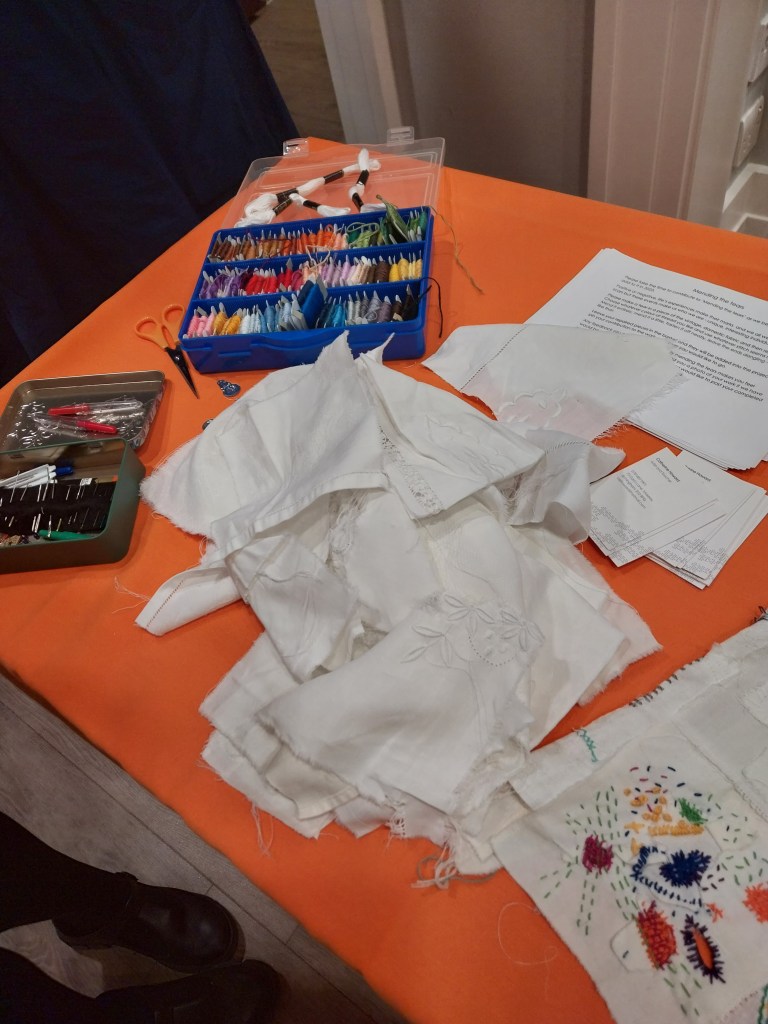
Another week which has zoomed (or at least MS Teamsed) by in a whirl of meetings and emails. The high point of the week was a day at the Wellcome Collection, host for the Endangered Materials Knowledge Programme’s two-day workshop on the role of Mending and Making in museums. I attended day one in person, and dropped in to the morning of day two online. EKMP is a programme set up to research and capture the skills, technology, knowledge and values being lost as processes become more and more industrialised. It explores how these skills are being passed on, and connects source communities with museum objects. One of the speakers spoke about the annexing of the ‘make do and mend’ ethos from WW2: it’s not all about making do, it’s about making new, learning new skills and mending to extend or repurpose. Just the addition of commas changes the sense of the phrase (much like the ‘let’s eat, grandma/let’s eat grandma’ example).

In museums (in my head, anyway, I am sure conservators will tell me I am wrong), I have always assumed that damage is part of the story of an object: the evidence of being buried as grave goods, the reason something was thrown away, the story of on object surviving centuries underground. You know, the stuff that ends up on archaeological display in the British Museum – helmets with bloody great blunt instrument damage, for example.

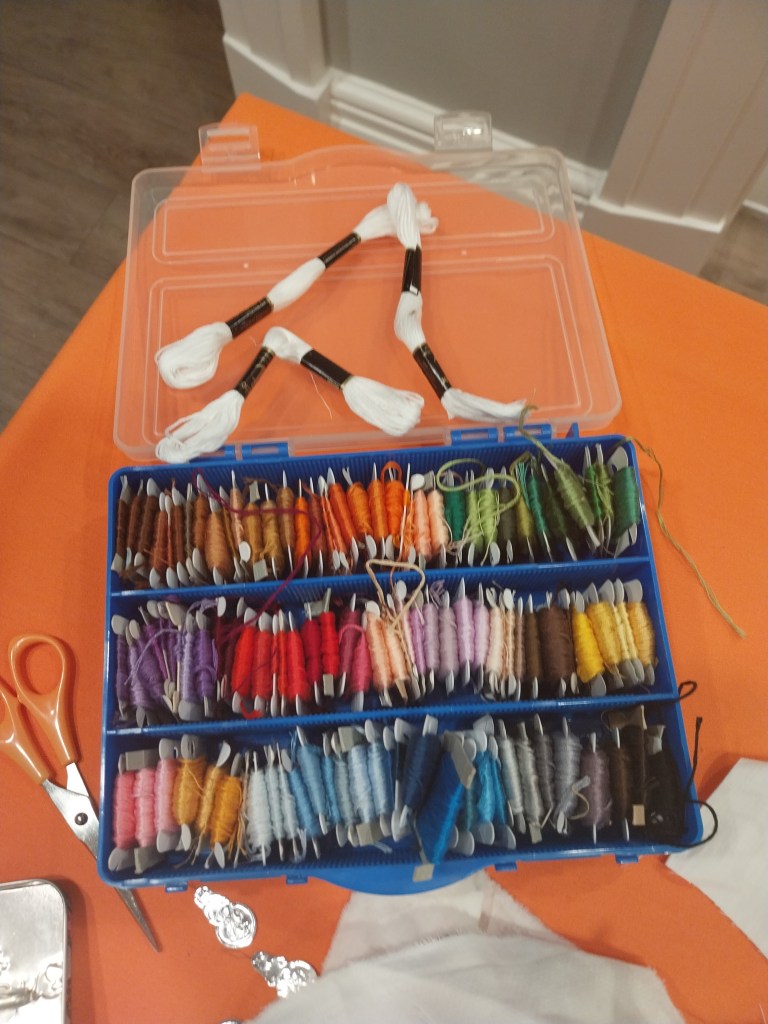
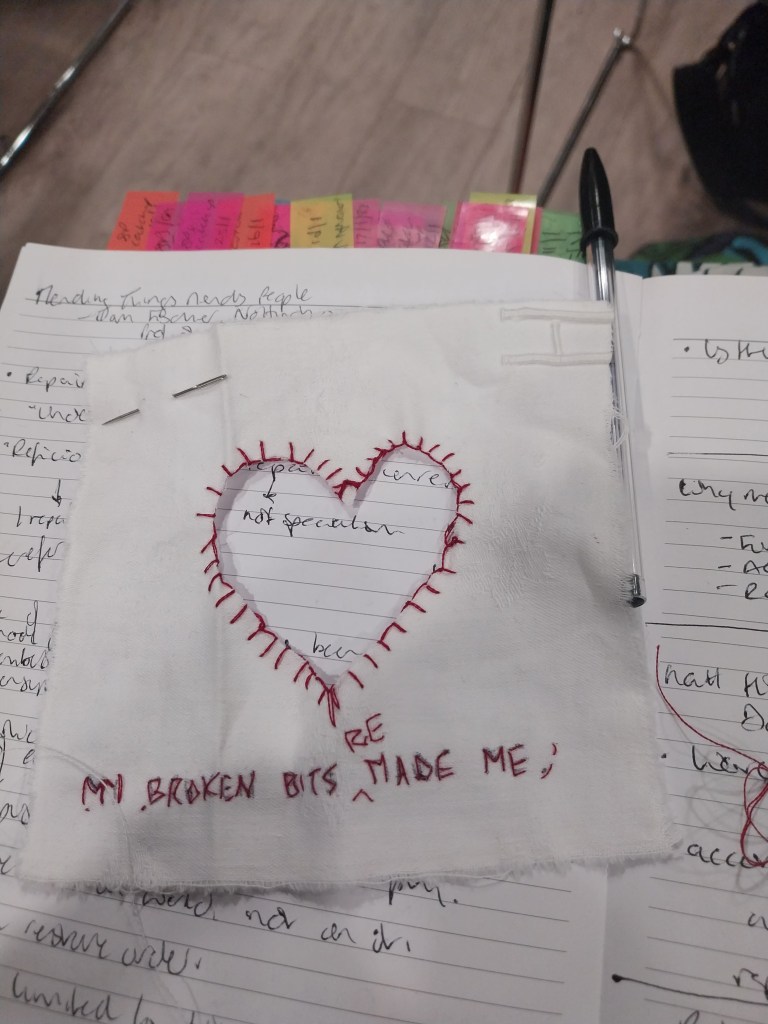
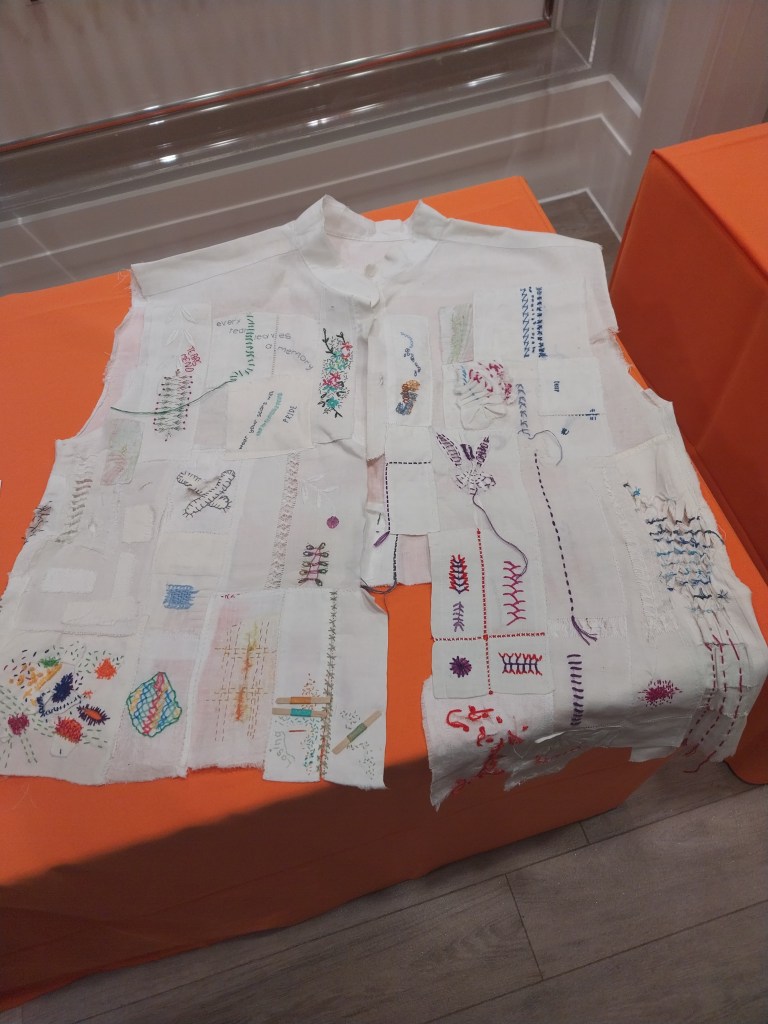
As we know from Instagram and so on, ‘visible’ mending – sashiko, boro, kintsugi, darning, etc – is enjoying a moment in the limelight as a reaction to the rise of fast fashion and consumer culture. In my explorations of the handling collection before we sent it off to other museums, invisible mending was more apparent: the ricrac braid covering the tell-tale line where a dress had been taken up or down, miniscule stitching on tears or holes in baby clothing. The attendees of the conference – fabulous people like Kate Sekules and Bridget Harvey, and Celia Pym who was lurking online – wore clothes with gorgeous rainbow darns and embroidery highlighting and reinforcing holes. Catherine Reinhart was darning socks and Catherine Howard brought vintage textiles and encouraged people to tear and mend squares in any way they liked, to add to a collective project. There were lots of links made between making, mending and mental health and wellbeing – both collective and individual. I was secretly thrilled when several people commented on the dress I was wearing (one of my repurposed duvet covers) and my quilted jacket (ditto). Talks on yurts in Kyrgyzstan and fishing nets, on how saris are repurposed, explored how fabrics are remade to support new pieces when they are too far gone to repair.

Of course, it wasn’t only textiles, though this was what had attracted me in the first place. There was a talk on why miniature artists make using repurposed household objects, patchwork and bricolage in southern Africa, and from someone who used an old French horn to give his lawnmower a new lease of life. All of these were basically a justification for never getting rid of things which may come in useful (my Beloved would agree with this: he was thrilled when making our deck to use a piece of oak which had been in the garage for 30 years, in case it was handy).

I was particularly interested in a talk on damage and repair in Iron Age shields, which challenged the theory that things like the Battersea Shield and other objects previously thought to have been made purely for ritual purposes or flashy display had actually been used in battle until they were no longer repairable. X-rays and scientific testing showed craftsman-level repairs of small damage presumably caused in day-to-day use, perhaps training – and when damage was inflicted in battle the repairs were deliberately obvious, maybe to say ‘OK, I survived this – come and have a go if you think you’re hard enough’. Only when the shield or helmet’s owner was dealt a death blow were the objects consigned to grave or the liminal spaces of the rivers and lakes.

There was, of course, lots of interest in the museum reopening and the work I have been doing with Spotlight and Scott Ramsay Kyle on sustainable fashion and mending. I also caught up with Scott this week, over coffee and a tour of his department at Central St Martins. I’d have loved to have had a go on the looms and spinning wheels, as well as spent time talking to the students. They had a swap shop going on, where students could bring materials left over from projects and swap for something they needed. UCL have a Repair Cafe, part of a worldwide movement, which helps people mend and repurpose.

Later today I’ll be catching up with an online session from the Textiles Skills Centre – find their YouTube channel here – from their Tea ‘n Chat series. After I have defrosted a bit from my ice swim this morning…

Other things making me happy this week…

  1. First training walk done for the Race to the Stones. Just under 9km, negotiating swamps and electric fences. Only six months to get up to speed! https://www.justgiving.com/team/Gwrachod-Ar-Daith for more info on who we are and what we’re doing.
  2. Nice conversation with an older lady on the tube about crochet
  3. An update on the museum’s progress.

Now I must go and defrost a bit…. same time next week!

Kirsty x

What I’ve been reading:

Summer Knight/Brief Cases/Death Masks – Jim Butcher

Guards! Guards!/Men at Arms – Terry Pratchett (Audible)