…both of which knock me for six these days which at least means I have slept well!
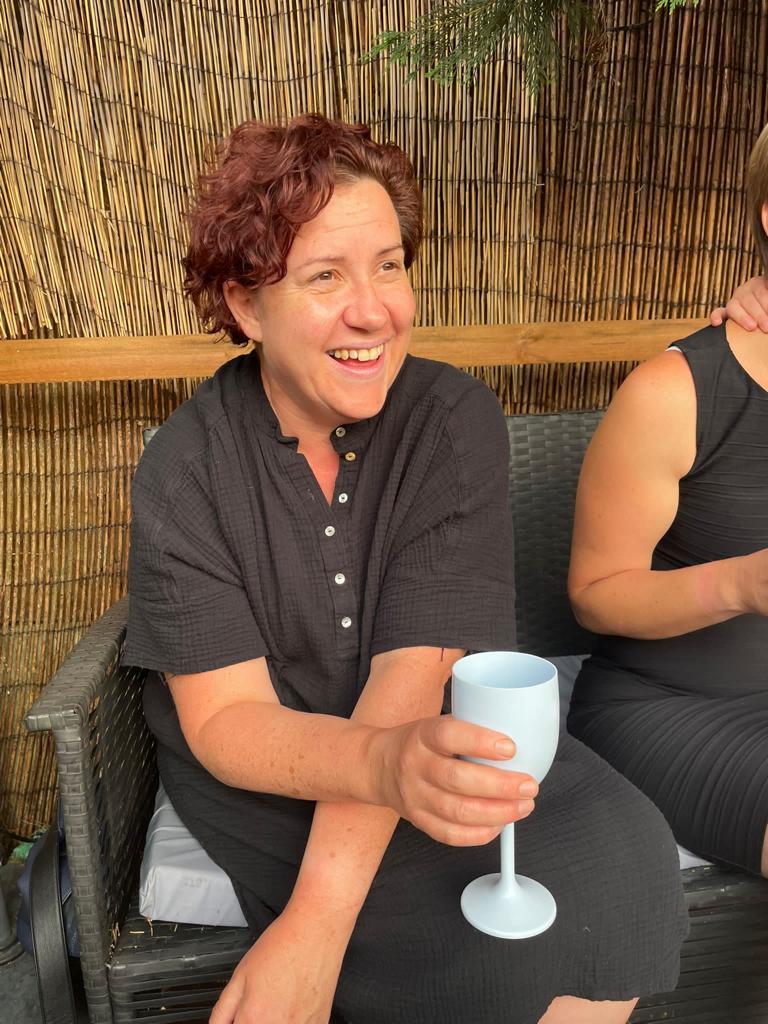
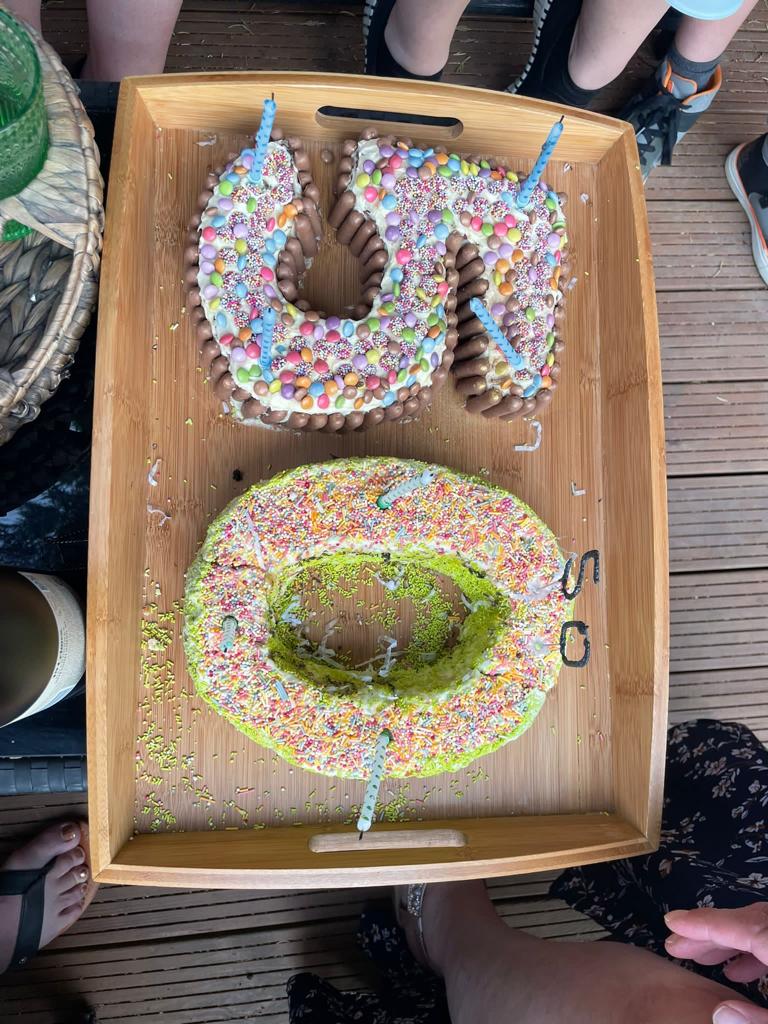
On Monday I was fifty, and while for the past few years my birthday has been celebrated in the garden with barbecues and coffee tequila, this year I’ve been training hard for the Race to the Stones so I didn’t plan anything. My lovely neighbour Sue had invited me round for a hot tub in the evening, which turned out to be a surprise mini-gathering with cake and fizz and presents, which was most unexpected and very lovely!
The cake did actually catch fire, thanks to Jill’s sparklers and decorations – not down to the number of candles: all we in the garden heard was “happy birthday to AAAARGGH!”.
Presents included a selection of plasters and a voucher for our local salon so I can book myself a post-Race pedicure or massage – bless them!
The second prosecco event was the private view of Young V&A on Wednesday evening, at which I was so excited I didn’t take any photos.
Even knowing what to expect (having worked on it for five years!) I still had a wow moment when I walked in and saw it full of colour and people. Last time I was on site, about two months ago, it was in full chaos with cases and objects being installed, and it seemed very unlikely that they’d ever be ready to open on time.
The mission – thanks to a throwaway comment by a snarky pre-teen – was to create the most joyful museum in the world. There were definitely moments during the five years that joy was in very short supply, but the end result is wondrous. At the event I attended there were adults and children interacting in the all the ways we’d hoped and my new colleague Cassie who joined me at the event was enchanted too. The museum is bright and full of colour, yet definitely not a play area. Opening up the roof lights has changed the atmosphere in what is essentially a Victorian greenhouse. The huge gallery titles bring colour and playfulness to the central space – not to mention the flying Microlino car – and there are still enough ‘I had one of those!’ moments to draw in the adults. Clever moments like the Teenage Mutant Ninja Turtles’ house being added to the dolls houses make you smile, as do the poems commissioned from people like Michael Rosen and Valerie Bloom to illustrate the letters in the ‘Apple is for A’ section.
The Design gallery – the one I worked on and which at times felt like an afterthought – does exactly what we wanted it to do: brings the stories of the design case studies to life, and highlights the work of young people. Works by teens are hung next to work by Issey Miyake and Bethany Williams, and I was sneakily thrilled to see the border panel I made as part of the quilt. The open studio was filled with people, the ‘boob carpet’ is in place (go and see what I mean) and the Shed walls were filled with amazing pieces by the resident Clara Chu.
The overall shine was tarnished for me by the discovery later in the week that for some reason the V&A’s director, Tristram Hunt, had ordered the removal of two posters from the ‘Design gives people a voice’ display and some books from the shop. The space limitations in that area of the gallery meant that every single object had to work hard to get its message across, was included after much debate and the gallery had been through multiple presentations to the directors and various trustees before this point. Our ethos throughout the project had been to reflect our audience in what we showed and to be genuinely inclusive. To have a Stonewall poster removed and the books from the shop – on the anniversary of Pride in London – denies and devalues the work we did towards this. Kristian Volsing, who was lead curator on this gallery, wrote a brilliant blog post this time last year about the pieces. Please read it and understand what our mission was.
I’d be interested to know what prompted the decision to censor objects in the gallery and in the shop mere days before opening and what apologies will be made to the communities being hidden by the V&A. I hope Hunt is challenged and the objects are reinstated. So far he has refused to retract the decision despite representations from the LGBT staff forum and the union.
As for the Piriton…bloody mosquitoes.
Next week’s blog may be late as I have to go for a walk…
This week we were finally able to share the opening date for Young V&A – it’s been a long time coming, and there’s still lots to do before we open the doors, but as of 1 July we will be back! Back!! BACK!!! as Smash Hits magazine used to say (a long time ago, obviously). All the things I’ve rambled on about on here – blue blocks, shoes, creativity etc – will all start to make sense.
Drumroll please 🥁
We’re officially opening our doors on Saturday 1 July!
It’s all very exciting but also quite daunting: I know that the sessions we have planned for the new school programme are interesting, and I know that the galleries are dynamic and interesting and aimed carefully at the different age groups (but still with content for everybody), but WHAT IF NO ONE COMES? We all know that schools are suffering at the moment from teacher strikes (which I fully support), from delivering a pay rise and associated pension/NI contributions unfunded by a spiteful government, from lack of supply teachers, LSAs and other post-pandemic staffing issues. School trips – however much they benefit the students and support the curriculum – are staff-heavy, planning-heavy, resource-heavy. Gone are the days of primary schools with ‘enrichment co-ordinators’ who would take the trip planning load off the teachers.
This is without even considering the ethics of asking parents to fork out cash – for travel, for a facilitated session, for theatre tickets, for entry to charging sites, for exhibition tickets even at a discounted rate – during a cost-of-living crisis. We are free to enter but have to charge for sessions: during closure we’ve been able to offer our sessions free, and this has helped us engage thousands of children across Tower Hamlets, but once we reopen that has to change. My children haven’t gone on theatre trips at secondary school as the cost of that trip is equal to a month’s bus fare for them or two weeks’ school dinners. I hate saying no, but the reality is that for many people culture comes second to food. I had a conversation with a North London secondary school teacher last term who was going back to her headteacher to tell them that she couldn’t justify running food technology (Home Economics, for those of us that remember Smash Hits) this year if it meant asking families to provide the ingredients.
Historically, too, the majority of school trips have been linked to history, geography or English – museums and theatres, heritage sites etc. Design Technology, unless at GCSE isn’t high on the priority list and this is particularly the case for Key Stage 3. I think of this as the Cinderella Key Stage: past SATs and before GCSEs, and no one knows quite what to do with them, when really this should be the point where schools are working hard to spark their interest in creative subjects before they have to make their GCSE options. I do feel that unless their school (not just individual DT teachers, who are without exception wonderful, passionate people) recognises the benefits of DT and other creative subjects in developing the skills children need to make it in the world today (problem-solving, collaboration, communication and so on) they are being short-changed. However, unless there’s a sea change in the government, causing them to create a culture of learning where students are helped to learn skills they need in 21st century life rather than to pass exams, I can’t see this happening. I’m very lucky to have been piloting my KS3 sessions in just such a school but research into the way DT, art and so on are delivered across my key boroughs means they are in a minority.
In previous roles my way around this was to develop cross-curricular sessions: history and maths, history and science, history and pretty much anything we could cram in, especially for primary schools where cross-curricularity is a selling point. This doesn’t work for secondary schools except in ‘enrichment weeks’ and I haven’t seen one of those for a while. School budgets seem to be focused on buying in enrichment or PSHE activities, like the ‘drugs bus‘ which Thing 2 will be visiting this week and which caused much bemusement/hilarity in the office this week. ‘Maddie’s Crack Shack’, after all, sounds more like a CBeebies series than a hard-hitting educational opportunity.
TL;DR: Please, schools, give KS3 a chance. And come and visit me.
That was week one of 2023, apparently, which has passed in a blur of meetings, taking care of poorly child and cat (who have the same thing, it turns out) and getting back into staying awake all day. Cat had to go and have a sleepover at the vet on Thursday, where he made friends with all the staff, but they wouldn’t take Thing One. Shame, really, as getting a vet appointment is considerably easier than getting to see a doctor.
Hopefully you all heeded last week’s excellent advice and have spent the first week of 2023 thinking of nice things to do with your year. I have booked in a massage and am looking forward to next weekend’s woolly workshop and show, and to an online V&A Academy course on Tuesday.
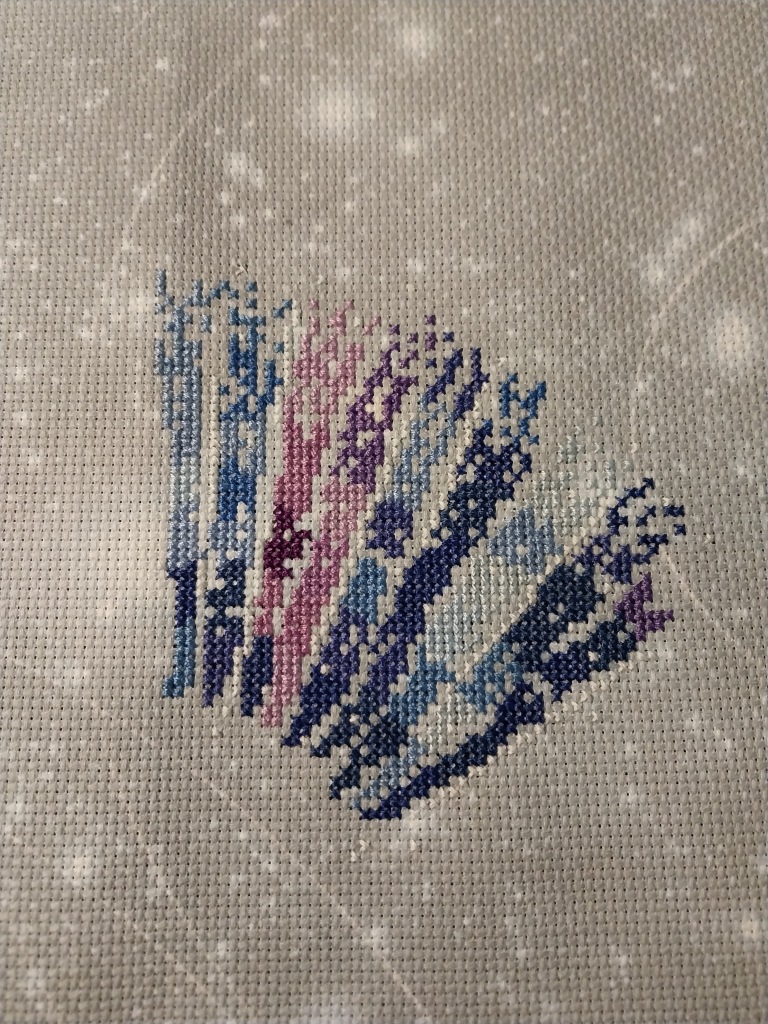
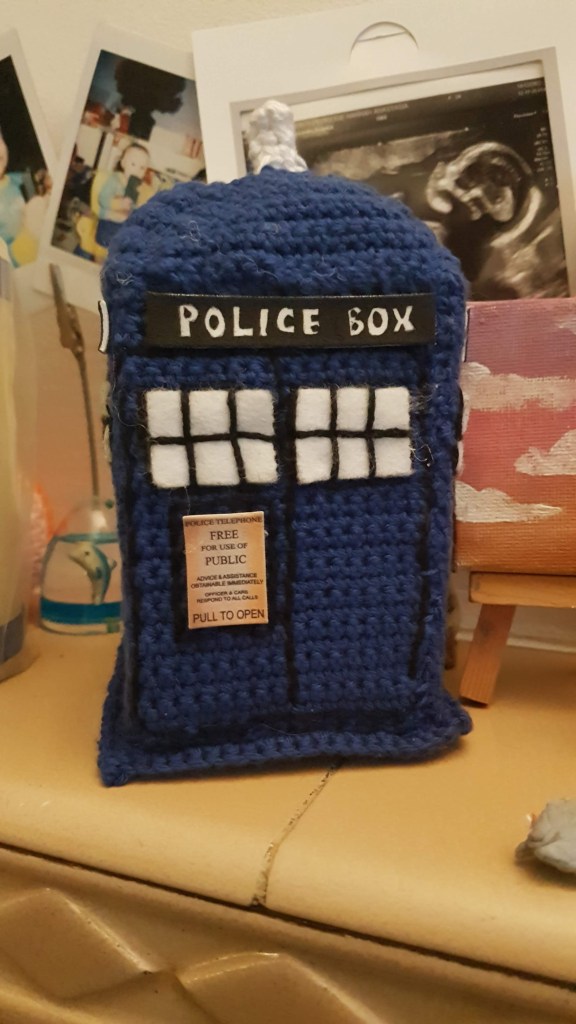
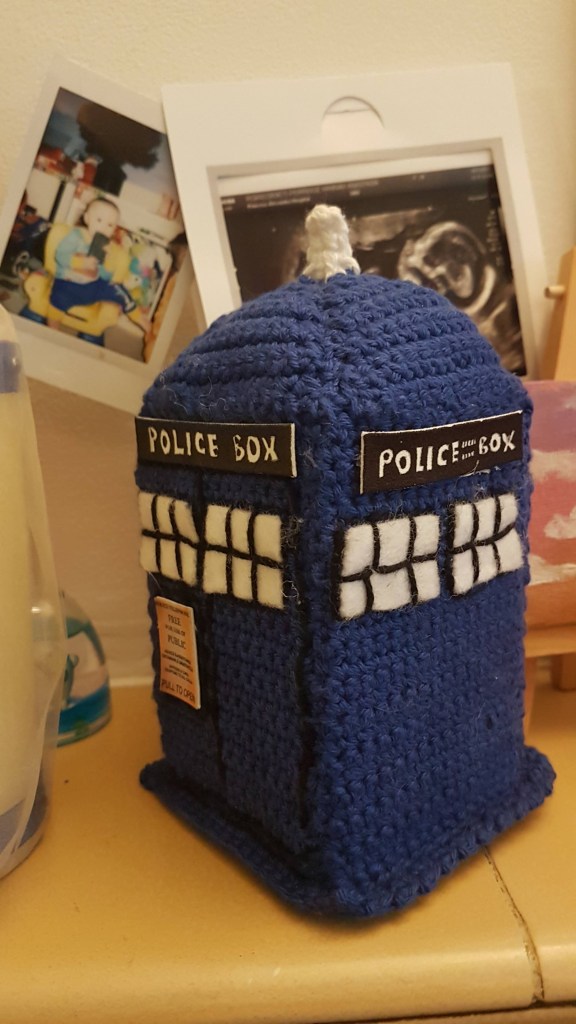
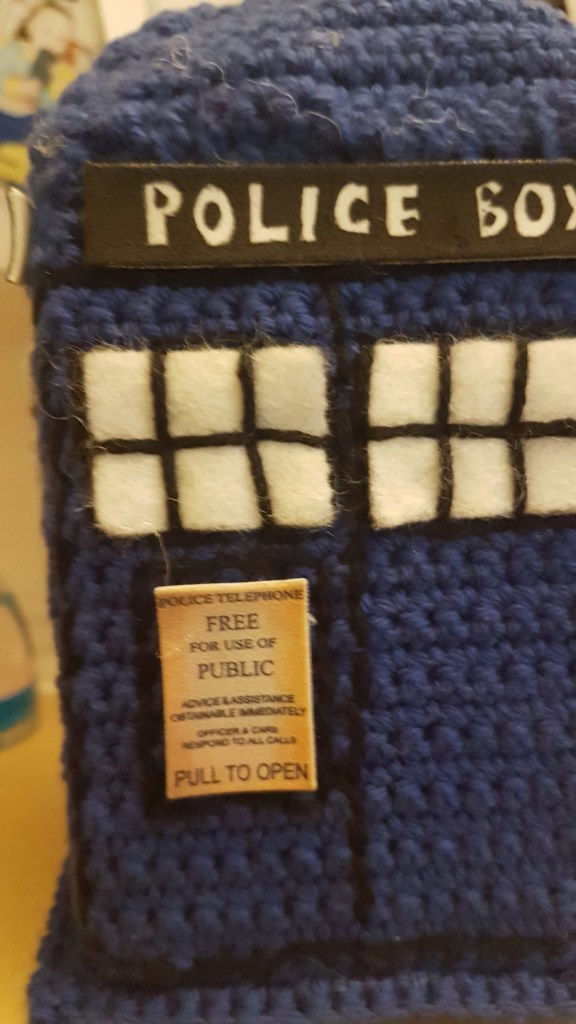
I am not sure I managed to get the hang of last week before it was all over, quite honestly. I did manage to get as far as November in the temperature galaxy, which serves me right for not keeping up with it since August, and have finished the Mk II TARDIS (slightly bigger on the outside, at least). I made the roof more domed and outlined the windows as well as the panes, but I think I prefer the smaller one which has now gone off to a new home with a Whovian colleague who had a birthday this week. Hope she likes it!
Having said I definitely wasn’t going to do a temperature stitch this year, I went back to Climbing Goat Designs to just have a look and ended up buying this one and, after this year, I will use a larger range of colours in case of extreme temperatures again. I have also ordered some printed space fabric to stitch it on, for a change, and I might brave the glow-in-the-dark thread for the stars. I am definitely not doing one next year though.
I also did some work: planning a new session for schools and thinking about what we’re missing from the handling collection. Suddenly the six/three/one month before opening to-do lists are NOW and not a future countdown. This sense of ‘ARGH’ wasn’t helped by this Time Out article on things to do in 2023 – we are number 13. It’s all starting to get a bit real… there’s such a lot that needs to happen before we open the doors, including getting all our kit back out of the various storage spaces and catalogued, working out how to store it all in my shiny new learning centre cupboards, convincing schools that even though we’re not doing historic toy sessions any more there’s still a good reason to come and visit, and at the same time as business as usual we’re also working on the first of our paid exhibitions which opens in October.
The session I was planning this week is based on Rachel Whiteread’s Place (Villlage) installation which was one of my favourite objects in the museum, and which is being redisplayed in the new space – the problem here is that trying to create a gallery based session before the gallery is installed is a bit tricksy as it all may change down the line. I really dislike dolls*, but this collection of dolls houses is atmospheric and magical, and provides excellent potential for literacy sessions. I can’t wait to see the new installation.
We’re also planning game design sessions, architecture, storytelling, and more – it’s all very exciting, but the marketing to teachers is keeping me awake at night!
*yes, it’s been suggested that I may be in the wrong job. I am also scared of masks.
This week I am bored with…
All things royal. Every time I turn on the TV or open Google there is some new ‘revelation’ from Prince Harry’s book which was allegedly leaked this week. Enough already. Siblings fight and there’s no law that says you have to like your sibling’s choice of partner. The trick is not to tell them and hope they work it out for themselves. Also, no one likes someone who constantly whinges that it’s not fair and everyone is horrid. Grow up.
‘Train cancellations’ on the Central Line. Which appears to be yet another excuse for constant delays.
Laundry. Where does it all come from?
Work. It is cutting into my nap time.
On that note, the washing machine has finished, so I will sign off!
Kirsty x
What I’ve been reading:
The Paper Magician/The Glass Magician/The Plastic Magician – Charlie N. Holmberg
Kill the Farm Boy – Delilah S. Dawson and Kevin Hearne
Over the last few weeks I’ve listened to a four part podcast from the BBC World Service’s The Compass, called ‘Why We Play‘. Each part explored a different phase of life, from childhood through to old age, and the impact and potential benefits of play. It covers things like video games, which can help adolescents navigate issues around anxiety and depression; why we shouldn’t stop playing in old age; the importance of play in making sense of the world in the early years; and how play can increase productivity at work. I won’t go into too much detail here but it’s an interesting listen.
As part of a team developing a museum dedicated to young people, where play is one of the key themes, we bang on about play a lot. I even go off to colleges and universities occasionally and talk about how important it is, referencing people like Johann Pestalozzi, Friedrich Froebel, Maria Montessori alongside toy designers like Patrick Rylands.
PlayPlax, 1968, Photograph: David Levene/Guardian
You may not recognise Rylands’ name but for people of my generation his toys will have been part of your childhood. He was the creator of Playplax, which – along with its direct descendant Super Octons – was still a staple part of nursery kit in the late 1990s. He talked about Playplax as something that was ‘just stuff’: there were no pre-determined outcomes, only what the child made of it.
“A toy that does everything by itself, does nothing for the child. The main purpose of a toy is to enable children to enter into a world of make-believe, as it is in this way that children relate to reality.”
Patrick Rylands
The power of these little perspex squares is amazing: when we were doing some training with a childcare setting in the summer on how to use the big blue blocks we took the Super Octons along and several of the adults latched onto them and spent ages with them. A teenage girl at Epping Forest College made a set of sunglasses in a session which she was very proud of. People love the simplicity of slotting the shapes together, of mixing the colours and building up and out. The blue blocks (and Lego, and any building kit!) have the same effect – they are an invitation to play, to build and create.
Where was I? Oh yes, banging on about play again. Going out and talking to teenagers can get a bit depressing at times as a) they don’t want to talk back to me, so getting them to answer questions is like squeezing money out of HMRC and b) they often tell me that you stop playing when you stop being a child. The definition we often use, both in the sociology and the play sessions, is that childhood lasts from birth to puberty, although we do discuss legal and social definitions as well. They talk about play – when I can get them to talk at all – as something they ‘used to do when they were young’ (thanks, 15 year olds!) or as something they do with younger siblings or cousins.
There are many definitions of play, especially when you start getting all academic about types of play and things (it’s Sunday, so I won’t) but the very simplest one, the one I use when talking into the teenage void, is that it’s something you choose to do for enjoyment and recreation, rather than for a serious purpose. If you ask them what they do for fun, they tell you that they go and hang out at Westfield (other shopping centres are available, apparently), play online games and so on. Some may play football or skateboard, some might have a hobby that they enjoy, and some – very occasionally – admit to enjoying the odd board game at Christmas or with family. They then often mention Monopoly, which to me is less a game and more a form of hideous torture, but there we are. I’m still not sure they agree that their non-game activities are ‘play’ but at least they are talking to me.
Before I joined the museum, the Importance of Play session finished with a chance for the students to play with various toys that they had seen in the galleries – a teddy bear’s picnic, dolls house, Playmobil sets, building blocks etc – and their task was to set them up as they might if they were inviting nursery children to join in and then we’d discuss what children might learn. This might be fine or gross motor skills, social skills, colour matching or maths. After several months of the teenage void I noticed that as we walked into the classroom the students were more interested in the activities than in the talk, so I flipped the session and invited them to play at the start of the session. It was a revolution, as far as I was concerned, and the sessions became much more open: they’d play, and then we’d ask them the same questions about what young children might learn. But now they’d answer me, and they’d talk about their own activities, and were more confident in sharing their prior knowledge.
The podcast (see, you knew there was a point) made me think about whether I was practising what I preached, to coin a phrase. Am I playful enough in my adult and work life? You all know what I enjoy doing – I make things, I hurl myself in lakes and so on – but do I play?
Sometimes, I admit, I forget: having to be a proper grown up and keep other people alive, negotiating peace settlements among children, being the grumpy one that makes them turn the Minecraft off and so on are not conducive to playfulness. But I sing and dance in the kitchen while I cook those dinners and spin passing children into a twirl, and sometimes have the urge to bake a cake and smother it with Smarties ‘just because’. When London sister and I went to Ireland for our niece’s First Communion there was a bouncy castle and we regressed entirely, spending a lot of the afternoon on it and ganging up to bounce our mum off the apron at the front; playing with the niece and nephew and being entirely silly. When we have our big family holidays the various children often accuse us of being childish, as we tend to get a bit giddy.
Things 2 and 3 do enjoy board games and both of them will help me if I get a jigsaw out at Christmas, and Thing 2 likes to play with beads and make things. Thing 1 enjoys playing with make up and will be doing a course at college next year which will teach her about special effect make up. Popular games here have been Tsuro, Mijnlieff and Horrible Histories’ Stupid Deaths games, as well as traditional fare like Pop-up Pirate, Hungry Hippos and Connect 4. My mum bought us Sorry!, in a vain attempt at revenge for the Christmas when she got so annoyed at being sorried once too often that she threw it across the room and we’ve never let her forget it. It failed – I just saved it till she came to stay and made her play it with them.
Last September I joined a Dungeons and Dragons campaign – I used to play when I was at uni, so when I was invited to join this set of characters that I’d already made voodoo dolls of at the Dungeon Master’s request, I jumped at the chance. So every Thursday night I wander off down the road with my dice and my tablet and for a couple of hours I’m a bardic gnome (or possibly a Gnomic Bard) with a magical dragon plushie I haven’t brought into play yet, a set of spells and a good excuse to make extremely silly puns on a regular basis. And I love it – I’m still finding my feet and sometimes my dice hate me and conspire to kill me, but it’s so much fun. Some weeks are tense and battle filled (I got grappled by a giant monstery thing!) and other weeks are completely daft and giggly (last week we ‘helped’ someone with the world’s most uncomfortable first date) but I love it. Some weeks, if we have people missing, we end up playing board games and that’s great too. One of my lovely colleagues also plays D&D, and we often sit over coffee and talk about our campaigns – neither of our partners play, so we can nerd out in safety!
A secondary school I visited a few months ago, which is for boys with social, emotional and behavioural needs, has a D&D room. These boys can go and work through different scenarios in a safe space, giving them a set of coping skills they can apply in real life. They might not run into owlbears or svartalves in the streets of East London but the skills they learn are very much real.
All our new learning sessions will have elements of play as well as imagination and design, so I’m learning to build it more into my work life. Enforced playfulness in work life can be excruciating, especially when confronted with ‘role play’ activities in training sessions, but being more playful in how I build activities is definitely more fun!
So, I might not be entirely playful – but I’m working on it….
With that, I’m off to do the ironing and then I’m going to play with some yarn. See you next week!
Kirsty x
The House at the End of Hope Street/The Dress Shop of Dreams/The Witches of Cambridge – Menna van Praag





 What Kirsty did next