75: delays to normal service continue

Ten years ago, on a bank holiday weekend much like this one, I came downstairs to find a message from London sister on the answerphone, left in the early hours of the morning: my brother-in-law had had a massive heart attack and they didn’t know if he was going to make it. I wandered back upstairs and told my beloved, who said – like we all did – ‘are you sure? what? that can’t be right’, or words to that effect. But he’s really fit and healthy, he’s only 36. That sort of thing. He had an undetected heart condition, apparently: scanning young adults is not routine, so it was never picked up. It’s the same thing that caused footballers like Fabrice Muamba and Christian Eriksen to collapse on field.

They had been out running and out of the blue he had dropped. She did CPR and with the help of a passer by – as she didn’t have her phone on her – had called the ambulance and he’d been raced off to hospital where they operated. He’d been half an hour without a heartbeat and was given a 10% chance of making it through the next 24 hours. I still go cold thinking about it now.

London sister and her husband met at school when they were 11, and did the whole playground ‘going out’ thing, so he’d been in our lives for 25 years at that point. They broke up, as you do when you’re 11, and got back together on my 20th birthday (which made remembering stuff a lot easier). He was a hugely talented guitarist, a sound engineer who had worked on some great albums with some very big names, a guitar teacher, a rock to the whole family when our Grandad Bill passed away. He and I hadn’t always got on, but I love him dearly.

They married in 2005, in a joyful ceremony (I’m not sure I’ve ever seen another bride turn round and give the entire congregation a thumbs up and a massive grin when the vows were said) with a reception where their first dance was to ‘If I had a million dollars’ by the Bare-Naked Ladies.
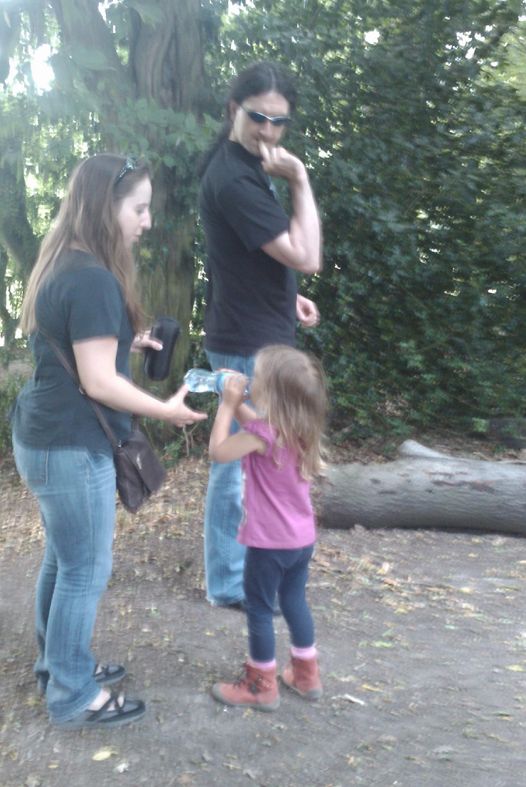
High Beech, 2011 – pre-cardiac arrest. Thing 1 nicking her aunty’s water

Things 1 and 2 adore their uncle (and aunty, of course), and Thing 1 treated him as a giant climbing frame. Thing 2 didn’t like a lot of people but he was one of them. I don’t think that that she talked to him much, but she did at least acknowledge his existence which was rare. At five and rising three they didn’t understand what was happening, and Thing 3 was only seven months old at the time. I was due to go back to work a few days later, at the end of my maternity leave. I am not sure how much use I was back at work, but there we are.

Both London sister and my brother-in-law are, fortunately, stubborn types. He pulled through, and after several months in hospitals he came home. He had to learn to walk, talk and eat again, and both their lives have changed irrevocably. The long – and ongoing – journey they have been on since then is not my story to tell. Thing 3 never knew Uncle Mk1 as he was too young, but he adores Uncle Mk2 and treated him as a climbing frame in much the same way as his big sister did. He was a sturdy child, to say the least, and had to be reminded to be gentle at times.
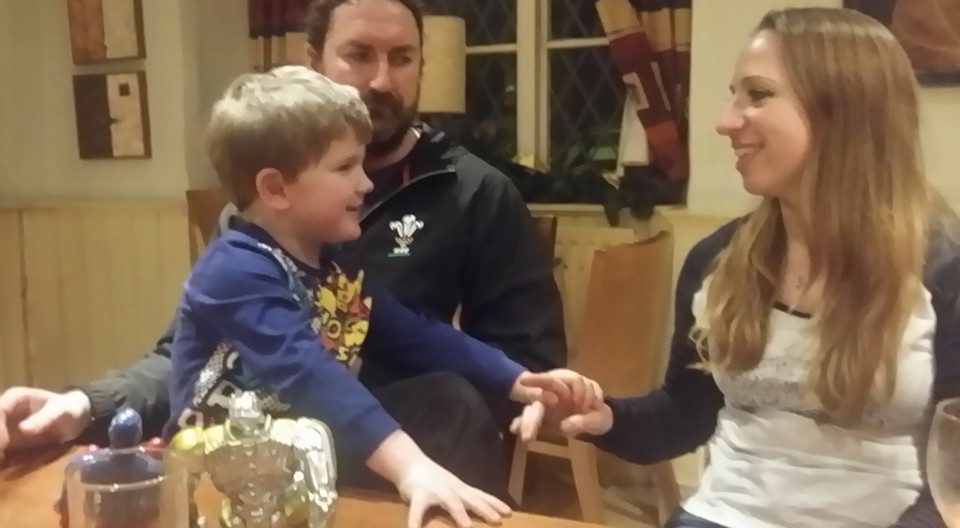
Thing 3 and his beloved uncle and aunty

The swift work of my sister and the NHS meant that we still have my giant, grumpy, funny, beloved brother-in-law in our lives, and my sister still has her soulmate. They have raised thousands for C-R-Y (Cardiac Research in the Young) and Headway since then, and I am proud to have been a small part of that when we did a half marathon together. Well, together at least part of the way – she finished before I did!

Twelve people each week under the age of 35 die due to sudden cardiac arrest. If more of us knew how to do CPR – I have the vaguest idea, having last done first aid training when I was a student teacher in the mid-90s – then that number could probably be reduced. There are defibrillators all over the country now, but I am not sure I would know how to use one.

When I went back to work I asked our HR team about first aid training: no, I was told, it’s only for front of house staff. While I wasn’t working on the floors, I was delivering sessions in basement classrooms without a radio or a telephone, or on gallery, so I was working with the public. Still not good enough, I was told. This seemed shortsighted, but they wouldn’t budge.

If they can find the space in the school curriculum to teach financial literacy and ‘British values’ they can find a space to teach CPR: a half day out of the school year isn’t that much and it could – quite literally – save a life.

Normal service returns next week, honest.

Kirsty x

What I’ve been reading:

Mort / Interesting Times/Reaper Man – Terry Pratchett
74: peekaboo, I see you

Afghanistan has been all over the news for the last couple of weeks, as the Taliban take over the country once more and the US and UK evacuate troops and civilians in an unplanned, chaotic dash – but not, in many cases, other people who have links to them and who will now be left vulnerable in their home country. Activists, for example, promoting women’s rights or democracy: according to some reports, the Taliban are going house to house seeking out people with links to foreigners and the government. Twelve people have died simply trying to reach the airport in Kabul to get out of the country this week, from stampedes or gunshots.

You may be reading this and wondering what this has to do with my usual ramblings, and may be inclined to point out that this is hundreds – possibly thousands, given my tenuous grasp of world geography – of miles away.

You may be reading this and wondering why I am venturing into the world of international politics, given that I am usually going on about crochet and dressmaking and lovely ‘hello clouds, hello sky’ walks, with only the occasional rant about free school meals and things.

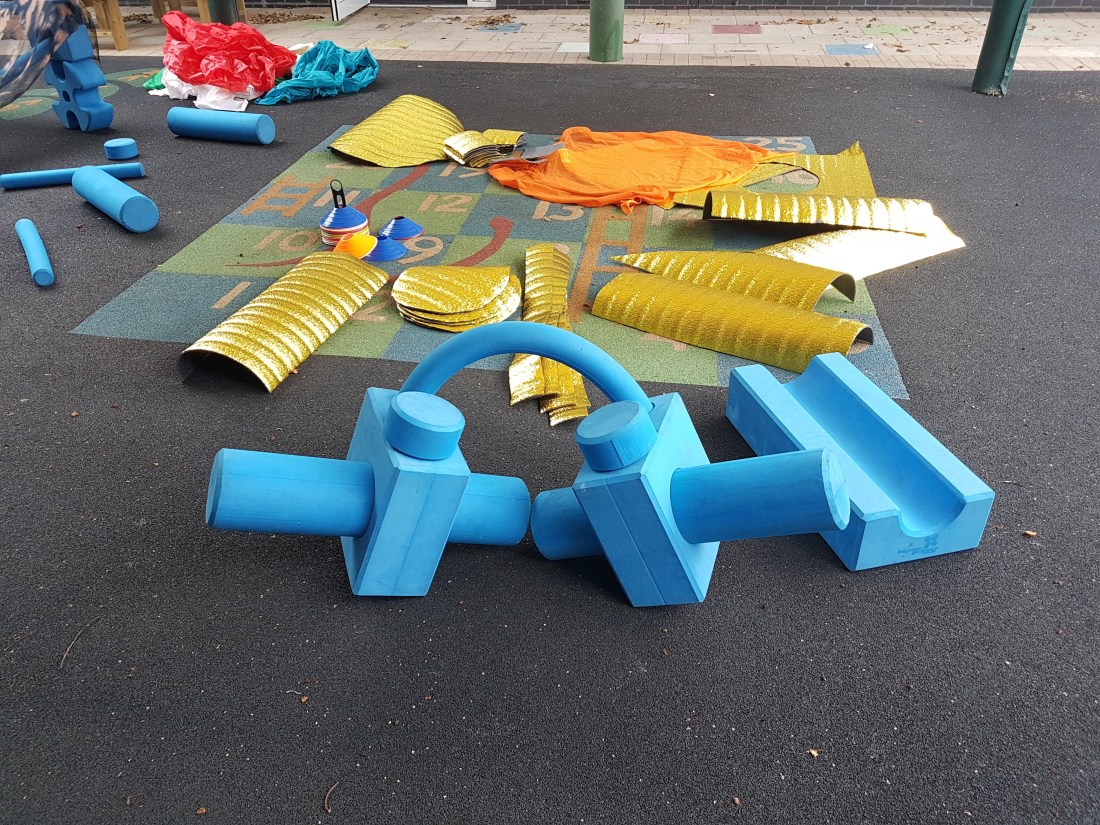
Well, this week I had one of those moments when world politics ended up within a few feet of me, in the shape of a small girl and her dad, and a pile of those blue blocks my colleagues and I have been carting round east London since the beginning of July.

This week we were at a children’s centre in Whitechapel, at a family play day, meeting children and parents from the local area to do some building and playing. The majority of the children we encountered were pre-schoolers: very small when the pandemic started, who had missed out on many of the baby groups to which they would usually have had access. Language and social delays are common.

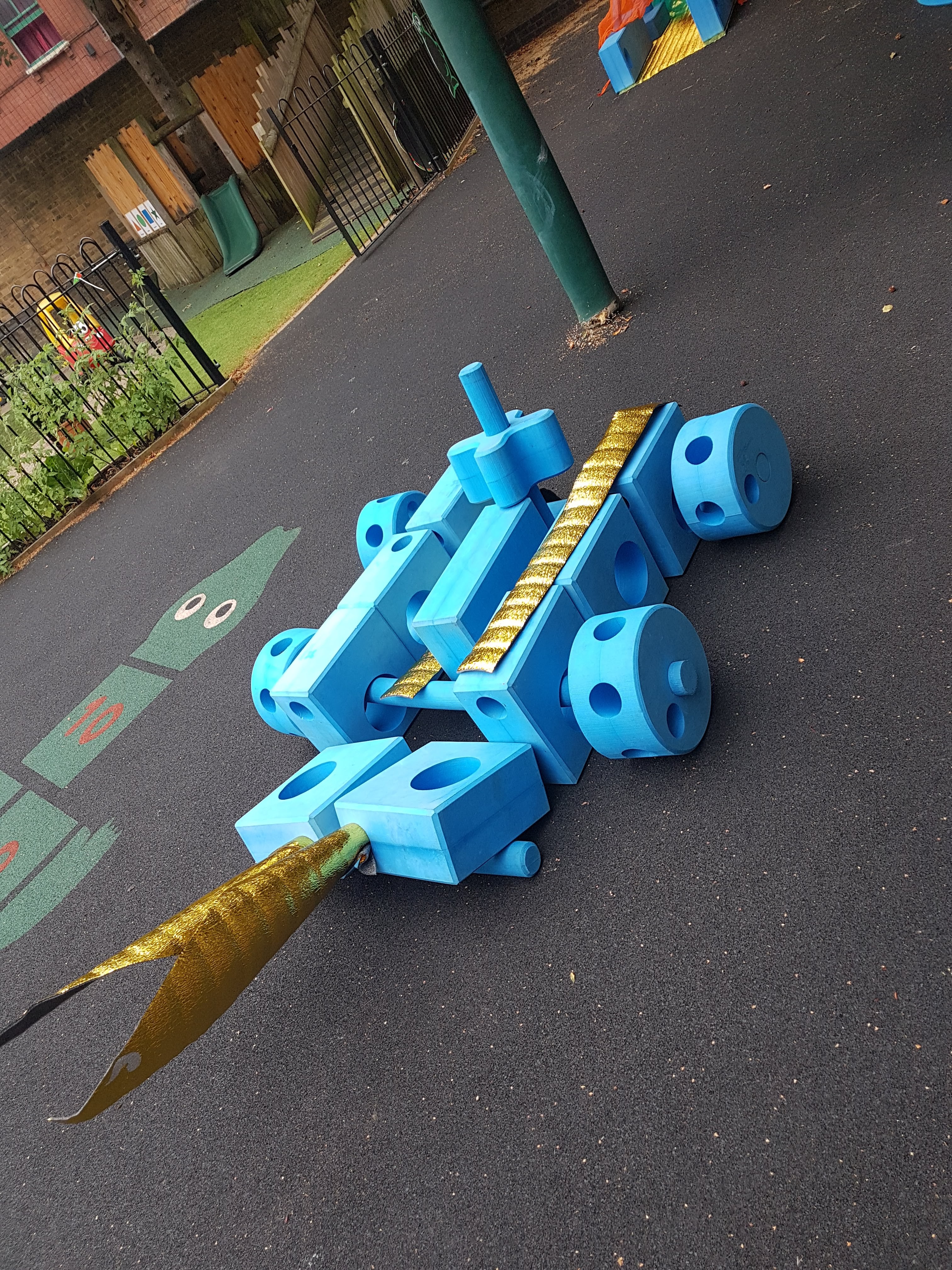
We set up the session with figurative structures, which they could either interact with as they were or rebuild to make something else. We had a rocket car, a tunnel, a den, and I had great fun building a castle. We built very tall things and knocked them down, we engaged in Godzilla games, we made a finish line and cheered when people came through it. We wondered where you could go in a rocket car and we pantomimed and clowned around.

After a while a dad and his daughter arrived. She was clutching a doll which she wouldn’t let go of and her dad was trying to get her to build something with him, which is quite hard to do one-handed. So I began to build a castle, big enough to get inside. One girl from another family decided it needed a door, so she added one and after going in and out a few times she wandered off.

The finished castle

The dad came and started helping me to build the castle taller, checking it was OK: of course it was, and we built it taller and taller and then added a fabric roof. His little girl crept into the castle and stood there with her doll, so I began to play ‘peepo’ with her through the gaps between the blocks and the holes in them. It took a while to get her to respond, although she watched me very seriously to see where I would pop up next. Eventually she smiled when I appeared in a different hole and even, at one point, giggled.

My castle needed something to make it less blue, so I started using the gold foil cutouts to link some of the holes and to make tubes. Marble runs had been very popular, so I found the small plastic balls and began to roll them through the tubes. At first, my new friend just pushed them out through the gaps between the blocks, but after a few minutes of watching me roll them through different tubes each time she started to join in, and to try and push the balls back to me before they could drop. I added a second ball and she put the doll down so she would have both hands free to play.

Her dad began to talk to me: he had very little English, and he told me that her name was Raya, and her English was better but she didn’t talk much. She knew the animals and colours, he said, and she talked at home. She didn’t know many people. This was the first time she had been able to play outside safely, he said. She’s three. I assumed this was because of Covid – isn’t everything, after all?

After a while Raya came out of her castle, leaving the doll behind, and came over to her dad for a cuddle. He picked her up, so I made another foil tube and used it as a telescope – dad joined in the game and moved her closer and further away from the end, and she giggled some more. It’s hard to resist a giggling child, so we carried on playing.

A pair of the bigger boys – Eastern European, again with very little English – asked me using gestures whether it was OK to knock the castle down. Of course, I said, and we cheered as they demolished it thoroughly.

‘That is what they are doing in my country, too,’ observed the dad. ‘In Afghanistan. They knock things down.’

As we were packing away the kit, one of the children’s centre managers came over for a chat and was telling us that they had been phoning a local hotel where a group of newly arrived refugees from Afghanistan were staying, to try and get them to come along, but she didn’t think any had. The penny dropped and we talked about Raya and her dad, and how it had taken a while to engage the little girl but we’d got there in the end.

A new country. A new language. Three years without being able to play safely outside. Three years.

Raya and her dad, and our play session, have stayed with me all week. This country isn’t perfect, heaven knows, but I can take my kids to the park and they can play outside. They haven’t been displaced from their home, although if you listened to them for the first couple of years I’d ruined their lives by making them change schools.

What else has remained with me is that play truly is the universal language: you don’t need words to play peekaboo, or peepo, or whatever its name is where you live. And that sometimes the world lands on your doorstep in the shape of a small girl and her dad.

Normal service will resume next week, I’m sure.

Kirsty x

What I’ve been reading:

Moving Pictures /Small Gods – Terry Pratchett
The Sandman – Neil Gaiman (Audible)

Addlands – Tom Bullough (from the Shelf of Shame)

72: it’s not goodbye, it’s au revoir

This week I have not done a lot, really – work, read, enough stitching and crocheting to make my arm and shoulder ache, watched a lot of films (with Jason Statham in, for some reason – not my choice) and fed a lot of children.

I did go out on Wednesday: to give blood (donation 24! The things I do for a mint Club) and then into Bethnal Green where we said goodbye to the old Museum of Childhood before the base builders etc move in for the next couple of years. It was a quiet goodbye, with a lot of faces missing from the team I joined four years ago: a few through natural career progression but more thanks to the many restructures that we have been through in that time. I also ate at Chiringuito in Bethnal Green for the first time (fish tacos) and learned more about flying ants than I ever thought I needed to know. This is what comes of working in museums, where we acquire random bits of information through being incurably curious about pretty much everything. Top tip for you people out there – curators and other museum people are good to have on pub quiz teams*.

Photo by Helena Rice

For the next two years we are wandering souls, washing up in small groups in corners of the V&A at South Kensington, clutching our laptops and wondering where we left our pen last week. 40% of our time is ‘on-site’ at the moment, though for the learning team that time is currently out and about with our blue blocks, which is great fun even in the rain. (I am writing this on Saturday morning, by the way, as tomorrow I will be out with the team all day at The Get Together in the Queen Elizabeth Olympic Park).

This seems to be a fairly normal work pattern right now, as far as I can tell. Hybrid working, blended working, whatever you want to call it, seems to be here to stay, certainly in the non-people-facing jobs. It’s good not to have to commute all the time, and platforms like Teams and Zoom are making it easier to stay in touch with colleagues, but I do miss the spontaneous Friday lunches and the kitchen chats, or feeding the ducks on a lunchtime walk. It’s too easy when working at home to not have those social moments. In ‘normal’ times you spend 36 hours a week with your colleagues, and if you have good ones (I do) they become your work family. I miss the kettle moments (water cooler moments, presumably, in those nations less reliant on tea for functioning), team problem solving in the office (gang, have you got a minute?), people popping in and out to raid the biscuit tin. Our office was the home of the biscuit tin, which meant we knew what was going on on the floor as people came in for Oreos and hugs. Mostly I just miss people!

*However, a whole quiz night made up only of museum people is a terrifying experience. If you are the quizmaster/mistress, be very very sure that your answers are correct, or the likelihood of a dawn duel with historically accurate weaponry is high. You have been warned.

Why my arm aches…

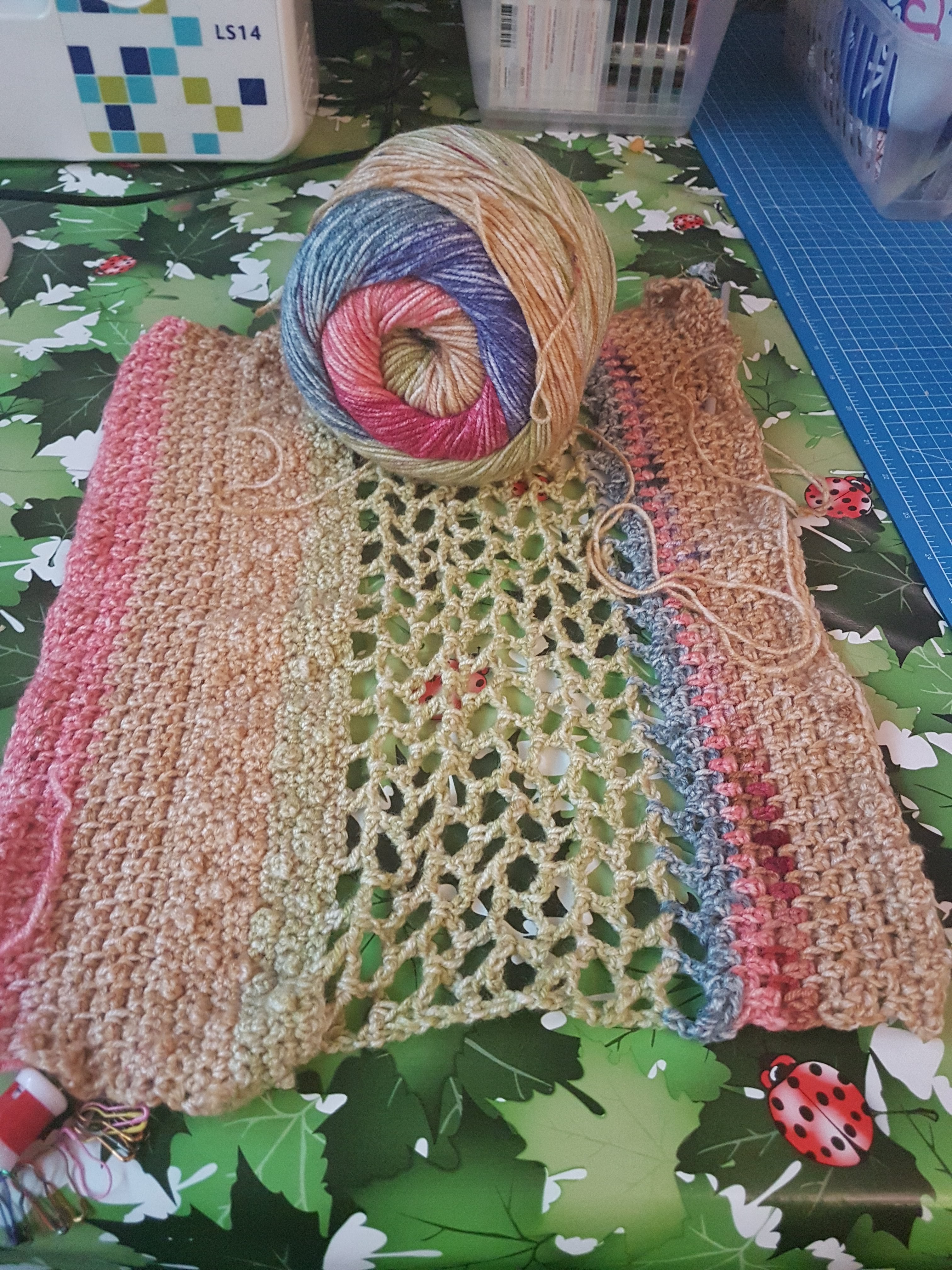
This week I started the shawl pictured here – the Build Your Own Beehive Shawl CAL by Fleabubs and Lala. I did not need another project, but this was such a pretty pattern and I already had the yarn sooooo…. the yarn is Stylecraft Batik Swirl in the Rainbow colourway. The shawl is made up of ten-row repeats of three different stitches – trellis, pollen and honeycomb. It feels a bit more scarfy than shawly to me at the moment, despite increasing the starting chain from 60 to 80, but my friend Ruth who pattern tested it says it pays for blocking. I hope so – when it comes to scarves and shawls I definitely lean towards the dramatic swish and swirl rather than the single wrap! Perhaps this is what comes of working in historic buildings, where ‘work blankets’ are definitely a thing in the winter.

I’ve also made progress on the Hobbit Hole – only the lettering to go now, which is exciting, and then I need to frame it and find it a home.

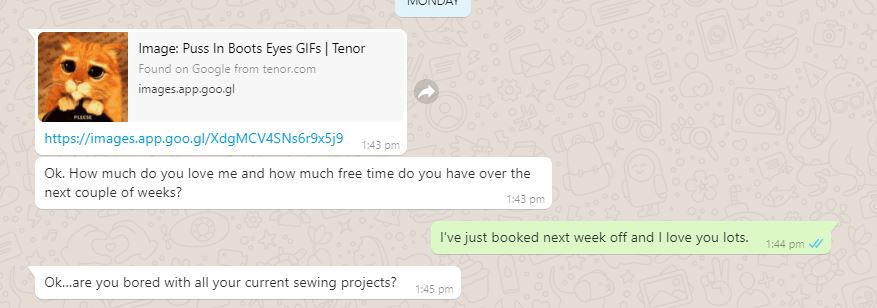
I am off work next week. About half an hour after booking the time off, Irish sister messaged me…

How could I resist? So this week I’ll be making a skirt for a 1921 schoolmistress, using a historic pattern that is very light on instructions. That’s the problem I have found with vintage patterns: the publishers assumed that all women had been taught the basics of sewing and garment construction and knitting and crochet, either by their mother or in school. That’s not the case these days, sadly, so this week will be a learning curve all round!

I am off now, as we are going to see Timeshare 1 and the grandson shortly. See you next week!

Kirsty x

What I’ve been reading:

The Lost Tribes of Pop – Tom Cox

Stardust – Neil Gaiman (Audible)

From the shelf of shame….

Jigs and Reels – Joanne Harris

Holy Fools – Joanne Harris

Meadowland – John Lewis-Stempel

71: rain did not stop play

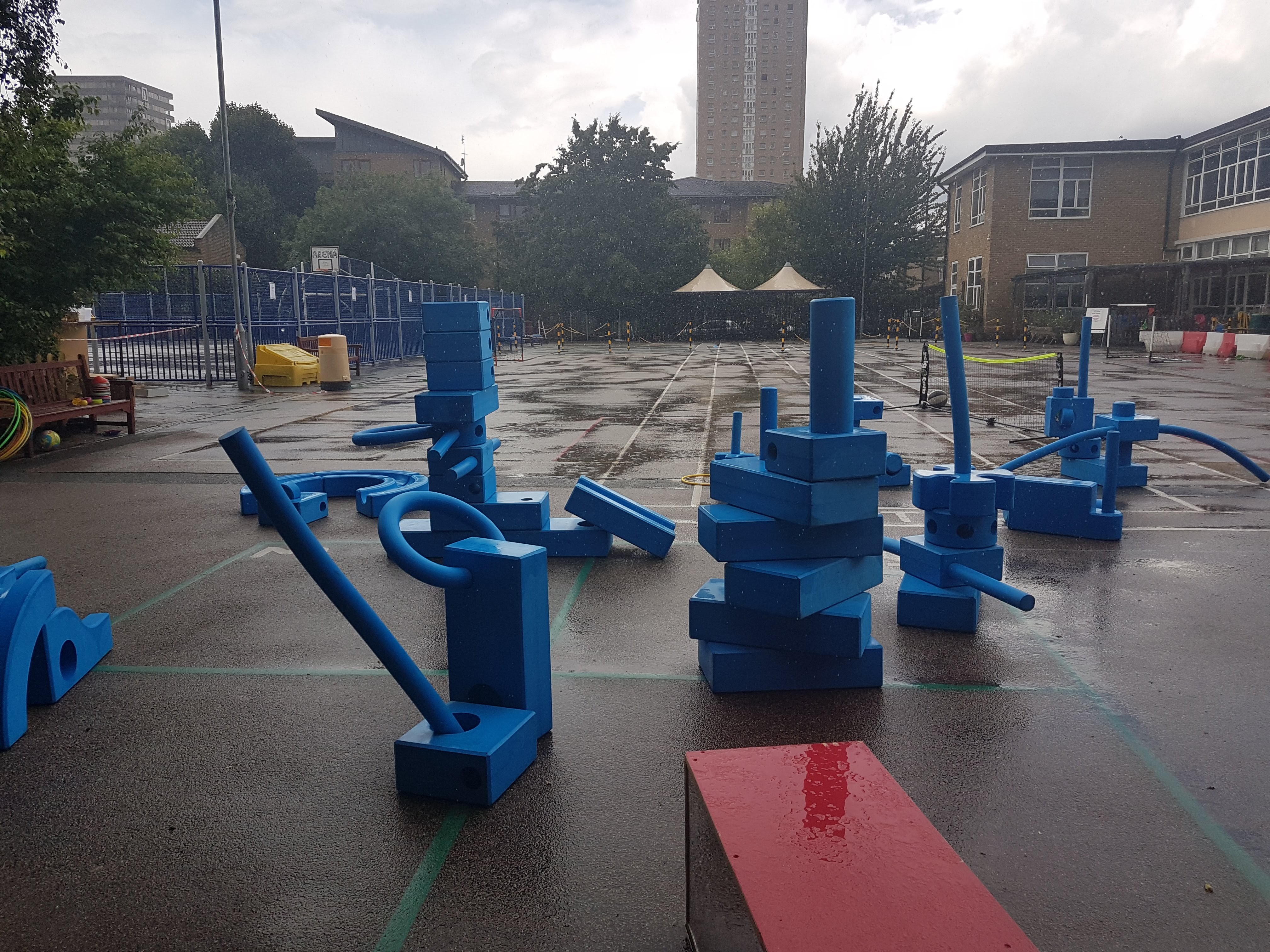
This week has felt almost normal: two days of delivery and a day in the office, drinks with colleagues on Wednesday and a noisy evening in a pub on Friday night. Never mind that one of those days of delivery was outdoors, with sessions bracketed (but not cancelled) by torrential downpours – we were doing our job, the reason we went into learning in the first place. I did have to wring out the bottom half of my dress while I was wearing it, as we cleaned 100 or so pieces of play equipment under a shelter made pointless by the rising waters and the horizontal rain, but there we are. We had a great day! It was noisy, joyful and inspiring.

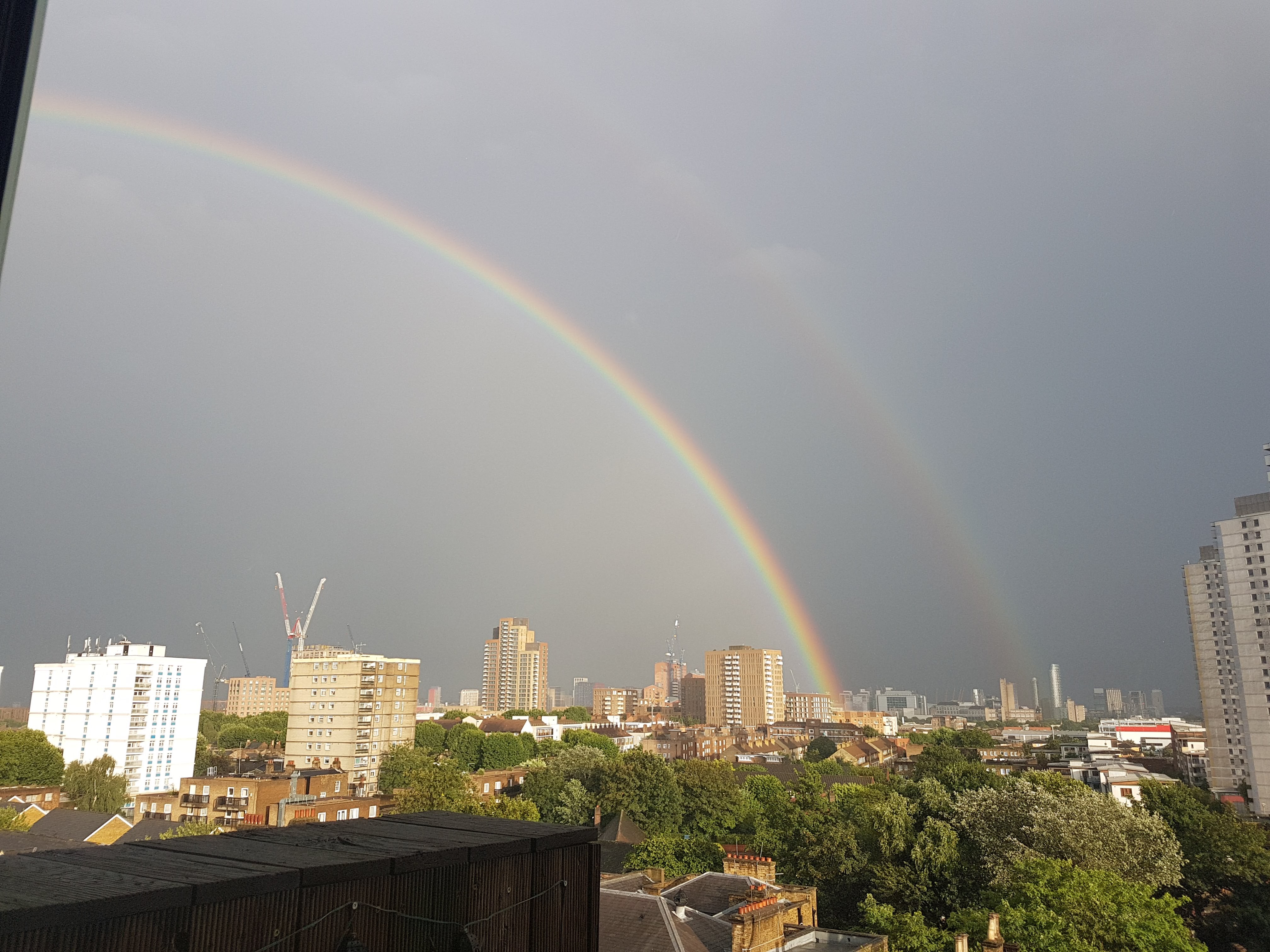
British summertime…

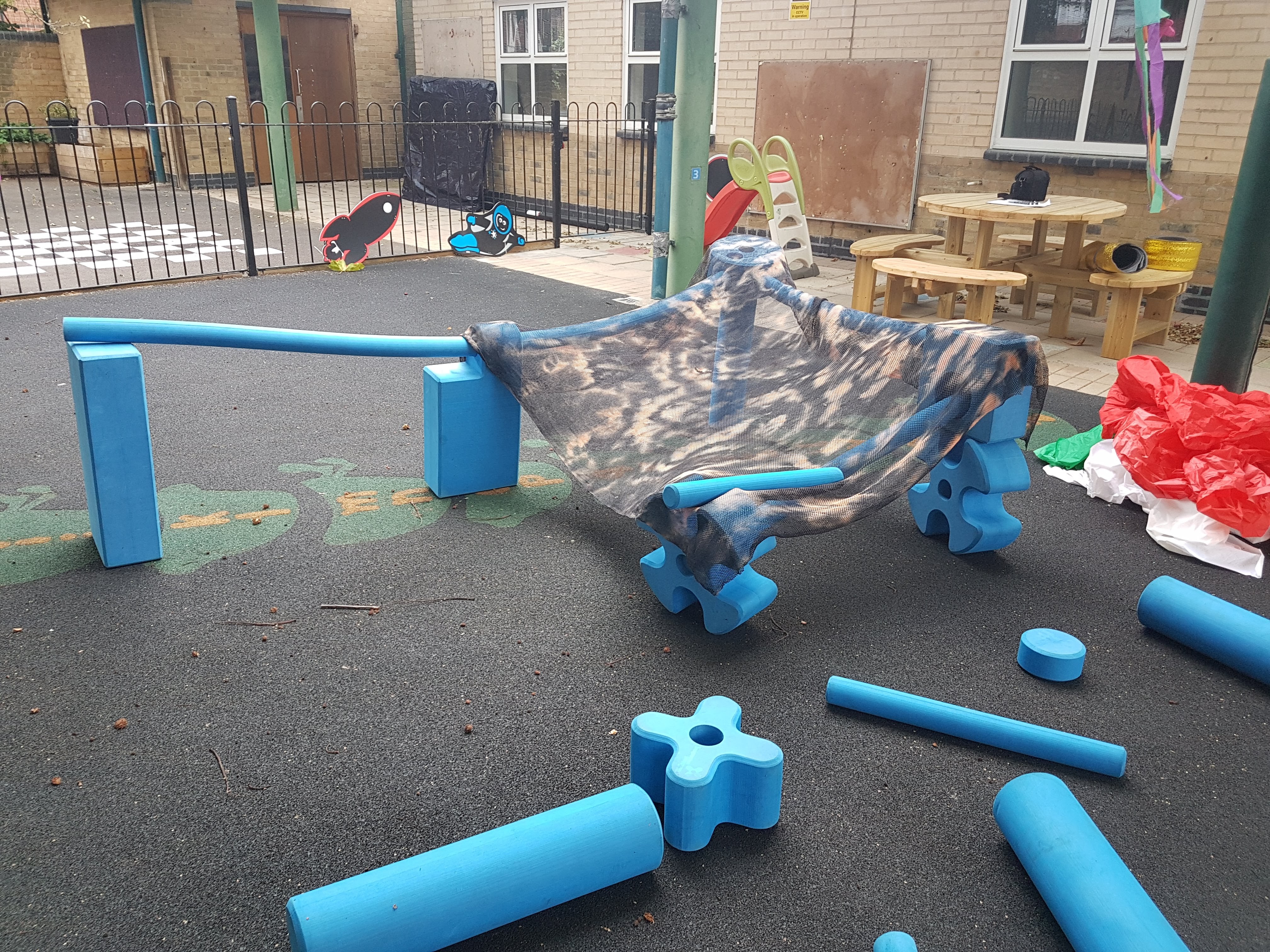
I have mentioned the Imagination Playground Big Blue Blocks we are using before: it’s quite well-known and is used all over the world. We also have a kit designed by CO-DB which can be used to create pop-up spaces for craft workshops and more, and we had some of those pieces with us as well. As soon as we started to put out wooden structures we were surrounded by children who had some very firm ideas about how they thought it should be set out: they wanted to build a house, and when there weren’t enough pieces they collected other objects from around the playground to make their creation. They carried across tables and chairs, a giant Connect-4 game, and PE equipment. The house was initiated by a couple of small boys and others soon joined in, bringing their own ideas to the game.

My role that day was supporting our Informal Learning producer. Later in the day we were joined by an artist, Matt Shaw, who has been commissioned to create a ‘plus’ set to add to the Blue Blocks – he brought some rolls of corrugated card with him, some cut up plastic pipes and connectors and large pieces of fabric, to see how they added to the play. The Theory of Loose Parts is behind this. We introduced those about halfway through each session, when the children were evaluating their creations to see how they could add or improve them – something they did independently, rather than directed by us.

It was an interesting day: we had children ranging from Early Years to young teens, and we were presenting them all with exactly the same base equipment. We wondered whether the older ones would engage with the blue blocks or if they’d think they were too babyish for them, but we were surprised by how much they enjoyed it. All the sessions started with free play so they could see how the blocks worked together and could be connected, and then we threw in a challenge to finish off. Often this was to make the tallest structure they could, which they then enjoyed knocking down. Matt’s fabric was used to create dens and sails, and some ripstop fabric lengths became roofs for a shelter built by a team of girls called ‘the prime house’ because it was all primary colours. We asked one group to design and build a way to cross a river, so we saw some great bridges: we’d tested this with schools in early July.

The free play was interesting, as every age group made some kind of fitness equipment, often from a starting point of a dumbbell made from a noodle shape and two round pieces. The oldest group made theirs very elaborate, with a bench press and a leg machine, while the younger ones were more basic. Most groups made a marble run: if two sets of children started making one and discovered there weren’t enough pieces, we encouraged them to team up and create one large one. It was brilliant to watch them testing angles to make sure the ball would move smoothly, tweaking things to ensure it didn’t fly off, and solving problems together. The activity brought children together: this was a council play scheme which had only been open a couple of days, with children from all over the borough. Many had never met before that week, and the blue block activity got them talking to each other for the first time, according to the adults.

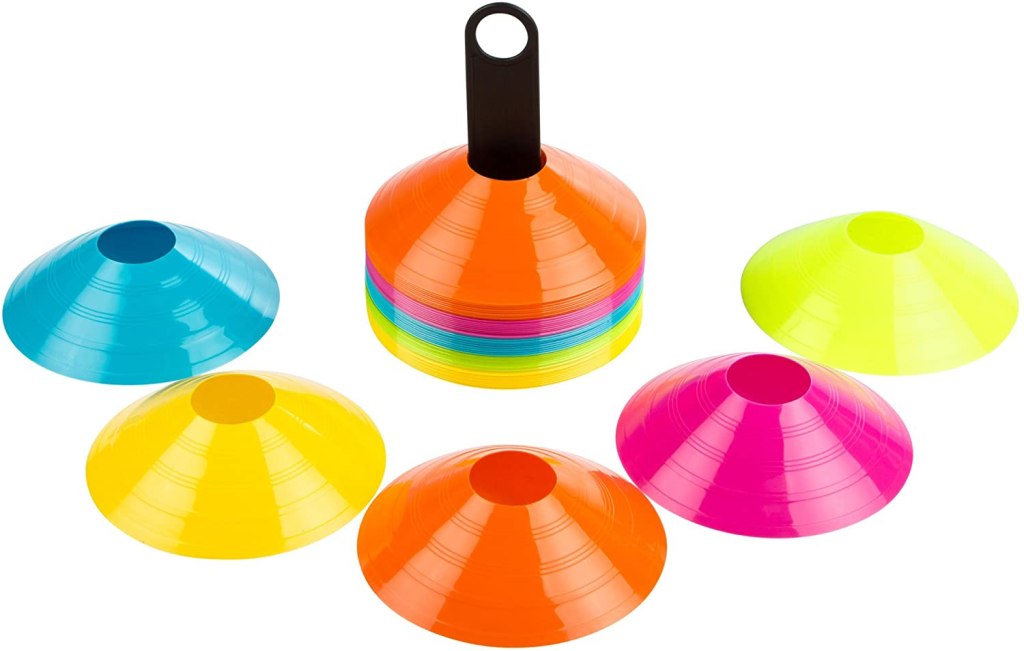
Of all the loose parts the children chose to add to their creations, the most popular were a set of marker cones which had been left in the playground – so much so that we will be adding them to our own kit for other events. They became decoration for houses, stoppers on the marble run, wheels, eyes and more. So simple that we wouldn’t have thought of them ourselves, but every group added them in to their creations. They also enlivened the Blue Blocks, which are otherwise just – well – blue.

The idea behind our participation in this playscheme, the school sessions I have mentioned in previous episodes, play streets and festivals is to support creativity and the skills that creativity builds: confidence, communication, collaboration and more (yes, they all begin with C) and I think we saw that in spades this week.

My other delivery day was at Spotlight, an amazing youth space in Tower Hamlets where I was supporting our Creative Producer. This was part of a local transition Summer School for Year 6s going into Year 7, and were working with School of Noise who run workshops encouraging the exploration of music and the science of sound. I learned loads – about how sound travels, chladni plates, about making sound effects and more. The students were really engaged too, and were amazed at how the sounds they could make with their bodies could create music. We tried some Foley in the afternoon, making the sound of fire with bubble wrap, tin foil and a plastic shopping bag, and we saw this video which left us in awe of Foley artists. I have had some strange requests from my Foley artist neighbour over the years but this video really put them into context.

Just having these days with the team in real life, and Friday in the office at South Kensington, reminded me why I love my job and the people I work with. We went out on Friday night to the Zetland Arms in South Ken to say a goodbye to our wonderful director. I saw people I had previously only met on Teams calls, and others I hadn’t seen since before lockdown – it made the ludicrously expensive G&Ts worthwhile. (Lovely director has just messaged me to say thank you for the letter and crocheted angel I handed her on Friday night – when she arrived two years ago we had just been through a horrible restructure and we found guardian angels on our desks waiting for us, so it seemed right to send her off with one too!)

And now it’s August. How did that happen?

Biscuit, anyone?

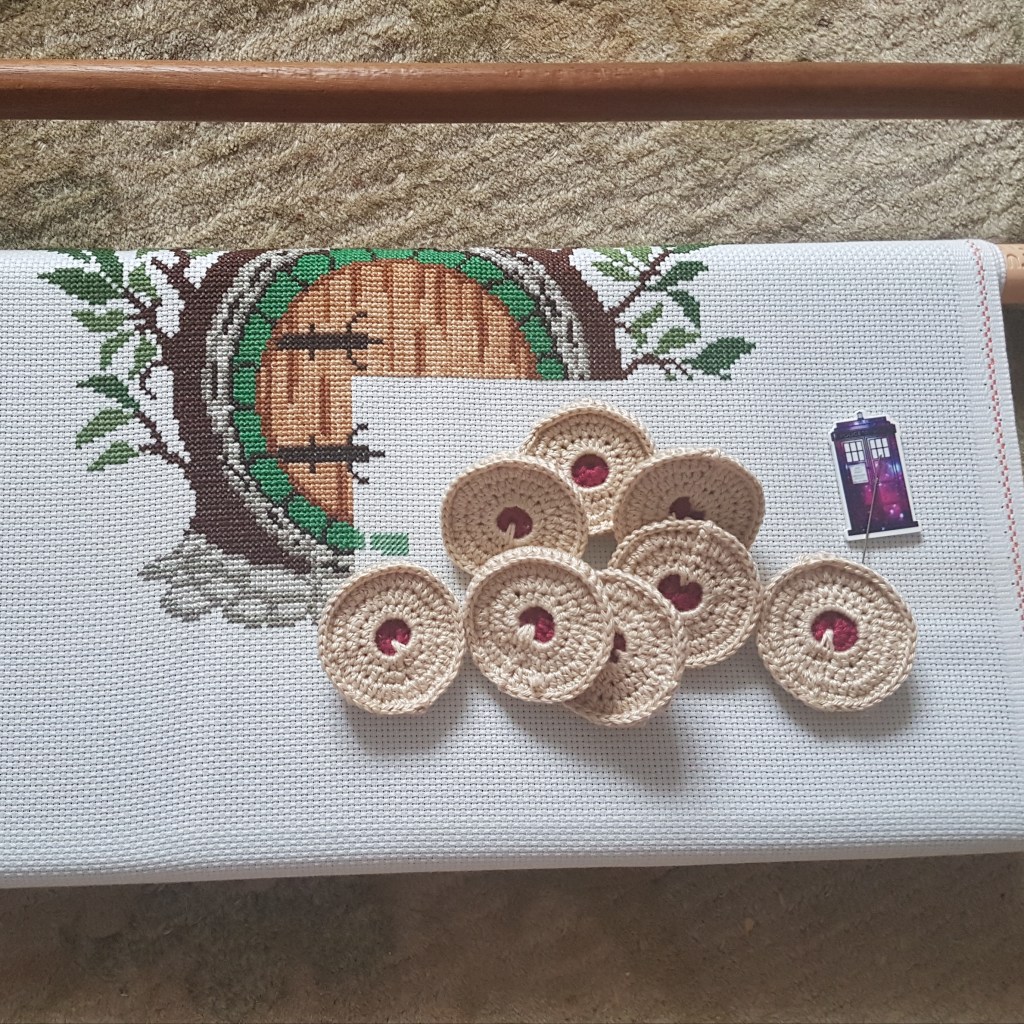
All this travelling on tubes has meant that I could spend some serious time crocheting daft things – more jammy dodgers, in fact. Here’s eight I made on the tube – there would have been nine, except a small girl was entranced by what I was doing so I gave her a finished one. I think it made her day. These are very satisfying to make, as other than weaving in the ends there is no construction: you join as you go. They will either end up as brooches or tree decorations – these are made with the 2mm hook, rather than the larger one, so the stitches are tighter.

The background is, of course, the Hobbit Hole – I am now onto the bottom half and will be starting a new page this evening. And now I am off to do some other sewing. I should be constructing jeans but I have a PDF that needs sticking together for a dress, so let’s see how far I get!

Kirsty x

What I’ve been reading

The Shadow Wing (Crow Investigations) – Sarah Painter

Good Omens – Terry Pratchett and Neil Gaiman (Audible)
From the shelf of shame:

Bring me the head of Sergio Garcia – Tom Cox

Jigs and Reels – Joanne Harris

70: I promise you, you’ll love it

Sometimes you get handed a book, or a recommendation for a book, that a friend or family member has loved and you read it….and it’s okay. It’s not life changing, and you probably wouldn’t say it’s great, but it’s readable. There have been many books like that- and that’s fine, because there’s a lot of different authors and tastes in the world and as Terry Pratchett says many times it would be a funny old world if we were all alike.

Sometimes the book is so terrible you question why you’re so fond of that person.

Sometimes you recommend a book that you have absolutely loved to people you like and they think it’s….okay. Not life changing, not great but…okay. I find it’s best not to take these things personally as clearly those people are wrong, or just need to read it again properly, or aren’t in their right minds.

Sometimes a book has rave reviews, and/or a massive marketing budget, and shoots up the bestseller lists, and films are made of them starring people who you may or may not have heard of, and that’s fine too. Sometimes these are good books and terrible films, sometimes these are terrible books and okay films. Sometimes they are terrible books and you can’t bring yourself to watch the film.

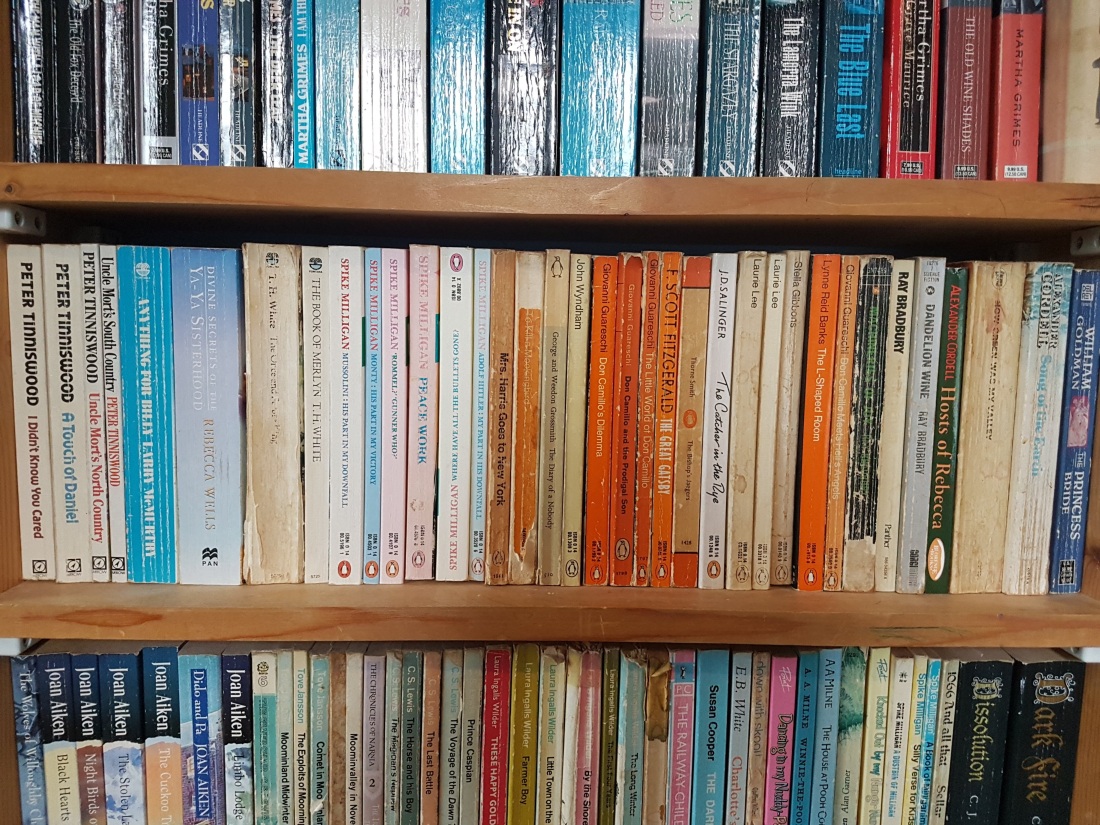
Sometimes – just sometimes – you get given a book and it’s wonderful: it keeps you awake long after your bedtime and stays with you so you can’t wait to pick it back up in the morning. This can be for many reasons: the adventure, the need to know what happens next, the lyricalness of the writing, My recent read ‘Once upon a River’ by Diane Setterfield was one of these books. Others include:

  • Boy’s Life – Robert McCammon
  • Hearts in Atlantis and The Body – Stephen King
  • The Once and Future King – T.H. White
  • The Outsiders – S.E. Hinton
  • The Great Gatsby â€“ F. Scott Fitzgerald
  • Stardust – Neil Gaiman
  • The Travelling Cat Chronicles â€“ Hiro Arikawa
  • Ring the Hill – Tom Cox
  • The Time Traveller’s Wife – Audrey Nieffenegger

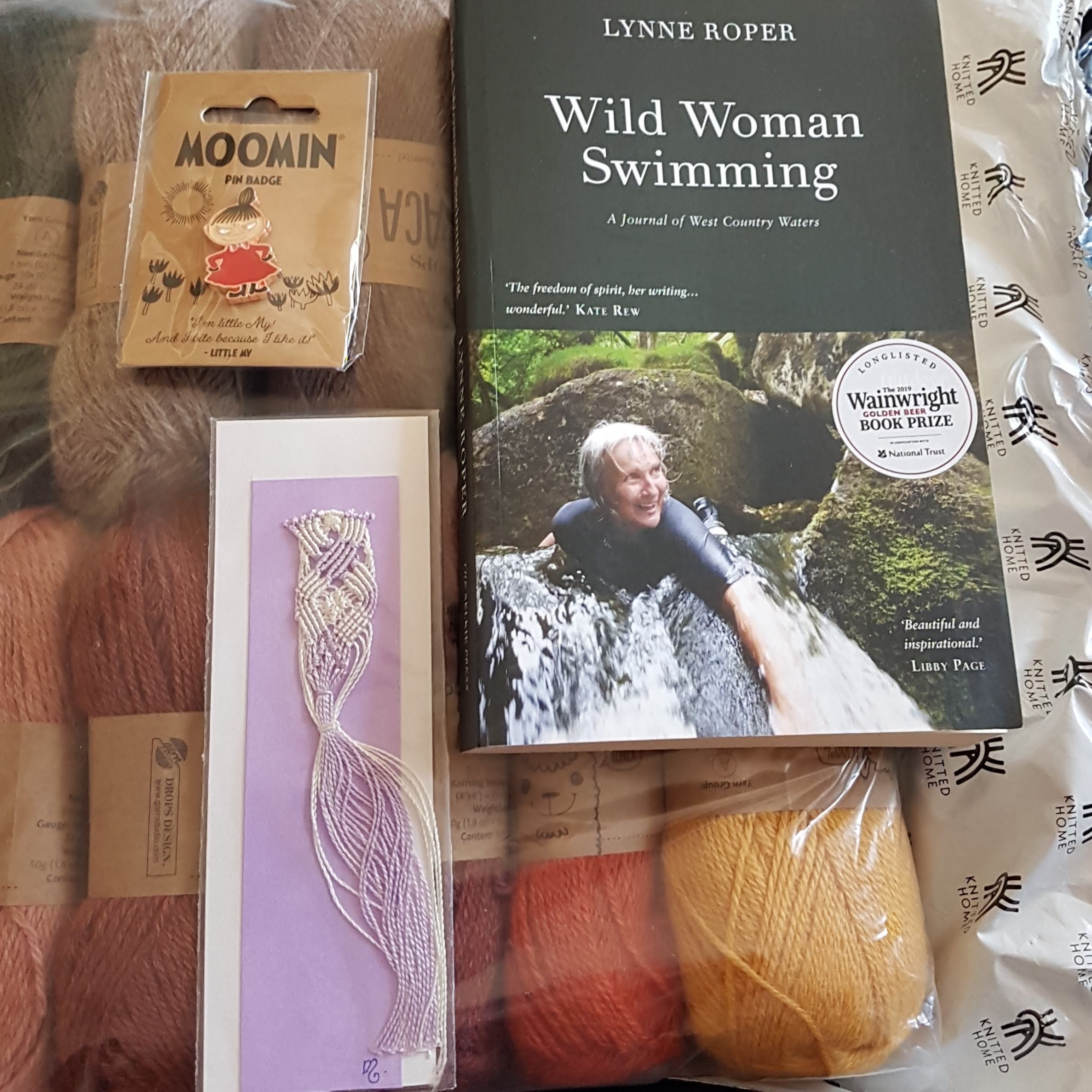
This week I have added another one to the list – a birthday gift from my colleagues but I detect the hand of my wild swimming colleague in this one. Wild Woman Swimming by Lynne Roper, which is a journal kept over five years of wild swimming in West Country waters. It’s a poignant read: Roper took up wild swimming after a double mastectomy and built a community of swimmers around her, as well as becoming a key member of the Outdoor Swimming Society. Sadly she died five years later of a brain tumour, but she filled those five years with adventure and wrote about them in exquisite, immersive prose. I’ll be recommending this one to friends, but I might not lend them my copy….

There may be many more of these magical books on my shelves of shame, or lurking on my Kindle, and I really ought to get round to reading them. I always swear I won’t buy any more books until I have finished the ones I have (I know, I laugh too) and then the BookBub daily email comes in, or I find something wonderful in a charity shop, or someone recommends a book they have loved and suddenly there’s a new addition. Perhaps I need to make a reading resolution that every other book I read is one from the shelf…. that sounds more realistic, at least!

In the meantime, if I promise not to buy them, will you tell me which are your favourite books to recommend to people?

Trial and error, error, error

You would think that if you have sewed a neckband onto something the wrong way up that it would be a straightforward job to unpick it and put it on the correct way. This was not the case with the blouse hack of the McCalls 8104 dress, which I had to unpick three times before I worked out which way was the right way, and which bits I’d sewed together wrong in the first place. I also managed to sew the bodice and lower bodice pieces together upside down when I started it on Monday, so I am amazed I got it finished at all.

The lovely turquoise cotton fabric is from Higgs and Higgs, and I bought it with my birthday Amazon vouchers – I love the statement sleeves and the slightly fitted waist on it, and the fact that there isn’t a standing collar. I’m not sure what it is with sewing patterns, but every collar I have made is just too seventies – indie or big four, it’s a bit of an issue. I shall just have to learn how to redraft them.

In the name of sorting out my shed I have gone through the hundreds of sewing patterns (mainly free magazine gifts) with a view to handing them over to a friend who has just qualified as a DT teacher – if she doesn’t want them herself she can donate them to school! My August resolution is to have a good tidy up in the shed and donate anything I really won’t use to people who will make good use of them. Things 1 and 2 have just had their ears pierced, so Thing 2 has been making earrings and jewellery with one of her friends which is making a dent in the stash already!

I haven’t done a lot else, really – my sourdough starter has been in heavy use this week as Thing 3 has decided he really likes the bread, and with the discard I have made pizza (always a hit) and cinnamon rolls which were soft and delicious. I’ll definitely be making those again!

So that’s my week! I’ll be off now to do a bit of reading over lunch and then start constructing the jeans I cut out last week….

Kirsty x

What I’ve been reading:

Wild Woman Swimming – Lynne Roper

Raising Steam/The Truth – Terry Pratchett

How to Sew Sustainably – Wendy Ward

The Ultimate Sashiko Sourcebook – Susan Briscoe

Visible Mending – Arounna Khounnoraj

Cider with Rosie – Laurie Lee (Audible)

Good Omens – Terry Pratchett and Neil Gaiman (Audible)
69: yes, but can you play on it?

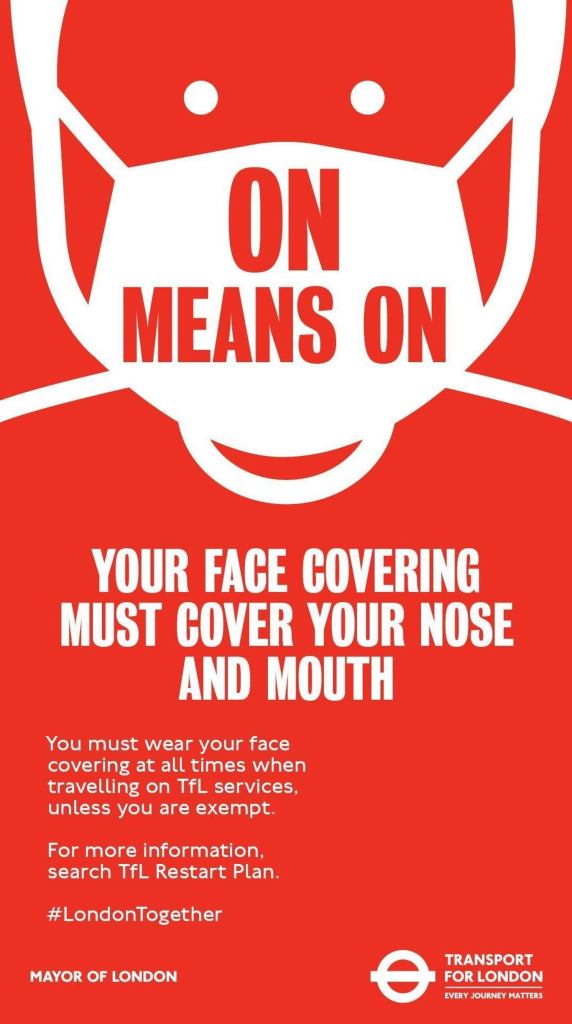
This week I have mostly been in my house, having been ‘pinged’ by a (double vaccinated) friend I saw last weekend: I did leave the house on Friday as Thing 3 had to go back to school but by that point I’d done four lateral flow tests and a PCR and all of them came back negative. I find it quite unbelievable that so-called ‘Freedom Day’ is going ahead tomorrow, when cases are shooting up again and school bubbles are bursting on a daily basis. Herd immunity by vaccination isn’t working as you can clearly still catch the virus. Herd immunity like some kind of national chicken pox party seems to me a rather irresponsible idea. Passing responsibility from the government to the people to keep themselves safe seems pretty idiotic also, especially when some of these people being given that responsibility require bloody great posters on public transport explaining how to wear a mask properly.

 Â© TfL

One of the pluses of being at home has been the opportunity to attend – if only virtually – courses, conferences and seminars that would otherwise be out of reach: those in Australia and America, for example, but also those closer to home but at a tricky time e.g ones that happen while the Things are claiming they are about to actually die of starvation, Mum, die! Like this weeks Crafts magazine event on “Space for play: how can makers bring joy back to our cities?” (Disclaimer: I was given a free ticket for this, as a bonus of attending the CPD I wrote about last week). Thank you to Thing Two, who with assistance from Thing One made delicious gnocchi for the family dinner that night.

Featuring architects, artists and playworkers, this was a really interesting discussion around public art as play space and why it’s a good idea to commission these rather than anchoring a lot of off-the-shelf play equipment in a fenced-off square. Penny Smith of Assemble Play pointed out that playgrounds like these were invaluable when we needed to build a workforce of people with physical strength and co-ordination – but are less useful now, in the 21st century, when employers value creativity, collaboration and problem-solving skills over more traditional needs. Risa Puno, an American interactive installation/sculpture artist, spoke about the need to build spaces that connect people to each other. Hadrian Garrard of Create London, an organisation that commissions public art and architecture, explained why they brought in artists to build these spaces. Artists research a space, work with the local community to find out what they think a space needs, and explore materiality. Higham Hill Theatre, by vPPR, is great for this: a community amphitheatre which joins up the cafe and the play area. This was commissioned as part of Waltham Forest’s ‘Making Places’ scheme.

vPPR selected the site because it was a forgotten parcel of the park, used for anti-social behaviour. By re-activating the site, and creating links to the park amenities, the place is transformed into a site of creativity and play.

vPPR

As Risa Puno says, you never know how people will interact with a space or an installation, so you need to make something that people can explore on their own terms. The Diana Memorial Fountain, never envisaged as a play space, is a prime example of this: once it became clear that people were going to use it as a paddling play area, it had to be made safe to do so. Why not build in play from the start?

In the panel discussion at the end, the speakers were asked where they most enjoyed playing as children: outdoors was usually the answer. Several of the speakers had grown up in rural areas, and talked about fields and woods, which reminded me of my own play spaces.

When we moved to Raglan, I was just seven and only a few houses in our road had been finished: there was a building site opposite the house with no fencing (imagine!) and a meadow next door but one, and for a child whose outdoor boundaries had previously been a couple of lamp posts, this was magical. Piles of brick dust and sand (brick dust does not come out of socks), bulldozers, foundations and scaffolding: this was an adventure playground when the builders had left for the weekend. In the meadow, there was a cave of trees and a stream with very shallow banks and we played for hours in this space. There were tiny fish in the stream and water snails to be caught, archaeological discoveries to be made, wildlife like slow worms and grass snakes in the long grass, and all within metres of the front door. That’s not to mention the castle at the top of the hill and the fields around it, all of which were within ten minutes of home. There was a play park at the other end of the village, which was fun, but once you’ve been on the swings and that mad Wicksteed rocking horse, what else was there to do? So we exercised our imaginations and explored the world, and made discoveries and generally entertained ourselves.

I’m glad we are bringing up the Horde in a space where there are trees to climb and woods to explore, though they don’t have the freedom that I did as a child which is sad but a sign of the times. Walks – when we can convince them to leave the house! – can take hours, and that’s fine by me.

The sun has got his hat on

Summer is putting in one of its brief appearances at the moment, so I have had a couple of happy post-work hours in the garden during isolation. As well as the gnocchi, Thing Two is turning out an excellent G&T with fresh raspberries and strawberries, which was a perfect Friday afternoon treat.

A perfect post-work moment

I had a day off on Friday and spent it cutting out a pair of Morgan jeans, an Anna dress and a blouse hack from this month’s Love Sewing magazine free pattern. Yesterday morning I put the Anna dress together: it was supposed to be the maxi length but where I’d extended the arms on the bodice I didn’t have quite enough fabric so ended up with the midi. The fabric is from last summer – Pound a Metre, I think – and is a light polycotton. I made my first Anna dress last year and it’s become my go-to throw on this summer, so a new version was definitely in order. I managed to jam my overlocker in the process, so I think it’s going to need a trip to to the sewing machine doctor if I can’t work out what the problem is myself!

The Morgan jeans are also a remake of one from last summer, as they have become a wardrobe staple – boyfriend cut and cropped, they are so comfortable. I bought some black lightweight denim from Amazon with my birthday vouchers, so will hopefully get to those tomorrow at some point.

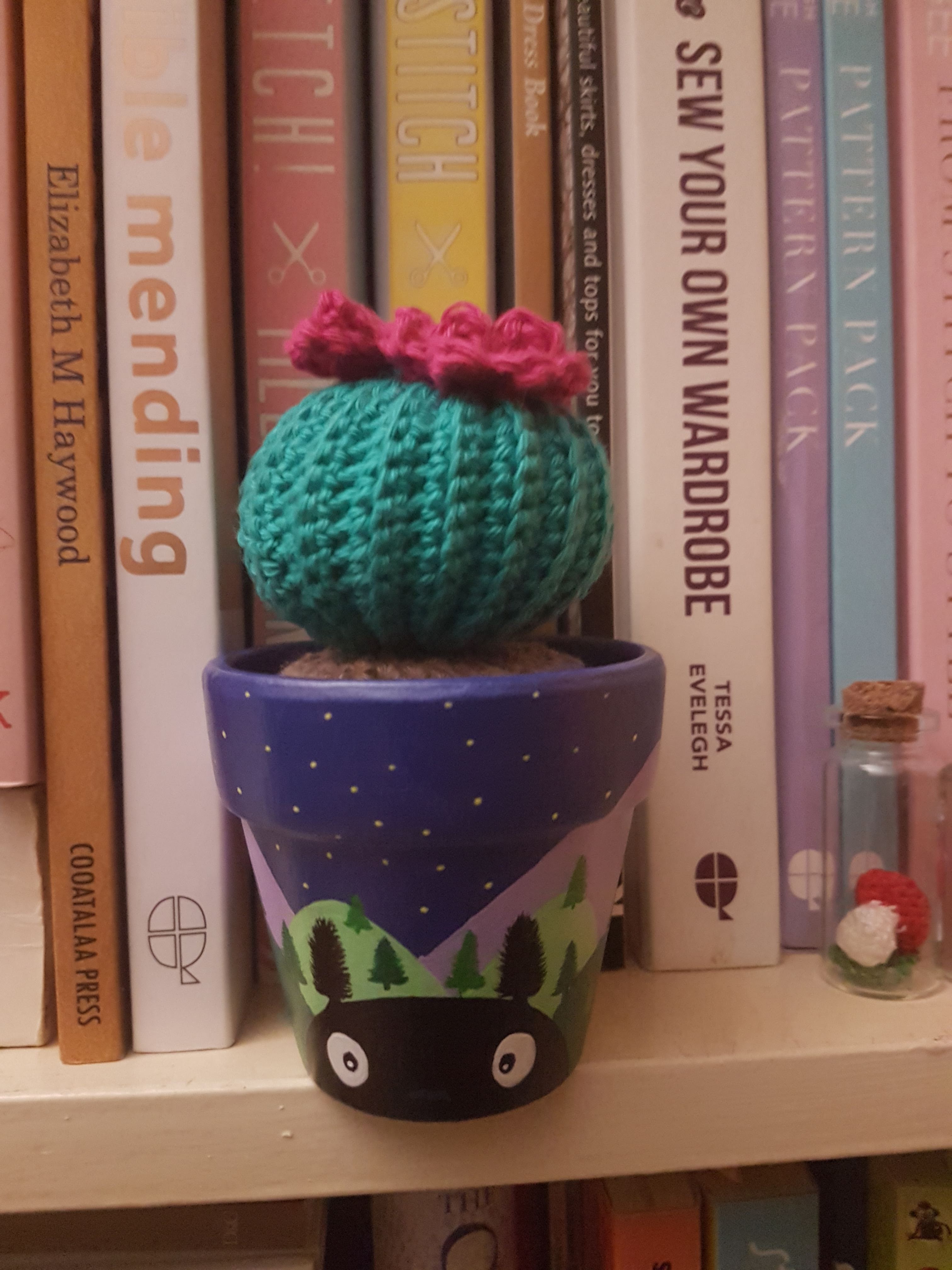
I’ve been crocheting with cotton this week – it’s too hot for anything else! One of my lovely birthday gifts from my colleagues was a gorgeous hand painted flower pot from DOMIcafe on Etsy – not having the greenest of fingers, as my hydrangeas would testify if I hadn’t killed them all, I decided I’d make a crochet cactus to go in it instead. I used Scheepjes Catona from the stash, and this pattern for a round barrel cactus by Zoe Bartley on Ravelry. It only took a couple of hours, and I love it.

I also whipped up a crochet jammie dodger, because why not? The top one is with a 3mm hook, the bottom is with 2.5mm and I think I prefer that one.

So that’s been my week: I’ll be released back into the wild on Wednesday, just in time for the summer holidays!

See you next week for week 70!

Kirsty x

What I’ve been reading

Night Watch, Thud!, Snuff, Raising Steam – Terry Pratchett
Listening: The Socially Distant Sports Bar. (Not to be listened to on public transport as you will become that person sniggering in a corner, in front of children, or in earshot of the easily shocked)

68: Rage against….pretty much everything

Hot flushes, night sweats, the need to carry tweezers with you at all times, difficulty sleeping, problems with memory and concentration….just some of the symptoms of perimenopause that people tell you about. Apparently there are 34, but I’m trying not to treat this as some kind of hormonal bingo – I mean, what the hell do you shout when you’ve ticked them all off? And do you even get a prize?

One of the symptoms they don’t tell you about is the rage. The all-consuming, completely random rage. We are not talking a ladylike ‘tsk tsk’ here, this is fury incandescent enough to power whole countries.This week, for example, some of the things I have been furious at include:

  • people who stop in the middle of the pavement
  • old ladies walking up steps
  • sellotape
  • cat litter bags that don’t open properly
  • Oyster card readers
  • bra underwires
  • people who wake me up in the middle of the night
  • cinnamon jelly beans.

And that’s the little things. That doesn’t even cover the big stuff, like 40,000 screaming people at Wembley not wearing masks (had they all been double vaccinated? Were they all tested before entering the ground? Did they have to show their vaccine passports?) Or pretty much everything the bloviating buffoons in charge of the country say, particularly on the subjects of education or post-Covid recovery. Aggressive England fans shouting that football is coming home as if some silverware is going to solve England’s problems. (I will be supporting Gareth Southgate tonight, for those of you in any doubt: I think he’s a really nice bloke, who is down to earth, honest, well-dressed, intelligent, and if the team win people might just shut up about a penalty he missed 25 years ago, the poor sod. I couldn’t care less about England winning, but I would like Southgate to win.)

They call it ‘the change’, which sounds quite gentle, but this isn’t like WonderWoman spinning around and reappearing in sparkly pants. This is more like American Werewolf in London at full moon, complete with snarling and a really bad hair day. There are definitely moments when I’d be happy to bite people, and there are definitely moments when people need to realise that these bared teeth are not a smile and that backing away slowly is their best hope.

Back in the saddle

This week my colleagues and I have been back in a school, launching our Summer of Play programme in a Bethnal Green primary school. We saw nine classes over three days, and had enormous fun – I was only there for two days, as on day three I got as far as Whitechapel and then had to turn round and come back as Thing 3’s class had to go into self-isolation.

We had two activities running simultaneously: Fran, our creative facilitator, was working on barefoot coding and I was working on design challenges using the Imagination Playground kit above. With Key Stage One we were doing timed challenges and with Key Stage Two we were designing ways to cross a river: you can see me above in a boat built by a Year Six class. What we needed that day was probably an ark, as we were delivering sessions in between rain storms!

There were some surprises across the days: Year One worked brilliantly as a team, building together and sharing really well. Years Five and Six worked well when the teams were split boys against girls, but not so well when they were mixed. Some children worked really democratically, others not so much. Some teachers pitched in and got involved, others found it hard to let go and had to be gently persuaded to let us get on with it…but it was so good to be back doing what we do best, which is engaging with learners and talking to people.

The next lot of schools isn’t till September, but over the summer we’ll be out and about at festivals and play schemes with the kit, and I can’t wait.

Crafty!

On Friday I attended the launch event for Craft School – Yinka’s Challenge which is a nationwide challenge from the Crafts Council to get children and teachers engaged with craft thinking and making along three themes: play, storytelling and empowerment. I love these Crafts Council CPD sessions, as they are often designed as make-alongs. I had a free ticket, but people who paid £10 got sent a ‘material play pack’ including clay, so they could join in. The brilliant Rebecca Goozee, education manager, is very keen on embodied learning and plans sessions with great makers so you can learn along with them. I always find it easier to focus if my hands are busy, as regular readers will know, so these sessions are great for me. I fixed my pile of escaping bra wires and did some cross stitch as the sessions went on.

The final session, with a ceramicist, took the form of an informal conversation between the maker and Rebecca while they made pinch pots, rather than a tutorial (as the first two sessions had been) and it was wonderful – just listening to them talk about how working with the clay made them feel, and about their own experiences in the world of making, was incredibly soothing. If I was the Crafts Council I’d be thinking seriously about a podcast series in this format!

There was also a conversation between Yinka Ilori and his secondary school art teacher and mentor, who was clearly one of those teachers who stay with you for a lifetime. A lot of conversations that day – as the majority of the attendees were craft, art and design teachers – hinged on those teachers who supported us to become what we wanted to be and who gave us the space and the confidence to discover our passions and talents. And on those teachers who didn’t….

The three themes of the challenge sit well alongside my own museum’s new mission, so I hope we’ll be able to work with the Crafts Council in a more formal way moving forwards!

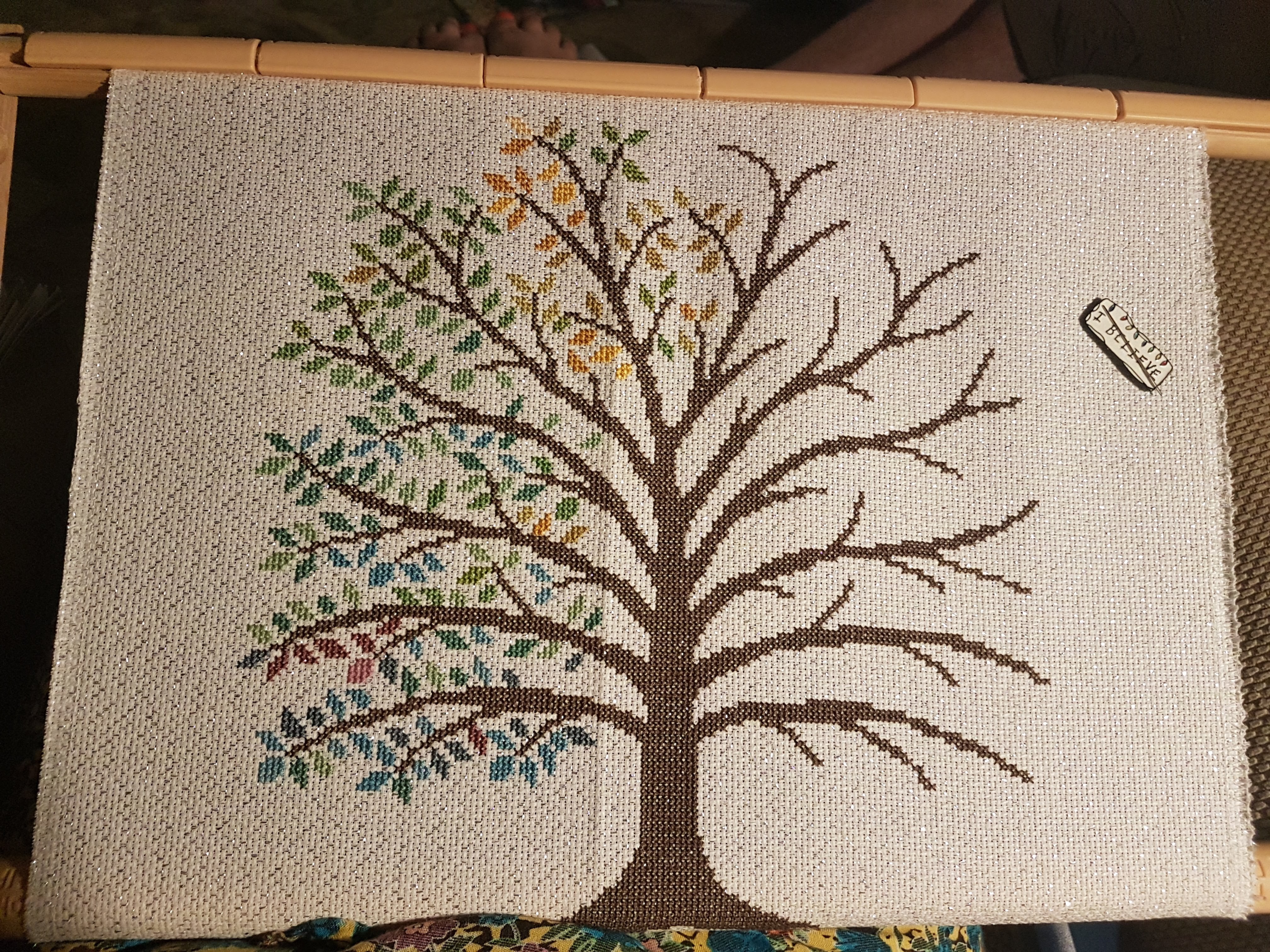
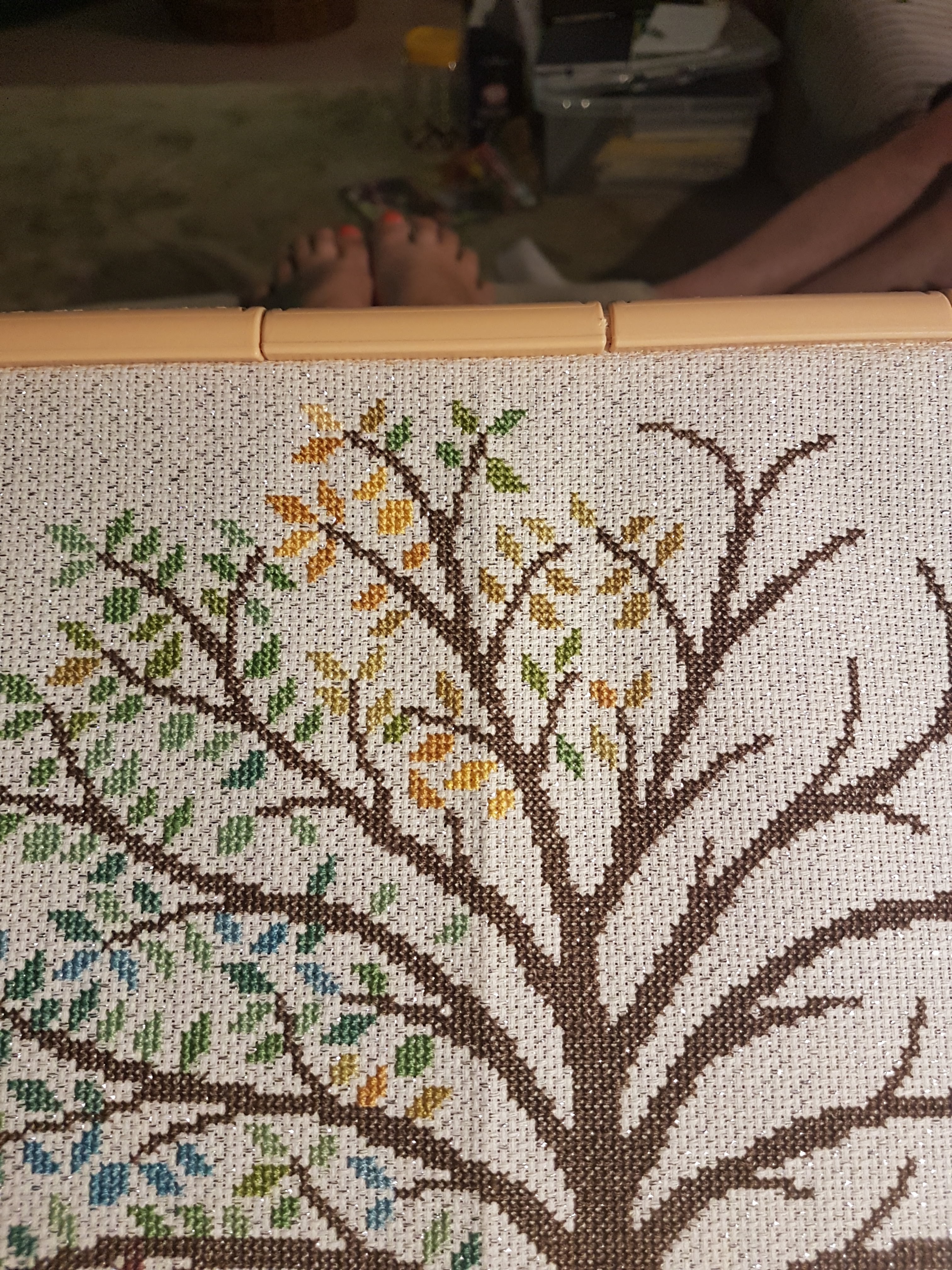
I can’t share the cross stitch I was working on, as it’s a gift, but here’s the Temperature Tree update for June and early July. As you can see, June wasn’t terribly warm either – a low of 13 and one day when we hit 27 ( a pale yellow at the very top). July’s not shaping up too well either.

So that was week 68 – we’re more than halfway through 2021 according to the tree, and coasting towards the end of term in ten days or so. Same time next week!

Kirsty x

What I’ve been reading:

Guards Guards, Men At Arms, Feet of Clay, Jingo, The Fifth Elephant – Terry Pratchett (these are the first five of the City Watch series: you can see a reading order here)

67: the book is always better?

Regular visitors to my little corner of cyberspace will have spotted that I am a big fan of books and reading in general. I love fantasy, and magic, and supernatural thrillers; different worlds, sideways views of our own world, the idea that there are things we can’t see (and, in the case of Stephen King, that we don’t want to see). I don’t love it when some bright spark decides to take one of these books and turn it into a film or a TV series, unless they are people who can be trusted to do it properly. Simon Pegg and Nick Frost, I think, can be trusted with Ben Aaronovitch’s Rivers of London books, but the teams responsible for The Seeker: The Dark is Rising (from the novel by Susan Cooper) and Midwinter of the Spirit (from Phil Rickman’s Merrily Watkins series) should never have been allowed near the productions.

I can almost imagine the conversation in The Seeker‘s production meeting: “Yeah, so we’ve got Eccleston as the bad guy and McShane as the wizard, right, but we gotta make it relevant to American kids, we can’t have another magic English kid, Harry Potter and all that, let’s make the kid and his family American, let’s transplant them to England, fish outta water stuff…”. Just, no. You killed the story. Suffice to say they didn’t get the go-ahead to film the rest of the novels.

Midwinter of the Spirit suffered from some of the same problems: the brilliant Anna Maxwell Martin cast in the main role was a great choice, but they hammered a long novel into a short series in a very heavy-handed way, losing a lot of the suspense and also – by choosing not to start the series with the first novel – a lot of the context. Shame, because these are brilliantly written, unputdownable books.

The one notable exception is William Goldman’s The Princess Bride, possibly because by 1973 when the novel was published he was already an Academy Award-winning screen writer for Butch Cassidy and the Sundance Kid (Best Original Screenplay) and he also adapted the novel for the screen. It’s still one of my favourite films and books, and finding another fan almost always means finding a new friend. Not that having the original author on board is always a good thing, of course, because then you run the risk of making, say, eight long films from seven long books (I’m looking at you, J.K.Rowling, you and your ‘direct assistance’ in the screenwriting).

(As an aside, Twilight and The Vampire Diaries were actually better than the books but only because they could not have been worse. So it does work both ways. Sometimes).

It was with some trepidation. therefore, that I headed to BBC iPlayer this week to check out The Watch, ‘inspired by’ characters from Terry Pratchett’s Discworld. BBC2 has the tagline “In a world where crime is legal, a group of chaotic misfit cops rise up to save their city from catastrophe. A punk rock comedy thriller inspired by Terry Pratchett’s Discworld.” The buzz on the Pratchett fan pages has been almost entirely negative. Outrage around the casting has been prominent: a woman as Lord Vetinari (Anna Chancellor)? A short person (Marama Corlett) as Angua? A tall person (Jo Eaton-Kent) as Cheery? A black woman (Lara Rossi) as Sybil Ramkin? Other than Carrot, who remains true to Pratchett’s vision, the casting producer has created a hugely diverse and entertaining ensemble. Richard Dormer, cast as Vimes, is guilty of gurning too much and perhaps too much comedy has been written in for him, but he was a good choice. Matt Berry and Paul Kaye are always good value, too.

Image © Radio Times

Part of the outrage has also come from a fierce loyalty to Terry Pratchett and, latterly, to his daughter Rhianna. She very diplomatically tweeted that “It’s fairly obvious that The Watch shares no DNA with my father’s Watch. This is neither criticism nor support. It is what it is.” Den of Geek has more on the controversy here. Funnily enough, Good Omens wasn’t criticised in the same way, perhaps because Neil Gaiman is Pratchett-adjacent and David Tennant is similarly adored for his time as the Tenth Doctor. The news this week on hearing that a second series of Good Omens in in the works should probably have provoked outrage as there isn’t a book, but once you’re in the Pratchett family, you’re in and you can pretty much do no wrong.

Previous big-budget adaptations of the Discworld novels have tended to be by Sky, who filmed the first two novels as The Colour of Magic, then did Hogfather and Going Postal. These weren’t perfect in terms of casting, either, but also weren’t terribly revolutionary. Charles Dance was perfectly cast as Vetinari, Tim Curry made an excellent wizard. Sean Astin was OK as Twoflower but David Jason was utterly wrong for Rincewind (he did make a great Albert in Hogfather, to give him his dues). The problem with filming such beloved novels is that readers have a very clear vision of who they think would be the best actor for the role, and are vociferous on the subject. The constant ‘casting posts’ on the various fan pages are annoying in the extreme, so one learns the art of scrolling.

Suffice to say that none of the actors in The Watch have featured in any of these posts. Was this possibly a deliberate decision, in the sense of ‘we’ll never get it right, so let’s have some fun’?

So, I went into the series knowing that the production company had played merry hell with the storylines, the characters and the sacred Discworld canon. And, you know what? I really enjoyed it. I left my Discworld expectations back on Roundworld and went along for the ride. The writers have picked bits from any number of the novels, not just the Watch series: Soul Music, Guards Guards, Night Watch, The Light Fantastic, Thud! to name a few, and they really have had fun with them. Many of the puns have been lost, and the addition of a gloriously camp dance routine came a bit out of leftfield, but it’s still thoroughly bonkers, funny and sweet in places. It does look as if most of the filming took place in the Elephant and Castle shopping centre, but you don’t get much more dystopian than that. The soundtrack is great, Cheery is an absolute delight, and the ending leaves it open for more….though as yet series 2 hasn’t been commissioned, sadly.

We’ve also watched Katla this week – gloomy, spooky and Nordic – and a 2018 series called Requiem, chosen because we like most things Joel Fry does.

What is there in this world that makes living worthwhile?

A surprise birthday present arrived this week from my lovely work colleagues, combining Pratchett, cross stitch and cats – three of my favourite things! I love getting handmade gifts and, believe it or not, it’s quite a rarity. I don’t know who made it but I LOVE it.

I also packed off the gift I couldn’t share last week: I could not get it straight in the hoop, so I gave up in the end. The pattern is by Climbing Goat Designs on Etsy.

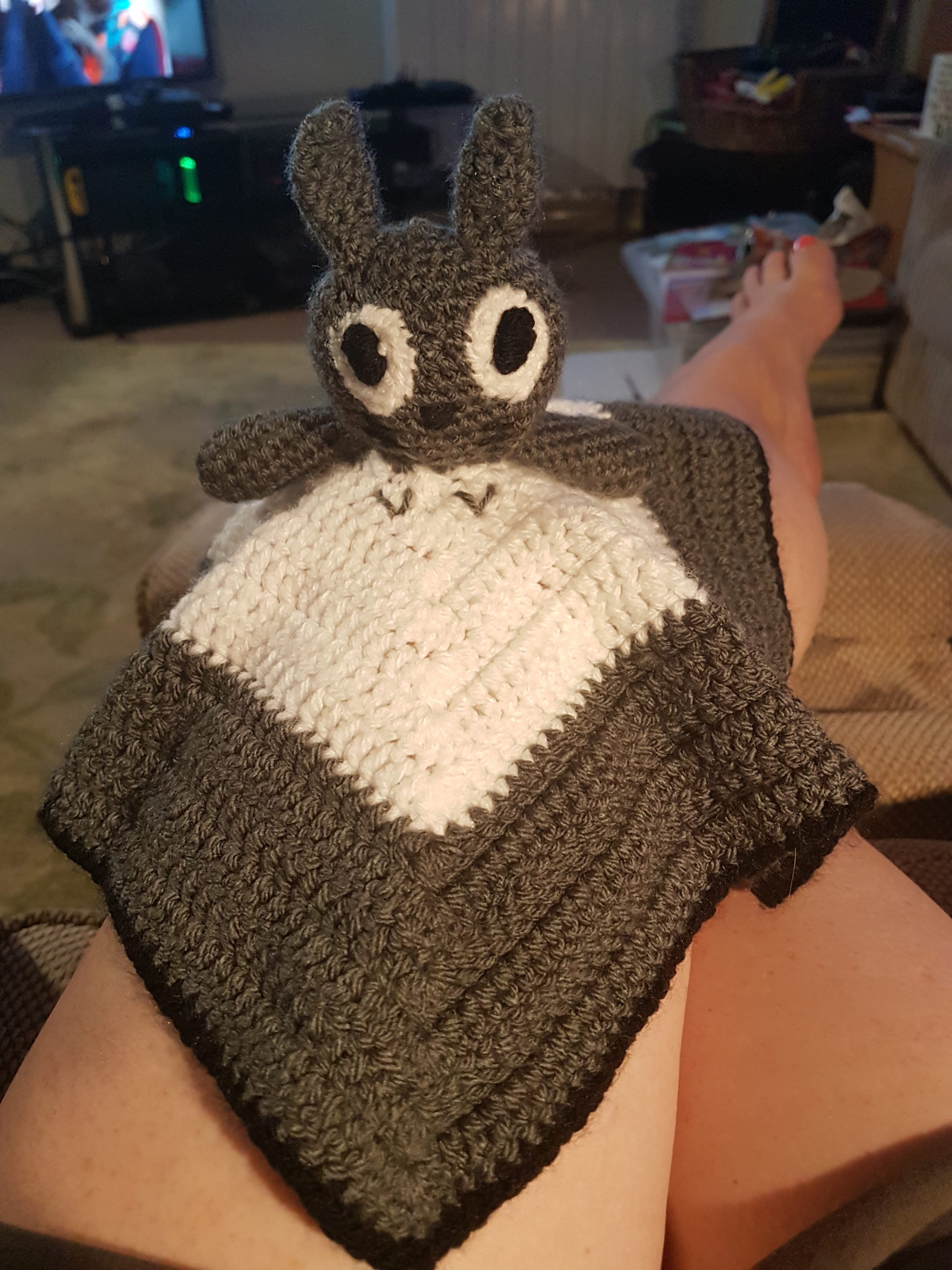
This week I have been working on another gift, and another Totoro baby lovey – this time a commission. My cross stitch is on 18 count fabric and it’s getting to the point where I can’t see the holes in the fabric any more so may need to invest in one of those magnifying lights! Old age is creeping up fast…

This week I am looking forward to doing some delivery in schools, which I have really missed, and hopefully the sun will come out at some point!

See you next week

Kirsty x

What I’ve been reading:

The Museum of Broken Promises – Elizabeth Buchan

The Wisdom of Sally Red Shoes – Ruth Hogan

The Mermaid and Mrs Hancock – Imogen Hermes Gowar

Guards, Guards – Terry Pratchett

Lundy, Rockall, Dogger, Fairisle – Matthew Clayton and Anthony Atkinson

66: happy birthday to me!

Yesterday was my 48th birthday, and among the presents I requested from the various people who asked was an Ordnance Survey map of Chelmsford and the Rodings, and one of their Pathfinder books of circular walks. I bought another map (Chelmsford, Harlow and Bishops Stortford) with one of the Amazon vouchers I was given as well. Those of you who have ever been anywhere with me and experienced my sense of direction might wonder a bit at this, of course, as I am the adult who once got so hopelessly lost in Sainsburys in Whitechapel that I handed myself in at Customer Services and waited to be collected. I am also regularly flummoxed by Google maps on my phone: it’s all very well showing me where I am, but it still takes a few false starts, watching the direction the arrows are moving when I walk, to work out the direction of travel.

Still, you all know I love a good walk, so my thinking is that with the aid of these maps I can explore a bit more of my local area. North Weald sits on the border of both these maps, rather than conveniently in the middle, hence needing two of them.

I have a vague plan that for my 50th birthday I will walk the whole of the Essex Way over a series of weekends, in the company of whoever I can persuade to do various stretches with me. I have a couple of years to plan this adventure, fortunately! I have done some of the local stretches on training walks, and I am keen to do the rest. If I was the sort of hardy hiking person who could be bothered to carry lots of equipment on my back I might do it all at once, but that’s never going to happen!

I like marking big birthdays. I haven’t worried about my age since I was 27 and I cried all day as I was so old. Back when I was still in infant school in Cardiff our class teacher, Mrs Price, asked us to work out how old we would in the year 2000, and 27 was the answer: it felt such a long way away, and such a vast age to a six year old, that I never forgot it. No other birthday has ever felt so traumatic!

My 30th was a mad evening out in London with friends, where we did the Jack the Ripper walk after a few drinks in All Bar One at Tower Hill (chosen as it was formerly the Mark Lane underground station, and I am nothing if not a nerd). My 40th was a barbecue in the back garden, with a ball pool for the kids and surrounded by friends. So I am planning an adventure for my 50th: it’s a big birthday, so I ought to celebrate it by doing something interesting with people I like. Volunteers for future weekends on the Essex Way welcome!

Other gifts included yarn, rhubarb and ginger gin and books: you all know me so well!

There has, of course, been other things in my week: my second Covid vaccine, so I am now fully 5G enabled or something (I don’t care if it causes me to pick up Radio Caroline, quite honestly, as long as it means I can see my parents and sisters). It was the monthly sunset/full moon swim, and this month the moon was up but covered in clouds so I still didn’t see it from the lake. There has been lots of making, but nothing I can share yet!

There has also been a lot of reading: a book that had me grabbed from the first page, and which would have kept me awake into the early hours to finish it if the battery on my Kindle hadn’t died. Once Upon a River, by Diane Setterfield, was one of those 99p Kindle deals that’s been lurking on the virtual shelf of shame since then. I finally got round to it this week. It’s one of the best books I have read for a very long time – if you haven’t run across it already, go and grab it. History, magic, mystery, the Thames: what else do you need?

And now I must head for Tesco, as the cupboard is mostly bare and the Horde need feeding! Same time next week?

Kirsty x

What I’ve been reading:

Once Upon a River – Diane Setterfield

Madame Burova/The Keeper of Lost Things/Queenie Malone’s Paradise Hotel – Ruth Hogan

Cider with Rosie – Laurie Lee (Audible)

65: how to ruin a good book

This week’s ramblings have been brought to you because I have been listening to the audiobook of Cider with Rosie, read by Laurie Lee himself: lush, sunshine-drenched prose, set in countryside not so very far from where I grew up in Monmouthshire. There are some books which, if you mention them to people of a certain age, elicit an instant response of eye-rolling and and ‘urgh, I hate that book, we had to read it in school, it’s so boring.’ It’s true, a terrible English teacher can ruin a wonderful book (equally, a good one can bring it to life: I’m looking at you, Mr Bradley, you and your passion for Jane Austen).

Prime candidates for this, at least for people of my generation, seem to be:

  • Of Mice and Men – John Steinbeck
  • Cider with Rosie – Laurie Lee
  • The Great Gatsby – F. Scott Fitzgerald
  • To Kill a Mockingbird – Harper Lee
  • Catcher in the Rye – J.D. Salinger

All of which are classics, of course, and I love them all, but ‘studying literature’ as opposed to just reading a book can really ruin it for people. Second-guessing what the author meant, analysing their intent in using this word or that, deconstructing poetry often means that you can’t see the story for the words, to paraphrase that famous saying about forests and trees.

My own GCSE texts included a story or two from Leslie Norris’s Sliding, which I still love, Shakespeare’s A Midsummer Night’s Dream and probably some other ones but, amazingly, none of those listed above featured – probably because of the move from O-level to GCSE the previous year.

A badly-chosen text can have the same negative impact: for me this was Graham Swift’s Waterland, set in the Fens and with content so far out of my sphere of experience as an A-level student that I couldn’t engage. Mr Mills tried his best, bless him, but it was hard going. Ten years later, I found myself spending a lot of time in the Fens around March and Ely, so I went back and read the book as an adult: it’s brilliant, frankly, but it took an understanding of the area and the concerns of an adult to understand it. My youngest sister had The Remains of the Day by Kazuo Ishiguro as one of her A-level texts: my mum and I loved it, she didn’t – presumably for the same reasons I couldn’t get to grips with Waterland. It doesn’t matter how much you love books and reading, if you can’t engage with the content then you’re unlikely to enjoy it.

I suppose the point of teaching literature is to inspire a love of reading in children, but I do wonder occasionally who chooses the texts. Thing 1 is in her first year of GCSEs and is doing Macbeth and A Christmas Carol and doesn’t like either of them: she loves analysing text but hasn’t engaged with either of those. She’s just said that she likes book she can relate to: she read William Goldings Lord of the Flies before being given it at school and loved it.

I love reading, I don’t understand why they can’t just let us read it, they keep stopping us every five seconds to make us analyse why Lady Macbeth is a symbol of patriarchal society. What if he just liked Lady Macbeth? If they just gave me ‘The Outsiders’ or ‘The Perks of Being a Wallflower’ I could analyse them in about five minutes cos I can relate to them.’

Thing 1

The school Things One and Two attend practise DEAR (Drop Everything and Read) so they are expected to have a book of their choice to hand at all times, and the teachers have door signs saying what their current book is as well. I love this idea, and it’ll probably go further to instilling a love of literature in children who aren’t growing up surrounded by books than if their first encounter with great books is stripping them into their component parts without ever getting to enjoy the stories first.

The year of the handmade gift

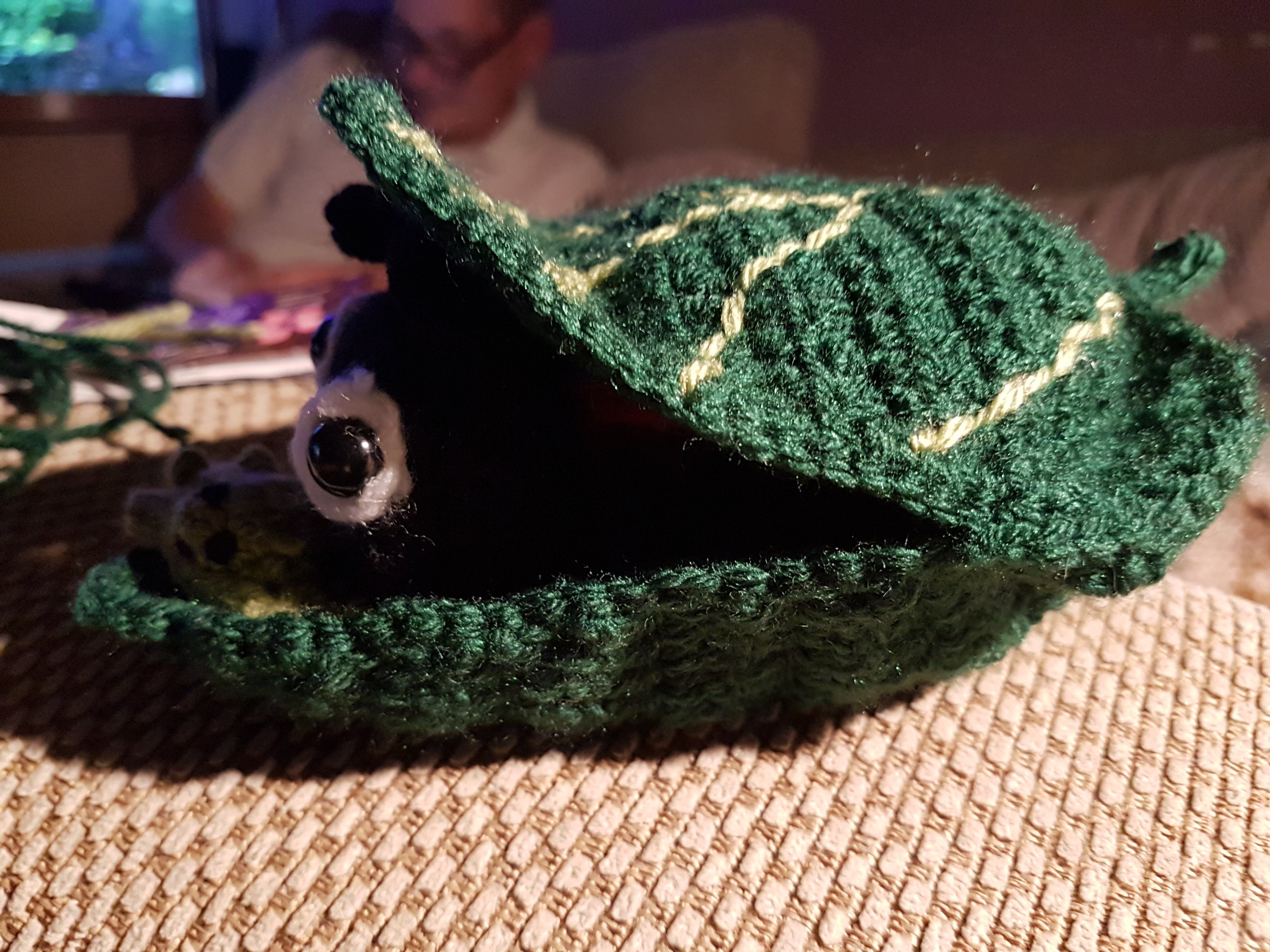
Back to a bit of crochet for the latest gifts: I made the ladybird a leaf sleeping bag, and also made this Totoro baby comforter. Both will be going off to a colleague whose wife is expecting. The ladybird is for his older daughter, as big sisters need a present too! It’s back to the cross stitch now, while I carry on listening to Cider with Rosie even though the sun has gone away again.

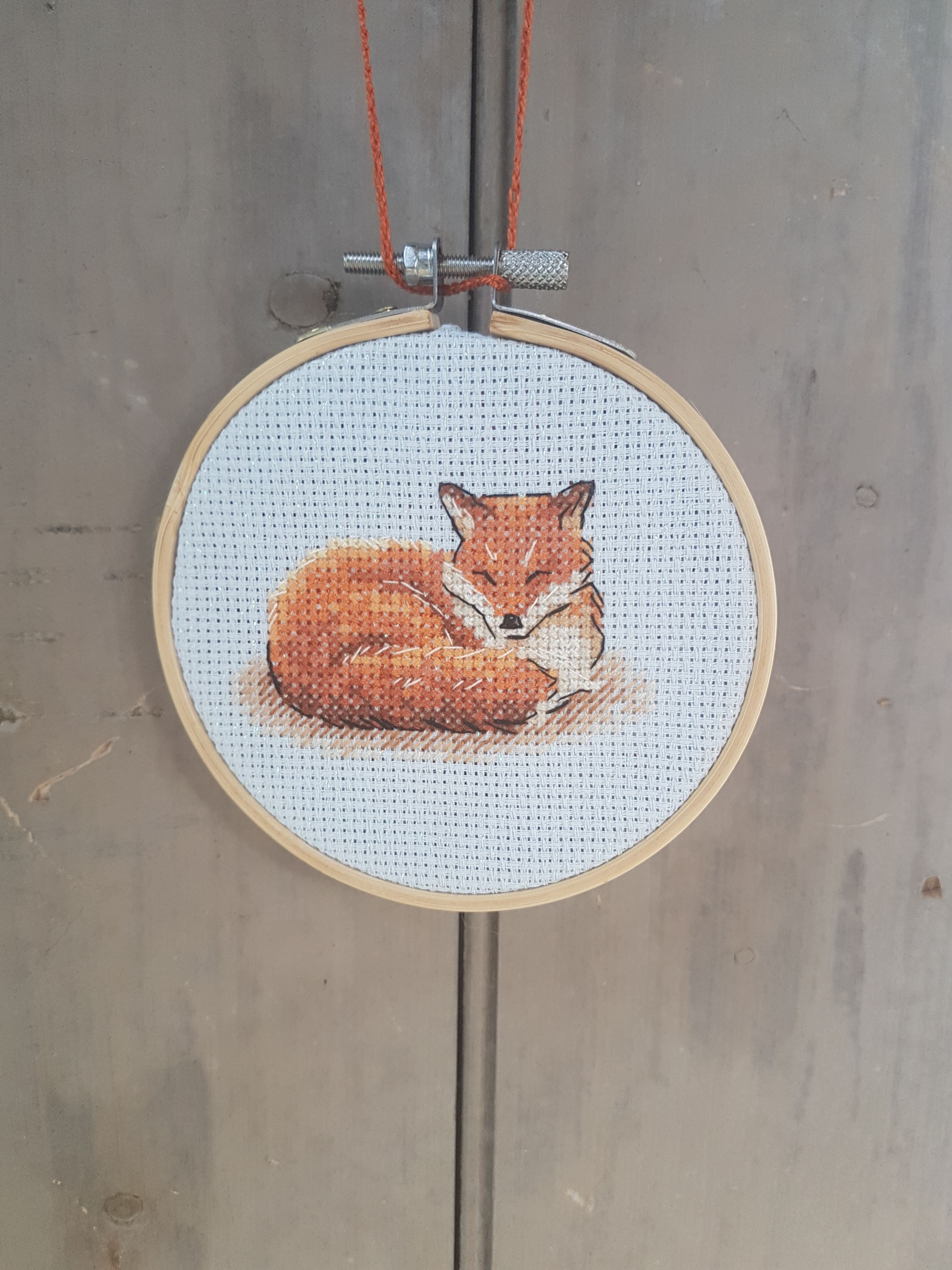
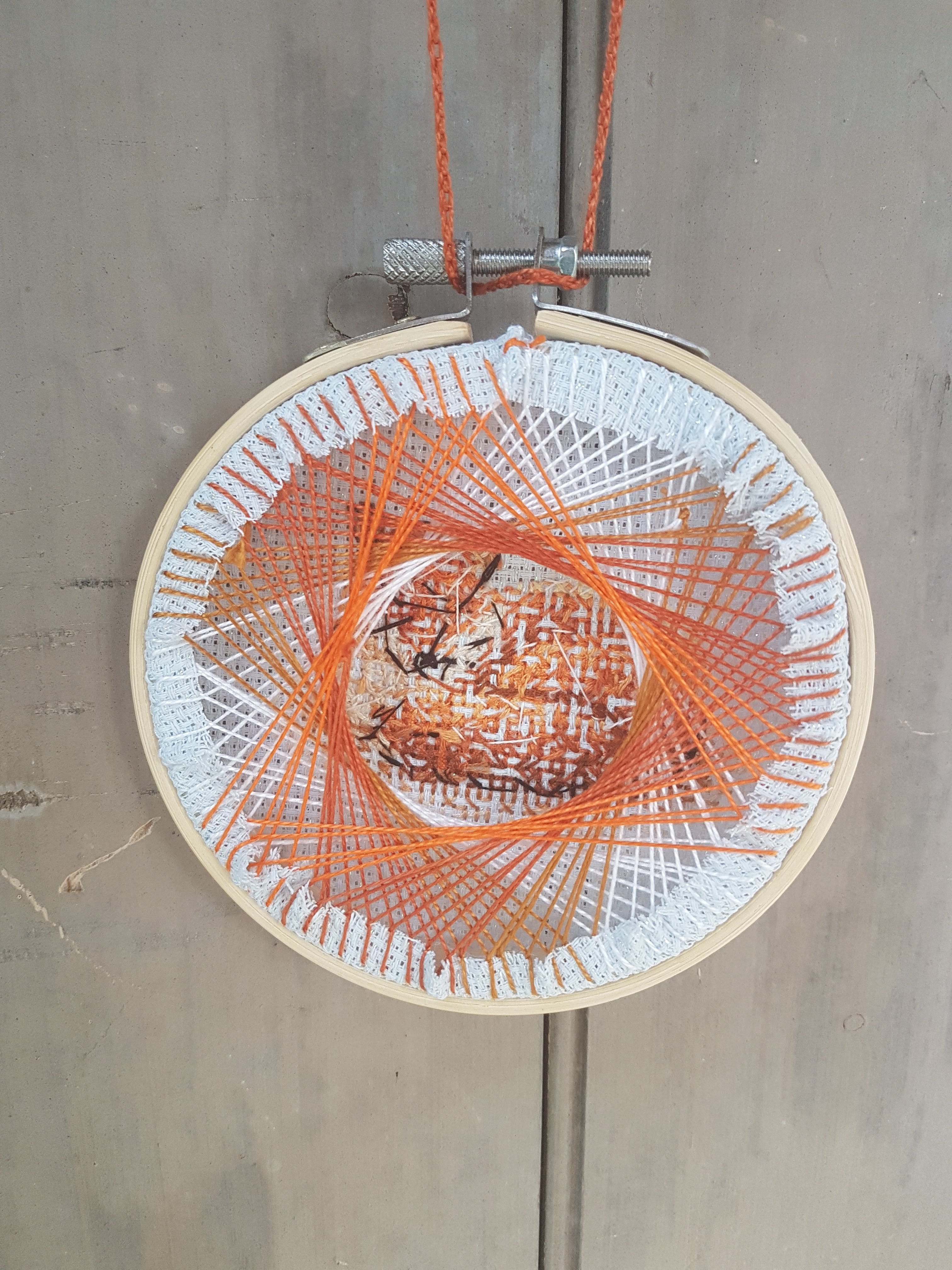
Another gift is with its new owner today – I have just this minute had a text message to say thank you, so happy birthday Gina! We have always had a resident fox at the Museum, with cubs most years, so this seemed like an apt present. The pattern is from MaxStitch.

I am off now to get on with things….see you next week!

Kirsty x

What I’ve been reading:

The Glamourist/The Conjurer – Luanne G. Smith

Moonshine – Jasmine Gower

Attention All Shipping – Charlie Connelly

Cider with Rosie – Laurie Lee (Audible)